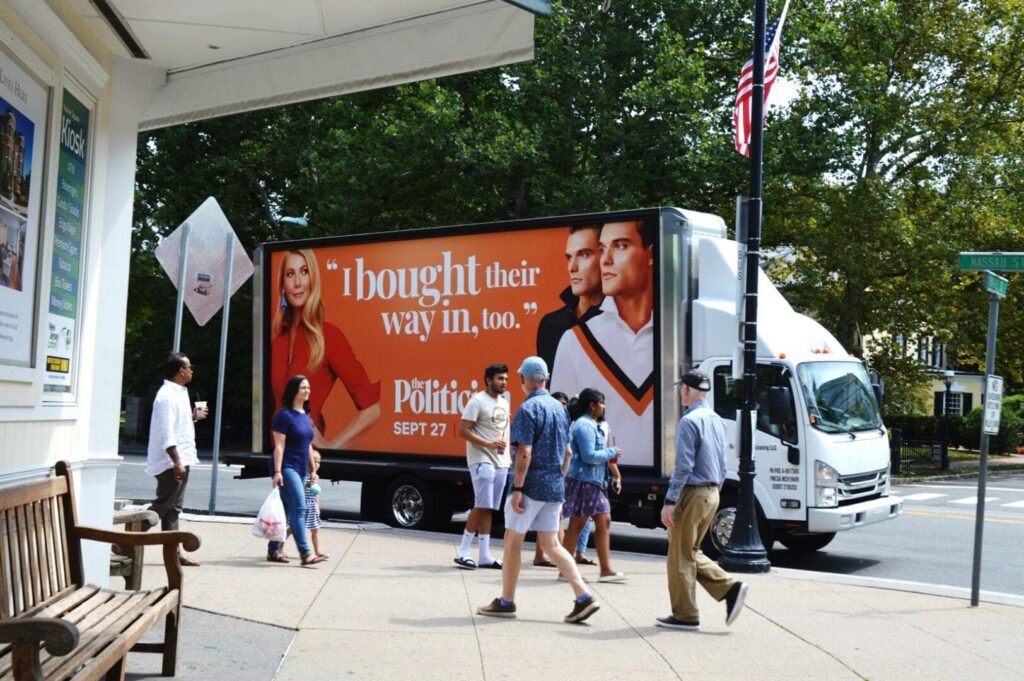
Experiential vehicles take your brand into the streets, markets, and neighborhoods where your consumers actually spend their time. Here is how to plan, build, and operate them well.
Experiential vehicles are the format that makes mobile brand marketing tangible. Not a wrapped fleet truck rolling past at 40 miles per hour. Not a pop-up tent that blows over in the wind. A real, purpose-built brand environment on wheels — designed to stop people, pull them in, and deliver a brand experience they actually remember.
The category covers a wide range of vehicle types: Airstream trailers outfitted as sampling studios, box trucks converted into walkthrough product experiences, sprinter vans equipped for neighborhood-level seeding, double-decker buses transformed into multi-room brand environments. What they share is the combination of mobility and designed brand space. You bring the experience to the consumer, not the consumer to the experience.
We have operated experiential vehicles in more than 30 US markets. This guide covers the format in the detail that actually helps you plan a campaign: vehicle selection, build approach, staffing, permitting, routing, documentation, and what separates programs that deliver from ones that do not.
The core logic of an experiential vehicle is market reach without fixed infrastructure. Building a branded pop-up space in a single city is one approach to consumer engagement. Building that same quality of experience but deploying it across 12 cities in eight weeks is a different order of impact, and it requires a vehicle.
Brands choose experiential vehicles for several specific reasons. Product launches that need to generate trial quickly across multiple markets rely on vehicles because the alternative — staffing temporary installations in each market — is more expensive and slower to stand up. Brands that sponsor recurring events (music festivals, sporting events, cultural gatherings) use vehicles because the vehicle becomes a standing brand asset that appears at each event. Brands that sell through independent retail channels use vehicles to activate near retailer locations, combining the street-level brand engagement of an experiential activation with the conversion opportunity of immediate in-store availability.
The economics of experiential vehicles improve significantly with campaign length. A vehicle that costs $60,000 to build and $8,000 per week to operate over 8 weeks has a total cost of $124,000 across 8 weeks of deployment. The same quality of temporary branded environment built anew in each of 8 cities would cost considerably more and lack the visual consistency of a single owned asset.
Vehicle Format Options
Selecting the right vehicle type is a strategy decision, not a preference question. The vehicle needs to match the consumer experience you are trying to create, the markets you plan to reach, and the budget you have available for the full program.
Sprinter Van
The sprinter van is the most versatile and accessible experiential vehicle format. It is large enough to carry meaningful product inventory, display, and brand materials. It is small enough to park in most urban environments where larger vehicles cannot operate. Interior build-outs for sprinter vans can range from a simple branded shelf-and-counter setup to a fully finished interior with lighting, graphics, and display systems.
Sprinters are the default choice for neighborhood-level seeding campaigns, sampling programs that need to move through multiple locations in a single day, and brands that need multiple vehicles operating simultaneously in different markets. A fleet of three branded sprinters operating independently across a major metropolitan area can cover more consumer touchpoints in a day than a single large vehicle operating from one fixed location.
Box Truck
Box trucks offer more interior volume than sprinters, which enables more sophisticated consumer experience design. A 16-foot or 20-foot box truck can accommodate a proper brand environment with defined consumer flow — entry, experience zone, product display, exit — rather than the single-space experience of a smaller vehicle.
Box trucks are well-suited for product launches where the vehicle needs to serve as both a demonstration environment and a sampling station. They are also effective for brands that want to park at a single high-traffic location for a full day rather than routing to multiple stops. The challenge with box trucks in urban markets is parking: they require more clearance than a sprinter and cannot fit into spaces where a small vehicle would work.
Airstream Trailer
Airstream trailers have become the premium end of the experiential vehicle category. The silver aluminum form factor is recognizable and inherently attention-catching. Interiors can be built to a level of finish quality that approaches permanent retail space — custom millwork, professional lighting, quality materials throughout.
The Airstream format is most effective for brands where experience quality is a premium signal. Beauty brands using Airstreams for consultation and service experiences, wellness brands creating retreat-style brand environments, beverage brands with a craftsmanship positioning — these are the natural Airstream applications. The limitation is the tow vehicle requirement and the urban parking challenges that come with trailer formats.
Double-Decker Bus
Double-decker buses are the large-format option for brands that want to create a multi-room immersive experience. The two floors allow for distinct zones: ground floor for consumer reception and product interaction, upper floor for a more premium experience, media moment, or VIP engagement. The visual impact of a branded double-decker in a high-traffic urban location is significant.
Double-decker operations require specialized drivers, appropriate commercial permits, and careful route planning around bridge clearances and overhead obstacles. They are also substantially more expensive to build and operate than smaller formats. For brands with the budget and the creative concept to justify the format, they are among the highest-impact mobile brand environments available.
Vehicle
Best For
Urban Parking
Build Timeline
Relative Cost
Sprinter Van
Sampling, seeding, neighborhood routing
Excellent
2 to 4 weeks
Low to Medium
Box Truck
Product demos, launch activations
Good
4 to 8 weeks
Medium
Airstream Trailer
Premium brand experiences
Moderate
8 to 14 weeks
Medium to High
Double-Decker Bus
Multi-room immersive, high-impact
Challenging
10 to 16 weeks
High
Step Van
Retail sampling, neighborhood routing
Good
3 to 6 weeks
Low to Medium
Planning a Multi-City Vehicle Tour
A multi-city tour with experiential vehicles involves more moving parts than most brands anticipate when they first plan one. The vehicle is the constant. Everything else — staffing, permits, location strategy, logistics support — must be handled market by market, and no two markets are exactly the same.
Tour Structure
Most vehicle tours are structured around a fixed number of markets with a set number of activation days per market. A 10-market, 8-week tour might allocate 4 activation days per market, with 2 travel days between markets. The activation calendar should account for market-specific events that create high-traffic opportunities (local festivals, major sporting events, seasonal consumer behavior patterns) and avoid periods when target locations will be inaccessible or low-traffic.
Tour structure also needs to consider drive time between markets. A tour that sequences geographically adjacent markets — New York, Philadelphia, Washington DC, Richmond, Charlotte — is operationally cleaner than one that jumps cross-country between markets. Vehicles can develop maintenance issues on long drives. Building sensible geographic routing into the tour plan reduces operational risk.
Staffing the Tour
Vehicle tour staffing works on a hub-and-spoke model. A tour manager (sometimes called an activation lead) travels with the vehicle throughout the tour and provides continuity across markets. Market-specific brand ambassadors are sourced locally in each city, briefed on the tour manager’s protocol, and deployed for the activation days in their market.
The tour manager role is critical. This person is responsible for vehicle operation and maintenance, local logistics coordination, ambassador briefing and performance management, documentation quality, and escalation when things go wrong. A bad tour manager makes every other element of the campaign worse. A great tour manager makes average situations work well.
Location Selection
Location selection for a vehicle tour happens in two stages: strategic targeting (identifying the types of locations that match the brand’s consumer profile in each market) and operational confirmation (verifying that specific proposed locations are accessible, permit-appropriate, and will generate the required foot traffic on the planned activation dates).
Strategic location targeting for experiential vehicles considers: proximity to where the target consumer shops, works, and recreates; competitive density (locations already saturated with brand activations from competitors or other campaigns); and vehicle access (can the vehicle physically reach, park at, and operate from this location within the permit terms available).
In New York City, the difference between a street activation permit and a park activation permit is significant. Street permits are issued by the Mayor’s Office of Citywide Event Coordination and Management. Park permits are issued by NYC Parks. Film permits for commercial activity on city property require separate processing. Start permit applications no later than 4 weeks before the first New York activation date — longer if the program includes Times Square or major park locations.
Vehicle Wrap Design
The exterior wrap of an experiential vehicle is doing two jobs simultaneously: it identifies the brand and it functions as advertising. A vehicle driving through a city, parked at a high-traffic corner, or rolling into a festival activates brand recognition from everyone who sees it, not just the consumers who stop to engage.
Effective vehicle wrap design is bold, simple, and readable at distance. The brand name and a single key message or visual should be legible at 30 feet. Fine-detail design elements that read well on a screen do not translate to a vehicle wrap viewed from across a street. Agencies and brands that apply their standard digital creative directly to a vehicle wrap without considering viewing distance and angle produce ineffective results.
Color choice matters significantly on exterior wraps. High-contrast color combinations — black and yellow, white and red, navy and white — read clearly under most lighting conditions. Monochromatic or low-contrast designs that look sophisticated in print become invisible in street environments. Test wrap designs at actual scale before approving final production.
What the Interior Experience Should Accomplish
The interior of an experiential vehicle has a limited time window to work with each consumer. Most interactions last 60 to 180 seconds. The interior design needs to accomplish the campaign objective within that window.
For a sampling campaign, the objective is trial. The interior should present the product clearly, make sampling easy, and reinforce why this product is worth trying. Complexity hurts. A sampling vehicle that requires a brand ambassador to explain the experience before delivering it is already losing the consumer.
For a product demonstration campaign, the objective is understanding. The interior should give the consumer enough direct product exposure to understand what the product does and why it is different. Video and interactive elements work well when they supplement the physical experience, not when they replace it.
For a service experience campaign, the objective is preference change. A beauty brand that gives a consumer a skin consultation, a customized recommendation, and a sample of the exact product recommended for their skin type has changed that consumer’s relationship with the brand in a way that no advertisement could replicate. The interior needs to be designed to deliver that service experience efficiently enough to serve meaningful volume while maintaining quality.
Documentation and Post-Campaign Reporting
Every market in a vehicle tour generates documentation: photos of the vehicle in operation, photos of consumer interactions, geo-tagged location records, staffing logs, and product distribution tallies. End-of-campaign reporting compiles this documentation into a summary that demonstrates campaign execution and consumer engagement against plan.
Good documentation serves the brand in three ways. It demonstrates to marketing leadership that the campaign ran as planned and reached the markets it was supposed to reach. It provides the creative asset base for social content, media pitches, and case study development. And it generates the data that informs the next campaign — which markets performed best, which locations generated the highest quality interactions, which brand ambassador approaches worked most effectively.
Common Mistakes in Experiential Vehicle Campaigns
The vehicles themselves are rarely the source of campaign failure. The process around them is.
Starting permit applications too late is the most common operational failure. A brand that finalizes its market list four weeks before launch and expects to have public street operating permits in New York, Chicago, and Los Angeles within that window will be disappointed. Permit processing in major markets takes time. Applications submitted late result in campaigns that either operate on private property with limited foot traffic or start running days behind schedule.
Underestimating staffing quality requirements is the most common strategic failure. A vehicle that cost $80,000 to build, staffed with brand ambassadors who were not properly briefed and are not genuinely enthusiastic about the brand, delivers a mediocre consumer experience. The vehicle creates the opportunity. The staff determines the outcome. Invest accordingly in selection, training, and management.
Routing without verification produces locations that look good on paper but fail in practice. A location that generates high foot traffic in the general sense may not generate the specific consumer type the brand needs. A location that permits commercial activations in general may have restrictions on the type of activity planned. Confirming locations operationally — walking them, checking access, verifying permit status — is not optional for a quality campaign.
How AGM Manages Vehicle Programs
We manage experiential vehicle programs from brief through final report. That means vehicle sourcing, build oversight, wrap production, tour management, market-by-market permit handling, staffing, location strategy, documentation, and post-campaign reporting.
We do not have a preferred vehicle format or a templated campaign structure. Every vehicle program starts with the brief: what consumer action does the brand need, in which markets, over what timeline, within what budget. The vehicle format, campaign structure, and operational plan follow from the answer to those questions.
For brands running their first vehicle campaign, we often recommend a single-market pilot before committing to a multi-city tour. A well-executed single-market program demonstrates what the format can deliver for a specific brand, identifies the operational issues to solve before scaling, and generates the documentation assets needed to make the case for a larger investment.
The Economics of a Multi-City Vehicle Tour
Understanding the economics of a vehicle tour requires separating the build cost from the operating cost. Brands frequently focus primarily on the build cost when planning a vehicle program, then encounter the operating cost as a surprise during execution. A complete vehicle tour budget covers both.
Build cost is the one-time investment in the vehicle itself: sourcing the base vehicle, fabricating the interior, producing the exterior wrap, installing electrical systems, and stocking with initial materials. This cost is amortized across the campaign. A vehicle that cost $80,000 to build deployed across 10 markets over 8 weeks has an $8,000 per-market build amortization. That same vehicle deployed on a second campaign the following year costs nothing additional to build — only to operate.
Operating cost covers everything that recurs during the tour: brand ambassador staffing, tour manager compensation, fuel and vehicle maintenance, permit fees per market, product inventory for each activation day, logistics and storage, documentation, and hotel or accommodation for the tour team. For a mid-complexity tour with a single vehicle, operating costs typically run $6,000 to $12,000 per week depending on market and staffing requirements.
The build vs. operate framework changes the ROI analysis for vehicle programs. A brand that owns its vehicle and runs three tours per year is dividing the build cost across three campaigns, bringing the per-tour build cost down significantly with each deployment. A brand that rents a vehicle for a single campaign is paying full market rates without building a long-term asset. The decision to own versus rent should account for the expected frequency and duration of future vehicle programs, not just the immediate campaign.
Vehicle Activation Integration with Digital Marketing
The most effective vehicle activation campaigns integrate their in-person consumer engagement with digital marketing in both directions. Digital channels promote the tour’s arrival in each market before the vehicle shows up. The tour generates photo and video content that feeds digital channels during and after the campaign. The two channels amplify each other rather than operating independently.
Pre-market digital promotion builds consumer awareness of the vehicle’s coming presence. Social posts announcing the tour route, the vehicle’s arrival dates in specific cities, and what consumers can expect when they encounter it generate the advance awareness that drives consumer turnout. In markets where the brand has existing social following, this pre-promotion can meaningfully increase consumer interaction volume on the first day in each market.
Content generated on the vehicle — photos and video of the activation in operation, consumer interactions, the vehicle in distinctive location settings — provides the social content library that extends the campaign’s audience beyond the in-person activation. A tour vehicle operating across 12 cities generates hundreds of photo documentation opportunities. That documentation becomes the social content calendar for the weeks and months following the tour.
QR codes, scan-to-receive promotions, and loyalty program enrollment mechanics within the vehicle activation create a digital connection point from the physical interaction. Consumers who want more information, a coupon, or a loyalty enrollment can connect digitally without leaving the vehicle environment. This creates a measurable link between vehicle activation and downstream digital behavior that can inform future campaign investment decisions.
Some national brand campaigns deploy multiple vehicles simultaneously rather than routing a single vehicle through markets sequentially. A fleet of three or four vehicles operating independently in different regions of the country can cover more total consumer geography in the same campaign period as a single vehicle tour, while also allowing each vehicle to spend more time per market than a single-vehicle national program permits.
Fleet programs are significantly more complex to manage than single-vehicle tours. Each vehicle needs its own tour manager. Training must be consistent across all vehicles. Documentation protocols must be standardized so that the consumer experience at a fleet vehicle in Dallas matches the experience at a fleet vehicle in Seattle. Quality control across multiple simultaneously operating vehicles requires a central program manager who has real-time visibility into each vehicle’s operation and performance.
The economics of fleet programs also change the build decision. A brand that owns a fleet of four sprinter vans that it deploys each summer is managing capital assets that require maintenance, storage, and depreciation accounting. The flexibility gained by fleet ownership — the ability to deploy vehicles on short notice for event opportunities, to loan vehicles to retail partners, to use them as standing brand assets for appearances and events — offsets the capital cost for brands with sufficient activation volume to justify it.
Vehicle Activation and Press/Media Coverage
A distinctive, well-designed experiential vehicle at a high-profile location in a major market generates media interest beyond the organic consumer documentation it produces. Trade press covering brand marketing, local lifestyle media, and social journalists who cover consumer trends regularly document and share standout vehicle activations. This earned media extends the campaign’s audience to readers and viewers who were not present at the activation but encounter the vehicle through media coverage.
Earned media from vehicle activations is not guaranteed or reliably predictable, but it is reliably more likely for vehicles with genuine visual distinctiveness. Generic brand wraps on generic vehicle types rarely generate media interest. Custom-built vehicles with architecture, art elements, or creative concepts that are genuinely interesting to a general audience have a substantially higher probability of press pickup.
Proactive media outreach — notifying relevant local and trade journalists about the vehicle’s presence in their city before it arrives — improves the probability of coverage. A brief, well-constructed press note with strong photography sent to the 10 or 15 most relevant journalists in each market before the vehicle arrives is a low-cost investment with meaningful upside for campaigns where earned media is a secondary objective.
Frequently Asked Questions
What are experiential vehicles?
Experiential vehicles are branded mobile units — Airstream trailers, box trucks, sprinter vans, double-decker buses — converted to serve as interactive brand environments. They travel to consumers rather than requiring consumers to visit a fixed location.
How many markets can experiential vehicles cover in a tour?
A well-planned experiential vehicle tour typically covers 6 to 20 markets over 4 to 12 weeks. The number depends on travel distances, desired activation depth per market, and operational budget.
What is the difference between an experiential vehicle and a wrapped vehicle?
A wrapped vehicle is a passive format that generates visual exposure as it moves. An experiential vehicle is an active format where consumer interaction is the objective. People approach, enter, and engage with the brand environment inside.
Do experiential vehicles require permits?
Yes, operating commercial vehicles in public spaces requires permits in most US cities. Requirements vary by market. AGM handles permit procurement for all markets on our vehicle campaigns.
What vehicle type is best for a first experiential vehicle campaign?
For a first campaign, a sprinter van or step van is the most practical starting point. Lower build cost, easier urban parking, and simpler logistics make them accessible for brands testing the format before committing to a larger vehicle program.