Experiential Vehicle | American Guerrilla Marketing
A purpose-built experiential vehicle takes your brand off the page and puts it in front of people in the real world. Here is how they work, what they cost, and how to get the most out of one.
An experiential vehicle is exactly what the name suggests: a vehicle converted into, or operated as, a platform for brand experience. It might be a converted Airstream trailer turned into a micro sampling studio for a beverage brand. It might be a double-decker bus transformed into a walkthrough product demo environment. It might be a custom-wrapped sprinter van deployed across 14 cities in six weeks to seed a new product launch. The format changes. The principle stays constant.
Experiential vehicles combine the strategic advantages of mobile marketing with the creative possibilities of a designed brand environment. They go where the consumer already is — rather than asking the consumer to come to a fixed location. When they arrive, they create a real encounter with the brand instead of just a logo impression. That combination is why vehicle-based activations continue to be one of the most requested formats in the brand activation industry.
We have designed, sourced, wrapped, and operated experiential vehicles across the country for brands in CPG, beverage, beauty, automotive, tech, and apparel. This guide covers what makes an experiential vehicle work, what separates a good build from a wasteful one, and how to approach the format with clear objectives.
An experiential vehicle is any vehicle that has been modified, designed, or operated to function as a platform for direct consumer brand engagement. The vehicle itself is the activation. It provides the physical environment, the mobility, and often the visual identity for the campaign.
This is different from a fleet vehicle with a brand wrap on the side. An experiential vehicle is purpose-built for consumer interaction. Consumers approach it, enter it, interact with it, or engage with brand representatives operating from it. The vehicle is not carrying the campaign from place to place. The vehicle is the campaign.
The format has existed for as long as there have been vehicles. Bookmobiles, demonstration trucks, and sampling vans all predate modern brand marketing. What is newer is the production quality of the builds, the sophistication of interior brand environments, and the social content potential that a well-designed vehicle now generates. A great experiential vehicle today is designed as much for photo documentation and organic social content as it is for physical consumer interaction.
Types of Experiential Vehicles
The vehicle type drives almost every downstream decision: how many people can interact at once, what kind of experience is possible, where the vehicle can legally park, and how much the build costs. These are the formats we deploy most frequently.
The build ranges above reflect the vehicle conversion cost — fabrication, wrapping, interior build-out, electrical, and branding. They do not include staffing, fuel, permits, market-specific logistics, or campaign management fees. A vehicle that costs $50,000 to build might cost another $50,000 to operate over a six-week tour.
Why Brands Choose Vehicle-Based Activation
Vehicle-based activation solves a specific problem: how do you create a real brand experience at scale, across multiple markets, without the cost and complexity of building a permanent retail or event space in each city?
The vehicle handles the logistics that would otherwise kill a multi-city experiential program. It carries the brand environment, the product inventory, the staffing equipment, and the point-of-sale materials from market to market. You set up once, deploy many times. The consistency of the experience across markets is built into the vehicle itself.
The best experiential vehicles are designed to create a moment worth photographing. If the vehicle does not make people stop, take out their phones, and share what they are seeing, the build is underperforming. Exterior design is a distribution mechanism for social content, not just a brand statement.
Beyond logistics, vehicles create a kind of street-level authority. A custom-built experiential vehicle parked at a high-traffic intersection or festival entrance is a brand statement in itself. Passersby do not need to be pre-sold on the brand to engage. The vehicle stops them. The experience inside converts them.
The Build Process: From Brief to Deployment
Every experiential vehicle project starts with a brief, not a vehicle. The brief defines the consumer action you want, the markets you need to reach, the timeline for deployment, and the budget envelope. The vehicle type, build approach, and staffing model all flow from there.
Phase 1: Brief and Concept
The brief answers four questions: What do we want the consumer to do? Where are the consumers we need to reach? How long does this need to run? What is the budget for the full program (build plus operations)?
Brands frequently over-invest in vehicle build and under-invest in operations, or vice versa. A stunning vehicle that is staffed poorly or deployed in the wrong locations fails. A less flashy vehicle deployed with excellent staffing and a precise location strategy outperforms it every time. Getting the balance right requires honest brief work before any fabricator quotes are requested.
Phase 2: Vehicle Sourcing
Vehicle sourcing is not glamorous work, but it has outsized impact on the campaign. Buying versus renting depends on the campaign length and future use expectations. Most brands run one vehicle campaign and rent. Brands with recurring activation programs often own their fleet.
Sourcing involves finding the right base vehicle (a clean Airstream in good mechanical condition, a well-maintained box truck with appropriate clearance), verifying mechanical integrity before committing to build, and confirming the vehicle meets commercial operation requirements in the target markets. A beautiful build on a vehicle with mechanical problems will strand your campaign at the worst possible time.
Phase 3: Fabrication and Build-Out
Fabrication converts the base vehicle into the brand environment. This covers exterior wrapping, interior construction, electrical systems (generators, shore power, LED lighting), HVAC for climate control, counters and shelving, audio systems, digital screens, and any custom structural elements like fold-out walls or awnings.
Good fabricators understand that every interior element in an experiential vehicle must be able to withstand highway travel. Things that look great bolted to a studio wall fail when subjected to highway vibration for six hours. The specification of fasteners, materials, and mounting approaches in a vehicle build is not an aesthetic decision. It is an engineering decision that determines whether your activation arrives intact.
Build timelines are routinely underestimated. A custom Airstream build takes 8 to 14 weeks from vehicle acquisition to road-ready status. A sprinter van can be wrapped and kitted in 2 to 4 weeks. Plan for fabrication delays; campaigns that depend on vehicles shipping on a single specific date often do not survive contact with reality.
Phase 4: Staffing and Training
Vehicle staffing is the most important variable in consumer engagement quality. The staff operating from an experiential vehicle are the human face of the brand. They determine whether consumers stay for 90 seconds or six minutes. They control whether product is sampled correctly or handed off as an afterthought. They decide whether every interaction is photographed and documented or missed entirely.
Brand ambassadors for vehicle activations need specific preparation: product knowledge, talking points, brand voice training, experience with high-volume consumer interaction, and physical stamina for long activation days. A 10-hour festival day in a vehicle with 500 consumer interactions is demanding work. Staff selection and training is not an operational afterthought. It is a campaign investment.
Phase 5: Routing and Market Strategy
Where the vehicle goes determines who it reaches. Routing is a strategy exercise, not a logistics exercise. High-foot-traffic locations generate consumer interactions. The right high-foot-traffic locations generate consumer interactions with the right consumers for the brand.
We route vehicles based on the target consumer profile, not just street-level foot counts. A premium wellness brand routes to farmers markets, fitness studio parking lots, and specialty grocery adjacent locations. A streetwear brand routes to sneaker drops, basketball courts, and high-school adjacent commercial corridors. The vehicle is the same in both scenarios. The routing makes them different campaigns.
Permitting: The Reality of Vehicle Activation
Operating an experiential vehicle on public streets or in parks requires permits in most major US markets. This is one of the most common planning failures we see from brands working on vehicle activations for the first time. The vehicle is built, the staffing is hired, the route is planned — and nobody has handled permits. The result is a campaign that spends its first three market days parked on private lots because public street operations were not approved.
Permit requirements vary by city and by vehicle type. New York City requires filmed location permits for commercial vehicles operating in public spaces. Los Angeles has specific requirements for commercial vehicle parking and sampling operations on the public right-of-way. Chicago requires both city permits and often ward alderman notification for street-level commercial activations. These processes take time — typically two to four weeks minimum — and require documentation that the brand environment meets health and safety standards for food or sampling operations where applicable.
We handle permitting for every market in our vehicle campaigns because it requires local knowledge and established relationships. The permit process is part of the activation plan, not an afterthought handled the week before launch.
Location Strategy: Where the Vehicle Goes Matters More Than the Vehicle Itself
The most beautifully built experiential vehicle deployed in the wrong location produces mediocre results. Location strategy is where campaigns win or lose, and it is often the least discussed aspect of vehicle activation planning.
We evaluate locations against four criteria: foot traffic volume, foot traffic quality (does this audience match the brand’s target consumer), proximity to competitive noise (is there another brand activation nearby that will dilute attention), and venue access (does the property owner allow commercial activations, is there adequate parking for the vehicle size, is there power access if needed).
High-Performance Location Categories
Transit hubs: Train stations, bus terminals, and transit plazas generate consistent, high-volume foot traffic across demographics. They are particularly effective for CPG and beverage sampling because the foot traffic is captive and moving at pedestrian pace.
Fitness corridors: Locations adjacent to gyms, yoga studios, and running paths generate a self-selected health-oriented consumer that is disproportionately valuable for wellness, nutrition, and athletic brands.
Cultural events and markets: Farmers markets, street fairs, and arts markets generate a specific type of engaged consumer who has already demonstrated willingness to stop and explore. These are excellent for premium and discovery-oriented brands.
College campuses: On-campus activations reach a concentrated young adult audience. Most universities have specific permit processes for commercial activations; route planning for college markets needs to include campus affairs coordination well in advance.
Retail adjacency: Deploying a vehicle outside or adjacent to a retail location where the product is sold allows the activation to drive immediate trial-to-purchase conversion. Consumer samples a product from the vehicle, walks into the store, buys it.
Vehicle Activation Campaign Structures
Not all vehicle campaigns are structured the same way. The campaign structure you choose should match your marketing objective, not the other way around.
Single-Market Deployment
A single-market vehicle deployment concentrates the campaign in one city. This is the most cost-effective structure for brands with a regional focus or brands testing the format before committing to a national program. New York, Los Angeles, and Chicago are the most common single-market choices because they offer population scale, media pickup potential, and dense consumer corridors that can keep a vehicle active for multiple days without repeating locations.
Multi-City Tour
A multi-city tour moves the vehicle across a defined list of markets over a set period. Tour structures typically run 4 to 12 weeks and cover 6 to 20 markets. The vehicle is the constant. Market-specific staffing, permits, and location strategy are handled locally in each market. Multi-city tours are the standard format for product launches, national sampling programs, and annual brand activation campaigns.
Festival Circuit
Some brands build their vehicle activation calendar around the music and cultural festival circuit. The advantage is concentrated, engaged audiences with a specific demographic profile. The challenge is that festival operations are logistically complex, require early commitment to secure space, and often involve significant site fees in addition to the activation production costs. A well-planned festival circuit can put a vehicle in front of hundreds of thousands of consumers across a summer season.
Owning versus renting a vehicle is a genuine strategic question. A brand that runs one vehicle campaign every 18 months probably rents. A brand that runs three or more market campaigns per year, or uses a vehicle as a standing brand asset for events and appearances, likely benefits from ownership. The break-even point is typically 2 to 3 campaigns, depending on the build complexity and rental market rates.
What Can Go Wrong with Vehicle Activations
Experience with vehicle activations means understanding the failure modes. These are the most common problems we encounter and how we prevent them.
Mechanical Failures
The most expensive failure mode is a vehicle that breaks down mid-tour. A vehicle that cannot move is a campaign that cannot activate. Thorough pre-campaign mechanical inspection, a preventive maintenance protocol for multi-week tours, and clear breakdown response protocols (which vehicle vendor covers emergency repairs in which markets) are non-negotiable for programs of any significant length.
Permit Delays and Location Denials
As noted above, permit failures are a common first-deployment problem. We maintain permit contact relationships in the 20+ markets we activate most frequently precisely because permit processes are time-sensitive and relationship-dependent. First-time vehicle activations in a new market should assume a four-week permit runway, not one week.
Staffing Inconsistency Across Markets
Brand ambassador quality varies by market. Managing staffing through a single experienced staffing partner with national reach and consistent training protocols is the best hedge against this problem. Markets like Austin, Denver, and Nashville have strong local staffing pools but require direct oversight. Markets in smaller cities sometimes require flying in trained staff from major hubs rather than relying on local hires.
Interior Climate Control Failures
Vehicle HVAC systems are undersized more often than they should be. A vehicle with inadequate cooling fails in Miami in July. A vehicle with inadequate heating fails in Minneapolis in February. Climate control specifications should be based on the worst-case weather scenario for the markets on your tour, not the average.
Documentation and Reporting
Every vehicle activation campaign produces documentation that demonstrates campaign execution and consumer engagement. For AGM campaigns, this means photo documentation from every activation stop, geo-tagged route maps showing where the vehicle operated, staffing logs, and end-of-campaign summary reports.
Photo documentation serves two purposes: it demonstrates to brand decision-makers that the campaign ran as planned, and it provides the creative assets for post-campaign social content and case study development. A well-documented vehicle campaign produces hundreds of usable brand images. An undocumented campaign produces nothing for the brand beyond the in-person moments themselves.
Experiential Vehicle vs. Other Mobile Brand Formats
Brands sometimes confuse experiential vehicles with other mobile marketing formats that look similar but have different objectives and capabilities. Understanding the differences helps you choose the right format for your campaign goals.
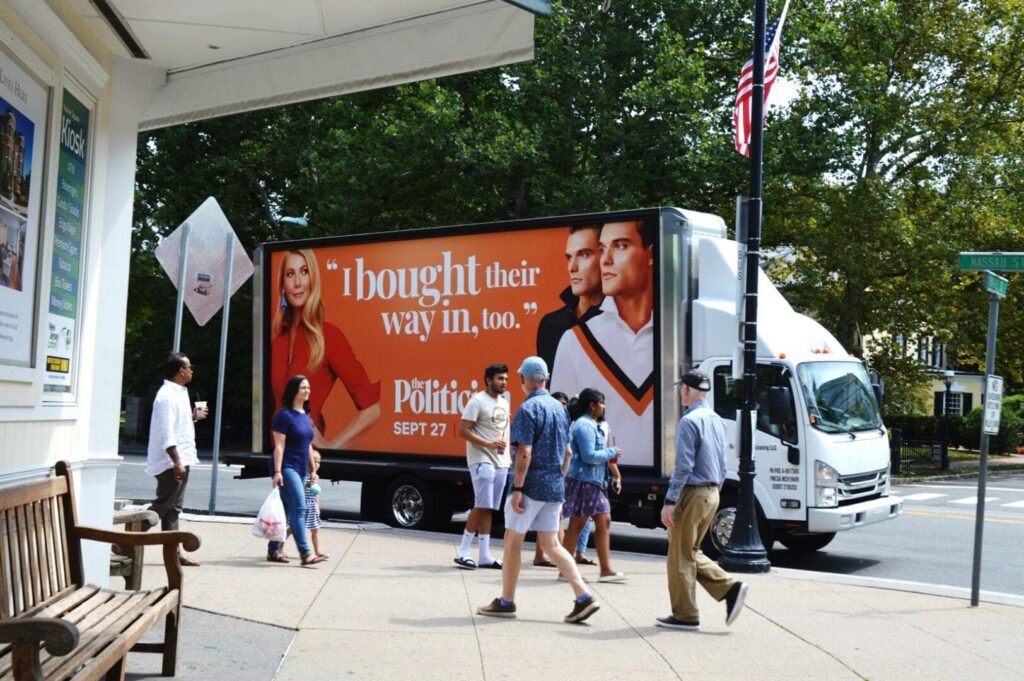
A wrapped vehicle used for fleet branding is a passive format. It generates visual exposure as it moves or parks, but it does not create consumer interaction. An experiential vehicle is an active format. Consumer engagement is the point of deployment.
A promotional van with staff handing out samples from the back is a sampling vehicle. It creates product trial but minimal brand experience. An experiential vehicle creates an environment — a space the consumer enters, interacts with, and experiences as a brand statement — not just a transaction point.
A trailer pulled by a separate vehicle is a different logistical and creative proposition than a self-propelled vehicle. Trailers offer more interior space for the build investment but require a tow vehicle and have limitations on parking in urban environments where fire hydrant clearances and loading zone restrictions make large vehicle placements difficult.
Industries and Categories Where Experiential Vehicles Work Best
Experiential vehicles are not appropriate for every brand or every campaign objective. They work best when the brand has a product that benefits from physical trial, a target consumer who is accessible in public environments, and a creative concept that is genuinely enhanced by the mobility and three-dimensional presence of a vehicle.
Beverage brands are among the heaviest users of experiential vehicles because sampling is central to their growth strategy and the vehicle format delivers high-volume sampling efficiently. Beauty brands use experiential vehicles for service experiences — skin consultations, hair styling, custom blending — that require a small controlled space to deliver properly. Automotive brands use experiential vehicles to create test drive staging and product display in markets where the dealership format does not generate spontaneous consumer interaction. Apparel and footwear brands use vehicles for limited product drops and community events that combine shopping with experience.
Designing for Social Content First
The best experiential vehicle designs of the past five years have been designed with photo documentation as the primary output metric, not just consumer interaction counts. A consumer who photographs the vehicle and shares it organically extends the reach of the activation far beyond the physical event.
Design elements that generate social content include distinctive color blocking or pattern work on the exterior wrap, architectural elements like fold-out awnings or neon signage that change the vehicle’s silhouette, photo-friendly interior moments (a product display presented against a bold graphic backdrop), and physical elements that give the consumer a natural reason to hold up their phone.
Designing for social content does not mean designing a “selfie moment” as a bolt-on. It means making the entire vehicle environment one that people want to capture and share. That requires design thinking from the beginning, not a content station added to a build that was otherwise designed for logistics.
AGM’s Approach to Vehicle Activation
We have been deploying experiential vehicles since long before the format was called “experiential.” We have operated Airstreams in Bryant Park and box trucks at Coachella. We have wrapped sprinter vans for two-week regional tours and managed double-decker bus activations in Times Square. The format is familiar to us in every variation.
Our approach starts with the brief, not the vehicle. We do not have a preferred vehicle type because we do not have a preferred activation formula. What we have is a clear process: understand the consumer action you need, design the experience that creates it, select the vehicle that fits the experience, build it to perform and survive the road, staff it with people who make the brand look its best, and document everything.
Brands that have worked with us on vehicle campaigns include national CPG companies running multi-city product launch tours, regional beverage brands seeding new markets, beauty brands creating custom service experiences, and tech companies building demo environments that needed to reach consumers in 10 cities in six weeks. The brief and the consumer are always the starting point.
Frequently Asked Questions
What is an experiential vehicle?
An experiential vehicle is any vehicle modified or operated as a platform for direct consumer brand engagement. It can be an Airstream trailer, converted bus, branded van, or custom truck designed to create brand experiences rather than simply display a logo.
How much does an experiential vehicle activation cost?
Costs vary widely. A single-day branded vehicle deployment can start around $5,000 to $8,000. A multi-week tour with a custom-built vehicle and staffing typically runs $40,000 to $150,000 or more depending on build quality, market count, and duration.
What types of brands use experiential vehicles?
CPG brands, beverage companies, beauty brands, automotive companies, tech brands, and apparel companies all use experiential vehicles. The format works for any brand that needs to deliver a physical product trial or immersive brand experience at scale.
How do you document an experiential vehicle campaign?
AGM documents experiential vehicle campaigns with photo documentation from each stop, geo-tagged route maps, staffing logs, and end-of-campaign summary reports covering locations visited, consumer interactions, and product distributed.