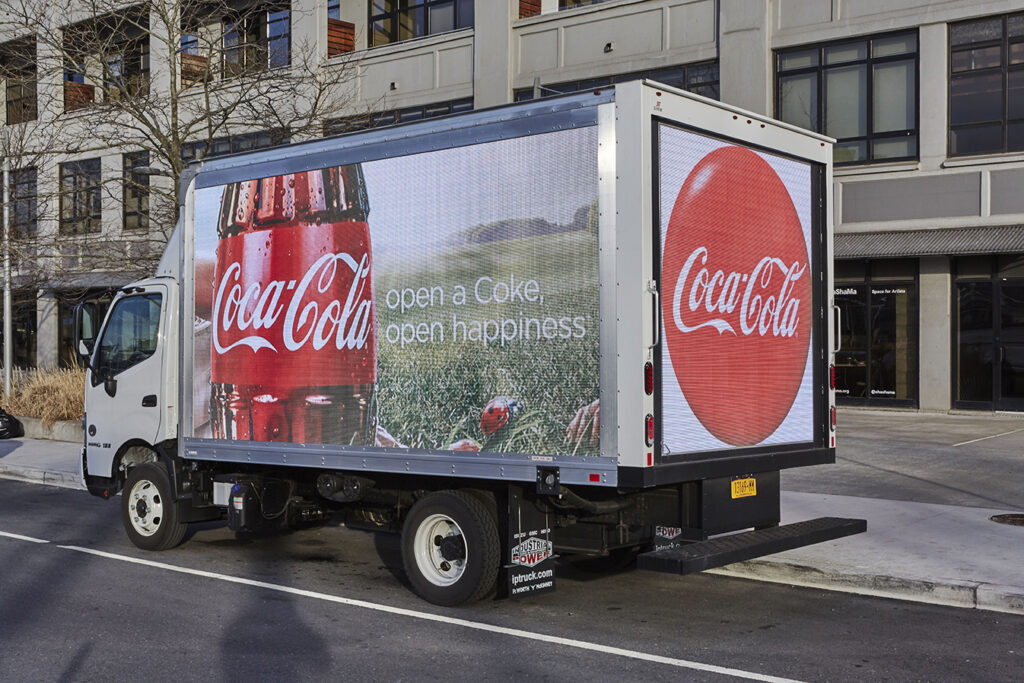
An experiential truck is a brand’s most mobile activation asset. It goes where the consumer is, creates brand presence on the move, and turns any parking spot in any city into a brand activation point. Here is how to build and operate one that actually delivers results.
An experiential truck is not just a vehicle with a logo on it. It is a purpose-built activation platform that combines the mobility of a commercial vehicle with the consumer engagement capability of a brand activation environment. When properly designed and operated, it creates direct consumer interactions at street level in any market a brand needs to reach, without requiring a fixed venue, an event partnership, or significant advance planning for each location.
We are American Guerrilla Marketing. We design, build, and operate experiential trucks for brand activation programs. This guide covers what makes an experiential truck different from a standard branded vehicle, how to design and build one that serves the brand’s specific program requirements, and what effective operation looks like in the field.
A standard branded vehicle is a company vehicle with the brand’s logo and contact information on the exterior. It communicates brand presence passively while in transit and when parked. It creates awareness for people who see it but does not create an interaction.
An experiential truck is built for active consumer engagement. The design intent is different from the ground up. The exterior is not just branded — it is designed to attract attention and draw consumers toward the vehicle. The interior is configured to support the activation program: product storage, sampling stations, demonstration areas, or customer interaction spaces. The team that operates the truck is trained for consumer engagement, not just driving and delivery.
The experiential truck is the intersection of a mobile billboard and a brand activation point. It creates passive awareness for everyone who sees it in transit and active engagement for consumers who encounter it when it is stationary at an activation location.
Designing an Experiential Truck for Your Program
The design of an experiential truck should follow from the specific program requirements, not from a generic template. The questions that define the design brief:
What is the primary consumer interaction? Sampling? Product demonstration? Information exchange? Physical experience?
How many consumers will interact with the truck at one time during peak activation hours?
What product or materials need to be stored and transported?
Does the interaction happen outside the truck, at a serving window, or inside the truck?
What climate conditions will the truck operate in? Does the interior need climate control?
Does the program involve technology components that need to be housed and powered?
What is the target impression the truck’s exterior should create when consumers first see it from a distance?
Answering these questions produces the design brief from which the truck build spec is developed. A truck built to an accurate brief performs better than a truck built to a generic spec that the program is then forced to adapt to.
Build Elements of an Experiential Truck
Exterior Wrap
The exterior wrap is the truck’s primary brand communication surface. A well-designed exterior wrap on a 20-foot box truck provides approximately 400 to 600 square feet of visible brand surface — comparable to a significant outdoor billboard placement, but one that moves through the city and positions at the highest-value consumer locations. The wrap design should be legible and compelling from 50 to 100 feet away.
Interior Configuration
The interior configuration depends on the activation format. Sampling programs typically configure the interior with product preparation areas, a refrigerator or cooler for chilled products, storage for dry goods and materials, and access points for serving samples to consumers outside the truck. Demonstration programs configure the interior as a product interaction environment. Some programs configure a portion of the interior as consumer-accessible, creating an inside-the-truck brand experience.
Power and Technology
Programs that require electricity inside the truck need a power solution: shore power connection for locations with available outlets, or an onboard generator for locations without. Technology components — screens, interactive elements, music systems, point-of-sale systems — need power and mounting integrated into the build. Adding these after the initial build is always more costly and less elegant than designing them in from the start.
The truck is only as productive as the locations it operates in. The most important operational discipline in experiential truck programs is location research and daily route planning.
Location Research
Effective experiential truck locations share several characteristics: they have high foot traffic from the target consumer demographic, they offer adequate parking or loading zone access for the truck, they have contextual relevance to the brand and its positioning, and they are accessible during the hours when consumer concentration is highest at that location.
Identifying these locations requires research, not improvisation. Market analysis, demographic mapping, local knowledge, and physical site surveys all contribute to identifying the locations that will produce the strongest consumer contact for a specific brand in a specific market.
Multi-Stop Day Planning
A well-operated experiential truck typically runs two to four activation stops per day in the same market, moving between locations as consumer concentration patterns shift throughout the day. A morning stop at a transit hub or commuter corridor, a midday stop at a destination location with lunch-hour traffic, and an afternoon or evening stop at a neighborhood gathering point all serve different consumer populations and maximize the day’s total consumer contact.
The best experiential truck programs treat every activation day as an optimizable unit. The team that operates the same route every day and does not adjust based on what they observe is leaving consumer contact on the table. The team that tracks performance by location, identifies which positions consistently outperform expectations, and continuously refines the route based on that data is getting the most out of the truck and the program investment.
Experiential Truck as a Multi-Year Asset
A quality experiential truck build is a capital asset that serves multiple campaign cycles over years. The economics of truck ownership improve significantly when the investment is viewed across the truck’s useful life rather than against a single campaign’s budget.
A truck that costs $75,000 to build and wrap, and runs two campaigns per year over four years, contributes $9,375 per campaign in capital costs. That is a very different economic picture than $75,000 as a single campaign expense. Brands that plan for truck longevity from the build stage — specifying durable materials, designing for graphics updates, and building to commercial vehicle maintenance standards — get significantly better economics from their vehicle investments than brands that optimize for single-campaign cost.
Building the Experiential Truck Exterior: Visual Impact at Street Level
The exterior of an experiential truck does its most important work before the truck ever stops. As the vehicle moves through a city, parks on a block, and sits at a location, its exterior communicates the brand to everyone who sees it — not just the consumers who walk over to interact. A well-designed exterior wrap extends the brand’s visual reach far beyond the consumers reached at the activation itself.
Effective experiential truck exterior design follows a few consistent principles:
Legibility from distance and speed: The consumer seeing the truck from a car or from across a busy intersection has approximately two seconds to form an impression. The exterior design must communicate the brand identity legibly in that two-second window. A single strong visual element — the brand name at large scale, a bold color, or a compelling image — is more effective than a complex design that requires extended engagement to process.
Brand identity consistency: The truck’s exterior should look like it came from the same brand world as the brand’s other visual communications. A consumer who recognizes the brand’s visual identity from social media or packaging should recognize it immediately on the truck exterior. Visual identity consistency across touchpoints builds recognition faster than any single touchpoint can build on its own.
Photography and illustration quality: If the exterior uses photography or illustration, the quality needs to match the brand’s quality positioning. Low-resolution images, stock photography that looks generic, or illustrations that feel off-brand all communicate the wrong message about the brand’s investment in quality. High-quality custom photography or original illustration is worth the investment for a vehicle that represents the brand publicly in dozens of markets.
Truck Program Performance Benchmarks
Understanding what realistic performance looks like for different truck program formats and locations helps brands set appropriate expectations and evaluate their programs against comparable benchmarks.
Activation Location Type
Consumer Interactions/Day
Samples Distributed/Day
Lead Capture Rate
High-traffic farmers market (weekend)
200-500
150-400
15-30%
Major urban transit hub
400-800
300-600
10-20%
Major outdoor event (adjacent)
300-1,000+
250-800
10-25%
Office district lunch rush
150-400
100-300
15-35%
Neighborhood street corner (standard)
50-200
40-160
10-20%
These ranges represent well-executed programs at appropriate locations. Poorly positioned or poorly staffed programs typically fall below the lower end of these ranges. Excellent positioning with strong staffing at peak-traffic times often exceeds the upper end. The ranges are useful for planning and expectation-setting but should not be treated as guarantees for any specific activation day.
Working With AGM on Experiential Truck Programs
American Guerrilla Marketing manages experiential truck programs for brands at every stage from concept to completion. Our role in truck programs can be comprehensive or targeted depending on what the brand needs.
For brands starting from scratch, we manage the full process: vehicle sourcing or rental, wrap design and production, interior build-out if required, ambassador recruitment and training, location research and daily route planning, field operations management, daily reporting, and campaign close-out analysis. Brands that engage us for the full service receive a managed activation program with minimal internal resources required to run it.
For brands that own branded vehicles and have existing operational capabilities, we provide the components where additional capacity or expertise is needed: location intelligence for specific markets, ambassador staffing and training, or program management infrastructure for multi-market deployments. We are structured to plug into existing programs, not only to operate them end-to-end.
Our ambassador network for truck programs spans all major US markets. Every ambassador we deploy on a truck program has been through our brand specialist training, understands the fundamentals of genuine consumer engagement, and has the product knowledge specific to the client’s program. The quality of the ambassador team is the quality of the program. We build that quality into every engagement.
Truck Program Budget Transparency
Brands planning their first experiential truck program often face uncertainty about what the investment will actually look like across all program components. Here is a realistic cost breakdown for a six-week single-market truck activation program:
Vehicle rental (6 weeks): $4,000-$8,000 for a suitable step van or box truck
Interior build-out (sampling station, storage): $8,000-$25,000 depending on complexity
Ambassador staffing (3 per day, 4 days per week, 6 weeks): $35,000-$65,000
Product for sampling (6 weeks of supply): Client-provided or $5,000-$30,000 depending on product category and volume
Program management and reporting: $12,000-$25,000
Total estimated range: $70,000-$165,000 for a full six-week single-market truck activation
For brands that own a wrapped truck and can provide their own product, the cost is primarily ambassador staffing and program management, typically $45,000-$85,000 for the same six-week program scope. Multi-market programs add vehicle, staffing, and logistics costs for each additional market at a lower marginal rate than the first market.
Common Experiential Truck Program Mistakes
Understanding the most consistent failure modes in experiential truck programs helps brands avoid the mistakes that predictably undermine program performance.
Underinvesting in the exterior design: The truck wrap is the most visible element of the program and it operates 24 hours a day wherever the truck is parked or in transit. A poorly designed or poorly executed exterior wrap undermines the brand every time the truck is visible. The exterior design investment pays dividends across every activation day of the program’s life.
Confusing the truck location with the activation location: Some brands position the truck at a location that is convenient for parking and logistics but is not where the target consumer is. The truck needs to go where the consumer is, even if that means more complex parking logistics. Consumer concentration drives program value; logistics convenience does not.
Inadequate staffing for the location: A truck at a high-traffic location with one ambassador cannot serve the consumer volume the location generates. Under-staffing leads to long waits, consumer frustration, and dramatically lower throughput than the location’s potential. Staff to the location’s peak hour volume, not to an average or minimum.
Not documenting the activation: An experiential truck program that does not produce photo documentation of each activation day loses the content value that the program generates. Every activation day with strong consumer engagement in a compelling location is a content production opportunity. A dedicated documentation protocol, whether from the ambassador team or a separate content person, captures the program’s visual output for future use.
Seasonal Strategy for Experiential Truck Programs
Experiential truck programs are most productive when their activation calendar aligns with the seasonal patterns of consumer behavior in each market. Understanding how seasonality affects truck program planning helps brands maximize the value of their activation investment.
In four-season markets (New York, Chicago, Denver, Minneapolis), the outdoor activation season runs from approximately May through October. Within that window, the most productive periods for street-level truck programs are late spring (when consumer outdoor activity surges after winter), midsummer (when peak event density concentrates consumer audiences), and early fall (when the outdoor season extends into a final productive window before winter). Brands planning annual programs in four-season markets should align their highest-investment activation periods with these peak windows.
In warm-weather markets (Miami, Los Angeles, Houston, Phoenix), outdoor truck programs run year-round, but summer heat creates specific operational requirements: early morning and evening activation windows that avoid peak-heat afternoon hours, climate-controlled vehicles for heat-sensitive products, and staff protocols for operating in high-temperature conditions. The year-round availability of outdoor activation in warm-weather markets is a significant strategic advantage for brands that operate nationally — it extends the effective activation calendar beyond the shorter outdoor seasons of four-season markets.
Event calendar alignment amplifies truck program performance at any time of year. A truck activation during a major neighborhood festival, food event, or cultural celebration in any market delivers substantially more consumer contact than the same truck at the same location on a non-event day. Building the activation calendar around the event calendar in each market is one of the highest-value strategy decisions in truck program planning.
The Experiential Truck as a Long-Term Brand Asset
Brands that invest in experiential truck programs often find that the truck itself becomes a recognized brand asset in the markets where it operates. A truck that appears consistently in the same market — at the same farmers market, at the same neighborhood events, at the same festival season — builds a community relationship that a one-time appearance cannot create.
Consumers who encounter the truck repeatedly develop a familiarity with the brand that accelerates the trust-building process. The truck becomes part of the neighborhood’s visual environment. Community members start to look for it. They tell friends about it. They track its schedule if the brand communicates about upcoming appearances. A truck program that runs for three or more seasons in the same market creates a brand community relationship that has durable value long after each individual activation day.
This compounding value logic applies equally to the ambassador team that operates the truck. A team that has operated the same truck in the same market for two seasons knows the consumer patterns, the location nuances, and the product presentation approaches that produce the best results in that specific environment. Their institutional knowledge cannot be replicated by a new team starting from scratch. Investing in the retention of strong truck program ambassadors from season to season is an investment in program performance that is often undervalued in program budget planning.
This compounding value is one of the most underappreciated aspects of recurring truck-based programs. The first season builds initial awareness. The second season builds recognition and early loyalty. The third season builds the community relationship that generates organic advocacy and word-of-mouth reach that extends the program’s impact far beyond the consumers directly contacted by the truck. The brands that commit to consistent presence over time earn returns on that consistency that single-season programs cannot generate.
Five Questions to Ask Before Starting an Experiential Truck Program
Before committing budget and timeline to an experiential truck program, these five questions ensure the program is designed for the right objectives and has the operational foundations it needs to succeed.
1. Where exactly is my target consumer, and when? Not a demographic description — a geographic answer. Which neighborhoods in which cities, at which times of day and week, have the highest concentrations of the consumers we most need to reach? This question should be answered with data before any vehicle is sourced or any ambassador is hired.
2. What specific consumer experience do we want to create? Not just “brand awareness” — but the specific sequence of interactions from first visual contact with the truck to final consumer departure. What does the consumer see, hear, taste, and feel? What do they leave with? What is the most important thing we want them to remember?
3. How will we measure whether it worked? Define success metrics before launching the program, not after. What data will the program collect? Who is responsible for collecting it? How will it be reported and to whom? A program that launches without a measurement plan will not be able to demonstrate its value when it ends.
4. Who will operate the program? Specifically: who manages the truck on a day-to-day basis, who are the ambassadors and what training have they received, and who handles operational issues when they arise? These are not abstract questions. The quality of the people operating the program determines the quality of every consumer interaction it produces.
5. How long will the program run, and will it repeat? A program planned as a one-time event is designed differently than one planned as the first installment in a multi-year commitment. If there is any possibility the program will repeat, design for repeatability from the start: modular systems, documented procedures, ambassador relationships worth maintaining. The cost of building for the long term upfront is far lower than retrofitting a one-time program for recurring use.
Frequently Asked Questions
What is an experiential truck?
An experiential truck is a branded vehicle that has been purpose-built or converted to serve as a mobile brand activation unit. It functions simultaneously as a mobile billboard, an operational platform for consumer engagement, and a logistics vehicle for the program’s product and materials.
How is an experiential truck different from a standard branded vehicle?
A standard branded vehicle typically just has the company’s logo and contact information wrapped on the exterior. An experiential truck is specifically designed to serve as an activation platform — with interior product preparation and storage areas, sampling or demonstration stations, consumer engagement features, and an exterior design intended to attract consumer attention and drive engagement.
The right size depends on the program format and the environments the truck will operate in. Compact step vans work well for dense urban environments where parking is limited. Medium box trucks (16-22 feet) provide a good balance of capacity and urban maneuverability. Larger trucks (24-26 feet) allow more interior space for complex activations but have less access flexibility in tight urban environments.
How do you select locations for an experiential truck program?
Location selection should be driven by research into where the target consumer concentrates at what times. High-foot-traffic locations with demographic alignment to the target consumer, appropriate parking or loading access for the truck, and contextual relevance to the brand are the primary selection criteria. Pre-activation site surveys confirm practical access before committing to a location.