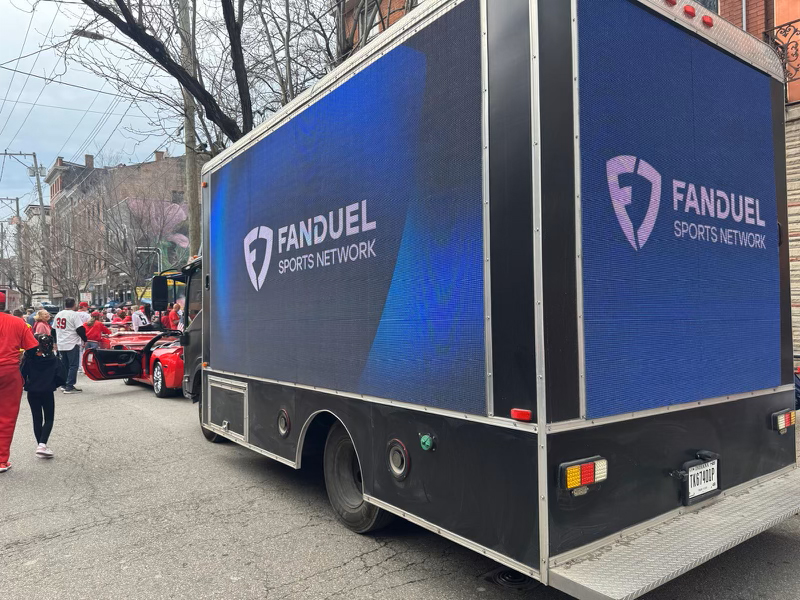
Experiential Sports Marketing: Fan Activations Beyond the Game
Experiential sports marketing is not about signing a jersey at a sponsor tent. It is about creating a physical moment that a fan carries with them long after the final buzzer.
Sports marketing works differently from most categories of brand advertising. The sports fan audience is emotionally invested in a way that most other consumer audiences are not. They show up wearing the colors. They know the players. They feel wins and losses personally. That emotional investment is the most valuable thing in sports marketing, it means any brand that authentically positions itself within the fan experience has access to an audience that is already primed for loyalty.
Experiential sports marketing is the discipline of creating physical, live brand moments that live inside the fan experience rather than next to it. Not a logo on a banner that fans walk past. Not a digital ad on the video board that plays between timeouts. Something the fan actually does, sees, touches, or photographs. Something that becomes part of their memory of the game, the season, or the moment.
We run experiential sports marketing activations in every major US market. Our work ranges from street-level brand ambassador deployments outside arenas to full on-site activation builds for official team sponsors to guerrilla installations in the neighborhoods surrounding sports venues. This guide covers what experiential sports marketing actually is in practice, the formats that work, and how to think about building a campaign that generates real fan response.
What Makes Experiential Sports Marketing Different from Standard Sponsorship
Traditional sports sponsorship is transactional. A brand pays for logo placement, on the jersey, on the scoreboard, on the dasher boards, and the return is measured in exposures. The fan sees the logo. The brand gets counted. That is a legitimate marketing channel, and the impression volumes in major sports venues are significant. But it does not create the kind of emotional association that changes how a fan feels about a brand.
Experiential sports marketing is relational. It creates an interaction, more than an impression. The fan tries the product, photographs the installation, wins the game, talks to the ambassador, gets the limited-edition giveaway. Something happens between the brand and the fan that cannot be replicated by a logo placement. That something is the experiential moment, and it is what the fan remembers and talks about.
The research on this is consistent: consumers who have a positive experiential brand interaction report significantly higher brand recall and brand affinity than consumers who have only seen brand advertising. In a sports context, where the emotional temperature is already elevated, the effect is amplified. A fan who has a great experience with a brand activation at a playoff game associates that positive feeling with the brand for years.
Formats of Experiential Sports Marketing
Experiential sports marketing operates across several distinct formats. Each has different reach, cost, and emotional impact profiles. Here is a comparison of the main formats we use.
Pre-Game Experiential Activations: The Highest-Impact Window
The 90 minutes before a game is the highest-impact window for experiential sports marketing. Fans are arriving, they are excited, they have time, and they are already in a socially engaged state, talking to friends, taking photos of the venue, looking for the pre-game experience to be something more than standing in line.
We position our best activations in this window. The approach corridor before Madison Square Garden on 7th Avenue between 31st and 33rd Streets during a sold-out Knicks or Rangers game carries dense pre-game foot traffic that lasts from about 90 minutes before tip-off to about 15 minutes after the opening buzzer. That is a 75-minute window of intense pedestrian activity that we can fill with a brand activation or street team that reaches a significant portion of the arena’s entire attendance.
Outside Chase Center in San Francisco’s Mission Bay neighborhood on the walk from the 4th and King Caltrain station, fans moving from transit to the arena pass a concentrated corridor before the game. We have activated this approach zone for client brands with product sampling and ambassador teams that created thousands of fan contacts per game date.
Designing the Activation for the Sport’s Fan Culture
Different sports have different fan cultures, and experiential activations need to be designed for the specific fan community, more than the sport. NFL fans have a pre-game tailgate culture that is unlike any other sport, the parking lot activation before a Seahawks game in the CLink lot is a completely different environment from the plaza activation before a Lakers game at Crypto.com Arena. NBA fans at a playoff game are predominantly urban, photographically active, and highly social-media-engaged. MLB fans span a wider age range and tend to be more family-oriented on weekend afternoon games and more adult-oriented on weekday evening games.
Field note: The pre-game activation that performs best is always the one that adds to the experience the fans are already having, not the one that interrupts it. Fans arriving at a game have a ritual: they find their crew, they take the photo, they grab a drink, they walk the plaza. The best activations happen inside that ritual, not across its path. Position your brand within what fans are already doing, not in front of it.
Experiential Sports Marketing Near Stadiums vs. Inside Them
The choice between activating inside the venue and activating outside it depends entirely on your brand’s relationship with the venue. Official sponsors typically have access to in-venue activation zones, concourse areas, club level spaces, and fan zones within the ticketed footprint. Non-sponsoring brands activate outside the venue in the public spaces and approach corridors.
Both approaches produce results. In-venue activations reach fans during the game experience itself, when emotional temperature is highest. Outside activations reach fans during the approach and departure, which are high-engagement windows with different dynamics. The outside activation typically reaches a higher percentage of the total attendance because it intercepts fans before they are distributed across the venue’s seating bowl.
For non-sponsoring brands, the outside window is often more valuable per dollar spent than official in-venue sponsorship because the cost of an outside activation is a fraction of in-venue sponsorship fees while reaching a comparable or larger audience. The tradeoff is the in-venue context, there is no substitute for a brand interaction that happens during the game itself. But for reach and efficiency, the approach corridor is an extremely strong position.
Creating Social Content Through Experiential Sports Marketing
Experiential sports marketing is most valuable when it generates content. The fan who photographs the branded installation on the plaza, posts it with the team’s game-day hashtag, and tags the venue creates an organic brand impression that reaches their entire social network. That network extension is free media. It is earned by creating something worth photographing.
We design every experiential activation with social content in mind from the first concept meeting. The questions we ask before designing anything: What will the fan photograph? What will they say about it in the caption? What hashtag or handle should be visible in the photo? Will the content work on Instagram stories, TikTok, or both? Does the activation create a video moment or a static photo moment? These questions shape the physical design in ways that have nothing to do with traditional brand design principles and everything to do with how social content actually works.
Experiential Sports Marketing at Scale: Multi-Venue and Multi-City Campaigns
Brands with national reach need experiential sports marketing at national scale. We have run multi-city, multi-venue experiential campaigns for brands that wanted consistent presence across the full schedule of games in a specific league or across multiple sports at the same time. The framework for these campaigns: a standardized activation design that deploys consistently across every market, adapted to the specific venue environment and local market culture in each city.
The adaptation is important. What works outside Fenway Park in Boston, where the approach on Yawkey Way has a specific neighborhood character and a specific fan arrival pattern, does not transplant identically to outside Dodger Stadium in Los Angeles, where fans arrive by car along Stadium Way and through the Chavez Ravine parking structure. Same activation concept, different physical deployment. We handle the market-specific adaptation and deploy from locally based field teams in each city.
Multi-city campaign tip: For national experiential sports marketing campaigns, build the activation design system first, the modular components that can be assembled in any venue environment, before finalizing market selection. The markets come second. The activation system has to work everywhere before you commit to where. We have seen campaigns get designed for one specific venue environment that then could not be replicated in the other nine cities on the schedule. Avoid that by designing for portability from the start.
The Difference Between Good and Bad Experiential Sports Marketing
We have watched a lot of sports activations from the outside over the years. The bad ones are easy to spot: they have no reason to exist other than the brand’s desire to be there. They sit in a corner of the fan plaza with a banner and a table and wait for fans to wander over. They hand out items that nobody asked for and collect interactions that nobody remembers. The activation adds nothing to the fan’s experience of the day and the brand gets nothing from the interaction except the ability to say it activated at a sports event.
The good experiential sports marketing activations are the ones where the fan gets something genuinely valuable from the interaction. More than a stress ball with a logo. A real product sample that is worth trying, a photo moment that the fan chose to create, a game or challenge that produced a genuine winner-takes-something outcome, or an environment that made the pre-game experience more fun than it was before the activation existed. The fan should leave the interaction having gotten something they actually wanted. That is what creates the positive brand association that experiential marketing is supposed to build.
Experiential Sports Marketing for Leagues and Teams vs. Sponsors
Leagues and teams use experiential marketing to build fan loyalty and deepen the emotional connection between the fan base and the franchise. Sponsor brands use it to transfer some of that fan loyalty to themselves through positive associations. The goals are different, and the campaign design should reflect those differences.
Team and league experiential campaigns focus on the player, the history, the community connection, and the season narrative. Fan activations that feature player imagery, team history references, and community messaging perform best for team-side campaigns. Sponsor brand campaigns focus on creating a positive physical experience that connects the brand to the positive feeling fans already associate with the sport and the team. Product sampling, interactive challenges, and giveaway moments that feel generous rather than transactional perform best for sponsor-side campaigns.
Measuring Experiential Sports Marketing Success
Every campaign we run is measured against a defined set of success metrics running before the first activation. The right metrics depend on the brand goals. A product trial goal uses samples distributed and post-activation purchase intent surveys. A social reach goal uses hashtag post volume and organic content exposures. A brand recall goal requires pre- and post-campaign awareness surveys in the target market.
We track the following baseline metrics on every experiential sports marketing activation regardless of brand goals: ambassador interaction count per hour, total consumers reached per deployment, branded giveaways or samples distributed, social content volume generated during and within 24 hours of the activation, and photo documentation of the activation footprint and consumer engagement moments.
These metrics are compiled into a post-activation report delivered within 48 hours of each game date. For multi-game programs, we compile a season summary that shows aggregate performance across all activations and identifies which game dates, formats, and locations produced the best results. That data shapes the following season’s plan.
Budget Allocation for Experiential Sports Marketing
Experiential sports marketing budgets break down differently than digital or traditional media budgets. The primary cost categories are build costs (for physical installations), staffing costs (for ambassador and field management teams), materials costs (for samples, giveaways, and printed materials), and documentation costs (for photo and video capture). Here is a general range for common activation formats.
Custom branded photo installation: $3,000-$12,000 for build and setup; reusable across multiple game dates
Street team deployment for a single game date: $800-$2,500 depending on team size and hours
Product sampling station with staffing: $1,500-$4,000 per game date
Interactive challenge or game structure: $5,000-$20,000 for build; $500-$1,000 per activation date for staffing
Full-season multi-game activation program: $25,000-$100,000+ depending on format complexity and market volume
AGM’s Approach and Field Experience
American Guerrilla Marketing has executed campaigns in this category across major US markets. Our field experience informs every recommendation here, from location selection to team structure to documentation standards. We approach each campaign with the same core operational discipline: walk every planned stop location before launch, source field teams locally in every market, document every activation systematically, and report with specific figures rather than approximations.
The campaigns that perform at the highest level in this category share consistent characteristics regardless of budget: precise audience targeting in specific physical environments rather than broad coverage, activation mechanics that deliver genuine consumer value rather than simply displaying brand messaging, locally sourced field teams who know their market and can engage its audience authentically, and systematic documentation that produces usable assets while proving the campaign executed as planned. These principles apply at every budget level. A $5,000 campaign and a $150,000 campaign both need them to perform at their potential.
The first strategic conversation for any campaign in this category is about audience concentration: where does the specific target consumer spend time in the specific target markets, and at what times are they most receptive to the kind of engagement this campaign is designed to create? That question determines every subsequent decision — the locations, the timing, the team structure, the activation mechanics. Start there, and the campaign plan develops with much greater clarity and efficiency than if the planning process starts with tactics or with budget allocation and works backward to audience strategy.
We work with clients at every stage of campaign development, from initial market analysis and audience targeting through full campaign production, field execution, and post-campaign reporting. If you are in the early stages of planning, we can help you define the audience targeting strategy and identify the highest-value stop locations in your target markets before any tactical production begins. If you have an existing plan and need field execution support, we can source and manage the local teams, handle logistics, and deliver the documentation. Contact us to discuss where you are in the process and what support your campaign needs.
Frequently Asked Questions
What is experiential sports marketing?
Experiential sports marketing is the discipline of creating live, physical brand interactions in and around sports environments. Instead of just placing a logo near the game, experiential sports marketing creates a moment, a sample, a challenge, a photo installation, a giveaway, that the fan actively participates in and remembers.
Who uses experiential sports marketing?
Both official team sponsors and non-sponsoring brands use experiential sports marketing. Sponsors use it to activate their official relationships and create in-venue presence. Non-sponsors use street-level and approach-corridor activations to reach the same fan audience in public spaces without the cost of official sponsorship.
What is the ROI of experiential sports marketing?
ROI varies by activation format and measurement approach. Direct measures include consumer interaction counts, samples distributed, and social content generated. Indirect measures include brand recall lift, purchase intent, and long-term affinity. The most comprehensive ROI analysis tracks both direct and indirect metrics and compares them to the cost of achieving similar outcomes through digital advertising.
How do you create a social media moment through experiential sports marketing?
By designing the activation for the camera first. Every element of the physical experience should be designed to produce a great photo or video. The background needs to be visually interesting. The interaction needs to be worth documenting. The brand identity needs to be visible but not dominant. Build the activation so that fans want to photograph it before you ask them to.
Can experiential sports marketing work without official team sponsorship?
Yes. Our strongest experiential sports marketing campaigns have often been run by non-sponsoring brands activating in the public spaces around venues. The key is working in the public right-of-way and creating activations that are compelling enough to draw fan attention without the advantage of an in-venue position.
What sports events work best for experiential marketing activations?
High-attendance, high-emotion events produce the best experiential marketing results: playoff games, rivalry matchups, opening day and closing day games, and championship events. Regular season games with strong home attendance are also effective but require more activation energy to generate the same fan enthusiasm level as marquee events.
How far in advance should we plan an experiential sports marketing activation?
For a single-game activation with street teams and sampling: three to four weeks minimum. For a custom-built photo installation or interactive challenge structure: six to eight weeks for design and build. For a full-season multi-game program: four to six months for planning, approval, production, and deployment scheduling.
Do you run experiential sports marketing in markets outside major cities?
Yes. We run campaigns in markets of all sizes, from major league cities to mid-size markets with minor league teams and collegiate sports. College football and basketball venues often produce the best per-capita engagement of any sports environment we work in, the student and alumni fan base is extremely emotionally invested and highly social media active.