These two terms get used interchangeably in marketing conversations and almost never mean the same thing to the people using them. A brand manager says “experiential” and means anything that happens outside a screen. A creative director says “guerrilla” and means anything unexpected. Neither definition is precise enough to actually plan a campaign, allocate a budget, or evaluate whether the strategy is correct for the objective.
The distinction matters because the two formats have different mechanics, different cost structures, different strengths, and different failure modes. A campaign designed as experiential that should have been guerrilla wastes money on production complexity that the audience does not value. A campaign designed as guerrilla when the objective required depth of engagement produces impressions without the conversion that justified the spend.
This guide defines both clearly, explains when each format is the right choice, how they combine effectively, and what realistic budget expectations look like for each. Our team at American Guerrilla Marketing executes both — operating across 50+ U.S. markets from our base in Industry City, Brooklyn, NY.
Definitions: What Each One Actually Is
Guerrilla Marketing: A Definition
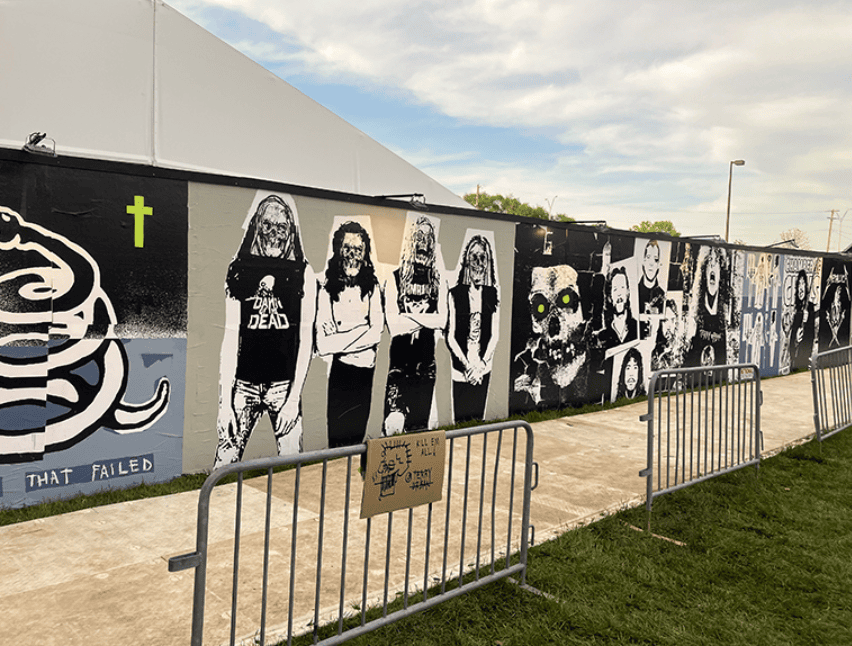
Guerrilla marketing uses unconventional, often unexpected tactics to create brand awareness, typically in public or semi-public spaces, at a cost that is lower than traditional advertising. The format prioritizes scale, surprise, and visual disruption. A wheatpaste campaign covering 50 walls in a neighborhood, a sidewalk stencil grid around a transit hub, a flyposting campaign across construction fencing on a city block — these are guerrilla marketing. The audience encounters the brand unexpectedly while doing something else. The impression is passive; the exposure is broad.
Guerrilla marketing is about presence: making a brand visible in the spaces where the target audience already exists. The mechanism is interruption — not aggressive interruption like a pop-up ad, but environmental interruption — a visual element in the landscape that the audience encounters because it is there, not because they sought it out.
Experiential Marketing: A Definition
Experiential marketing creates environments, events, or interactions where consumers directly engage with the brand as a participant, not just an observer. A pop-up store where customers can try a new product line, a sampling event where brand ambassadors offer tastings at a high-traffic location, a branded installation that people interact with and photograph — these are experiential marketing. The audience opts into the experience. The engagement is active; the encounter is deep.
Experiential marketing is about encounter: creating a moment where the brand and the consumer have a direct relationship, however brief. The mechanism is participation — the consumer does something, tries something, experiences something in the brand’s context. That participation creates a different type of memory formation than passive visual exposure.
Concrete Examples of Each
Guerrilla Marketing Examples
A fitness app launching in New York covers the blocks around four major gym locations with wheatpaste posters featuring a simple QR code and a single benefit message. The poster is seen by gym-goers walking in and out over a four-week window. Hundreds of thousands of impressions, a fraction of the cost of paid digital in the same market. That is guerrilla marketing: broad, efficient, ambient.
A food delivery company launches in Chicago using sidewalk stencils at the exits of the ten busiest subway stations in the target neighborhoods. Every commuter who exits those stations during the four-week campaign period sees the brand logo and offer at their feet. That is guerrilla marketing: contextually placed, unavoidable, cost-efficient.
Experiential Marketing Examples
A beverage brand sets up a sampling station at a music festival, staffed by brand ambassadors who offer product tastings and tell the brand story. Each person who participates has a personal, sensory encounter with the product. They taste it, they talk about it with the ambassador, and they walk away with a sample or a coupon. That is experiential marketing: individual, participatory, high-depth.
A DTC furniture brand opens a pop-up apartment in SoHo for two weeks, styled entirely with their products. Visitors book appointments to walk through, sit on the furniture, and experience the brand in a real living context. That is experiential marketing: the consumer is inside the brand’s world, physically engaging with the product in the intended use context.
Key Differences: Budget, Scale, Interactivity, Measurement
The practical differences between the two formats show up clearly when you look at four dimensions: budget requirements, audience scale, depth of interactivity, and ease of measurement.
Budget Reality for Each Format
Guerrilla marketing scales efficiently. A wheatpaste campaign covering 50 locations in one market might run $10,000 to $25,000. A stencil campaign at 20 transit corridors might run $5,000 to $15,000. You can deploy a credible guerrilla campaign in a major market for $20,000 to $40,000 with full documentation.
Experiential marketing scales with production complexity. A simple sampling event for one day in one location might run $5,000 to $15,000. A weekend pop-up with a custom-built environment, staffing, and branded materials might run $40,000 to $100,000. A multi-week produced experience in a premium location can run $150,000 to $500,000+. Production complexity is the main cost driver, and production requirements are built into the format.
Audience Scale vs. Audience Depth
A guerrilla campaign covering a neighborhood can generate 100,000+ passive impressions in a month. Each of those impressions is brief — a few seconds of visual contact with a poster or stencil. An experiential event might engage 500 people over a weekend with a 3-minute deep interaction each. The math is not directly comparable because the value of each contact is different. Guerrilla marketing wins on reach; experiential marketing wins on depth of engagement.
When to Use Each Format
When to Choose Guerrilla Marketing
Guerrilla is the right format when your primary objective is awareness — making a brand visible to a large audience in a defined geography, quickly and cost-efficiently. It is effective for product launches where broad awareness precedes availability (building anticipation before launch day), for market entry campaigns where the brand is new to a city and needs to establish visual presence, and for ongoing ambient presence campaigns where the objective is staying top-of-mind for a defined audience over an extended period.
Guerrilla is also the right format when your target customer is concentrated in walkable urban environments — neighborhoods where pedestrian density creates high organic impression volume per placement. The format’s efficiency advantage over experiential shrinks significantly in car-dependent markets where foot traffic is lower and placements need to be vehicle-visible to generate meaningful reach.
When to Choose Experiential Marketing
Experiential is the right format when your campaign objective requires consumer participation — trial, demonstration, or depth of engagement that passive impressions cannot create. Products with a strong sensory dimension (food and beverage, beauty, fragrance, furniture) benefit from experiential because the consumer cannot evaluate the product without physically interacting with it. No amount of posters or digital ads replaces tasting the product.
Experiential is also appropriate when your brand is repositioning or reintroducing — trying to change existing perceptions rather than build initial awareness. Changing perceptions requires a more intensive engagement than establishing initial awareness, and the deeper interaction of experiential marketing is better suited to that objective.
How Geography Changes the Calculus
Dense Pedestrian Cities Favor Guerrilla
In New York, Chicago, Boston, San Francisco, and Washington D.C., guerrilla marketing generates massive impression volume at low cost per impression because pedestrian density is high. A poster at a major Brooklyn intersection might be seen by 20,000 people per day. The cost per thousand impressions on that poster is lower than virtually any other media buy in that market.
Car-Dependent Markets Require Different Thinking
In Los Angeles, Dallas, Phoenix, and Atlanta, pedestrian density is concentrated in specific commercial corridors rather than distributed across the city. Guerrilla marketing still works, but the placement strategy must be more precise — focusing on the specific corridors and neighborhoods where the target customer actually walks. Vehicle-format options — our LED billboard trucks and mobile billboard programs — often complement street formats in car-dependent markets.
When to Combine Them
Many of the most effective campaigns combine guerrilla and experiential in a deliberate sequence that uses each format for what it does best.
The Awareness + Trial Model
Weeks before an experiential event, guerrilla placements in the target neighborhood build awareness and create anticipation. The posters, stencils, or street teams create a visual presence that makes potential attendees aware something is coming. The event provides the depth of engagement. Post-event, continued guerrilla presence keeps the brand visible for the audience who attended and serves the ongoing awareness objective for those who did not.
The Sampling + Outdoor Model
Brand ambassadors doing product sampling in a neighborhood are complemented by wheatpaste and stencil campaigns on the same blocks. The ambient outdoor presence reinforces the sampling conversation — someone who receives a sample and then sees the brand’s poster on their walk home has encountered the brand twice, through two different mechanisms, in the same day. That layered exposure drives recall and conversion significantly more than either format alone.
The Role of Timing in Format Selection
Campaign timing is a dimension of format selection that receives less attention than it deserves. Guerrilla marketing and experiential marketing are not equally appropriate at every point in a product’s lifecycle or in every moment of the marketing calendar. The timing of each format affects its effectiveness as significantly as the geographic and demographic targeting decisions.
Early Lifecycle vs. Mature Brand
Early in a product’s lifecycle — launch phase, first-year awareness building, market entry — guerrilla marketing is typically the higher-priority format because building broad awareness is the objective that requires the highest reach efficiency. A new brand needs as many people as possible to know it exists before it can benefit from the depth of engagement that experiential marketing creates. You cannot have an emotional brand relationship with a brand you have never heard of.
As a brand matures and initial awareness reaches saturation in its primary markets, experiential marketing becomes proportionally more valuable. The brand’s existing awareness base creates an audience that is ready for a deeper engagement — the person who has heard of the brand and perhaps bought it once is a much more valuable experiential target than a person who has never heard of the brand at all. Mature brands use experiential to deepen existing relationships rather than to build initial ones.
Pre-Event vs. Event-Window Timing
For campaigns timed around a specific event — a product launch, a trade show, a sporting event, a cultural moment — the relative timing of guerrilla versus experiential elements matters. Guerrilla campaigns work best in the weeks preceding the event, when they build awareness and anticipation in the audience that will attend. Experiential activations work best during the event window, when the target audience is already gathered and in an elevated state of engagement. Post-event, guerrilla maintenance placements serve the audience that attended and the broader audience reached through event media coverage.
Measuring Results Across Both Formats
Measurement approaches differ between experiential and guerrilla marketing because the audience interaction differs fundamentally. Guerrilla marketing creates passive impressions at scale — the measurement question is how many people saw the campaign and what they did afterward. Experiential marketing creates active, participatory encounters — the measurement question is what the participant experienced, felt, and did as a direct result of the encounter.
Measuring Guerrilla Marketing Results
Guerrilla campaigns are measured through direct attribution elements (QR code scans, vanity URL traffic, promo code redemptions), indirect digital signals (brand search volume in the campaign geography during the campaign period, direct website traffic from the target market), and documentary evidence (GPS-tagged proof of placement, estimated impression calculations based on foot traffic data for each location). A guerrilla campaign can produce attributable data at every level from individual placement performance down to total network CPM calculation.
Our team builds measurement infrastructure into every guerrilla campaign from the brief stage: unique QR codes per placement location if location-level data is needed, campaign-specific landing pages with conversion tracking, and geo-fenced digital overlays where digital attribution support is required. The measurement tools are standard; the question is whether the campaign was designed to use them from the start.
Measuring Experiential Marketing Results
Experiential campaigns are measured through participant-level data: how many people engaged with the experience, how long they spent, what they did during the experience, and what they did afterward. Secondary metrics include social sharing volume and content generated by participants, earned media coverage of the event, and any direct transaction or conversion data (samples distributed, products sold, signups captured) from the activation itself.
Brand lift studies — surveys administered to people who were present at the activation and a matched control group who were not — are the most rigorous measurement tool for experiential campaigns. They directly measure the change in awareness, consideration, and purchase intent attributable to the brand encounter. They are more expensive to execute than digital attribution tracking but produce the most defensible ROI data for campaigns where the primary objective is brand perception change rather than direct conversion.
Budget Allocation Between the Two Formats
When a campaign brief calls for elements of both guerrilla and experiential marketing, the budget allocation question is: how much weight should each format receive? The answer depends on the campaign’s primary objective and which format’s strengths are more aligned with that objective.
Awareness-First Budgets
When the primary objective is building broad awareness quickly in a specific geography, allocate the majority of the budget (60 to 70%) to guerrilla formats — wheatpaste, stencils, street teams, outdoor — that reach the highest number of people at the lowest cost per impression. The experiential component serves as the deeper engagement layer for the smaller audience who wants to know more: a sampling activation, a pop-up, or a brand ambassador program in the highest-traffic zones of the campaign geography.
Trial-First Budgets
When the primary objective is trial — getting the product in people’s hands or getting them through the door — allocate the majority of the budget (60 to 70%) to experiential formats: sampling events, ambassador programs, pop-up activations. The guerrilla component serves as the awareness driver that tells people where and when the experiential activation is happening, directing the awareness-level audience toward the deeper engagement opportunity.
How Our Team Approaches the Two Formats
At American Guerrilla Marketing, our primary specialty is street-level guerrilla campaigns — wheatpaste, stencils, street teams, projection, and LED trucks. We integrate experiential elements — sampling events, ambassador activations, pop-up support — into campaigns where the brief calls for depth of engagement alongside broad awareness.
We do not try to make every campaign a fully produced experiential event when guerrilla tactics would serve the objective better at a fraction of the cost. And we do not run pure ambient campaigns when the product or positioning genuinely requires consumer participation. The format recommendation follows the objective, not the other way around.
Our team operates across 50+ U.S. markets. Every campaign we execute — guerrilla or experiential — includes GPS-tagged documentation of every placement and activation, proof of posting reports, and post-campaign analytics. We are based in Industry City, Brooklyn, NY and can be reached at (646) 776-2770.
Frequently Asked Questions
What is the difference between experiential marketing and guerrilla marketing?
Guerrilla marketing uses unexpected, unconventional methods in public spaces to create broad brand awareness at low cost. Experiential marketing creates branded environments or events where consumers directly participate. Guerrilla prioritizes scale; experiential prioritizes depth of engagement. They are complementary, not interchangeable.
Is guerrilla marketing always cheaper than experiential marketing?
Generally yes. A guerrilla campaign covering 10 cities can run $30,000 to $80,000. A simple pop-up event in one city can run $15,000 to $40,000. A large-scale experiential event with custom builds and staffing can reach $200,000 to $500,000+. Format determines budget range.
When should I choose guerrilla marketing over experiential marketing?
Choose guerrilla when your primary objective is broad awareness in specific geographies, when budget efficiency is critical, when your target customer is concentrated in walkable urban areas, or when you want persistent visual presence over time rather than a single event moment.
When should I choose experiential marketing over guerrilla marketing?
Choose experiential when your campaign objective requires trial, demonstration, or deep engagement — when the consumer needs to interact with the product to understand it. Events and installations work best for product launches that benefit from hands-on experience and for brand repositioning campaigns.
Can experiential and guerrilla marketing be combined?
Yes, and many effective campaigns combine both. Guerrilla placements drive awareness in the target neighborhood before an experiential event. The event provides depth of engagement. Post-event, continued guerrilla presence keeps the brand visible. The two formats address different moments in the customer journey.
Does American Guerrilla Marketing handle both guerrilla and experiential campaigns?
Yes. Our primary specialty is street-level guerrilla marketing, but we integrate experiential elements including sampling events, pop-up activations, and brand ambassador programs. We operate across 50+ U.S. markets and build integrated campaigns that combine both approaches.