Your booth space at a trade show is a starting point, not a destination. The floor space you pay for gives you a approved location inside the hall, a place for your brand to live for the duration of the show. Whether that location becomes a high-traffic, lead-generating machine or a quiet corner that gets skipped by most of the people you were there to meet comes down entirely to how well your exhibitor marketing works. See also: Convention Marketing.
Exhibitor marketing is everything you do before, during, and around the show to make your booth impossible to miss. At American Guerrilla Marketing, our team builds the during-show component of that strategy: the street-level activation campaigns that intercept your target audience in the zones around the venue, build awareness before they step on the floor, and create a clear reason to visit your booth before any other.
This guide covers the full scope of exhibitor marketing , from the pre-show outreach phase through street-level activation to post-show follow-up , and explains specifically how outside-the-hall campaigns make every other component of your exhibitor investment more effective.
The Three Phases of Exhibitor Marketing
Effective exhibitor marketing is not a single campaign. It is a three-phase program built around the show timeline.
Phase one: pre-show. The pre-show phase starts four to eight weeks before the event. The goals are to generate awareness among registered attendees, book pre-scheduled meetings at the booth, and create anticipation for whatever you are launching or demonstrating at the show. Tactics include targeted email campaigns to the attendee list, social media content using the show hashtag, direct outreach to specific prospects, and digital advertising targeted to the conference’s audience.
Phase two: during-show. During-show exhibitor marketing is where we operate. Street-level tactics in the public zones surrounding the venue, deployed during the arrival windows and break periods of each show day, intercept your target audience at moments of high receptivity and direct them to your booth. This is the component that most exhibitors skip entirely, leaving the during-show period to passive floor browsing.
Phase three: post-show. Post-show exhibitor marketing converts booth visitors and lead captures into sales conversations. Speed matters. Leads contacted within twenty-four to forty-eight hours of the show close at significantly higher rates than those contacted after a week. The post-show phase should be planned and resourced before the show begins, not built after you get home.
Why During-Show Street-Level Activation Changes the Outcome
The during-show phase is the most overlooked in exhibitor marketing because most exhibitors assume that being present on the floor is sufficient. If they built a strong booth, the attendees will find them.
The floor reality is different. A major trade show floor with five hundred exhibitors presents attendees with a navigation challenge that most resolve through the path of least resistance , main aisles, familiar brand names, and whatever is immediately visible from the entrance. Mid-floor booths, new brands, and companies without a premium sponsorship package are systematically undervisited regardless of how good the booth looks. See also: Brand Ambassadors.
Street-level activation in the public zones outside the venue changes this calculus. When attendees arrive having already seen your brand name in three different contexts , the poster on the block near their hotel, the ambassador who handed them a sample at the shuttle stop, the LED truck that circled the venue entrance , your booth is not a discovery, it is a destination they intended to reach.
This pre-loaded intent is the most valuable outcome of during-show exhibitor marketing, and it is entirely created in the sixty to ninety minutes before the show floor opens.
Brand Ambassadors at Hotel and Transit Zones
The highest-concentration window for exhibitor marketing is the morning arrival push. Attendees move from hotels to the convention center in a predictable forty-five minute window. Brand ambassadors positioned in the hotel lobby zone, at the shuttle stop, and at the primary pedestrian approach can make contact with a significant portion of the day’s attendee flow before the hall opens.
Our exhibitor marketing ambassador teams carry a specific booth invitation , not a general brand pitch. “We’re at booth [Number] and we’re demoing [Product] every thirty minutes. The first fifty visitors get [Offer]. Worth two minutes when you’re on the floor.” That specificity is what converts a brief interaction into a committed booth visit.
LED Trucks for Exhibitor Visibility
For exhibitors who want maximum impact in the shortest time, an LED billboard truck circuit during the morning arrival window is the single most effective available option. A full-color display truck running the convention center perimeter reaches every attendee approaching the venue on foot, by shuttle, or by rideshare during that window.
For exhibitor marketing specifically, LED truck creative should be clean and directive: your brand name large, your booth number clear, and one compelling message. “Booth 419. New Product Launch. See It First.” Every word is doing work.
Sampling as an Exhibitor Marketing Tool
For brands with a physical product, sampling in the zones around the convention entrance is the most direct form of pre-show exhibitor marketing. Getting your product into an attendee’s hand before they walk onto the floor creates a product experience that passive booth browsing cannot replicate.
An attendee who received your sample at the hotel coffee queue, tried it on the walk over, and found it genuinely good is not a cold prospect when they arrive at your booth. They are a warm one with a specific question or reaction to discuss. That quality of pre-warmed prospect converts at a dramatically higher rate in booth conversations.
Wheatpasting and Stenciling for Persistent Coverage
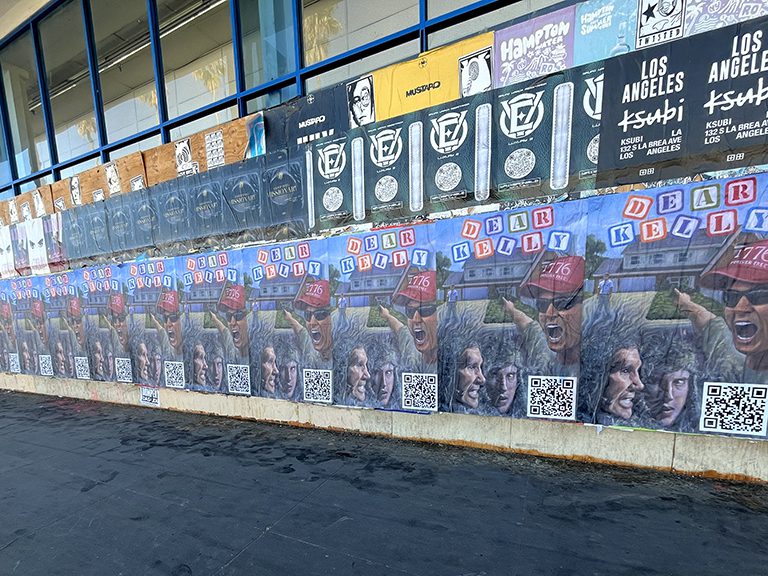
Wheatpasted posters and sidewalk stencils in the pedestrian zones around the venue provide persistent brand presence for the full duration of the show without requiring staff time after installation. These are the background layer of an exhibitor marketing campaign , always there, always reinforcing, always adding to the accumulated awareness that makes the booth visit feel inevitable rather than random.
For multi-day shows, we refresh posters and stencils between show days to keep creative current and catch any attendees who missed the initial installation on day one.
Integrating Your Booth Experience With the Street Campaign
Outside-the-hall exhibitor marketing only delivers its full value when the booth experience delivers on the street-level promise. If ambassadors are telling attendees they will see a product demo every thirty minutes, the demo needs to run every thirty minutes. If the LED truck promised a limited giveaway, the giveaway needs to be there.
We coordinate the street campaign message with your booth team’s planned experience to ensure consistency. Attendees who arrive with pre-loaded expectations need to find those expectations met, or the street-level campaign creates frustration rather than goodwill.
How We Build Convention Campaigns That Actually Work
Our team at American Guerrilla Marketing has executed convention marketing programs at major trade shows across the country. We have deployed teams at shows in Las Vegas, New York, Chicago, Orlando, Atlanta, and every other major convention market. That field experience informs how we plan every new campaign: we know what works in the Javits Center neighborhood, how to navigate the hotel district around the Las Vegas Convention Center, and where to position teams for maximum impact at McCormick Place.
Every program we run is documented from start to finish. Before the show opens, we confirm every outdoor placement with geo-tagged photos. During the show, field supervisors submit timestamped shift logs that include deployment position, team size, and conversation or sample counts for each shift. After the show closes, we compile the full campaign documentation into a post-show report that gives clients proof of what was executed and the data they need to evaluate the program.
The documentation also creates the performance record that informs optimization of the next campaign. Which deployment locations generated the most qualified conversations? Which outdoor placements received the most engagement? Which shift timing produced the highest-quality audience encounters? These questions get answered over multiple campaigns, and the answers compound into a progressively more effective convention marketing program year over year.
Planning Your Convention Campaign Timeline
Convention marketing campaigns work best when they are planned against the full timeline: 8 to 12 weeks before the show for the most complex programs, 4 to 6 weeks for ambassador-only or outdoor-only programs. The earlier the planning begins, the more options are available for every element of the campaign.
The pre-show window (6 to 8 weeks out) is when pre-show meeting outreach campaigns should launch. Personalized outreach to registered attendees using the specific conference or show context achieves significantly higher response rates than generic outreach because the timing is immediately relevant to the recipient’s known upcoming plans. We build pre-show outreach sequences for clients as part of convention marketing engagements, segmenting by target buyer persona and show registration data where available.
Production of printed materials for wheatpaste campaigns and stencil programs requires 3 to 4 weeks from design approval to installation. LED truck route planning and driver coordination requires 1 to 2 weeks. Ambassador team recruitment and briefing requires 3 to 4 weeks for shows with specific professional audience requirements. Running all of these in parallel against the show date requires a planning timeline that starts at least 6 weeks before the first deployment day.
We provide campaign timeline planning as part of the proposal process: every proposal includes a production and deployment timeline that shows exactly what happens when, what deliverables are required from the client, and what our team is responsible for executing at each stage. This timeline planning prevents the last-minute scrambles that degrade campaign quality and limit creative options.
Working With American Guerrilla Marketing
Our team at American Guerrilla Marketing is based at Industry City in Brooklyn. We have been running street-level marketing campaigns for brands across every major consumer category for years. Our field operations experience spans New York, Los Angeles, Chicago, Miami, Austin, San Francisco, and dozens of other markets. That operational depth is what we bring to every client engagement, alongside the creative and strategic work that makes campaigns worth executing.
Our engagement process is straightforward. We start with a discovery call where we learn your brand, your audience, your market, and your campaign objectives. We turn that understanding into a campaign proposal with specific tactics, deployment plans, a timeline, and investment. Once approved, we handle every aspect of production and field management from start to finish. You receive documentation from every deployment day and a post-campaign report at close.
We work with brands at a wide range of budgets and campaign scales. A focused street team program in one neighborhood is as important to us as a multi-city multi-format program. Every campaign we run reflects the same standard of planning, execution, and documentation regardless of scale.
Frequently Asked Questions
What is exhibitor marketing?
Exhibitor marketing encompasses the full range of marketing activities a brand undertakes to maximize the return on its trade show or expo participation. This includes pre-show audience outreach and meeting scheduling, the design and staffing of the exhibit environment, surrounding venue campaigns in the host city, on-floor ambassador activation, and post-show follow-up with leads generated during the event.
How is exhibitor marketing different from exhibit design?
Exhibit design creates the physical environment where brand interactions happen. Exhibitor marketing creates the audience for those interactions. Both are necessary, but exhibitor marketing is the more consequential investment for determining show ROI. A beautifully designed exhibit with poor exhibitor marketing generates disappointing results. A modest exhibit with strong exhibitor marketing consistently outperforms.
What are the components of a complete exhibitor marketing program?
A complete exhibitor marketing program includes: pre-show audience identification and outreach to registered attendees matching the target customer profile; meeting scheduling campaigns that build a committed appointment calendar before the show opens; surrounding venue campaigns in the host city’s attendee-concentrated areas; ambassador staffing for active floor traffic generation; on-floor engagement management; and post-show follow-up support for leads captured during the event.
When should exhibitor marketing activities begin?
Exhibitor marketing activities should begin six to eight weeks before the show for most programs. Pre-show email sequences require several sends over multiple weeks to build progressive awareness. Ambassador recruitment and briefing require three to four weeks minimum. Surrounding venue campaign production requires additional lead time depending on format. Brands that wait until three weeks before a show cannot execute a complete exhibitor marketing program.
How does surrounding venue marketing help exhibitors?
Surrounding venue marketing reaches the show’s attendee population in the city areas outside the official venue, building brand awareness before attendees enter the exhibition hall. When attendees encounter an exhibitor’s brand in hotel corridors, on transit routes, or through street-level media during the show, their first interaction at the exhibit begins with existing brand familiarity rather than a cold introduction. This familiarity accelerates qualification and improves lead quality.
What exhibitor marketing mistakes do brands most commonly make?
The most common exhibitor marketing mistakes are starting too late (planning begins one to two weeks before the show rather than six to eight), under-investing in pre-show marketing relative to exhibit design, relying entirely on passive in-booth staffing without corridor ambassador presence, treating lead capture as an afterthought rather than a designed process, and failing to build post-show follow-up content before the show closes.
Does AGM provide full exhibitor marketing services?
Yes. AGM provides integrated exhibitor marketing services covering pre-show audience marketing, surrounding venue street campaigns, brand ambassador staffing and briefing, and post-show follow-up support. We approach exhibitor marketing as an integrated campaign with multiple coordinated components rather than a collection of independent tactics.
How does digital marketing support exhibitor marketing?
Digital marketing supports exhibitor marketing through pre-show email outreach to registered attendees, social media content that builds show awareness and promotes specific demonstrations or announcements, LinkedIn account-based outreach to target attendees, and show-day content that drives additional floor traffic. Digital tactics are most effective when integrated with physical surrounding campaigns rather than deployed as the sole exhibitor marketing vehicle.
How do you measure exhibitor marketing effectiveness?
Exhibitor marketing effectiveness is measured through pre-scheduled meeting count, qualified lead volume, lead quality score, demonstration participation rate, surrounding campaign audience coverage, and post-show lead-to-pipeline conversion rate. These metrics should be defined before the show and tied to the business objectives the exhibit participation is meant to serve.
What shows does AGM provide exhibitor marketing services for?
AGM provides exhibitor marketing services for brands at trade shows and expos across the United States, including shows in Las Vegas, Chicago, New York, Orlando, Miami, and other major convention cities. Our services include surrounding venue campaigns in any US show market with adequate advance planning, and ambassador staffing through our national network.