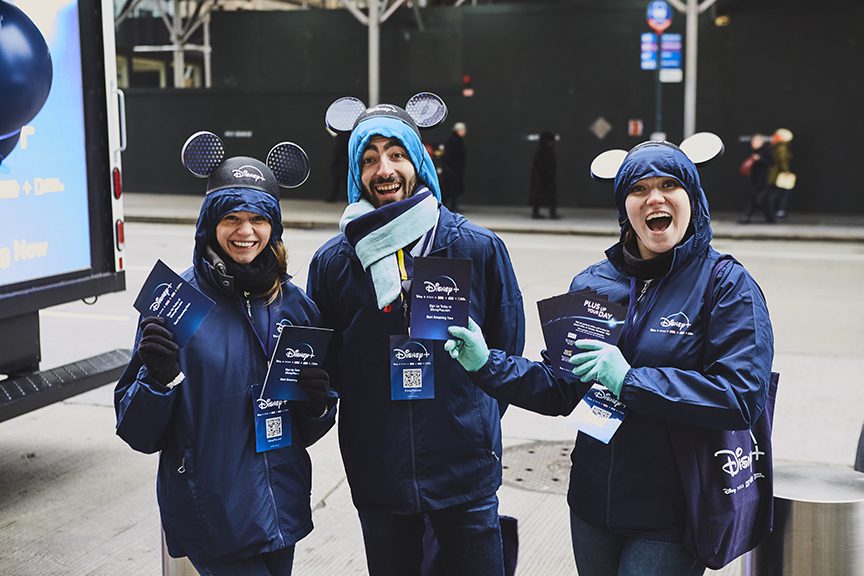
The best way to understand what experimental marketing can do is to look at what it’s actually done. Not the theoretical case studies in marketing textbooks – the real campaigns, street-level and documented, that moved product, built audiences, and created cultural moments that media buys alone couldn’t manufacture.
American Guerrilla Marketing has executed hundreds of campaigns across 50+ U.S. markets since 2006. We’ve seen what works across categories: CPG, entertainment, fashion, food and beverage, tech, nonprofit, and more. The examples in this guide span formats and scales, from street-level wheatpasting campaigns to multi-market sampling tours, to show what experimental marketing actually looks like in the field when it’s done right.
This isn’t a list of brand storytelling wins. It’s a breakdown of formats, objectives, and outcomes – structured so you can identify what might work for your brand and why.
Example Category 1: Street-Level Sampling Activations
Sampling is the foundational format of experimental marketing. A well-placed sampling activation puts a product directly in a consumer’s hand, bypasses the entire consideration funnel, and lets the product make its own case. Done right, sampling produces trial rates and immediate purchase intent that no media channel can match.
High-Traffic Urban Sampling
A natural food brand entering the New York market deployed AGM to run sampling activations across six high-traffic neighborhoods over eight weekends: Williamsburg, Park Slope, the Lower East Side, Chelsea, the Upper West Side, and Downtown Brooklyn. The objective was to build product awareness and purchase intent ahead of a Whole Foods regional rollout. Trained brand ambassadors distributed samples with product education cards and coupons at morning and afternoon commuter peaks.
Results: over 22,000 direct product trials across the campaign. Post-activation velocity at Whole Foods locations in sampled zip codes ran 40% higher than in unsampled comparison markets in the six weeks following the rollout. The campaign’s cost-per-trial was significantly lower than digital alternatives, and the direct consumer feedback gathered in the field gave the brand product education and messaging insights they used to update their packaging language.
Event-Adjacent Sampling
Event-adjacent sampling positions a brand in the foot traffic patterns of a major event without requiring the sponsorship investment of official event participation. A sports drink brand deployed sampling activations in the blocks surrounding three major running events in New York, Boston, and Chicago. Runners received samples at packet pickup locations, finish line zones, and post-race recovery areas – exactly the right consumer, at exactly the right moment, in the highest-relevance physical context possible. The format produced high engagement rates and significant social documentation from athletes who had just had an authentic product experience.
Example Category 2: Guerrilla Street Installations
Not all experimental marketing requires a staffed footprint. Guerrilla installations – sidewalk stencils, wheatpasting campaigns, ambient projections, and branded environmental interventions – create brand presence in urban environments at scale and often generate social sharing disproportionate to their production cost.
Wheatpasting for Entertainment Launches
For a streaming platform’s new original series launch, AGM executed a wheatpasting campaign across New York, Los Angeles, and Chicago. Custom-designed posters were placed at high-visibility locations in the entertainment and arts districts most frequented by the target demographic: young adults 18-35 with demonstrated interest in prestige drama. The visual language was designed to feel culturally native to each city rather than corporate – which is why the content earned organic street photography documentation on social media, extending the campaign’s reach significantly beyond direct impressions.
The campaign ran for three weeks before the series premiere and produced significant earned media coverage in entertainment and culture publications that covered the street campaign as a story in its own right. That coverage – worth multiples of the campaign cost in equivalent advertising value – was the direct result of designing the work to be genuinely interesting rather than merely branded.
Sidewalk Stencil Campaigns
Sidewalk stencils are one of the highest-efficiency outdoor formats for urban brand presence campaigns. A tech app looking to drive downloads in specific New York neighborhoods deployed AGM for a stencil campaign that placed directional messaging near subway exits in neighborhoods with high concentrations of the target user profile. The stencils directed foot traffic to download screens with QR codes, providing a direct digital attribution path for an inherently physical campaign. Download rates in stenciled neighborhoods outpaced unseeded comparison areas by a measurable margin over the campaign window.
Example Category 3: Pop-Up Brand Environments
Pop-up activations create immersive brand environments in temporary spaces. They’re particularly effective for product launches, limited edition releases, brand story campaigns, and scenarios where depth of consumer engagement matters more than breadth of reach.
Product Launch Pop-Up
A premium beverage brand launching a new product line used a pop-up model rather than traditional media for their New York launch. AGM helped scout and set up a two-weekend pop-up in a vacant storefront in SoHo, designed to give consumers a full brand environment experience. The space included product tasting stations, brand story content, and a social photo opportunity with distinct visual branding.
The pop-up generated social content from hundreds of visitors, earned coverage from three food and beverage trade publications, and produced a dossier of consumer feedback – on taste, packaging, messaging – that the brand used to refine their full launch plan. The cost of the pop-up was a fraction of what a media launch would have cost for equivalent share-of-voice in the target market, and the quality of consumer feedback was categorically superior to anything a survey or focus group could produce.
Retail Partnership Pop-Ups
Brands don’t always need to take over a standalone space. Retail partnership pop-ups place brand experiences within existing retail environments – a sampling station in a grocery aisle end cap, a demonstration station inside a sporting goods store, or a brand experience corner in a fashion retailer. The advantage is that the consumer is already in a purchase environment, and the brand encounter happens at the moment of highest purchase intent. AGM has executed retail partnership activations across major chains in New York and nationally.
Example Category 4: Street Team Campaigns
Street teams are one of the oldest experimental marketing formats and remain one of the most effective for specific objectives: neighborhood-level brand building, direct literature and product distribution, event promotion, and face-to-face consumer education. The key variable is training – a street team staffed with knowledgeable, enthusiastic brand ambassadors produces outcomes that a poorly briefed team cannot.
Neighborhood Brand Ambassador Programs
For a fashion brand entering a new urban market, AGM deployed a brand ambassador street team in four neighborhoods selected for high concentrations of the target demographic. Ambassadors were given product samples, lookbooks, and branded content to distribute over a series of weekends, with the objective of building brand familiarity and driving website traffic in advance of a local retail partnership launch. The team was briefed extensively on brand history, product quality, and messaging – so every consumer conversation added brand equity rather than just distributing materials.
Event Promotion Street Teams
For concert tours, film premieres, and major consumer events, street team campaigns in the weeks and days prior to an event drive ticket sales and create cultural anticipation. AGM has run event promotion street teams for entertainment clients across New York, Los Angeles, and Chicago – distributing materials and driving social conversation in advance of events ranging from small venue shows to stadium concerts.
Example Category 5: Mobile and Vehicle-Based Activations
Mobile activations bring the brand experience to consumers rather than requiring consumers to come to a fixed location. LED billboard trucks, branded sampling vehicles, and custom-wrapped units can cover multiple high-traffic locations in a single day, producing impressions across a broad geographic footprint while remaining highly targeted.
LED Truck Campaigns Around Live Events
A sporting goods brand deployed an LED truck campaign around three consecutive weekends of major league games in New York. The truck ran routes through the pregame and postgame foot traffic zones surrounding the stadiums, displaying product launch creative at high visibility. Because the truck could reposition between venues on the same day, it captured multiple distinct audience segments – arriving fans, departing fans, and surrounding neighborhood traffic – that a fixed billboard cannot reach.
Sampling Vehicles for CPG Launches
Custom-wrapped sampling vehicles are a particularly effective format for food and beverage brands. A truck or van wrapped in brand creative, staffed with trained brand ambassadors, and stocked with product samples can visit multiple high-traffic locations per day – farmers markets, transit hubs, office districts, event venues – and accumulate sampling volume that would require multiple fixed activations to match. The vehicle itself is a moving billboard, producing impressions beyond the sampling interactions.
Example Category 6: Mural and Large-Format Brand Art
Brand murals have become a major format in urban experimental marketing – and for good reason. A well-executed mural in the right location is seen by thousands of people daily, earns significant organic social documentation, and carries a cultural legitimacy that traditional outdoor advertising doesn’t have. Unlike a billboard, a mural is permanent, community-adjacent, and often appreciated by local residents as much as by the brand’s consumers.
Neighborhood Mural Campaigns
For a consumer lifestyle brand, AGM coordinated the placement of brand murals in three New York neighborhoods known for street art culture: Bushwick, the Lower East Side, and Long Island City. The murals were designed to be visually compelling independent of their brand function – meaning local residents and artists shared them as examples of street art, not just advertising. The brand received months of organic social impressions from a single production investment, and the murals established genuine cultural presence in markets where the brand was trying to build credibility with young urban consumers.
What These Examples Have in Common
Looking across the formats above – sampling, guerrilla installations, pop-ups, street teams, mobile activations, murals – a few consistent principles emerge from campaigns that actually worked.
First, they all had clear, specific objectives. Not “create brand awareness” – but “drive 10,000 product trials in these five neighborhoods before the retail launch.” Specific objectives allow for specific design decisions and meaningful post-campaign measurement.
Second, they were all executed by teams with genuine field experience in the markets where they ran. Permitting, location selection, staffing, community sensitivity – these aren’t things you learn from a brand brief. They’re things you learn from years of field operations.
Third, they all produced documented evidence. GPS-tagged photos, engagement counts, media pickups, post-campaign sales data. The campaigns that proved their value were the ones that built measurement into the execution plan from the start, not as an afterthought.
Example Category 7: Interactive Digital Extensions
Experimental marketing that integrates digital components – QR codes, augmented reality activations, app-triggered experiences – extends the campaign’s measurable reach beyond direct physical encounters and creates a digital attribution trail for physical consumer contacts.
QR Code Integration in Street Campaigns
Incorporating QR codes into wheatpasting campaigns, sampling activations, and ambient installations creates a direct connection between physical brand encounters and digital conversion tracking. A consumer who scans a QR code from a street poster, enters a product code from a sampling activation, or uses an app trigger at a brand installation provides a data point that connects the physical campaign to a measurable digital action. For brands that need to demonstrate campaign attribution for specific audiences, QR integration converts physical impressions into trackable digital signals.
AGM has integrated QR-triggered experiences into street campaigns for clients across categories – entertainment launches with exclusive digital content unlocked by street-level codes, CPG brands with post-trial purchase conversion offers accessible via QR, and events with registration or ticket purchase flows triggered from outdoor placements. The integration adds measurability without compromising the physical impact of the street-level campaign.
Augmented Reality Street Experiences
AR-triggered experiences – where consumers point a smartphone at a branded installation, poster, or stencil to trigger a digital overlay – create a premium experimental marketing format that combines physical presence with digital experience. These formats generate strong social documentation because the digital experience is visually striking and novel enough to share. The production investment is higher than standard street campaigns, but the social content generation and press coverage potential make them appropriate for high-profile launches and brand moments where premium impact justifies the investment.
The Role of Documentation in Experimental Marketing Success
One of the most consistent differentiators between experimental marketing programs that get fully valued and those that don’t is documentation quality. A campaign that ran well but was poorly documented can’t be adequately reported on, which undermines internal confidence in the format regardless of the actual outcomes achieved.
What Professional Documentation Looks Like
GPS-tagged photographs confirm that campaign elements appeared at the specified locations during the specified time windows. Timestamped video provides context and evidence that static photos can’t fully capture. Engagement count logs document the volume of consumer contacts, samples distributed, and direct interactions completed. A narrative summary contextualizes the quantitative data with qualitative observations from field managers about consumer reactions, questions, and behavior patterns. Together, these elements produce a post-campaign report that gives brands the evidence they need to evaluate the program and justify future investment.
Documentation as Strategic Asset
Documentation from experimental marketing campaigns serves multiple strategic purposes beyond basic accountability. The photographs and video become content assets usable across the brand’s own channels – social media, internal presentations, press materials. The consumer feedback captured in the field informs product development, packaging, and messaging. The engagement data provides benchmarks for cost-per-trial and cost-per-engagement that improve future campaign planning. Brands that invest in thorough documentation get more total value from their experimental marketing programs than those that treat documentation as a compliance afterthought.
Building an Experimental Marketing Program Over Time
The most effective experimental marketing is not a one-off event but a sustained program that builds community relationships and brand familiarity through consistent presence. Brands that treat experimental marketing as a campaign-by-campaign tactic miss the compounding value that sustained community presence creates.
The Compounding Relationship Effect
A brand that shows up in the same neighborhoods consistently – at farmers markets across multiple seasons, at community events throughout the year, through recurring street team programs – builds genuine community familiarity that a single campaign can’t create. Community members who encounter a brand repeatedly through authentic, valuable interactions develop the kind of trust and familiarity that translates into advocacy – recommending the brand to neighbors and friends because the brand’s community presence has genuinely earned that relationship.
What is experimental marketing?
Experimental marketing creates direct, physical encounters between brands and consumers – sampling activations, pop-ups, guerrilla installations, street team campaigns, and live demonstrations. The goal is genuine engagement and product trial rather than passive ad exposure. The “experimental” framing emphasizes testing and measuring what works rather than assuming media reach translates to consumer behavior change.
What are some famous examples of experimental marketing?
Well-known examples include Red Bull’s early street sampling campaigns that built brand identity through physical product encounters before significant media investment, Nike’s pop-up installations around major sporting events, and T-Mobile’s flash mob activations. At the street level, the most effective examples are often less publicized – sampling campaigns, guerrilla installations, and brand ambassador programs that drive direct trial and measurable sales rather than press coverage alone.
How do you make an experimental marketing campaign shareable on social media?
Design visual distinctiveness into the activation – an installation or structure that looks different from its surroundings creates an automatic photo opportunity. Interactive elements, unexpected locations, and genuine novelty all increase organic sharing. Branded photo moments should feel like a natural part of the experience rather than a forced photo op. The best social content from activations happens because the activation itself is genuinely interesting to document.
What’s the difference between experimental and experiential marketing?
The terms are used almost interchangeably in practice. Both describe marketing strategies that create direct consumer encounters with a brand rather than mediated ad exposure. Some practitioners use “experiential” for more structured event formats and “experimental” for more unconventional or test-oriented approaches, but in the field the boundary is blurry and the strategic principles are the same.
How much does an experimental marketing campaign cost?
Costs range from around $10,000 for a focused single-market street activation to $200,000 or more for multi-city tours with custom fabrication. The most effective campaigns aren’t necessarily the most expensive – a well-executed sampling activation in the right neighborhood at the right time, run by a team with real local knowledge, often outperforms a much larger production budget applied without that knowledge.
What industries use experimental marketing most effectively?
Consumer packaged goods, food and beverage, entertainment, fashion, tech product launches, and nonprofits all use experimental marketing effectively. The format works particularly well for categories where physical product trial matters, where cultural relevance is important to brand positioning, or where the brand needs to create direct human connection rather than relying on mediated messaging to build consumer relationships.
Can AGM execute experimental marketing campaigns outside New York?
Campaign Architect — American Guerrilla Marketing
Frequently Asked Questions
What is experimental marketing?
Experimental marketing creates direct, physical encounters between brands and consumers – sampling activations, pop-ups, guerrilla installations, street team campaigns, and live demonstrations. The goal is engagement and trial rather than passive ad exposure.
What are some famous examples of experimental marketing?
Well-known examples include Red Bull’s early street sampling campaigns, Nike’s pop-up installations around major sporting events, and T-Mobile’s flash mob activations. At the street level, the most effective examples are often less publicized but more measurable – sampling campaigns, guerrilla installations, and brand ambassador programs that drive direct trial and sales.
How do you make an experimental marketing campaign shareable on social media?
Design visual distinctiveness into the activation – an installation or structure that looks different from its surroundings creates an automatic photo opportunity. Interactive elements, unexpected locations, and genuine novelty all increase organic sharing. The best social content from activations is never forced; it happens because the activation itself is genuinely interesting.
What’s the difference between experimental and experiential marketing?
The terms are used almost interchangeably in practice. Both describe marketing strategies that create direct consumer encounters with a brand rather than mediated ad exposure. Some practitioners distinguish experiential as more event-focused and experimental as more unconventional or test-oriented, but in the field the boundary is blurry.
How much does an experimental marketing campaign cost?
Costs range from around $10,000 for a focused single-market street activation to $200,000+ for multi-city tours with custom fabrication. The most effective campaigns aren’t necessarily the most expensive – a well-executed sampling activation in the right neighborhood at the right time can outperform a much larger production.
What industries use experimental marketing most effectively?
Consumer packaged goods, food and beverage, entertainment, fashion, tech, and nonprofits all use experimental marketing effectively. The format works particularly well for categories where physical product trial is important, where cultural relevance matters, or where the brand needs to create a direct human connection rather than a mediated one.
Can AGM execute experimental marketing campaigns outside New York?
Yes. AGM operates in 50+ U.S. markets, including Los Angeles, Chicago, Miami, Houston, Atlanta, Seattle, Boston, and more. All campaigns are documented with GPS-tagged photos and timestamped evidence regardless of market.