The best way to understand what makes a marketing campaign work is to look at campaigns that actually did the job. Not the ones that won awards for creative cleverness while failing to move product. The ones that changed how consumers thought about a brand, drove measurable business results, or created cultural moments that extended the brand’s reach far beyond paid media.
We build campaigns for brands across categories and markets. We have seen firsthand what separates campaigns that generate real consumer response from ones that look polished but disappear without impact. Looking at strong campaign examples across different formats and objectives clarifies the principles that produce effective marketing work.
This guide covers examples of marketing campaigns across major formats and categories, with analysis of what made each one effective and what principles you can extract for your own work.
A marketing campaign is a time-bounded, integrated set of activities organized around a specific creative concept and a defined objective. The best campaigns are recognizable as a coherent unit. Every element reinforces the same central idea.
Before looking at specific examples, it is worth understanding the principles that make campaigns effective. These principles show up consistently in successful campaigns across categories and time periods.
A clear, singular idea drives the best campaigns. Not a range of product features. Not a collection of brand values. One specific idea that the campaign communicates with consistency and force across every element. Nike’s “Just Do It” is one idea. Dove’s “Real Beauty” is one idea. The simplicity is not a limitation. It is precisely what makes these campaigns coherent and memorably.
Consumer truth beats brand truth. The campaigns that achieve cultural resonance are the ones rooted in something real about how consumers feel, what they want, or what they believe. When advertising reflects a consumer truth back at the audience, it creates recognition and connection that brand-centric messaging cannot achieve.
Consistency over time compounds the effect. A campaign idea executed once is an ad. The same idea executed consistently over months or years becomes a brand. The campaigns we remember most are the ones that committed to an idea and built on it rather than reinventing every season.
Example 1: A Beverage Brand’s City-by-City Sampling Tour
A regional energy drink brand wanted to expand from its home market into five new cities over a single summer. The company had a modest budget that could not support national television or significant digital advertising in multiple markets at the same time. They needed a strategy that created genuine consumer trial and local credibility without the reach of mass media.
The campaign they built was a city-by-city sampling tour anchored to music events, outdoor markets, and fitness locations in each target city. In Chicago, they sampled outside CrossFit gyms along the lakefront and at Lollapalooza adjacent venues. In Austin, they activated at food truck courts on Rainey Street. In Denver, they showed up at weekend trail head parking lots and RiNo gallery openings. In Miami, they placed sampling teams at beach volleyball courts and Wynwood on Saturday mornings.
The core idea was the same across every city: meet the consumer where they are already doing the activity the drink was made for. The execution was adapted to each local market. The result was genuine trial among exactly the right demographic in each city, social content from real consumers doing real activities, and distribution velocity that gave retail partners confidence that the product had genuine local consumer demand.
The lesson: concentration of resources behind specific consumer moments in specific locations produces more authentic results than spreading the same budget thinly across all channels in all markets at the same time.
A streetwear brand launching in New York City ran a poster campaign specifically designed to build credibility within the fashion and sneaker community before the product was available at retail. Instead of advertising to the general public, the campaign placed posters exclusively in neighborhoods where the core target demographic lived, worked, and shopped: the blocks around Soho, the Bowery, and the stretch of Flatbush Avenue in Brooklyn where sneaker culture is dense.
The poster creative was minimal. No product shot. No price. No retail call-to-action. Just the brand mark, the neighborhood name, and a single line of copy specific to the culture of each neighborhood. The SoHo posters said something different from the Flatbush posters. The geographic specificity communicated cultural awareness, which was itself the most important brand signal in this community.
The campaign generated organic photography and social sharing from people in the neighborhood who found the posters. The geographic specificity made them feel personally addressed. The cultural fluency of the messaging made the brand feel like it belonged rather than like it was trying to buy its way in.
The lesson: sometimes the most effective campaign is the most specific one. Knowing your audience deeply enough to speak differently to different sub-communities within it creates the feeling of being understood that generic mass marketing cannot replicate.
The campaigns that feel most personal are often the most geographically and culturally specific. Mass reach is not the same as deep connection. The best campaigns often sacrifice one to achieve the other.
Example 3: A Consumer Tech Brand’s Event Experience Campaign
A hardware startup launching a new personal fitness tracking device built their launch campaign around an experiential activation at three major running events in their first three target markets. Rather than buying standard race sponsor inventory (banners, logo placement, program ads), they built a branded experience at each race’s post-event finish area.
The experience included a branded recovery lounge where finishers could sit, rehydrate, and have their race performance reviewed through the device. Staff members had the product on their wrists and could demonstrate real-time performance data from their own training sessions. The experience was genuinely useful rather than purely promotional: it offered something real to exhausted runners at the moment they were most interested in their own performance data.
The three events produced thousands of direct consumer interactions, significant social content from runners sharing their post-race experience, and media coverage at each race that mentioned the brand specifically as an sharp presence rather than just a logo sponsor. The unit economics of the experiential investment, measured against the cost per meaningful consumer interaction, was dramatically better than what standard digital advertising in the same markets would have achieved.
The lesson: the right experiential context produces consumer interactions that are orders of magnitude more valuable than digital exposures. A consumer who uses your product, talks to someone who represents your brand thoughtfully, and leaves with a positive felt experience is worth more than hundreds of people who saw your banner ad while scrolling.
Example 4: A Food Brand’s Influencer + Sampling Hybrid Campaign
A premium snack food brand entering the natural grocery channel built a launch campaign that combined influencer seeding with direct sampling at the specific retail locations where the product would be stocked. The strategy addressed the central challenge of new CPG brands: getting people to try a product they have never heard of at a price point above commodity alternatives.
The influencer component seeded product to creators in the health, fitness, and clean eating categories whose audiences overlapped with the target consumer. The creators were given product and asked to share their honest experience with no scripted messaging. The natural, unscripted content produced authentic advocacy that the brand could not have manufactured.
The sampling component placed teams inside and immediately outside the specific Whole Foods, Fresh Market, and specialty grocery locations where the product was stocked. Consumers in the store, already in a buying mindset and in the exact aisle where the product was shelved, received samples at the exact moment of the purchase decision. The sampling drove immediate conversion rather than building awareness for a future purchase occasion.
The combined campaign produced a launch velocity that convinced retail buyers to expand distribution from 12 initial locations to 80 within 90 days. The influencer content created pre-awareness that made the in-store sampling convert more efficiently. The sampling provided the trial that the influencer content primed consumers to take.
Example 5: A Neighborhood Business’s Hyper-Local Campaign
A new independent coffee shop in Chicago’s Lincoln Square neighborhood ran a marketing campaign with a total budget of $8,000. The campaign had one simple goal: get every resident within a 6-block radius of the store to know the shop existed and to visit at least once in the first three months.
The campaign was deliberately local. Door hangers distributed across the target 6-block radius. A small street poster placement at the 10 highest foot traffic corners in the neighborhood. A neighborhood-specific Instagram account targeting the local zip code. Participation in the neighborhood’s Sunday farmers market for six consecutive weekends with free coffee samples and branded takeaway cups.
The farmers market presence was the campaign’s centerpiece. Six weekends of consistent presence at the neighborhood’s most attended local gathering built familiarity, generated goodwill, and drove first visits from hundreds of neighbors who converted to regular customers. The total campaign investment of $8,000 generated a customer base that sustained the shop’s business through its first year.
The lesson: hyperlocal focus with a modest budget, executed with consistency over time, can produce results that heavily funded broad campaigns cannot achieve. The clarity of focus, the consistency of presence, and the genuine community participation were more powerful than a larger but less focused investment would have been.
Example 6: A Streaming Service’s Out-of-Home Launch in New York
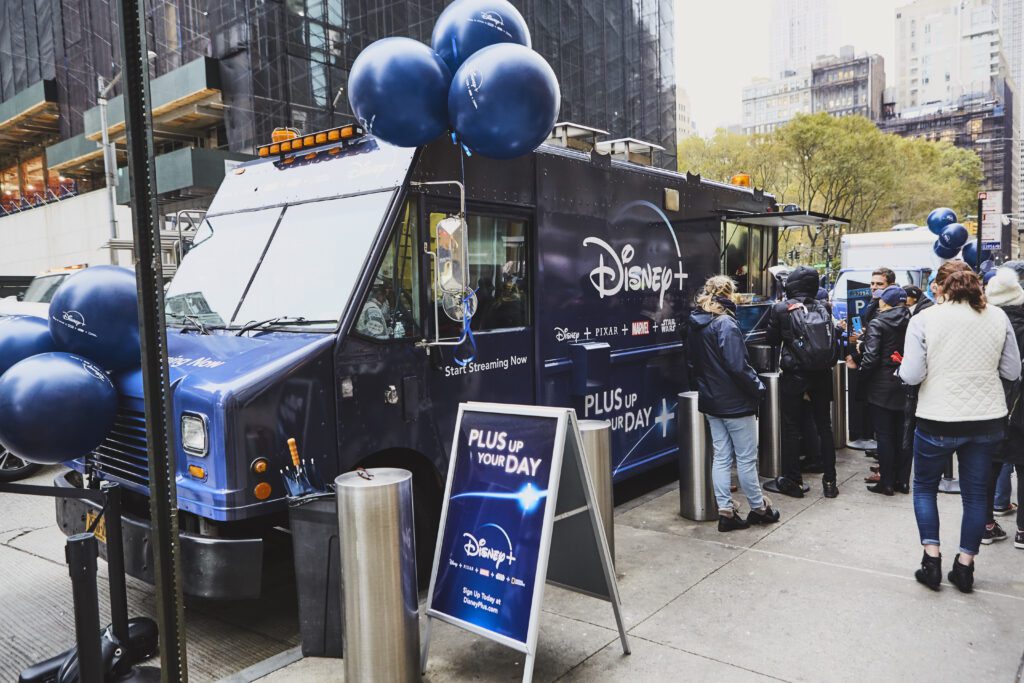
A streaming service launching a new original series built a two-week out-of-home campaign concentrated specifically in the neighborhoods where their core target audience was most dense: Brooklyn, the Lower East Side, and the areas around major university campuses in Manhattan. The campaign ran on street-level poster locations, transit shelter panels, and subway station placements.
The creative was character-driven rather than platform-driven. The campaign did not advertise the streaming service. It advertised the characters and the world of the specific series in a way that made people curious about the story before they encountered the brand attribution. The intrigue-first approach made the campaign feel more like editorial content than advertising, which created stronger attention from an audience that has learned to ignore standard advertising creative.
Timed to run for two weeks before the series premiere date, the campaign was designed to create street-level buzz that would be noticed and discussed by the specific cultural community the series was targeting. Press coverage from culture media that spotted and photographed the campaign provided earned media amplification on top of the paid placement. The combination of paid out-of-home presence and earned editorial coverage created the impression of a campaign significantly larger than its actual footprint.
The lesson: timing and concentration of out-of-home campaigns creates a sense of saturation in a specific market that can feel much larger than the actual number of placements. Two weeks of dense, well-chosen placements in a target neighborhood makes more impact than the same number of placements spread across six weeks and spread across the entire city.
What All Effective Campaign Examples Share
Looking across these examples, several patterns emerge that apply regardless of budget, category, or format.
Every effective campaign starts from a genuine consumer insight or opportunity. The beverage brand’s sampling tour started from the insight that their consumer is active and wants energy during activity. The apparel brand’s poster campaign started from the insight that their target community values cultural authenticity over advertising reach. The coffee shop campaign started from the basic insight that hyperlocal awareness is the one thing a new neighborhood business must build before anything else.
Every effective campaign concentrates resources. None of these campaigns tried to be everywhere. They all made deliberate choices about where to invest and where to hold back. That concentration is what created impact in the places they chose to activate.
Every effective campaign had a measurable objective defined before it launched. The objective shaped the strategy, the channel selection, the creative brief, and the measurement approach. Campaigns that know what they are trying to accomplish before they spend a dollar consistently outperform campaigns that define success retrospectively.
What These Campaign Examples Don’t Show You
Case studies are useful. They’re also incomplete. Every marketing campaign example you read about omits the parts that were hard, the decisions that didn’t work, and the pivots that happened mid-campaign. Here’s what’s usually missing from the success stories.
Every campaign that performed well had at least one element that didn’t work as planned. The beverage brand sampling tour in this guide had two cities where the chosen locations underperformed and had to be changed in week two. The apparel brand poster campaign had one neighborhood where the creative felt wrong for the local aesthetic and needed a different version. The streaming service out-of-home campaign had two planned locations pulled at the last minute due to permit issues. None of these appear in the version of the story that gets told after the campaign succeeds.
The lesson is that campaign execution is adaptive. A plan that can’t adjust to real-world conditions isn’t a plan, it’s a wish. The brands and agencies that consistently produce strong results are the ones that build flexibility into their campaigns, monitor performance in real time, and make changes when something isn’t working instead of waiting until the campaign ends to acknowledge the problem.
Study the examples. Extract the principles. Then build a campaign that’s prepared to be different from the plan when the real world requires it.
What is an integrated marketing campaign?
An integrated marketing campaign uses multiple channels that work together toward the same creative concept and objective. The out-of-home advertising, digital content, social media, PR, and experiential components all communicate the same idea through their respective formats. Integration means the consumer encounters a coherent, mutually reinforcing campaign across every touchpoint rather than disconnected activities in different channels.
Frequently Asked Questions
What is a marketing campaign?
A marketing campaign is a time-bounded, integrated set of marketing activities organized around a specific creative concept and designed to achieve a defined objective. It has a start and end date, a coherent creative idea, a defined target audience, and measurable success criteria.
What are some examples of successful marketing campaigns?
Examples span all budgets and formats: city-based sampling tours for beverage brands, neighborhood-specific poster campaigns for streetwear brands, experiential activations at sporting events for tech products, hybrid influencer and retail sampling programs for food brands, and hyper-local community campaigns for independent businesses. Each was effective because it matched the approach to the obj
What is the difference between a marketing campaign and a marketing initiative?
A marketing initiative is the broader strategic program. A campaign is a time-bounded component of an initiative. Multiple campaigns can exist within a single initiative, each advancing the same overarching objective through different themes, channels, or time periods.
How long does a marketing campaign typically run?
Campaign duration varies by objective and format. Street poster campaigns might run 2-4 weeks. Event-based campaigns run the duration of the event plus any pre and post-event windows. Digital campaigns might run for months with optimization throughout. The right duration is whatever the objective requires to achieve sufficient reach and frequency with the target audience.
What makes a marketing campaign successful?
A singular clear idea, genuine consumer insight, concentrated resource deployment, consistent execution across all elements, and measurement against predefined objectives. The campaigns that fail most commonly do so because they lack one or more of these elements: vague objective, scattered resources, inconsistent messaging, or no measurement framework.
Can a small business run an effective marketing campaign?
Absolutely. Some of the most effective campaigns are hyperlocal, small-budget programs that achieve their objectives precisely because they are focused rather than scattered. A $5,000 neighborhood campaign for a local business that achieves clear local awareness is more successful than a $50,000 broad campaign for the same business that fails to build meaningful awareness anywhere.
Marketing campaign costs range from a few thousand dollars for a focused local campaign to millions for a national integrated program. Most effective regional or urban campaigns for emerging consumer brands run between $25,000 and $150,000 for a meaningful multi-channel effort. The right budget is the one that allows the campaign to achieve the reach and frequency needed to meet the stated objecti