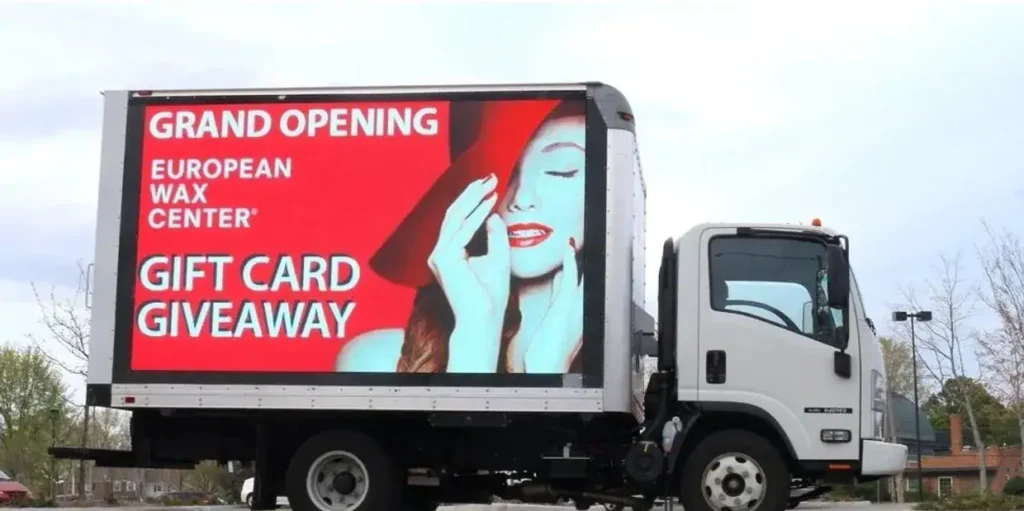
Static outdoor advertising has a fundamental problem: it is static. A billboard in Times Square reaches everyone who passes that corner — including the vast majority of those people who are not your target audience. A bus shelter poster on 5th Avenue runs the same creative for 30 days regardless of who walks past it at 8am versus 6pm. A digital sign on the side of a building cannot follow your audience when they move.
Digital billboard trucks solve all three of these problems simultaneously. They are mobile — routing through the exact corridors where your audience concentrates. They are dynamic — running different creative at different times of day. And they follow the audience — to events, to neighborhoods, to specific dates and locations where campaign-relevant consumer activity is occurring.
American Guerrilla Marketing deploys digital billboard trucks across 50+ U.S. markets with GPS tracking, professional route management, and full campaign documentation. Here is what makes digital billboard trucks a revolutionary format in outdoor advertising, and how we deploy them to maximum effect.
What Digital Billboard Trucks Are and How They Work
A digital billboard truck is a commercial vehicle — typically a box truck or flatbed — equipped with large-format LED display panels that broadcast advertising content while the vehicle routes through predetermined corridors. The displays are fully digital, controlled by onboard content management systems that can be updated remotely, and capable of generating visibility in both daylight and nighttime conditions.
LED Display Technology
Modern digital billboard truck displays use LED (light-emitting diode) technology rather than the older incandescent or fluorescent illuminated displays of previous generations. LED panels offer significantly higher brightness output — measured in NITs (candelas per square meter) — which maintains visibility in direct sunlight conditions that would wash out lower-output displays. Current standard truck displays operate at 5,000-8,000 NITs, which is sufficient for full-brightness visibility in outdoor urban environments at any time of day.
Three-Panel Configuration
The most common digital billboard truck configuration features three panels — left side, right side, and rear — allowing the vehicle to display advertising in three directions simultaneously as it routes through traffic. Each panel can show the same or different content depending on campaign requirements. Some configurations also include top-facing panels for additional visibility in markets with elevated pedestrian vantage points (elevated rail stations, terraces, bridges).
Remote Content Management
Digital content management systems allow creative updates to be pushed to truck displays via wireless connection — eliminating the need for physical access to the vehicle to change campaign materials. This flexibility allows brands to run different creative for different dayparts, update messaging in response to real-time events, and rotate multiple campaign elements within a single daily deployment.
Why Digital Billboard Trucks Outperform Static Outdoor Advertising
Digital billboard trucks create several structural advantages over static outdoor formats that compound as market complexity increases.
Geographic Targeting Precision
Static billboards are locked to a single geographic point. Digital billboard trucks route to wherever your audience is — a specific neighborhood, an event venue, a commercial corridor, a political precinct. This flexibility allows campaign resources to be concentrated where audience quality and density is highest, rather than committed to a fixed location whose audience relevance may vary significantly across a campaign window.
Time-Based Audience Alignment
Consumer behavior is time-dependent. The audience on a given street corner at 8am (commuters) is completely different from the audience at 6pm (returning commuters, leisure seekers) and from the audience at 10pm (nightlife participants). Digital billboard trucks can be scheduled to run different routes at different times — targeting morning commuter traffic with one creative and the same city’s entertainment district with a different creative in the evening.
Event-Driven Audience Capture
Major events — sporting events, concerts, conventions, festivals — concentrate large, engaged audiences at specific locations at specific times. Digital billboard trucks routed to event venue perimeters during these windows capture audience volumes and engagement levels that no static placement in the same market can efficiently match. A truck routing outside Yankee Stadium during a playoff game reaches 40,000+ fans in an activated, high-energy state with a quality of attention no commuter impression can approximate.
Creative Flexibility Without Reprinting Costs
Updating a static billboard campaign requires reprinting and reinstalling physical materials — a process that takes days and costs money. Updating a digital billboard truck campaign takes minutes and costs nothing. This flexibility allows brands to test multiple creative variants in rapid succession, respond to competitive messaging or news events, and align campaign creative with real-time market conditions.
Route Strategy: How We Design Digital Billboard Truck Campaigns
Route design is the single most important determinant of campaign effectiveness for digital billboard trucks. A powerful truck with excellent creative running a low-yield route will consistently underperform a comparable truck on a well-designed route.
Audience-First Route Selection
We begin every route design with the audience, not the geography. Who is the target consumer? Where do they concentrate? At what times are they most present and most receptive? A campaign targeting 25-34 urban professionals should route through restaurant and entertainment districts at evening prime time, not through suburban commercial corridors at noon. Audience-first thinking prevents the default error of optimizing for traffic volume rather than audience quality.
Dwell Time Optimization
Routes that pass through high-traffic corridors with low dwell time (highway overpasses, fast-moving arterials) generate large raw impression counts but low-quality impression depth. Routes that include traffic-management zones, pedestrian areas, event venue approaches, and commercial corridors with natural stopping behavior generate more valuable impression quality. We design routes that balance total impression volume with dwell time quality.
Multi-Zone Route Architecture
For full-day deployments, we design multi-zone routes that rotate the truck through different high-value areas throughout the day — capturing morning commuter traffic in one zone, midday retail traffic in another, and evening entertainment traffic in a third. This architecture maximizes total daily impression quality by ensuring the truck is always in the highest-value available audience concentration at any given time window.
Competitive Separation
For brands with specific competitive objectives — driving trial away from an established competitor, building presence in a competitor’s home market — we design routes that strategically position the truck’s visibility in relation to competitor retail locations, advertising placements, or event sponsorships.
Markets We Serve with Digital Billboard Trucks
Our digital billboard truck network spans 50+ U.S. markets, with established operational capacity in the following major metros and their surrounding areas:
Northeast Corridor
New York City, Boston, Philadelphia, Baltimore, Washington D.C., and the connecting suburban and transit-corridor markets represent our densest operational concentration. Our New York City fleet deploys across all five boroughs with specific expertise in high-value Manhattan routes, Brooklyn creative-district deployments, and Queens and Bronx community-focused routing.
Southeast and Gulf Coast
Miami, Atlanta, Houston, Dallas, San Antonio, Austin, Nashville, Charlotte, and New Orleans represent our Southeast and Gulf Coast operational footprint. Miami’s tourist economy, Houston’s energy and medical sector, and Nashville’s entertainment industry create distinct campaign opportunities across this region.
Midwest and Great Lakes
Chicago, Detroit, Cleveland, Columbus, Indianapolis, Minneapolis, and Milwaukee round out our Midwest operational coverage. Chicago’s dense urban market and the Great Lakes cities’ manufacturing and healthcare-oriented economies create campaign opportunities suited to both consumer and B2B advertising.
West Coast and Mountain West
Los Angeles, San Francisco, Seattle, Portland, Denver, Phoenix, Las Vegas, and Salt Lake City represent our West Coast and Mountain West operational network. Los Angeles’s entertainment economy, Las Vegas’s tourism concentration, and Denver’s outdoor-active professional market each create distinct campaign environments for digital billboard truck advertising.
Campaign Documentation and Reporting
Every digital billboard truck campaign we run includes comprehensive GPS documentation, photography, and post-campaign performance reporting.
GPS Route Tracking
All trucks are GPS-equipped with continuous location logging throughout every deployment. Route documentation confirms coverage of every zone in the campaign plan, with timestamps and location coordinates available for client review.
On-Route Photography
Our team captures photography of the truck at key route locations — showing your creative displayed at premium urban positions, event venues, and high-traffic corridors. These images are delivered as campaign documentation and are available for use in your own marketing and social media channels.
Impression Estimation
Post-campaign impression estimates are calculated using route-specific traffic count data from state DOT sources, foot-traffic analytics, and event attendance records where applicable. These estimates are presented alongside GPS route data and photography as part of the comprehensive campaign report.
Integrating Digital Billboard Trucks with Other Campaign Tactics
Digital billboard trucks generate the strongest campaign returns when coordinated with complementary tactics that create multi-touchpoint brand exposure in the same audience environment.
Brand Ambassador Integration
Deploying brand ambassadors in the same zones where digital billboard trucks are routing creates simultaneous aerial and ground-level brand exposure. The truck builds awareness and visual presence; ambassadors convert that awareness into direct human engagement and product trial.
Wheatpaste and Poster Campaigns
Wheatpaste poster campaigns deployed in the same corridors as digital billboard truck routes create environmental brand saturation. The truck reaches audiences in motion; fixed poster placements maintain brand presence 24 hours a day between deployment windows.
Full Guerrilla Marketing Coordination
Our complete guerrilla marketing services framework integrates digital billboard trucks with street teams, poster campaigns, sidewalk stencils, and experiential activations into unified multi-channel programs that generate significantly stronger results than any single tactic executed in isolation.
Frequently Asked Questions: Digital Billboard Trucks
What is a digital billboard truck?
A digital billboard truck is a commercial vehicle equipped with large-format LED display panels that broadcast brand advertising while routing through predetermined corridors. Displays support static images, animated content, and video, and can be updated remotely via wireless content management systems.
How much do digital billboard trucks cost per day?
Rates typically range from $700 to $2,500 per day depending on market, route, and campaign duration. Premium markets command higher rates. Multi-day and multi-week campaigns receive volume pricing. Contact our team for a custom quote.
How many impressions does a digital billboard truck generate?
High-density urban routes generate 50,000-150,000+ daily impressions. Standard suburban routes typically generate 10,000-50,000 daily impressions. Impression estimates are provided for specific routes as part of campaign planning.
What types of content can run on digital billboard trucks?
Digital billboard trucks support static images (PNG, JPEG, PDF), animated graphics, and video content (MP4). Multiple content pieces can rotate on a timed cycle, and daypart-specific scheduling allows different creative at different times of day.
How far in advance do I need to book a digital billboard truck?
Standard campaigns need 2-3 weeks of lead time. Event-tied campaigns should be booked 4-6 weeks in advance. Rush bookings within 1 week are available in some markets subject to availability.
What markets does American Guerrilla Marketing deploy digital billboard trucks in?
We deploy across 50+ U.S. markets including New York City, Los Angeles, Chicago, Houston, Philadelphia, Dallas, Miami, Las Vegas, Atlanta, Boston, Seattle, Denver, and Washington D.C., among others.
Are digital billboard trucks effective for political advertising?
Yes. Digital billboard trucks allow political campaigns to route through specific precincts, neighborhoods, or demographic concentrations with precision that static billboard placements cannot match, and content can be updated quickly in response to news cycles or opponent messaging.
Frequently Asked Questions
What is digital billboard trucks revolutionizing outdoor advertising?
American Guerrilla Marketing provides digital billboard trucks revolutionizing outdoor advertising services across 50+ U.S. markets. Every campaign is planned, scouted, executed, and GPS-documented by our field teams. We work with regional brands and Fortune 500 companies on campaigns that require real street-level execution and documented proof of performance.
How does AGM approach outdoor advertising?
Our process starts with a market consultation to understand your goals, target audience, and budget. We then scout locations, handle any required permissions or permits, coordinate production and installation with our local crews, and provide a full GPS-tagged photo report after the campaign runs.
What markets does American Guerrilla Marketing cover for outdoor advertising?
We operate in 50+ U.S. markets including New York, Los Angeles, Chicago, Miami, Houston, Atlanta, Seattle, Denver, Boston, and dozens of secondary markets. Contact us to confirm availability and pricing for your specific market.
How much does a outdoor advertising campaign cost?
Campaign pricing depends on market, format, quantity, and duration. We work with budgets ranging from targeted single-market runs to national rollouts across multiple cities. Use our RFP Builder or contact us directly for a custom quote based on your specific campaign requirements.
How do I get started with outdoor advertising through AGM?
The fastest way to get started is to submit your campaign details through our RFP Builder at americanguerrillamarketing.com, or contact us directly at [email protected] or (646) 776-2770. Our team typically responds within one business day with availability and initial pricing.