CPG brand marketing experience is not a credential you earn from a textbook. It comes from spending time in the actual places where consumer packaged goods brands live and die: on the shelf, on the street, in the hands of real people trying your product for the first time. This is what it looks like from the inside, and why it matters for every brand that wants to grow.
We have built CPG marketing experience across dozens of brands and hundreds of campaigns. From beverage brands launching in Brooklyn delis to snack brands pushing into national retail. From personal care brands finding their first community to household product companies defending shelf space against aggressive competitors. Here is what that experience teaches you.
What CPG Brand Marketing Experience Actually Means
When a brand or an agency claims CPG marketing experience, what are they really saying? Experience in this category means knowing how the category operates at every level: consumer psychology, retail distribution dynamics, trade marketing, brand architecture, and campaign execution.
It means knowing that a 0.5% lift in trial rate in your category is significant. It means knowing which retailers your target demographic actually shops at in each of your key markets. It means knowing how to talk to a grocery buyer about your brand’s velocity story in a way that earns more shelf space.
Most importantly, it means understanding how CPG consumers actually make decisions. They do not deliberate. They do not compare specifications. They reach, they grab, and they move on. The entire marketing job is to make sure they reach for your brand when the moment comes.
The Learning Curve in CPG Brand Marketing
CPG marketing has a steep learning curve for anyone coming from other categories. The instincts that work in B2B or luxury or direct response are often counterproductive in CPG. Here is what the learning curve looks like:
Learning to Think in Volume, Not Conversion Rate
Digital marketers trained in direct response often arrive at CPG and try to optimize for click-through rates and immediate conversion. This is the wrong metric. CPG marketing is about building broad, shallow awareness that stacks into durable brand preference over time. The right question is not “how many people clicked?” but “how many people reached for our product this week?”
Learning to Respect the Shelf
The shelf is where CPG brands succeed or fail. Everything else is in service of what happens at the shelf moment. Experienced CPG marketers think backwards from the shelf. What does our buyer see when they approach the category? How does our packaging stand out from the shelf environment? How does our pricing communicate value? What do our promotions accomplish at the shelf?
Learning the Retail Relationship
Retail buyers are not passive distributors. They are active partners or active obstacles, depending on how you approach them. Brands with marketing experience know how to present data that matters to buyers: velocity, distribution points, out-of-stock rates, promotional performance. They do not show buyers their Instagram follower count. They show them why this product moves.
Learning the Consumer Directly
The best CPG marketing experience comes from direct consumer contact. Sampling programs put you face to face with real people trying your product for the first time. You learn which flavors they prefer, which claims they respond to, which packaging elements they notice. This direct feedback is more valuable than any focus group or consumer survey because it captures spontaneous, authentic reactions.
Every hour we spend at a sampling activation teaches us something that three days of strategy sessions cannot. We see what people say when they taste a product for the first time. We see what makes them reach for the packaging and what makes them hand it back.
Experiential marketing is the CPG marketing tactic that produces the strongest consumer connections. When a consumer has a real, physical experience with your brand, the resulting memory is far more durable than the memory created by any digital impression.
The best CPG experiential moments are built around the natural use context of the product. A beverage brand that creates a refreshing moment at a hot outdoor event. A snack brand that shows up at a late-night gaming event with a perfectly timed product. A personal care brand that offers a sample at exactly the moment a gym-goer needs it.
These moments work because they are relevant, timely, and personal. They create an emotional memory that says “this brand gets me and my life.” That memory is what drives the habitual purchase behavior that CPG brands depend on for long-term growth.
Experiential Format
Best CPG Category Fit
Conversion Strength
Farmers market sampling
Food, beverage, personal care
Very High
Gym and fitness studio sampling
Energy, protein, hydration, personal care
High
Festival and event activation
Beverage, snacks, beauty
High
Transit commuter sampling
Beverage, coffee, snacks, personal care
Medium-High
Retail demo programs
Food, beverage, household
High (at point of purchase)
Pop-up brand experience
Premium food, beauty, lifestyle brands
High for brand equity
Street hand-to-hand distribution
Snacks, beverage, personal care sachets
Medium
Street Marketing as CPG Brand Experience
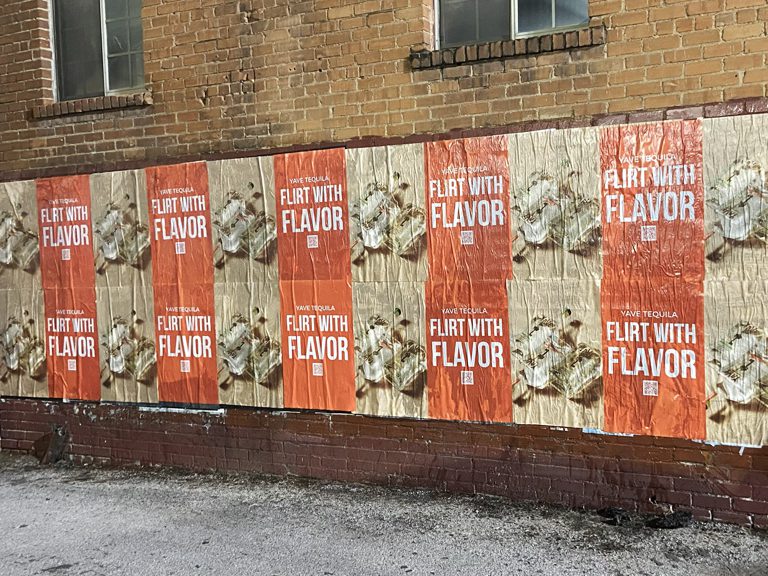
Street marketing creates brand experience at the neighborhood level. It puts your brand into the physical environment your consumer moves through every day and creates a presence that feels earned, not bought.
For CPG brands, street marketing serves a specific function: it builds local brand familiarity in the neighborhoods surrounding key retail distribution points. When a consumer sees your brand in their neighborhood through postering, stencil work, or sampling, they arrive at the store with a level of brand recognition that makes the shelf decision easier.
We run street-level CPG campaigns in cities across America. Our approach is neighborhood-specific. We do not run generic city-wide campaigns. We identify the specific blocks, transit corridors, and community spaces where the target consumer concentration is highest and we saturate those micro-geographies with brand presence.
In New York, that might mean the L train corridor from First Avenue to Lorimer Street for a brand targeting the 25-35 Brooklyn creative professional demographic. In Los Angeles, it might mean the blocks around Erewhon locations in Venice, Silver Lake, and West Hollywood for a premium wellness brand. In Chicago, it might mean the Milwaukee Avenue corridor from Wicker Park to Logan Square for a brand targeting young urban professionals.
The precision of the targeting is what makes street marketing efficient for CPG brands. You are not broadcasting to everyone. You are concentrating presence in the specific micro-geographies where your target consumer density is highest and where the nearest retail distribution is already running.
CPG brand marketing experience taught us that precision beats scale every time for emerging brands. Owning six square blocks in the right neighborhood outperforms a diluted presence across an entire city. Concentration creates the impression of ubiquity within the communities that matter most.
Building CPG Marketing Experience Within Your Organization
For CPG founders and brand managers, here is how to build genuine marketing experience that translates to better campaigns:
Spend time at retail. Visit the stores where your brand is sold every week. Watch how people move through the category. See which products they pick up, which ones they read, and which ones they buy. The shelf is a laboratory for understanding consumer behavior in the CPG category.
Run your own sampling. Even if you have an agency managing your broader sampling program, spend time personally doing hand-to-hand sampling with consumers. The direct feedback is invaluable. You will learn things about how people experience your product that no market research report will ever tell you.
Talk to retail buyers. Buyers see your brand from a completely different angle than you do. They see your velocity data, your promotional performance, your distribution patterns. That perspective is enormously valuable for brand strategy decisions. Build relationships with buyers and listen carefully to what they tell you about what is working.
Track your category competition obsessively. Visit stores in every new market you enter. See how your competitors are positioned on the shelf. Note which competitors are growing their shelf space and which are losing it. Study their packaging, their pricing, and their promotional activity. Competitive awareness in CPG is not optional. It is survival.
Measure retail velocity in every market where you advertise. Connect your marketing activity to your retail velocity data as directly as possible. Over time, you will build an understanding of which marketing tactics move product most efficiently in your category and your specific consumer market.
CPG Brand Experience Across Different Retail Channels
CPG brand marketing experience looks different depending on which retail channels your brand occupies. Natural and specialty retailers like Whole Foods and Sprouts attract different consumers than mass-market chains like Walmart and Target. Convenience store buyers behave differently from grocery buyers. Online grocery and DTC channels have their own dynamics entirely.
Brands that succeed across multiple channels develop channel-specific brand experience strategies. The consumer who shops at Whole Foods is looking for different signals than the one who grabs something from a corner bodega. The premium positioning that wins at Whole Foods can feel pretentious in a mass-market context. The value messaging that moves product at Walmart can undermine premium positioning at specialty retail.
We help CPG brands navigate this complexity by designing channel-appropriate activation strategies. A sampling program at a farmers market speaks to the Whole Foods consumer in their natural habitat. A hand-to-hand distribution program at transit hubs reaches the mass-market convenience buyer. A creator program focused on meal prep content reaches the online grocery buyer who plans purchases in advance.
The channel-specific experience strategy also informs which neighborhoods and geographies to prioritize for street-level marketing. In Brooklyn, we target the neighborhoods with high concentrations of natural grocery shoppers for premium brand activations. In Queens, we target transit corridors that serve working families for mass-market brand campaigns. The same brand may require completely different street-level approaches in different boroughs of the same city.
Understanding these channel dynamics is a core component of genuine CPG marketing experience. Brands that treat all retail channels as equivalent make costly mistakes. Brands that understand the distinct consumer behavior in each channel build more targeted, more efficient, and more successful campaigns.
We have spent over a decade building CPG marketing experience through street-level campaigns, sampling programs, and integrated activation across dozens of categories. Our experience spans the full CPG spectrum: from refrigerated beverages to shelf-stable snacks, from personal care to household products, from premium organic brands to mass-market value brands.
What we have learned from this experience is that the fundamentals of CPG marketing do not change across categories. Find the consumer where they are. Give them a genuine reason to try your product. Make it easy to buy. Reinforce the brand impression repeatedly through multiple channels. Measure retail velocity above all other metrics.
These fundamentals are not theory. They are what we have confirmed through real campaign execution across real markets. We apply them to every campaign we design. Whether the client is launching a new kombucha in Portland, defending shelf space in Chicago grocery chains, or expanding a personal care brand from the Northeast into the Sunbelt, the underlying principles guide the tactical decisions.
The CPG Retail Moment: Why Physical Location Matters More Than Ever
The e-commerce growth of the past decade has convinced many CPG marketers that digital is where the battle is won. In reality, 85 percent of CPG purchases still happen in a physical store. The consumer makes the final buying decision in an aisle, in front of a shelf, where your packaging, your brand’s physical presence in the surrounding neighborhood, and the strength of their previous trial experience all converge in a single moment.
This means that street-level campaigns near retail distribution are not supplemental to CPG marketing. They are foundational. A poster campaign in the blocks surrounding your key grocery accounts builds the brand familiarity that makes the shopper reach for your product rather than a competitor’s when they arrive at the shelf. A sampling program at the farmers market four blocks from the Whole Foods where you are trying to build velocity primes the consumer for the purchase before they enter the store.
The brands that win in CPG understand this spatial logic. They know where their consumers shop. They know the specific stores where retail velocity matters most. And they run marketing campaigns in the physical geography around those stores that build brand familiarity in the consumer’s real-world environment before the purchase decision point. This is not a complex insight. But very few brands execute it with the consistency and the specificity that it requires to actually move velocity numbers.
We map retail accounts to campaign geography on every CPG engagement we take. The specific Whole Foods in Wicker Park, the Target on Ashland Avenue in Chicago, the Erewhon on Fairfax in Los Angeles. We build campaigns around specific stores because specific store velocity is what CPG success looks like at the market level. Generic city-wide awareness campaigns miss the point. Targeted neighborhood-level presence adjacent to distribution points is what actually moves the needle.
Frequently Asked Questions
What makes CPG marketing different from other types of marketing?
CPG marketing operates in a low-deliberation purchase environment where brand memory drives buying behavior more than rational evaluation. The job is to build brand associations that survive the moment between the consumer entering the store and their hand reaching for a product on the shelf. This requires fundamentally different creative and media strategies than B2B, luxury, or direct response.
How important is experiential marketing for CPG brands?
Extremely important, particularly for emerging brands that need to generate trial. No other marketing tactic converts at the rate that direct product trial does. A consumer who has tasted, smelled, or used your product has a much higher purchase probability than one who has only seen it in an ad. We prioritize experiential and sampling tactics in CPG campaign design because the conversion efficiency is significant.
What is the biggest mistake CPG brands make in marketing?
Prioritizing broad digital reach over concentrated physical trial and presence. Digital exposures are easy to buy and easy to report on. But for most CPG brands, the highest-efficiency marketing investment is concentrated street-level presence near key retail distribution points, combined with sampling programs that drive direct product trial. Many brands skip these tactics in favor of digital campaigns.
How does street marketing create brand marketing experience for CPG brands?
Street marketing creates a physical brand presence in the environments where your target consumer lives. When consumers encounter your brand in their neighborhood through postering, stencil work, sampling, or events, they develop a familiarity that is qualitatively different from digital advertising exposure. That physical familiarity creates trust and lowers the barrier to purchase when the consumer encounters the product.
How do I measure the success of a CPG experiential campaign?
Primary metrics for CPG experiential campaigns include units sampled, conversion rate from trial to repeat purchase, social content generated, and retail velocity in the targeted geography during and after the activation period. Secondary metrics include brand awareness lift in targeted neighborhoods and earned media reach from event coverage. We track all of these across our CPG experiential campaigns.
How many markets should a CPG brand launch in at the same time?
For most emerging CPG brands, we recommend launching in one to three markets initially and building genuine depth in those markets before expanding. A brand with strong retail velocity and consumer advocacy in two markets has a much more compelling story for national retail buyers than a brand with weak performance spread across ten markets. Depth before breadth is the principle that has served our CPG campaigns well.
What is the relationship between brand marketing and trade marketing in CPG?
Brand marketing builds consumer demand. Trade marketing manages the retailer relationship and ensures that consumer demand can be captured at the shelf. Both are essential. A strong brand without good trade marketing loses shelf space to well-marketed competitors. Good trade marketing without a strong brand is just a pricing and promotion game that erodes margin over time. The most successful CPG campaigns coordinate both sides so consumer demand and retail execution reinforce each other.