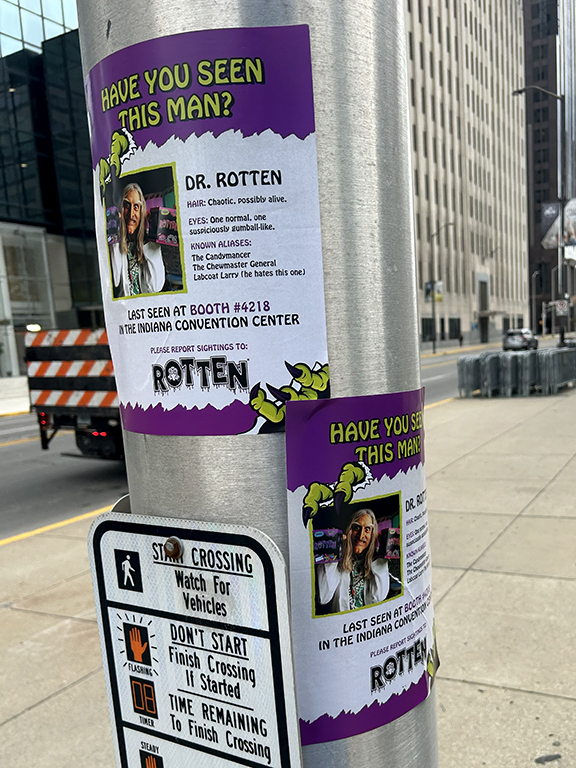
There is a fundamental misunderstanding in how most brands approach conference marketing. They think of conference marketing as what happens inside the convention center: the booth, the signage, the sponsored sessions, the co-located events. That is not wrong — those things are part of conference marketing. But they are the part that every other exhibitor is also spending on, in the same building, competing for the same attendee attention with the same tools. The result is a highly competitive, high-cost environment where the marginal value of any individual marketing investment is compressed by the density of everything else competing alongside it.
What most brands are not doing is marketing outside the convention walls. The approach corridors where the full attendee population passes twice a day. The hotel zones where the same population wakes up, has breakfast, and returns each evening. The transit stops and lunch destinations and outdoor break areas that constitute the actual physical environment of the conference attendee’s daily experience in the convention city. That geography is essentially uncontested. It is the conference marketing territory that a real conference marketing agency occupies.
At American Guerrilla Marketing, we build conference marketing programs that occupy that outside-the-hall territory. Our team designs the tactic mix, manages the logistics, deploys the crews, and delivers the results across every major US convention market. This guide explains what a conference marketing agency actually does when it is operating in the space beyond the convention walls.
The Outside-the-Hall Conference Marketing Landscape
The geographic area surrounding any major conference venue becomes a temporary, high-density marketing environment during the show days. The specific characteristics of that environment — how many attendees are present, where they move, when they are most concentrated, and how the neighborhood around the venue structures their movement — determine what conference marketing tactics are most valuable in that specific context.
A conference marketing agency with real outside-the-hall experience has a documented understanding of the specific geography, transit patterns, and attendee movement behaviors at each major convention venue. That knowledge is what allows precise tactic selection and positioning decisions rather than generic deployments that might perform adequately in any urban environment but are not calibrated to the specific conference context.
The Five Location Types That Drive Conference Marketing Performance
Across the diversity of major conference venues, five location types consistently produce the highest-performing outside-the-hall marketing results. Convention center entrance plazas and the approach corridors leading to them capture the full attendee population in the morning transit window. Hotel lobby zones and hotel entrance approaches reach the same population in a more relaxed, receptive state during morning and evening windows. Shuttle stops and transit station exits create captive, dwell-time-rich audiences during transit windows throughout the day. Lunch destination zones in the restaurant cluster surrounding the venue capture the midday break audience at their most relaxed and social. Evening networking zones in the bar and restaurant areas adjacent to the conference hotel district reach the post-show audience during the most social and high-quality interaction window of the entire conference day.
Brand Ambassador Programs: The Core of Conference Marketing
Brand ambassadors are the human face of outside-the-hall conference marketing. They are the mechanism through which the brand makes direct human contact with the conference attendee population in the uncontested space outside the exhibit floor. Everything else in the outside-the-hall tactic mix — mobile advertising, sidewalk elements, projection — creates impressions. Ambassadors create interactions.
A well-deployed brand ambassador program at a major conference reaches hundreds of unique attendees per day per position, in environments where no other brand has a human presence and where the interaction quality is significantly higher than the show floor can produce. The ambassador team is the difference between a brand that appears in the convention district and a brand that engages in it.
Staffing Conference Ambassador Programs for Professional Audiences
The difference between a consumer brand ambassador and a conference brand ambassador is depth. Consumer sampling programs can be staffed with energetic, personable individuals whose primary skill is high-volume, brief engagement. Conference programs require ambassadors who can credibly engage with professional audiences, speak to the brand’s professional positioning, and handle questions that require genuine product and industry knowledge rather than a scripted FAQ answer.
Our conference ambassador recruiting specifically targets individuals with professional backgrounds relevant to the conference industry when available, and we brief all ambassadors on the industry context, professional vocabulary, and specific concerns of the conference audience before each deployment. That preparation investment produces interaction quality that generic field staff cannot approach.
Product Sampling at Conferences: Logistics and Execution
For brands with physical products, product sampling outside the conference venue is one of the highest-ROI tactics available because it creates a direct, sensory product experience in an environment where no competing products are simultaneously present for comparison. The outside-the-hall sampling moment is the purest single-brand product experience available in the conference context.
Conference sampling logistics require end-to-end management: product receipt at the local market staging point, storage including temperature control for perishable products, branded packaging and collateral preparation, daily inventory management, crew distribution tracking, and post-event reporting. We manage all of those elements as a unified service, allowing brand teams to focus on strategic direction while our operations team handles field execution.
Mobile Advertising at Conferences: LED Trucks and Routes
LED billboard trucks on conference approach routes generate the broadest reach of any single field marketing tactic in the conference district. A well-routed truck running the hotel corridor and the approach routes during morning and evening show windows reaches the full attendee population multiple times per day, including attendees in vehicles who are not accessible to foot-based ambassador teams.
The route design for conference LED truck deployments is the critical performance variable. We design routes based on actual conference attendee transit patterns, not standard urban route templates, using venue-specific knowledge of how the attendee population moves between hotels and the convention center throughout the day. That route intelligence is what separates high-impression conference mobile advertising from trucks running through areas where the convention audience is not concentrated.
Sidewalk and Street-Level Conference Marketing
Sidewalk stencils on the approach corridors to the conference venue create a persistent brand presence that works continuously across all show hours. Every attendee who walks the approach corridor on foot passes through the branded sidewalk environment multiple times per day over the full conference duration. The cost-per-impression for sidewalk elements over a multi-day conference is among the lowest of any conference marketing format.
Street-level conference marketing that incorporates sidewalk stencils, combined with ambassador programs at the same approach corridor, creates a dual-channel brand experience: the visual element registers as a background impression and the ambassador creates a direct interaction. The combination produces higher recall than either element alone, because the attendee has encountered the brand in two different sensory modes in the same location.
Measuring Conference Marketing Performance
Conference marketing program performance is measurable across multiple dimensions when the program is designed with measurement in mind. Direct metrics include units distributed by location and shift, QR code scan rates by collateral piece, GPS-documented crew hours and locations, and booth attribution data when the ambassador program is connected to a booth visit tracking mechanic.
Indirect metrics include post-conference brand recall surveys among the attendee population, comparison of lead quality between attendees who received a street-level interaction and those who came to the booth organically, and digital campaign performance segmentation between convention attendees and non-attendees. We deliver a post-event report covering all direct metrics within 48 hours of program completion and advise on indirect metric measurement approaches for brands with the infrastructure to capture them.
The Conference Marketing Program Development Process
Every conference marketing program we build starts with a brief that establishes the brand’s specific objectives, the conference’s audience profile, and the venue geography. From that brief, our team develops a program structure that recommends the specific tactic mix, location strategy, timing, team size, and budget allocation most likely to achieve those objectives within the available investment level. That program structure is presented to the brand team for review, refined based on feedback, and then locked into an operational plan that guides all field deployments.
Location Survey and Deployment Planning
For programs at venues where we have not previously operated, or for brands with specific geographic requirements, our operations team conducts a location survey prior to the show. The survey walks the convention district on foot, maps the pedestrian flow patterns and attendee transit routes, identifies the highest-traffic non-venue locations for each tactic type, documents any permit requirements or access restrictions specific to that venue and city, and produces a location map that serves as the field operations guide for the deployment team.
For venues where we have established operational history, the survey is replaced by a review of the previous program’s performance data and an update to account for any changes in the venue geography, the show’s configuration, or the tactic mix. This accumulated operational knowledge is one of the most significant advantages of working with an experienced conference marketing agency over sourcing individual vendors for each show — the knowledge does not have to be rebuilt from scratch each time.
Content Production and Ambassador Briefing
Before any field team deploys, two preparation elements need to be complete: content for all advertising formats needs to be produced and approved, and the ambassador team needs to be briefed. Content production covers LED billboard truck creative, sidewalk stencil artwork, projection content, and any collateral or sampling materials. Ambassador briefing covers the brand identity, product knowledge, audience context, location-specific interaction approaches, and performance expectations.
Both preparation elements are managed by our team with specific timelines: content delivery is requested 10 days before the show; ambassador briefings happen 24 to 48 hours before the first deployment day, close enough to the show that the briefing content is fresh but far enough in advance that any questions or issues can be resolved before the field team is in place.
What Happens During the Show: Real-Time Program Management
During the show days, our program management function runs continuously. A dedicated program manager coordinates all field elements: ambassador team check-ins, LED truck route confirmations, product inventory management, real-time performance tracking against interaction count targets, and adjustment decisions when field conditions differ from the planned deployment. That real-time management function is the difference between a conference marketing program that adapts to what is actually happening at the show and one that runs a static plan regardless of how the attendee flow is behaving on any given day.
At the end of each deployment day, the program manager compiles a daily summary report covering all quantitative performance metrics and any qualitative observations from the field team. That daily report allows the brand team to track program performance in real time and provides the raw data for the comprehensive post-event report delivered at program completion.
Building a Conference Marketing Agency Relationship
Brands that run recurring conference programs — following their industry’s conference calendar across six to twelve shows per year — benefit from a sustained agency relationship rather than event-by-event vendor coordination. Our team builds institutional knowledge about your brand, your messaging priorities, and your specific conference objectives across each show, allowing subsequent deployments to benefit from everything learned at previous shows without starting from a blank briefing document each time.
That accumulated knowledge is particularly valuable for brands that attend the same shows annually. After the first year’s program at CES or NRF or Dreamforce, we know which positions performed, which time windows were strongest, and what adjustments to make the following year. Year two and three programs for repeat shows consistently outperform year one programs because the program design benefits from the previous years’ on-the-ground learning.
Our guerrilla marketing team is available to discuss your conference calendar and build a program structure across your full show schedule. Whether you are marketing at one major national show or following a dozen shows throughout the year, we can build the outside-the-hall conference marketing program that fills the gap between exhibit floor presence and the broader conference district audience.
Frequently Asked Questions
What does a conference marketing agency do that a booth builder does not?
A conference marketing agency builds brand presence outside the exhibit hall, in approach corridors, hotel zones, transit areas, and outdoor spaces where conference attendees move throughout the day. A booth builder creates your inside-the-hall presence. A conference marketing agency creates your outside-the-hall presence. Most successful conference marketing programs use both.
What specific services does a conference marketing agency provide?
Services include brand ambassador program design and staffing, product sampling logistics, mobile billboard truck deployment on conference approach routes, sidewalk stencil installation near the venue, projection advertising on conference center exterior walls, airport arrival marketing, and hotel zone programs targeting the conference attendee population outside the venue.
How do you choose the right conference marketing tactics for a specific show?
Tactic selection is based on the venue geography, the attendee profile, the conference duration, and the brand’s objectives — awareness vs. lead generation vs. booth traffic vs. sampling reach. We assess each variable and build a program structure that aligns the tactic mix with the specific conference context and the brand’s measurable objectives.
What is the minimum budget for a conference marketing program?
The minimum viable outside-the-hall conference marketing program is a 2-person ambassador team deployed for a half-day at a single location, running $2,500 to $4,500 depending on market and logistics. Comprehensive multi-tactic programs for major national shows range from $20,000 to $80,000 or more.
How do you measure the ROI of outside-the-hall conference marketing?
ROI measurement uses a combination of direct metrics (units distributed, QR code scans, booth attribution) and indirect metrics (brand recall, lead quality comparison, post-show digital engagement rates). We provide a full post-event report covering all measurable program outputs within 48 hours of program completion.
Does American Guerrilla Marketing work with brands across all industries at conferences?
Yes. We have executed conference marketing programs for brands in technology, healthcare, financial services, food and beverage, consumer packaged goods, automotive, retail, and other sectors. The outside-the-hall approach adapts to any industry with the tactic mix and ambassador briefing calibrated to each industry’s conference environment. Call us at (646) 776-2770 to discuss your program.