New York City’s MTA bus system is the largest in North America. More than 300 routes, roughly 5,800 buses, and more than 2 million daily rider trips make the MTA bus network one of the most powerful advertising vehicles in any market in the country. For brands that want to reach New York consumers across the boroughs — not just the subway-heavy corridors of Manhattan — bus advertising is the format that delivers the coverage.
At American Guerrilla Marketing, New York City is our home market. Our team operates from Industry City in Brooklyn, and we have executed street-level campaigns across all five boroughs. We work with brands on integrated campaigns that combine MTA bus advertising with street-level tactics — poster campaigns, sidewalk stencils, street teams, and LED trucks — to create layered, multi-touchpoint coverage that reaches New York consumers wherever they are in the city. This guide covers the MTA bus landscape, the routes that matter, the format options available, and how street-level campaigns amplify bus advertising investment across the five boroughs.
Whether you are planning a transit buy, a street-level neighborhood campaign, or an integrated New York strategy, this guide gives you the market context and the operational framework to build it effectively.
The MTA Bus System: Scale, Routes, and Strategic Relevance
The MTA operates bus service across all five boroughs through New York City Transit, the Staten Island Railway connection, and Select Bus Service routes. The system’s coverage is particularly relevant for campaigns targeting the outer boroughs — Brooklyn, Queens, the Bronx, and Staten Island — where subway coverage is less dense and buses are the primary mass transit mode for large segments of the population.
Manhattan Bus Routes
In Manhattan, the key bus routes for advertising are the north-south avenues — the M15 and M15-SBS on First and Second Avenues, which carry some of the highest ridership on the Manhattan bus network — and the major crosstown routes: the M34 (34th Street), the M42 (42nd Street), the M86 (86th Street), and the M116 (116th Street). Manhattan bus advertising delivers high exposure in the dense commercial corridors of Midtown and the Upper East Side and Upper West Side residential zones.
Brooklyn Bus Routes
Brooklyn’s bus network is extensive and serves a diverse geography. High-ridership routes include the B41 (Flatbush Avenue), B44 (Nostrand Avenue), B46 (Utica Avenue), B38 (Atlantic Avenue and Fulton Street), and the B54 (Flushing Avenue). These routes cover central Brooklyn’s densest commercial corridors and residential zones, and they are particularly valuable for campaigns targeting Brooklyn’s broad consumer market outside the relatively well-subway-served northern neighborhoods.
Queens Bus Routes
Queens is the most route-diverse borough in the MTA network. Key routes include the Q58 (Myrtle/Fresh Pond), Q17 (Hillside Avenue), Q44 (Jamaica Avenue), and the Q70 Select Bus Service from the subway to LaGuardia Airport. Queens bus advertising reaches one of the most diverse consumer markets in the country, with significant concentrations of specific immigrant communities that are well-served by specific routes.
The Bronx Bus Routes
The Bx12 Select Bus Service along Fordham Road is one of the highest-ridership bus routes in the entire MTA system. Fordham Road is the Bronx’s primary commercial corridor, and the Bx12 serves the full length of that corridor continuously. Other high-ridership Bronx routes include the Bx1 and Bx2 on the Grand Concourse — the main north-south arterial in the Bronx — and the Bx41 on Webster Avenue. The Bronx is an underused advertising market relative to its ridership density, which creates cost efficiency opportunities for brands willing to invest here.
MTA Bus Advertising Formats
MTA bus advertising is managed through an advertising concessionaire. Our team works with clients on format selection based on campaign objectives, budget, and market targets.
Bus King Signs
Bus king signs are the standard exterior side panel placement on MTA buses. They are the most common bus advertising format and deliver high daily impression volume along the route the bus travels. Kings are visible to pedestrians, cyclists, and motorists at street level as the bus moves through the city and to passengers at stops as the bus pulls in. NYC king rates typically run $1,200 to $2,500 per bus per 4-week period, placing New York among the most expensive bus advertising markets in the country.
Full Bus Wraps
Full bus wraps cover the entire exterior of an MTA bus with brand graphics. They deliver the highest attention and recall of any bus advertising format, create a strong street presence on high-traffic routes, and generate organic photography and social media sharing when the creative is distinctive. NYC full bus wrap rates typically run $5,000 to $12,000 per bus per month. A single well-designed full wrap on a major route like the M15-SBS or the Bx12 can generate millions of monthly impressions.
Interior Bus Cards
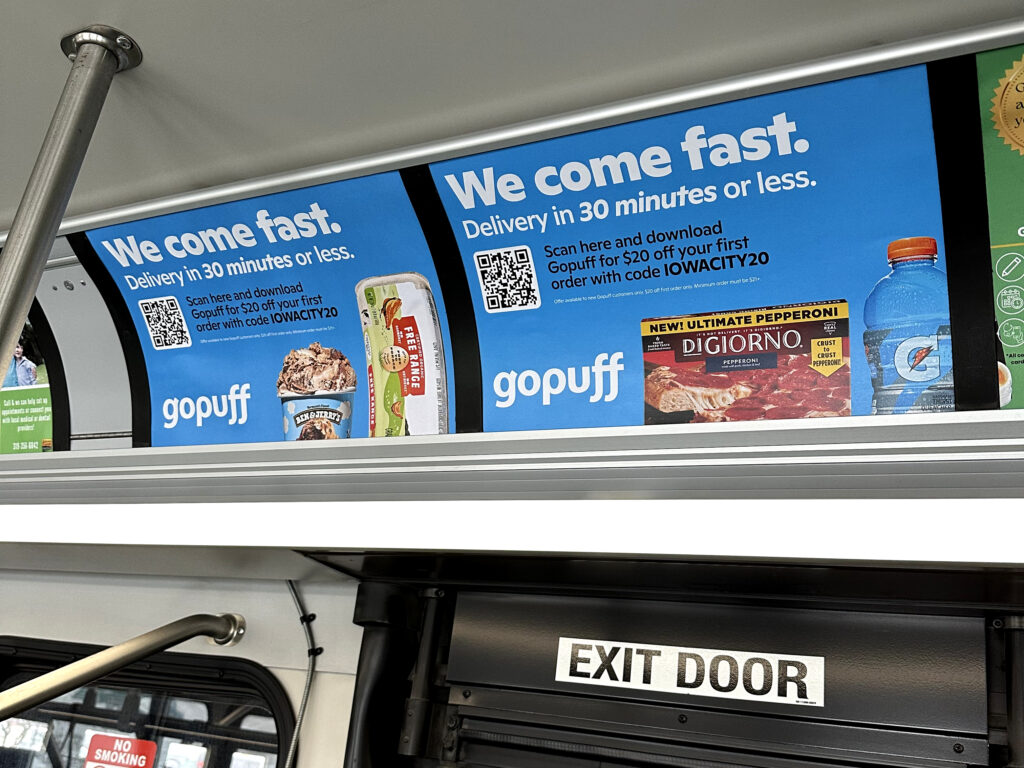
Interior bus cards are displayed above the windows or near the front of the bus and reach passengers during their ride when attention is more focused than in exterior environments. They work particularly well for campaigns with a more complex message — an app, a service, a product with a specific benefit — that benefits from extended consumer attention. Interior packages typically run $2,000 to $5,000 for a multi-bus, multi-route deployment.
Street-Level Campaigns That Amplify Bus Advertising in NYC
Our core expertise is street-level campaign execution, and we design street programs that complement bus advertising investments by adding neighborhood-specific density and engagement that bus vehicle placements alone cannot deliver.
Street Poster Campaigns in Target Neighborhoods
Street poster campaigns deployed in the commercial blocks of target neighborhoods create persistent brand presence where the target consumer shops, eats, and spends time between commutes. Our poster campaign services cover all five boroughs of New York City with full permitting and installation management.
Sidewalk Stencils Near High-Ridership Bus Stops
Sidewalk stencils at major bus stops on target routes create a brand moment at the specific location where transit audiences pause and wait. Our sidewalk stencil team covers all five boroughs and deploys according to MTA stop location data to ensure maximum ridership alignment.
LED Billboard Trucks on Major Corridors
LED trucks operating on the same major corridors served by target bus routes — Flatbush Avenue, Fordham Road, 34th Street, Atlantic Avenue — create complementary visual presence from a different vehicle and at different times of day than static bus placements. Our LED billboard truck fleet is based in New York and covers all five boroughs.
Street Team Activations at Major Transit Hubs
Major MTA bus terminals — the Port Authority Bus Terminal, the Jamaica Bus Terminal, Fordham Plaza, the 42nd Street crosstown hub — concentrate transit audiences at points of transfer and provide high-value environments for street team activations. Our brand ambassador agency deploys trained NYC field teams for transit hub activations. Our street team marketing program provides full staffing and field management for activations across the five boroughs.
Building an Integrated NYC Bus and Street Campaign
The most effective New York campaigns treat bus advertising and street-level tactics as parts of the same strategy. Our team builds integrated campaign plans that align route selection, neighborhood deployment, timing, and reporting across all formats in a unified campaign structure. Our guerrilla marketing services team handles the full execution stack for integrated NYC campaigns, from MTA advertising coordination through street-level installation and field management. Contact our team through the contact page or request our capabilities deck for a NYC-specific campaign plan.
Frequently Asked Questions
What are the highest-volume MTA bus routes for advertising in New York City?
The highest-ridership MTA bus routes in New York City include the Bx12 Select Bus Service along Fordham Road in the Bronx, the M15 and M15-SBS on First and Second Avenues in Manhattan, the B46 on Utica Avenue in Brooklyn, the Q58 on Myrtle and Fresh Pond in Queens, and the M104 on Broadway. Manhattan crosstown routes — the M34, M42, and M86 — are particularly valuable for campaigns targeting Manhattan office and retail corridors.
How much does bus advertising in NYC cost?
MTA bus advertising costs vary by format and contract type. Bus kings (exterior side panels) typically run $1,200 to $2,500 per bus per 4-week period. Full bus wraps on MTA buses range from $5,000 to $12,000 per bus per month. Interior bus card packages start at $2,000 to $5,000 for a fleet of cards across multiple buses and routes. New York is one of the most expensive bus advertising markets in the country.
Can bus advertising be targeted to specific NYC boroughs or neighborhoods?
Yes. MTA bus routes are geographically specific and can be selected to target individual boroughs, neighborhoods, or commercial corridors. A campaign targeting Brooklyn can concentrate on routes like the B38, B41, or B44. A Manhattan campaign can focus on high-ridership avenues like the M15 or crosstown routes like the M86. Borough-specific and neighborhood-specific targeting is standard for MTA bus advertising campaigns.
What is the best way to combine bus advertising with street-level marketing in NYC?
The most effective approach aligns bus route selection with street-level neighborhood deployments so that the same target audience sees the campaign across both formats. Street poster campaigns in the neighborhoods served by target bus routes, sidewalk stencils near high-ridership bus stops, and street team activations at major bus terminals all complement bus advertising and increase overall campaign frequency.
Does American Guerrilla Marketing plan bus advertising campaigns in New York?
Yes. New York City is our home market. Our team is headquartered in Industry City, Brooklyn, NY, and we have deep operational experience across all five boroughs. We plan integrated campaigns that combine MTA bus advertising with street-level tactics, and we manage street-level campaign components independently for brands that handle their own transit buys.
How long does it take to launch a bus advertising campaign in NYC?
MTA bus advertising campaigns typically require 4 to 6 weeks from contract execution to live campaign, including creative approval, production, and installation scheduling. Rush timelines are possible in some cases but typically involve additional costs and limited format availability. Street-level campaign components can often be deployed within 2 to 3 weeks.