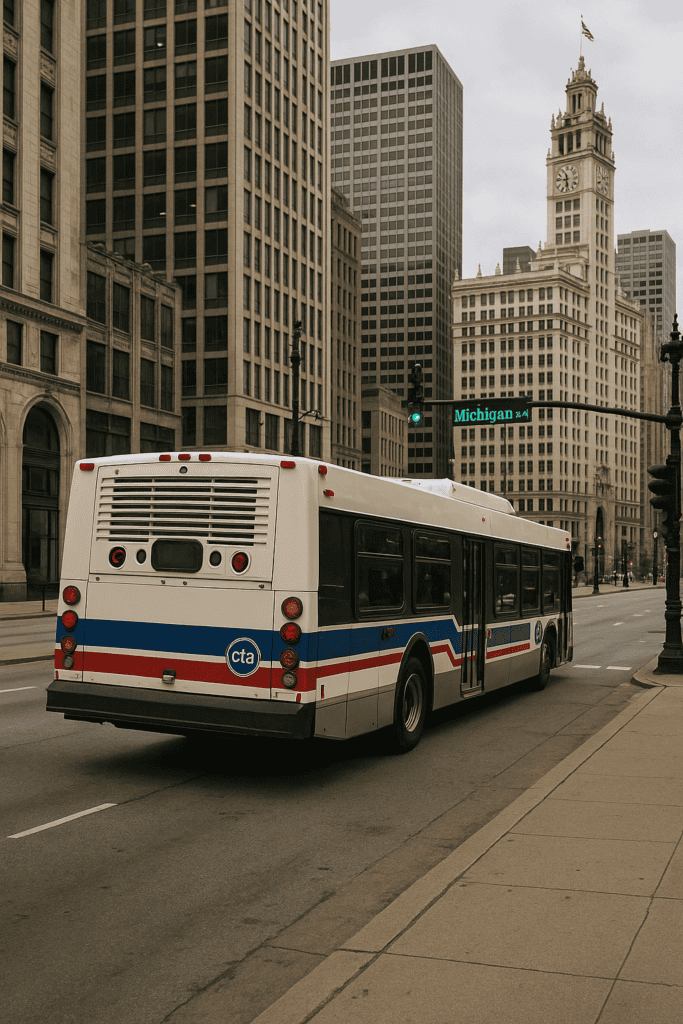
Chicago’s bus system is one of the most extensive in North America, and the CTA network covers a dense urban geography that spans everything from the Loop’s high-rise commercial core to the residential corridors of Logan Square, Hyde Park, and Bronzeville. For brands targeting Chicago consumers, bus advertising and transit-adjacent street campaigns offer a cost-effective, high-frequency format that reaches the city’s most active transit users across a broad geographic footprint.
At American Guerrilla Marketing, we plan and execute transit-adjacent campaigns and street-level strategies that complement bus advertising across Chicago’s neighborhoods and commercial corridors. Our team is based in Industry City, Brooklyn, NY, and we cover Chicago as one of our core markets. This guide covers the CTA bus routes that matter for advertising, the neighborhoods they serve, the format options available, and how street-level tactics integrate with a broader Chicago bus and transit strategy.
Whether you are planning a bus advertising buy, a street-level campaign in specific Chicago neighborhoods, or an integrated transit and outdoor strategy, this guide provides the market intelligence and operational context to plan it effectively.
The CTA Bus System: Scale and Coverage
The CTA operates over 130 bus routes covering the city of Chicago and some suburban areas. Combined, CTA buses carry approximately 600,000 riders per weekday. That ridership is distributed unevenly across routes, with a handful of high-volume routes carrying a disproportionate share of daily trips. Understanding which routes carry the highest ridership in your target markets is the starting point for any Chicago bus advertising strategy.
The Highest-Volume CTA Bus Routes
A small number of CTA bus routes dominate ridership. The top routes include the #66 Chicago Avenue, the #36 Broadway, the #22 Clark, the #77 Belmont, the #8 Halsted, and the #151 Sheridan. These routes run through some of the densest commercial and residential corridors in the city and collectively reach a broad cross-section of Chicago’s adult consumer population. For campaigns targeting broad Chicago market coverage, concentrating placements on these routes provides maximum ridership reach.
Neighborhood-Specific Route Selection
For campaigns targeting specific Chicago neighborhoods, route selection becomes more nuanced. The Near North Side, Wicker Park, and Ukrainian Village are well-served by the #66 Chicago Avenue and the #70 Division. Logan Square and Humboldt Park are primarily served by the #56 Milwaukee and #82 Kimball-Homan. Hyde Park and Bronzeville are served by the #6 Jackson Park Express and the #4 Cottage Grove. Campaign planners who understand this geography can target specific Chicago neighborhoods by selecting the routes that most directly serve them.
Bus Advertising Formats in Chicago
CTA bus advertising is managed through the Chicago Transit Authority’s advertising program. Our team works with clients on format selection based on campaign objectives and budget.
Bus King Signs (Exterior Side Panels)
Bus king signs are the most common bus advertising format — large rectangular panels on the exterior sides of CTA buses. They are visible to pedestrians, cyclists, and motorists as the bus moves through the city, and to pedestrians at bus stops as the bus pulls in. Kings offer high daily impression delivery along the route the bus travels. Typical 4-week packages run $800 to $1,500 per bus for a king placement, and fleets of 5 to 20 buses are common for neighborhood-targeted campaigns.
Full Bus Wraps
Full bus wraps cover the entire exterior of a CTA bus with brand graphics, creating a moving visual that is impossible to miss. They are the premium bus advertising format, delivering significantly higher attention and recall than panel-only placements. Full wraps on CTA buses typically run $3,000 to $8,000 per bus per month, depending on bus type and contract terms. A single well-designed full wrap on a high-ridership route can deliver millions of impressions over a 4-week period.
Interior Bus Cards and Headliners
Interior bus advertising — cards above the windows, headliners near the front of the bus — reaches passengers during their ride, when dwell time is longer and there are fewer competing visual stimuli than in the exterior environment. Interior placements are particularly effective for campaigns with a more complex message that benefits from extended consumer attention. Interior card rates typically run $150 to $400 per card per 4-week period.
Bus Stop Shelter Advertising
Bus stop shelters — the glass-and-steel structures at major CTA stops throughout the city — offer a distinct format that is adjacent to bus advertising but reaches a broader audience including pedestrians, cyclists, and motorists who pass by without boarding. Shelter placements in the Loop and major commercial corridors are particularly high-value given the foot traffic density in those environments. Our out-of-home advertising team covers shelter placements across Chicago as part of integrated campaign strategies.
Street-Level Campaigns That Complement Bus Advertising
Bus advertising delivers reach across the corridors the routes travel. Street-level campaigns complement that reach with geographically concentrated, high-density placements in the specific neighborhoods and commercial zones that matter most to the campaign.
Sidewalk Stencils Near High-Ridership Bus Stops
Sidewalk stencils placed at or near the highest-ridership bus stops on target routes create a ground-level brand moment at exactly the location where transit audiences are waiting and most receptive. Our sidewalk stencil campaigns in Chicago cover all major commercial corridors and high-traffic transit locations.
Street Poster Campaigns in Target Neighborhoods
Street poster campaigns deployed in the commercial blocks of target neighborhoods create persistent brand presence in the environments where the target consumer shops, dines, and socializes. Combined with bus advertising on the routes that serve those neighborhoods, poster campaigns create multiple sequential exposures that reinforce brand recognition across the consumer’s daily movement pattern. Our poster campaign services cover all Chicago neighborhoods.
LED Billboard Trucks on High-Traffic Commercial Streets
LED trucks operating on major commercial corridors — Michigan Avenue, Milwaukee Avenue, Division Street, Halsted — during peak commercial hours create high-visibility exposure alongside bus routes in the same corridors. Our LED billboard truck service covers Chicago with GPS-tracked routing and full documentation.
Street Team Activations at Transit Hubs
Street team activations at major CTA transit hubs — O’Hare, Midway, the State/Lake El stop, the Fullerton hub — reach the highest-concentration transit audience in the market in a location where they have a moment to stop and engage. Our brand ambassador agency provides Chicago field teams for transit hub and neighborhood activations. Our street team marketing program handles full staffing and field management.
Planning an Integrated Chicago Transit and Street Campaign
The most effective Chicago campaigns treat bus advertising and street-level tactics as components of the same campaign rather than separate buys. Here is how our team structures integrated Chicago campaigns.
Route and Neighborhood Alignment
We align bus route selection with street-level neighborhood deployment so that the same target audience sees the campaign across both formats. If the target consumer is concentrated in Wicker Park and Logan Square, we book bus advertising on the routes that serve those neighborhoods and deploy street-level campaigns in the same geographic zone. The alignment creates frequency that neither format achieves alone.
Timing and Campaign Duration
Bus advertising contracts typically run in 4-week cycles. Street-level campaigns can be shorter or more event-specific. For integrated campaigns, we recommend aligning at least 2 weeks of street-level activity with the bus advertising window to maximize the combined frequency effect. For product launch campaigns, leading the street-level campaign by 1 to 2 weeks before bus advertising begins can warm up the market before the bus reach component activates.
Frequently Asked Questions
What are the best CTA bus routes for advertising in Chicago?
The highest-volume CTA bus routes for advertising are the #66 Chicago Avenue, #36 Broadway, #22 Clark, #151 Sheridan, #77 Belmont, and #8 Halsted. The #66 and #36 carry some of the highest daily ridership on the system and cover dense commercial corridors. For campaigns targeting specific neighborhoods, route selection should be based on the demographic concentration along each route rather than ridership volume alone.
How much does bus advertising in Chicago cost?
Bus advertising costs in Chicago vary by format. Bus kings (side panels) typically run $800 to $1,500 per bus per 4-week period. Full bus wraps run $3,000 to $8,000 per bus per month. Interior card advertising runs $150 to $400 per card per 4-week period. Street-level campaigns adjacent to major CTA bus stops can complement transit placements at a range of additional cost points.
What is the difference between bus advertising and transit advertising in Chicago?
Bus advertising refers specifically to placements on CTA bus vehicles — exterior wraps, king signs, tail signs — or inside bus interiors. Transit advertising more broadly includes L train advertising, CTA station placements, and Metra commuter rail placements. A comprehensive Chicago transit campaign typically combines multiple transit advertising formats.
Can I target specific Chicago neighborhoods with bus advertising?
Yes, to a degree. CTA bus routes follow specific corridors that correspond to neighborhoods. Route selection allows for neighborhood-level targeting: the #66 concentrates on Near North and Wicker Park, the #8 serves South Loop and Bronzeville, the #36 covers Lincoln Park and Lakeview. For more precise neighborhood targeting, street-level campaigns adjacent to bus stops are more geographically flexible than bus vehicle placements.
Does American Guerrilla Marketing handle bus advertising in Chicago?
Yes. We plan and execute transit-adjacent and street-level campaigns in Chicago that complement bus advertising. We also work with clients on integrated transit and street-level strategies that maximize coverage across the full Chicago market. Our team is headquartered in Industry City, Brooklyn, NY, and covers Chicago as one of our core markets.
What street-level tactics work best alongside bus advertising in Chicago?
Sidewalk stencils near high-ridership bus stops, street poster campaigns in the dense commercial corridors that CTA routes serve, street team activations at key transit hubs, and LED billboard trucks on major commercial streets all complement bus advertising in Chicago. The combination creates layered coverage that reaches the target audience across multiple physical touchpoints.