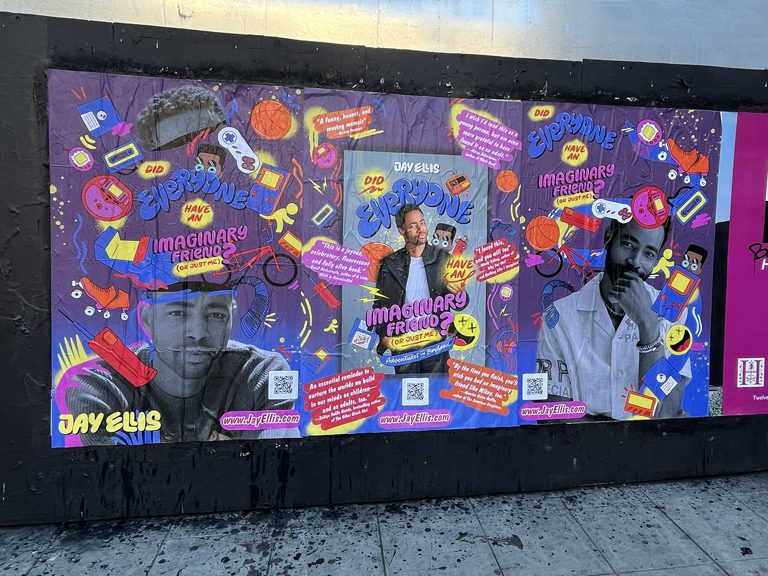
A book launch is one of the most time-sensitive marketing challenges in publishing. The window for driving pre-orders, launch-week sales, and bestseller list momentum is compressed. The audiences that matter most — committed readers, genre fans, campus communities, literary event attendees — are geographically distributed and not reliably reachable through a single digital channel. Street-level marketing addresses both problems by creating physical presence in the environments where the target reader lives, studies, and shops, in the weeks when it matters most.
At American Guerrilla Marketing, we have executed book launch campaigns for publishers, literary agencies, and independent authors. Our team operates from Industry City in Brooklyn, NY, and deploys in 50+ U.S. markets. We have run campus campaigns for debut novels, poster placements for major publisher releases, and street team activations at literary festivals and bookstore events. This guide covers the formats that work, the locations that produce results, and the campaign logic that makes street-level book marketing an effective complement to digital and publicity efforts.
If you are launching a book and want to build physical presence in the markets where your readers are, this guide is the right starting point.
Why Street Marketing Works for Book Launches
Books face an attention problem. The publishing industry produces more titles each year than any reader can track, and digital marketing channels are saturated with book advertising. Street-level marketing cuts through that noise by placing the book in the physical environment where readers already are — outside their favorite bookstore, on the campus where they study, on the sidewalk they walk every day. Physical presence creates a sense of cultural momentum that digital advertising cannot replicate.
Physical Presence Signals Cultural Relevance
When a book appears on the streets of a city — in poster placements, on sidewalks, in the hands of street team members — it signals that the book is a cultural event, not just a product listing. This is the same effect that concert poster campaigns have for music: physical presence in the urban environment implies that this thing matters, that other people know about it, that you should find out what it is. For books that depend on word-of-mouth momentum, that signal is worth a meaningful amount.
Campus Environments Are the Highest-Density Reader Markets
College campuses are the most concentrated reading communities in any major city. The combination of intellectual curiosity, peer recommendation culture, and physical density — all those students walking past the same bulletin boards and sidewalks every day — makes campuses one of the most effective environments for book launch street marketing. A campaign on or adjacent to a major campus reaches a high-concentration reader audience at a cost that beats most other placement options.
Formats for Book Launch Street Marketing
Our team deploys a range of formats for book launches depending on genre, target audience, budget, and market. Here is what works and why.
Street Poster Campaigns Near Bookstores
Poster campaigns placed in the blocks surrounding key bookstores — independent shops, Barnes and Noble locations, campus bookstores — create brand awareness in the exact environment where purchase is possible. A reader who sees a compelling book poster two blocks before they reach the bookstore is significantly more likely to look for the title once inside than a reader who sees only a digital ad. Our poster campaign services cover all major markets and include full location scouting and permitting compliance.
Campus Sidewalk Stencils
Sidewalk stencils placed in high-traffic campus pedestrian corridors — near the main library, the student union, popular dining halls, and the paths between major academic buildings — reach the campus reader community at extremely high frequency for the duration of the campaign. A stencil near the library entrance that a student walks past four times a day for two weeks creates a powerful recognition effect. Our sidewalk stencil team covers campus-adjacent locations in all major university markets.
Street Team Activations at Campus and Bookstore Locations
Street teams stationed at the entrances to campus bookstores, near popular campus cafes, or at the exits of major campus transit stops can distribute first-chapter excerpts, bookmarks with purchase QR codes, or promotional materials that drive both awareness and immediate action. Our brand ambassador agency provides trained field teams for these activations in every major college market in the country. Our street team marketing program handles staffing, training, and field management.
LED Billboard Trucks at Author Events and Literary Festivals
An LED truck positioned at a literary festival, an author reading, or a major cultural event where the target reader concentrates generates high-visibility exposure to the exact audience that buys books. For launch-week events, coordinating an LED truck with an author appearance creates a layered presence that reinforces the event and the book simultaneously. Our LED billboard truck service covers all major markets with same-day or next-day activation availability in most cities.
Ambient Placements Near Literary Cafes and Reading Communities
Indie bookstores, literary cafes, poetry venues, and other community anchors for serious readers are the most contextually relevant placement environments for literary fiction, narrative nonfiction, and other books with dedicated reader communities. Ambient placements in and around these venues — poster campaigns, stencils, and street team placements — reach the most committed readers in a context where book recommendations and discovery are already happening. Our guerrilla marketing services team maps these venue clusters in every major market as part of campaign planning.
Campaign Timing and the Launch Window
Book launch campaigns have a specific timing logic that differs from most other categories. The campaign needs to build awareness before the launch date, peak during the launch window, and maintain enough presence to capture late-arriving readers in the weeks following release.
Pre-Launch: Building Awareness and Pre-Order Momentum
The 3 to 4 weeks before a book’s launch date are the most valuable window for street-level pre-order campaigns. Street posters, stencils, and early street team activations deployed in this window build awareness in the reader community before the book is available, and include QR codes that link directly to pre-order pages. Pre-order campaigns on street materials are particularly effective for books with dedicated fan communities — genre fiction, celebrity authors, and sequel releases — where fans are actively looking for ways to support a title they already want.
Launch Week: Maximum Format Density
The book’s first week on sale is when all tactics should be running simultaneously. Poster campaigns, stencils, street teams, LED trucks, and any experiential elements should all be active during the first 5 to 7 days after release. This is the window that determines bestseller list placement and establishes the momentum that carries the book through its first month of availability.
Post-Launch: Sustaining Visibility for Late Readers
Poster campaigns and stencils can remain in place for 2 to 4 weeks post-launch to capture readers who were not immediately aware of the book during the launch window. Word of mouth about a book typically accelerates 2 to 3 weeks after launch as early readers share their reactions, and sustained physical presence during this period reinforces the discovery that word-of-mouth creates.
Measurement and Attribution for Book Campaigns
Our reporting for book launch campaigns covers all standard metrics: GPS-stamped installation photos, impression estimates by location and format, street team engagement counts, QR code scan rates and purchase link traffic, and social amplification monitoring for author hashtags and book mentions. For authors with Amazon or publisher dashboard access, we coordinate campaign timing documentation with sales data to enable pre/post comparison analysis.
Multi-City Tour Campaigns
Authors on tour create a natural multi-city campaign structure. We coordinate street-level campaigns in each tour market, timed to the author’s appearance schedule, so that physical presence builds in the days leading up to each event. This creates a compounding effect: the street campaign drives event attendance, the event drives word of mouth, and the combination accelerates post-event sales in each market. Our out-of-home advertising team coordinates multi-city campaigns with unified reporting across all tour markets.
Frequently Asked Questions
What street marketing formats work for book launches?
Street poster campaigns near bookstores and campus environments, street team activations at literary events and campus locations, sidewalk stencils in high-traffic pedestrian areas, LED billboard trucks in high-visibility corridors, and experiential activations tied to the book’s themes or settings all work for book launches. The right format depends on the genre, the target reader demographic, and the campaign budget.
Where should book launch street campaigns be deployed?
Near independent bookstores, Barnes and Noble locations, college campus bookstores and quad areas, transit corridors used by the target reader demographic, neighborhoods with high concentrations of the target audience, and in the vicinity of literary festivals or author events in each market. For genre fiction, deployment near genre-specific venues and communities is often more effective than broad market coverage.
Can a self-published author use guerrilla marketing for a book launch?
Yes. Self-published authors can use the same formats as major publishers, though the budget and scale are typically smaller. A focused single-city sidewalk stencil campaign or street poster push near key retail locations can drive meaningful awareness and sales for a self-published title at a budget accessible to independent authors.
How much does book launch street marketing cost?
Single-market sidewalk stencil or poster campaigns typically run $5,000 to $15,000. Street team activations at campus or bookstore locations run $3,000 to $10,000 per market including staffing and materials. Multi-city campaigns with multiple formats budget $25,000 to $100,000+ depending on scope and number of markets.
How does street marketing for books connect to pre-order and sales?
Street campaigns use trackable QR codes that link directly to the book’s purchase page — Amazon, publisher store, IndieBound — so that impression-to-purchase attribution is measurable. Street teams can also distribute pre-order incentive cards or first-chapter excerpts that include a trackable purchase link. Combined with geofenced digital retargeting, street campaigns create a measurable pipeline from physical impression to sale.
How does American Guerrilla Marketing support author events as part of a book launch?
We coordinate street-level campaigns timed to author readings, signing events, and literary festival appearances. A poster campaign and street team activation deployed in the days before an author event drives awareness and event attendance, which feeds launch-week sales. We can cover multiple markets on a tour schedule with coordinated campaign timing.