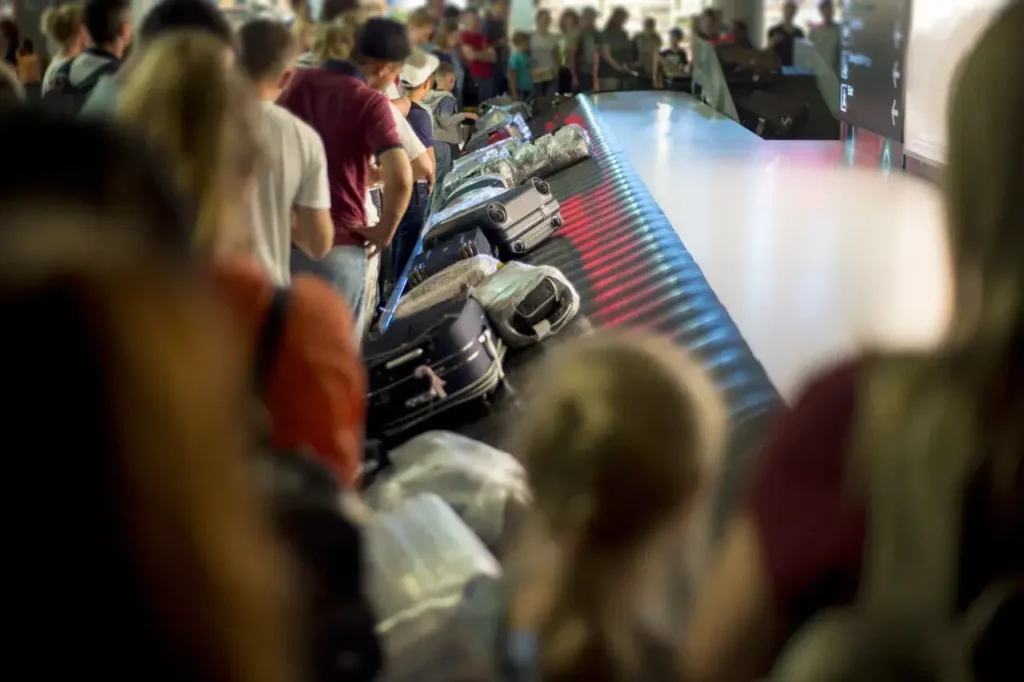
There are very few places in modern life where a brand has a guaranteed audience that isn’t scrolling, driving, or multitasking. Baggage claim is one of them. Travelers arriving at an airport have checked their bags, they’re waiting, and they have nowhere else to go. That captive attention window — typically five to twenty minutes — is what makes baggage claim advertising one of the highest-dwell-time formats in the entire out-of-home media landscape.
Our team at American Guerrilla Marketing has executed airport-adjacent and transit-corridor campaigns across dozens of U.S. markets. We see firsthand how placement environments shape brand perception. When travelers see your brand in an airport, the association is automatic: this brand is part of my world when I’m moving, successful, and spending money. That psychological context is something a banner ad or a social post can’t replicate.
This guide covers what baggage claim advertising is, how it works, what it costs, who the audience is, and how to build a campaign that makes the most of one of the most overlooked premium placements in out-of-home media.
What Is Baggage Claim Advertising?
Baggage claim advertising is the placement of branded content inside airport baggage claim areas — the zones where arriving passengers collect their checked luggage. Placements appear on carousel surrounds, conveyor belt panels, floor wraps, backlit static signs, digital screens, column wraps, and in some airports, the claim belt itself.
The Physical Environment
Baggage claim areas are designed for waiting. The seating is limited, the sightlines are long, and passengers have little to occupy them beyond checking their phones and watching the carousel. Advertising in this environment benefits from multiple exposure angles and extended dwell time in ways that most OOH formats can’t match. A roadside billboard delivers an impression in two to three seconds. A baggage claim placement delivers that same impression multiple times over fifteen minutes.
Digital vs. Static Formats
Both static and digital placements are available in most major airports. Static placements — backlit prints, vinyl wraps, floor graphics — provide maximum visual dominance and brand ownership of a space. Digital screens allow for creative rotation, time-targeted messaging, and content flexibility. Some brands run different creative at different times of day, serving business-travel messaging during morning arrivals and leisure-focused creative during evening peak periods.
The Baggage Claim Audience: Who You’re Reaching
The value of baggage claim advertising isn’t just dwell time — it’s who’s doing the dwelling. Air travelers are a self-selected high-value demographic that skews toward higher income, more frequent purchase decisions, and stronger brand responsiveness than the general population.
Demographics of Airport Travelers
According to TSA and industry travel data, frequent air travelers (those flying more than once per month) are disproportionately employed in management, professional, and technical roles. They index significantly higher than average on household income, technology adoption, premium brand preference, and travel-related spending categories including hotels, rental cars, dining, and financial services. For brands in these categories, airport advertising delivers an audience that would cost several times more to reach through digital targeting.
Business vs. Leisure Traveler Segmentation
Major hub airports like JFK, LAX, O’Hare, and Hartsfield-Jackson skew toward business travelers during weekday periods and leisure travelers on weekends. Regional airports near resort destinations skew toward vacation travelers year-round. Understanding the traveler mix at a specific airport helps inform both creative messaging and which airports are worth the investment for a given brand. A luxury hotel brand may prioritize airports with high business traveler concentration. A consumer lifestyle brand may prefer high-leisure airports in the Southeast and Southwest.
International Travelers
International arrival halls in gateway airports like JFK, MIA, and LAX reach a global traveler audience that’s actively making spending decisions during their visit. For brands targeting international visitors — hotels, cultural attractions, retail, transportation services — international baggage claim is a particularly high-value placement because these travelers are arriving with intent to spend.
Why Baggage Claim Advertising Works
Dwell time and audience quality are the primary value drivers, but there are additional factors that make baggage claim advertising outperform other OOH formats in brand recall and messaging retention.
Reduced Competitive Clutter
Airport baggage claim areas have limited advertising inventory. Unlike a city street with dozens of competing visual stimuli, a well-placed carousel surround or floor wrap has the visual field largely to itself. That reduction in clutter means your creative doesn’t have to fight as hard to earn attention — and the impressions that do register are more likely to result in brand recall.
Psychological Receptivity
Arriving travelers are in a distinctive psychological state. They’ve completed a journey, they’re often relaxed or in a positive frame of mind, and they’re planning what comes next — ground transportation, hotels, dining, meetings. Brands that appear in this context are associated with that forward momentum and anticipation. This is a meaningfully different psychological environment than a commute, where stress and routine tend to suppress brand engagement.
Brand Association with Travel and Success
Airport presence signals something about a brand. There’s an implicit status association with airport advertising that benefits brand perception beyond the direct impression. Brands that appear in airports are perceived as established, national or global in scale, and aligned with a premium audience. This halo effect extends beyond the airport — consumers who see a brand at an airport may perceive it differently when they encounter it elsewhere.
Best Baggage Claim Advertising Formats
The right format depends on your budget, creative assets, campaign objectives, and the specific airport environment. Each format offers different advantages.
Carousel Wraps
Carousel wraps are large-format vinyl graphics applied to the stationary surround of a baggage carousel. They provide maximum visual real estate and brand dominance. A full carousel wrap creates an immersive brand environment that’s impossible to ignore. These are typically the most expensive baggage claim placements and the most impactful for brand awareness campaigns.
Floor Graphics
Floor graphics are underutilized and often highly effective. Passengers waiting at carousels look down — floor branding captures that downward gaze with a format that most brands aren’t using. Floor wraps can guide travelers through a baggage claim area or position a branded message at the exact point where passengers stand to wait. We’ve seen floor graphics generate significant social sharing when designs are visually striking enough to stop people and take a photo.
Digital Screen Networks
Digital screen networks in baggage claim areas allow for flexible creative scheduling, video content, and daypart targeting. They’re typically sold on a share-of-voice basis rather than exclusive ownership, meaning your creative rotates alongside other brands. Digital placements are more affordable than static exclusives but offer less brand dominance. They’re appropriate for campaigns where message frequency and content flexibility matter more than visual ownership of a space.
Structural and Column Wraps
Columns and structural elements in baggage claim areas offer additional real estate for brand messaging. Wrapping multiple columns creates a corridor effect that makes a brand feel present throughout the space. Column wraps are often sold as package upgrades to core carousel placements.
Integrating Baggage Claim with a Broader OOH Campaign
Baggage claim advertising is most effective when it’s part of a coordinated airport media strategy or a broader out-of-home campaign that extends beyond the airport environment. We consistently recommend that brands think about the full traveler journey when planning airport placements.
The Airport Journey Media Plan
Departing travelers encounter your brand at ticketing, security, gate areas, and concourse retail. Arriving travelers see your brand at deplaning, wayfinding, and baggage claim. Pairing departing and arriving placements creates frequency — a traveler sees your brand leaving on Tuesday and arriving on Thursday. That repetition is how awareness converts to consideration. Combining airport placements with guerrilla marketing activations in the surrounding neighborhood or transit corridor extends reach to the ground-level audience.
Geo-Fencing and Mobile Retargeting
Airport environments can be geo-fenced for mobile ad retargeting. Travelers who see your baggage claim placement can be retargeted with digital ads on their devices as they leave the airport and over the following days. This creates a physical-to-digital connection that significantly extends the effective campaign window beyond the airport visit itself. Our team integrates mobile advertising assets with geo-fencing strategies to build multi-touchpoint campaigns that track audiences from OOH placements into digital channels.
Pairing with Street-Level Activations
For brands targeting specific metro markets, pairing airport advertising with street-level work creates a powerful frequency effect. A traveler arriving at JFK sees your baggage claim placement, then encounters your wheatpaste campaign in Brooklyn and your sidewalk stencils in Manhattan. Three touchpoints across three different media formats in the same market. That’s how brand awareness converts to brand familiarity.
Planning and Buying Baggage Claim Advertising
Airport advertising is sold through a small number of major OOH media companies that hold exclusive contracts with airport authorities. Clear Channel Airports, JCDecaux, and Lamar are the primary players in U.S. airport media. Understanding how they sell and what inventory is available requires direct outreach or a media buying partner with existing airport relationships.
Lead Time and Availability
High-traffic airports book premium placements weeks or months in advance. JFK, LAX, and O’Hare carousel wraps can be sold out three to six months ahead during peak advertising seasons. Planning airport campaigns with adequate lead time is essential — last-minute buys at major airports often mean settling for secondary placements with lower impact.
Creative Production Requirements
Airport advertising has strict production specifications. Vinyl materials must meet fire retardancy standards. Digital screen content must conform to specific resolution and file format requirements. Installation must be scheduled around airport operational windows, often occurring overnight. Working with a production partner experienced in airport formats prevents costly delays and compliance issues.
Measurement and Reporting
Most airport media companies provide audience data from passenger traffic reports, giving advertisers a reliable impression count based on actual passenger volume. This is more verifiable than many OOH measurement methodologies. For digital placements, play logs show when and how often your content appeared. Combining these data sources with brand lift studies or geo-fenced retargeting analytics provides a comprehensive performance picture.
Frequently Asked Questions About Baggage Claim Advertising
What is baggage claim advertising?
Baggage claim advertising refers to branded placements on baggage carousels, carousel surrounds, floor wraps, signage, and digital screens inside airport baggage claim areas. These placements reach travelers while they wait for checked luggage, typically for five to twenty minutes.
How much does airport baggage claim advertising cost?
Costs vary significantly by airport, format, and duration. Regional airports can start around $5,000 to $15,000 per month for standard placements. Major hub airports like JFK, LAX, or O’Hare can run $30,000 or more per month depending on format and exclusivity.
Who sees baggage claim advertising?
Every arriving passenger who checked a bag passes through baggage claim. This audience skews toward frequent business travelers, higher-income households, and international visitors — demographics that are difficult to reach efficiently through mass media channels.
What formats are available in baggage claim areas?
Available formats typically include carousel wraps, backlit static signs, floor graphics, digital screens, conveyor belt branding, and structural column wraps. Some airports also offer cart corral advertising and luggage trolley branding.
How long do travelers spend in baggage claim?
Average dwell time in baggage claim ranges from five to twenty minutes depending on the airport and flight load. This extended exposure window is one of the primary advantages of baggage claim placements over transit media formats with shorter exposure times.
Can baggage claim ads be paired with other out-of-home formats?
Yes. Baggage claim advertising works best as part of a broader airport media buy that includes ticketing area signage, gate area displays, jetbridge wraps, and in some cases mobile retargeting of airport visitors through geo-fencing technology.
What industries benefit most from baggage claim advertising?
Travel and hospitality, financial services, luxury goods, automotive, technology, healthcare, and entertainment brands consistently perform well with airport advertising because their products and services align with the high-income, frequent-travel profile of the audience.
Frequently Asked Questions
What is baggage claim advertising making a lasting impression?
American Guerrilla Marketing provides baggage claim advertising making a lasting impression services across 50+ U.S. markets. Every campaign is planned, scouted, executed, and GPS-documented by our field teams. We work with regional brands and Fortune 500 companies on campaigns that require real street-level execution and documented proof of performance.
How does AGM approach lasting impression?
Our process starts with a market consultation to understand your goals, target audience, and budget. We then scout locations, handle any required permissions or permits, coordinate production and installation with our local crews, and provide a full GPS-tagged photo report after the campaign runs.
What markets does American Guerrilla Marketing cover for lasting impression?
We operate in 50+ U.S. markets including New York, Los Angeles, Chicago, Miami, Houston, Atlanta, Seattle, Denver, Boston, and dozens of secondary markets. Contact us to confirm availability and pricing for your specific market.
How much does a lasting impression campaign cost?
Campaign pricing depends on market, format, quantity, and duration. We work with budgets ranging from targeted single-market runs to national rollouts across multiple cities. Use our RFP Builder or contact us directly for a custom quote based on your specific campaign requirements.
How do I get started with lasting impression through AGM?
The fastest way to get started is to submit your campaign details through our RFP Builder at americanguerrillamarketing.com, or contact us directly at [email protected] or (646) 776-2770. Our team typically responds within one business day with availability and initial pricing.