Advertising on the Street: What Works and How to Use It | AGM
Street advertising meets consumers in the environments they actually inhabit every day. No media buy required. Just presence, placement, and the right execution.
Advertising on the street is any brand marketing campaign that reaches consumers through the physical environments they move through in their daily lives, sidewalks, commercial corridors, transit entrances, public plazas, parks, and any other outdoor urban space where people spend time on foot. It is distinct from elevated outdoor advertising like billboards, which reach consumers primarily from vehicles. Street-level advertising operates at the height and pace of the person walking through the city.
This distinction matters for a simple reason: the consumer experience is fundamentally different. A person walking down the street at human pace, with the ability to stop, read, interact, and respond, is a far more available and receptive audience than a person driving at forty miles an hour past a billboard. Street advertising earns a higher quality consumer encounter by reaching people in environments where they have the time and proximity to genuinely engage with a brand message.
We are American Guerrilla Marketing. We design and execute street advertising campaigns in New York, Los Angeles, Chicago, Miami, and dozens of other markets. We have placed brand graphics on walls from SoHo to the South Bronx, run street teams on the Magnificent Mile in Chicago and on Abbot Kinney in Venice, and produced brand murals in Wynwood, the Arts District, and Wicker Park. Street advertising is the core of what we do, and this piece is our complete guide to how it works.
Street advertising works for several interconnected reasons that distinguish it from conventional media channels.
First, it reaches consumers who cannot be reached through conventional digital channels. Ad blockers, subscription services, streaming without ads, and trained inattention to digital advertising have created large gaps in digital reach. A person who pays for ad-free streaming, uses an ad blocker on their browser, and scrolls past sponsored content without registering it can still be reached by a compelling brand presence in the physical environment they walk through every day. The street cannot be blocked.
Second, it creates genuine surprise. Physical advertising in unexpected locations, a striking graphic on a wall the consumer walks past daily, a sampling team in a location the consumer visits regularly, an installation that appears overnight in a familiar public space, creates the pattern interruption that triggers genuine attention. The brain’s novelty detection system flags unexpected elements in familiar environments as worth examining. That genuine attention is the raw material of brand memory and brand preference.
Third, it generates earned digital reach. In cities with high concentrations of social media users, which is to say, in every major US metro, compelling street advertising generates organic social content as people photograph and share it. A brand mural in Wynwood or the Arts District gets documented by dozens or hundreds of people per week. That organic reach is unpaid and often reaches audiences far beyond the geographic footprint of the installation.
Fourth, it builds geographic brand authority. A brand that maintains consistent physical presence in the neighborhoods where its target consumers live and work builds a sense of local belonging that digital advertising cannot replicate. The consumer who sees a brand’s presence on the walls and streets of their neighborhood develops a different relationship to that brand than the consumer who only encounters it through a screen.
Formats of Street Advertising
Outdoor Wall Posters and Graphics
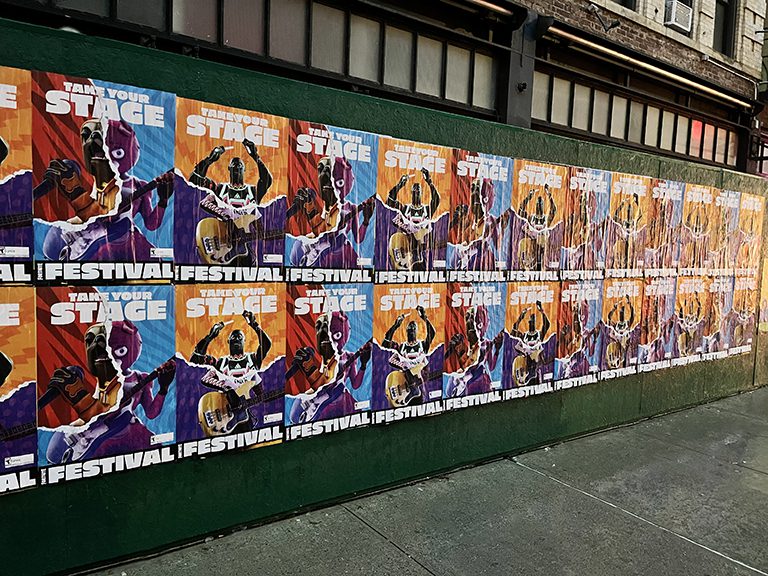
Large-format printed graphics placed on building walls, construction barriers, scaffolding wraps, and other prominent exterior surfaces at pedestrian height are the most running format of street advertising. The format is durable, repeatable, and produces high daily impression counts at locations with genuine foot traffic density.
The key variables are surface quality, location visibility, and creative size. A well-positioned wall poster at a major pedestrian intersection, say, the corner of Houston Street and Broadway in Manhattan, or the intersection of Melrose and La Brea in Los Angeles, generates tens of thousands of daily exposures. The same poster on a low-traffic side street generates a fraction of that at the same production cost.
Brand Murals
Brand murals are large-scale painted graphics on building exterior walls. They differ from printed poster placements in scale, permanence, and cultural weight. A brand mural in the right neighborhood becomes part of the visual environment of that neighborhood, generating exposures and social media content continuously over an extended period rather than for a defined campaign window.
In the right neighborhoods, brand murals are investments in cultural capital as much as in advertising exposure. A mural in Wynwood in Miami, the Arts District in Los Angeles, or the Bushwick Arts District in Brooklyn exists within a visual tradition of outdoor art that gives it cultural significance beyond its advertising function. The brand association that comes from genuine participation in that visual culture is different from and more valuable than what a conventional poster buy generates.
Street Team Activations
A street team is a group of trained brand ambassadors who deploy to a specific location with the objective of creating direct consumer interactions. They might distribute product samples, invite passersby to engage with a brand experience, collect contact information, or simply represent the brand in a way that creates a genuine positive encounter. Street teams create the highest quality consumer contact of any street advertising format because the interaction is human-to-human.
The most effective street team locations are places where the target audience is present in meaningful numbers and is in a state of relative openness, not rushing to a destination, but moving at a pace that allows a brief interaction. Transit station exits at commuter hours create large numbers of very rushed consumers who are hard to engage. Outdoor market corridors, park entrances, beach access points, and event venue approaches tend to create consumers in a more open, exploratory state that is more receptive to street team engagement.
Sampling Programs
Product sampling at street level is one of the most effective direct-conversion marketing tools available. Getting a product into a consumer’s hands, a food sample, a beverage trial, a personal care product, a small product demonstration, creates a trial experience that can convert to purchase at rates no advertising format can approach. The consumer who has physically tasted, used, or tried a product and had a positive experience is far closer to purchase than the consumer who has seen advertising for the same product hundreds of times.
Location selection for sampling is critical. A sampling program for an energy drink at the entrance to a New York City gym generates a fundamentally different consumer interaction than the same campaign at a general transit hub. Audience specificity in sampling location drives conversion rates far more than absolute foot traffic volume.
Stenciling and Chalk Graphics
Stenciled graphics and chalk-based street messaging are low-production-cost formats that work in high-traffic pedestrian areas where the floor or low surfaces are visible to passersby. The format is temporary by nature but can create large impression volumes during its active period. Best used for campaigns where the temporary nature is appropriate, event announcements, launch moments, time-limited offers, or where the budget constraints require a lower-cost format with acceptable reach.
Construction barriers on active commercial streets
High
Moderate (ambient)
Large-format poster/graphic wraps
Location over volume: We consistently find that the quality of the foot traffic at a location, whether the people there match the target consumer profile and are in a mental state that makes them receptive to brand engagement, matters more than the absolute number of people who pass. A corner that generates 5,000 highly receptive, well-matched consumers per day outperforms a corner that generates 50,000 rushed, mismatched consumers. This is why we do audience-specific location analysis rather than generic foot traffic analysis.
Planning an Advertising Campaign on the Street
A well-planned street advertising campaign starts with a clear brief and a clear audience profile. The brief should answer: who are we trying to reach, where are they, what do we want them to think or do, and what does success look like? The clearer the answers, the more precisely the campaign can be designed.
Once the audience profile is running, we map the geographic footprint, the specific streets, corridors, and locations where that audience concentrates in meaningful numbers at the times of day when they are most receptive. This is not a desk exercise. We walk the locations, count foot traffic at different times, document the surrounding context, and identify the specific surfaces and positions within each location that will generate the best sight lines and highest impression quality.
We then select the format or formats that best serve the objective in the identified locations. For sustained visual presence, outdoor graphics or murals. For direct consumer interaction and trial, street teams or sampling. For dramatic launch moments, projection or ambient installations. Often the best approach is a combination: visual presence that builds familiarity over days and weeks, combined with staffed activations that create direct engagement windows at peak traffic times.
Production, logistics, and staffing are then managed against the approved timeline. Every street advertising format has specific production requirements and lead times, and we build those into the project schedule from the beginning so clients can plan their campaign launches accurately.
What we tell every new client: The first question after the audience profile is always: what are the three most important blocks or corridors in this market where our target consumer is? Not the three biggest intersections, not the most famous streets, the three places where this specific consumer is actually concentrated at the moments when they are most open to a brand encounter. Getting that answer right is worth more to the campaign than any other single decision.
Street Advertising and Social Media Integration
Street advertising does not operate in isolation from digital channels in the contemporary marketing environment. Physical brand presence on the street generates social media content that extends the campaign’s reach into digital channels at no additional media cost. Designing campaigns with this integration in mind from the beginning, asking where the natural photography moment is, what design elements make the installation shareable, how to make the sampling interaction worth documenting, significantly amplifies the total reach and impact of the physical campaign.
We also advise clients to ensure that the digital side of the campaign is ready to receive the traffic that a strong street advertising campaign can generate. If a street mural in a high-traffic neighborhood generates social content that drives people to search for the brand online, the brand’s digital presence needs to be there to capture that intent. Physical and digital campaigns should be planned and launched in coordination, not as independent workstreams.
What Creative Works Best on the Street
Street advertising creative has to work at a glance. People walking past your poster or mural have two to five seconds of engagement. That’s your entire window. The creative that works best is bold, clear, and readable from ten feet away. One message. One visual hook. A brand identifier. That’s it.
Contrast matters more than detail. High-contrast color combinations, black and white with a single accent color, or a striking image against a clean background read better at pedestrian pace than busy layered compositions. Your campaign visual should be legible to someone walking at three miles an hour who isn’t trying to read it.
The best street advertising creative also understands its context. A mural in Wynwood can afford more artistic complexity because people in that neighborhood are actively looking at walls. A poster near a transit exit needs to communicate in a single second because the consumer is moving fast. Match your creative to your location. Design for the pace of the people who will actually see it.
How to Brief a Street Advertising Campaign
The quality of a street advertising campaign is directly tied to the quality of the brief that launches it. A weak brief produces a vague campaign that tries to reach everyone and succeeds for no one. A strong brief gives the campaign designer the specific information they need to make precise decisions about format, location, creative, and staffing.
A strong street advertising brief covers the following ground. First, the target consumer in behavioral terms: not just age and income demographics, but where this person is in the city, at what times of day, in what mental state, and what they are doing in the physical environment immediately before and after the moment of potential brand contact. This level of specificity allows us to design around the actual consumer moment rather than a demographic abstraction.
Second, the campaign objective in concrete terms. Not “increase awareness” but something specific: drive trial of this product with women 25 to 40 in Williamsburg and the Lower East Side over the next three weeks. Or: establish visual brand presence in the Arts District in Los Angeles before our retail launch date. The more specific the objective, the more precisely the campaign can be designed to achieve it, and the more honestly its results can be measured after.
Third, the budget, stated as a real number with real constraints. Campaigns designed without a clear budget figure almost always come back over budget or underscoped, because the brief’s ambitions have no limiting principle. When we know the actual budget from the start, we can design the right campaign for that budget rather than designing the ideal campaign and then compressing it into an uncomfortable financial container at the last stage.
Fourth, the timeline, including any fixed dates the campaign must work around. A product launch date, a major event in the market, a trade show or conference that will concentrate the target audience, any fixed date creates a planning anchor. We build the campaign production timeline backward from that date to identify what lead time we need and whether the proposed scope is achievable in the available time.
Weather, Seasonality, and Street Advertising Logistics
Outdoor advertising is affected by weather in ways that indoor and digital channels are not. This is not a reason to avoid the format, but it is a reason to plan for it. Here is how we handle weather and seasonality in street advertising campaigns.
For staffed activations, rain, extreme heat, and cold all affect both field team performance and pedestrian receptivity. A brand ambassador standing in heavy rain is not creating positive brand exposures. We build weather contingency plans into every staffed activation: a threshold for what weather conditions we will work in, a communication protocol for weather-related holds or adjustments, and a makeup plan for any lost activation days that matter to the overall campaign count.
For visual campaigns, material selection accounts for weather exposure. A scaffold wrap on a New York street in winter faces wind load, temperature cycling, and precipitation that a Los Angeles installation in the same period does not. We specify materials appropriately for the installation environment and build material performance guarantees into our production standards. If a print or vinyl installation fails prematurely because of weather, we replace it as part of our campaign commitment.
Seasonality shapes audience behavior in ways that affect campaign design. In northern markets, outdoor pedestrian culture shifts dramatically with temperature. Summer weekends in Chicago generate very different Wicker Park foot traffic than January does. Campaign timing in seasonal markets should account for when the target audience is actually outdoors and in the neighborhood rather than assuming consistent year-round patterns. We advise clients on optimal timing windows in each market based on the specific audience profile and the seasonal dynamics of the relevant neighborhoods.
AGM Field Note: The best insurance against weather disruption for a street advertising campaign is designing in flexibility from the start. We schedule staffed activations on days with good historical weather probability for the market and season, we pre-select rain-hold locations that keep the campaign moving if conditions deteriorate, and we communicate proactively with clients when adjustments are needed rather than discovering problems on activation morning.
Common Mistakes in Street Advertising Campaigns
After running hundreds of street advertising campaigns, we have seen the same mistakes surface repeatedly. Here are the ones that cost brands the most and how to avoid them.
The first mistake is using stock demographic targeting instead of behavioral and geographic targeting. Knowing that your audience is “men 18 to 34 with a household income above $60K” does not tell you where they are or when they are there. Knowing they commute through Union Square on weekday mornings and shop on Bedford Avenue on Saturday afternoons tells you exactly where to put your street advertising and when to staff it. Behavioral geography is the lever that separates effective campaigns from expensive ones.
The second mistake is buying cheap production to save budget. A poorly finished poster on a New York wall looks cheap to 20,000 people per day. The brand association that creates is not worth whatever was saved on printing. Production quality is visible in the field. Invest appropriately.
The third mistake is running the campaign without building in a social media amplification strategy. A street advertising campaign that generates zero organic social content is leaving significant earned media value on the table. Design the creative with shareability in mind from the start. Give people a reason to photograph and post. Then make sure the digital side of the brand is ready to capture the traffic the street campaign drives.
Frequently Asked Questions: Advertising on the Street
What should I look for when hiring an agency to manage street advertising?
Look for agencies with documented experience in the specific markets you need to run in, with specific case studies that name locations and outcomes rather than vague portfolio references. Ask how they staff their field teams and who supervises brand ambassadors on activation days. Ask to see a sample post-campaign report to evaluate their documentation standards. Ask about their location sourcing process and how many of their campaigns they have personally scouted versus how many they place based on data alone. The answers to these questions tell you whether you are looking at a real field operation or a sales organization with attractive pitch materials.
Frequently Asked Questions
What is street advertising?
Street advertising is any brand marketing that reaches consumers through the physical environments they move through on foot in urban areas. It includes outdoor wall posters and graphics, brand murals, street team activations, product sampling programs, stenciled graphics, ambient environmental installations, and any other format that operates at pedestrian level in the spaces where consumers spend time in their daily lives. It is distinct from elevated outdoor advertising like billboards, which reach consumers primarily from moving vehicles.
What cities are best for advertising on the street?
Cities with dense pedestrian cultures, where a large proportion of the population moves through the city on foot and by transit rather than primarily by car, are the most productive street advertising markets. New York is the strongest US street advertising market by virtually any measure. Chicago, San Francisco, Boston, and Washington DC are strong pedestrian markets. Los Angeles, Miami, and other more car-centric markets require more strategic location selection but have strong pedestrian zones and cultural neighborhoods where street advertising performs very well.
How do you measure the results of street advertising?
Measurement depends on the format and the campaign objective. For street team and sampling campaigns, we track direct consumer interactions and, when applicable, downstream conversion metrics. For outdoor poster and mural campaigns, we estimate exposures based on verified foot traffic counts at the specific locations during the campaign period. For all formats, we monitor earned social media content generated by the campaign. For campaigns with specific business objectives, sales lift, web traffic, app downloads, we establish pre-post measurement frameworks before the campaign launches.
Can small brands afford street advertising?
Street advertising scales from focused single-neighborhood campaigns to large multi-market campaigns at national scale. A single-market street team activation starts at $389.99 per 6-hour shift (minimum 5 days). Poster campaigns start at $4,500 for 100 standard posters (24×36). We help brands find the right-sized campaign within their actual budget.
How long should a street advertising campaign run?
It depends on the format and the objective. Outdoor poster and mural campaigns benefit from extended duration because they build cumulative impression counts and grow more familiar to regular passersby over time. A minimum of two to four weeks is generally recommended for visual campaigns to create meaningful impression depth. Street team and sampling campaigns are typically more concentrated, one to five days of intensive deployment in specific locations, because the format delivers high-intensity direct engagement rather than cumulative awareness building.
What kinds of businesses use street advertising most effectively?
Consumer packaged goods brands, restaurants and food and beverage brands, fashion and apparel brands, technology and app brands targeting urban consumers, entertainment brands, fitness and wellness brands, and financial services brands targeting urban professionals all use street advertising effectively. The category is less relevant for businesses targeting primarily rural or suburban audiences, or for B2B brands whose target decision-makers are concentrated in office environments rather than pedestrian corridors.
Location selection starts with audience mapping: we identify where the specific target consumer concentrates in the target market at the relevant times of day. We then cross-reference that with available surface inventory and foot traffic data for the prioritized locations. We always finish the selection process with direct field scouting, a team member walks every proposed location to document actual conditions, sight lines, surrounding context, and any issues that the data does not reveal. The combination of data analysis and field observation produces better location decisions than either alone.