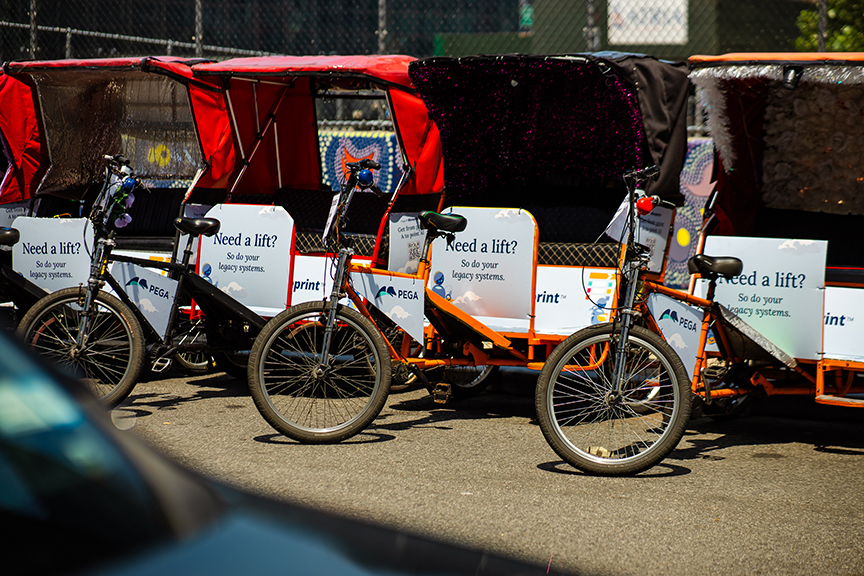
Advertising on Bicycles | American Guerrilla Marketing
Advertising on bicycles is a format built for urban environments where the most valuable consumer audiences gather. Parks. Greenways. Farmers markets. University campuses. Waterfront corridors. These are the spaces that vehicle-based advertising cannot reach and where bicycle advertising thrives. The format is mobile, flexible, and operates in premium access environments that no other outdoor medium can claim.
We are American Guerrilla Marketing, and we have deployed advertising on bicycles in every major American city. We plan routes based on audience geography, not just area coverage. We select formats based on campaign objectives, not convenience. We train riders as brand representatives, not just cyclists. And we report on campaign execution with data that gives clients something to actually learn from, not just pictures of a bike in a park.
This is the definitive guide to advertising on bicycles: what it is, how it works, what it costs to do well, where it performs best, and how to integrate it with the broader guerrilla marketing toolkit.
Advertising on bicycles operates on a straightforward premise. An advertising display, printed or electronic, is mounted on a bicycle or worn by the rider. The bike operates on planned routes through target areas during specific deployment windows. Everyone who sees the bike within visual range sees the brand message.
The sophistication is in the planning, not the execution. Knowing where to put the bike, when, and with what message requires the same strategic rigor as any other media placement. A bike riding aimlessly through a park is a waste of budget. A bike operating on a precisely planned route through the highest-density zones for the target audience during peak hours is a genuine media placement.
Planning the Audience Geography
Before we plan any route for advertising on bicycles, we map the target audience’s physical behavior in the target market. Where do they go? When are they there? Which parks, which corridors, which markets and events? We use a combination of local market knowledge, demographic research, and campaign history to build this map. Every routing decision derives from it.
Building the Route
Routes are built to maximize time in zones with the highest concentration of the target audience during the deployment windows. We account for time of day, day of week, event calendars, seasonal patterns, and the specific physical characteristics of each location. A route that performs well on a weekday morning in a commercial corridor is not the same route we build for a weekend afternoon park deployment.
Format Selection
The advertising format mounted on the bicycle shapes the campaign’s creative requirements, production costs, and field deployment logistics. Printed panels are the most accessible entry point. LED display panels generate more attention but require more investment. Cargo bikes with sampling capability add product distribution to the awareness function. We match the format to the objective.
Field Management
We manage every advertising-on-bicycles deployment with field supervisors who maintain real-time communication with riders, monitor route execution, capture documentation, and make adjustments when conditions change. Field management is what separates a professional deployment from a rider with a bike and a sign.
AGM Field Note: The zones where advertising on bicycles creates the most value are precisely the zones where other outdoor advertising formats are either restricted or physically unable to operate. We have run bicycle ad campaigns in environments where we were the only branded presence for the entire day. That kind of exclusivity in a premium consumer environment is not something that any amount of money can buy through traditional outdoor formats.
Advertising on Bicycles: Format Options in Detail
Advertising on bicycles encompasses a range of formats, each with distinct operational characteristics and creative requirements.
board_Bikes”>Double-Sided Billboard Bikes
The industry standard for advertising on bicycles. A large printed panel, typically four to six feet high and two to three feet wide, mounted vertically to the bicycle frame and rising above the rider’s head. Double-sided to cover both directions of travel. High-resolution printed graphics. The format is visible at distance, easily deployed, and cost-effective for campaigns where printed creative is appropriate.
Best applications: Brand awareness campaigns, neighborhood saturation programs, event support in outdoor environments, market-adjacent deployments.
LED Display Billboard Bikes
An electronic display panel mounted to the bicycle showing video content, animated graphics, or rotating static frames. LED displays generate substantially more attention than printed panels because human vision is attracted to light and motion at a primal level. A moving LED display on a moving bicycle is one of the most attention-interrupting formats in any urban environment.
Best applications: Product launches, campaigns with a social content goal, evening deployments, high-density urban environments where standing out from visual complexity is critical.
Cargo Bicycle Advertising
A cargo bicycle outfitted with branded exterior panels and a product storage compartment. The rider operates the bike on a planned route and distributes product samples, coupons, or branded materials to people along the route. This format merges the mobility of bicycle advertising with the directness of product sampling.
Best applications: CPG food and beverage launches, product trial programs, farmers market and outdoor event deployments where sample distribution adds meaningful conversion to the awareness function.
Rider-Worn Advertising
The rider wears a large-format branded display, typically an A-frame sandwich board or a branded backboard, while operating a bicycle through target areas. The display is visible from behind, above, and to the sides. This format is highly maneuverable in very dense environments where a frame-mounted panel creates logistical challenges.
Best applications: Dense event environments, narrow pedestrian zones, any deployment situation where maximum maneuverability is required.
Format
Visibility Level
Best Objective
Production Lead Time
Double-sided billboard bike
High
Brand awareness
5-7 business days
LED display bike
Very high
Launch, PR, social content
7-14 days depending on availability
Cargo bike with sampling
Medium-high
Trial, conversion
5-10 days
Rider-worn display
High in dense crowds
Event saturation
3-5 business days
Where Advertising on Bicycles Performs Best
The value of advertising on bicycles is directly tied to where the bikes operate. The format creates its most significant competitive advantage in environments that are restricted to or unsuitable for vehicle-based advertising.
Major Urban Parks
Central Park in New York. Lincoln Park in Chicago. Griffith Park in Los Angeles. Golden Gate Park in San Francisco. Rock Creek Park in Washington DC. These are premier bicycle advertising environments. They are vehicle-restricted on weekends or entirely. They draw enormous, concentrated audiences in a relaxed state. And they are places where people habitually photograph and document their experience, making every well-designed bicycle ad a potential piece of organic content for the brand.
Weekend mornings in major urban parks are our highest-value deployment windows. The audience concentration is at its peak. The competitive advertising environment is at its lowest. The viewer is at their most open and receptive.
Cycling and Pedestrian Greenways
Protected cycling and pedestrian paths in urban environments carry consistent daily traffic across both commuter and recreational segments. The Hudson River Greenway in New York, the Lakefront Trail in Chicago, the Beltline in Atlanta, the Burke-Gilman Trail in Seattle: these corridors carry millions of users annually and represent reliable daily deployment opportunities for advertising on bicycles.
Outdoor Markets and Event Environments
Farmers markets, street food markets, craft fairs, and outdoor festivals concentrate the urban consumer demographic in a pedestrian-first, often vehicle-excluded environment. These events are natural deployment zones for bicycle advertising because they offer exactly the access that the format is best suited to provide.
University Campuses
Campuses are dense, vehicle-restricted, and populated by a highly desirable consumer demographic. They are also environments where cycling is culturally appropriate, which means a bicycle ad does not create the visual incongruity that a commercial vehicle would in the same space. Campus bicycle advertising reaches students, faculty, and staff in their native environment during daily activity patterns.
Waterfront and Tourism Corridors
Waterfront promenades, boardwalks, and tourism-heavy urban corridors draw both residents and visitors in large numbers. The audience is in leisure mode, which means they are more observant of their environment and more open to novel stimuli than they would be during a commute or a work day. Bicycle advertising in these environments reaches people at their most receptive.
AGM Field Note: We have tracked significant differences in organic social media sharing from bicycle ad campaigns deployed in visually interesting environments versus standard commercial streets. Parks, waterfronts, and markets generate sharing. Commercial corridors generate awareness but not sharing. For brands with a social content amplification goal, environment selection is as important as creative design.
Integrating Bicycle Advertising with Street Teams
Advertising on bicycles is a mobile awareness format. It generates brand recognition in a target area over time. Street teams and brand ambassadors are direct engagement formats. They create person-to-person brand contact. The two formats are complementary in a way that multiplies the effect of each.
Our standard recommendation for campaigns in markets where the budget supports both: deploy the bicycle to cover approach corridors and generate broad awareness, and position the street team at the highest-traffic points within that coverage area. The bicycle primes the consumer with brand recognition. The street team converts that recognition into direct engagement.
The consumer who encounters the street team having already registered the brand from a bicycle is in a meaningfully different state than a consumer who encounters the street team cold. The warm encounter has a higher engagement rate and a higher conversion rate than the cold encounter. The difference is consistent across deployments.
Street team rates through American Guerrilla Marketing start at $389.99 per six-hour shift for a standard team member and reach $589.99 per shift for a premium member with enhanced communication skills, multi-location coverage, and on-site field management. Adding a two-person street team to a bicycle ad campaign is one of the highest-return incremental investments available in guerrilla marketing.
Start Your Advertising-on-Bicycles Campaign
We have deployed advertising on bicycles in dozens of markets across the United States. We know what works, what does not, and how to build a campaign that delivers genuine results in any of those environments. Call us and let’s talk about your brand, your market, and your goals.
Building a Program That Delivers in the Real World
The gap between a field marketing program that delivers genuine results and one that generates an expensive activity report with nothing to show for it comes down to three variables: strategic clarity in the brief, professional quality in the execution, and honest accountability in the reporting. When all three are present, field marketing programs create meaningful, measurable brand outcomes. When any of the three is missing, the budget gets spent without proportional returns.
We start every program engagement with a strategic conversation, not a price negotiation. We need to understand the brand deeply enough to make genuinely useful strategic recommendations. That means understanding the product, the target consumer, the competitive environment the brand operates in, the specific market we are activating in, and the specific outcome the client needs the program to produce. Without that understanding, we can execute tactics competently but we cannot build a program that is strategically sound.
Professional execution is what we are known for and what we protect as the foundation of every client relationship we have. Our field teams are trained, briefed, supervised, and held to clear performance standards. We do not deploy teams without field management. We do not finalize programs without creative review. We do not accept sample quality that does not represent the brand accurately. We do not allow route drift without field supervisor intervention. These standards exist because field marketing quality is the only thing that determines whether a program generates genuine consumer impact or generates the appearance of activity.
Honest reporting is the accountability mechanism that makes the whole system function. We deliver reports that tell clients what actually happened: where the program was strong, where it was weak, what we did to address problems when they arose, and what we recommend for the next program cycle based on what we learned. We do not optimize our reports for optics. We optimize them for usefulness. A client who gets an honest, useful report from a program that underperformed in specific areas can make better decisions with that information than a client who gets a glowing report that conceals what went wrong.
Field Marketing Program Economics: Getting Value from Your Investment
Field marketing programs are an investment, and like any investment, they require a clear-eyed view of what they return relative to what they cost. Here is how we think about the economics of field marketing across the main program types we execute.
Street team programs generate a specific type of value: direct, human-scale brand encounters with the target consumer in the physical environments where they spend their time. The cost of a six-hour shift with a trained, briefed, supervised street team member running from $389.99 at the standard tier to $589.99 at the premium tier reflects the cost of a professional who represents your brand competently in every interaction they conduct during that shift. The return on that investment is the number and quality of direct brand encounters generated during the shift and the downstream brand recognition and purchase consideration that those encounters produce over time.
Sampling programs generate a different type of value: direct product trial among the target consumer in contextually appropriate environments. The cost of a sampling program includes specialist staffing, sample production and logistics, equipment, field management, and reporting. The return is measured in trial volume, purchase intent lift, retailer velocity data, and long-term brand adoption among the consumers who had a positive first product experience. For brands with genuinely strong products, the ROI on well-executed sampling programs is among the highest in the marketing mix.
Mobile advertising programs, including billboard bikes, LED display bikes, and vehicle-based advertising, generate the value of brand presence in premium access environments. The cost reflects the unique access value of the format: being in Central Park, on the Lakefront Trail, at a major outdoor market is not the same as being on a commercial street. The premium access environment is what the format delivers and what justifies the investment relative to static or vehicle-restricted formats.
Across all program types, the most reliable way to maximize return on investment is to be specific about the objective, design the program specifically to achieve that objective, execute at a professional standard, and measure against the specific outcome the program was designed to produce. Generic programs generate generic results. Specifically designed, professionally executed programs generate the specific outcomes they were built for.
Common Questions We Get from Brands Starting Field Marketing Programs
We have introductory conversations with brands evaluating field marketing programs every week. Here are the questions we hear most often and the honest answers we give.
“How much does a field marketing program cost?” It depends entirely on the scope. A two-person street team for one week in one market is a modest investment. A twenty-city sampling program with twenty specialists per market and full field management is a significant one. We size programs based on objectives and build budgets based on the specific scope required to achieve them. We do not have a standard package price because no two programs are the same.
“How do I know if field marketing will work for my brand?” We evaluate fit based on the brand, the product, the target consumer, and the specific objective. For consumer brands with genuinely strong products targeting specific urban demographics in environments where field marketing operates effectively, it almost always works when it is executed at quality. For brands where the fit is less clear, we say so and recommend whether a test program or a different approach makes more sense.
“How do you ensure the team represents our brand appropriately?” Through recruitment based on genuine product-audience fit, thorough pre-deployment training, active field management throughout every shift, and honest performance reporting that holds teams and supervisors accountable for quality. We have multiple layers of accountability built into every program precisely because brand representation quality is the non-negotiable foundation of field marketing value.
“What if we are not happy with the results?” We have a direct conversation about it. We review the program data together, assess what worked and what did not, and make a recommendation about how to adjust the next program cycle to address the shortcomings of the current one. We do not tell clients that disappointing results are an inherent limitation of the format. We assess whether the issue was strategic, creative, or executional and address it specifically in the next program design.
Why Brands Choose American Guerrilla Marketing
We are a guerrilla marketing agency that has been executing field campaigns in New York and across the United States for years. We are not a large agency with a field marketing division and a hundred other service lines. Field marketing and guerrilla activation is what we do. It is the focus of our team, our systems, our relationships, and our expertise. That focus produces consistently better results than the same service delivered by a generalist agency with many competing priorities.
Our team includes field marketing strategists who have planned and executed programs in every major market in the country, riders and brand ambassadors who represent our clients with professionalism and genuine brand knowledge, field supervisors who manage every deployment with active oversight rather than passive check-ins, and account managers who maintain client communication throughout every program with the transparency and responsiveness of a genuine partner.
We do not have a minimum program size that prevents smaller brands from working with us. We have worked with single-location restaurants, emerging food brands with three grocery store placements, and campaign-stage startups launching their first product. We have also worked with national CPG companies, major entertainment brands, and Fortune 500 companies running simultaneous programs in twenty markets. The program structure scales. The quality standard does not vary by client size.
Our rates are straightforward and transparent. Street team and brand ambassador programs run from $389.99 per six-hour shift for standard members to $589.99 per shift for premium members. Product demonstration programs run the same range. Add-ons including overtime at $65 per hour, travel days at $275 per day, and hotel per diem at $65 per day are billed separately when applicable. There are no hidden fees. The program cost you agree to at the start is the program cost on the invoice at the end.
We operate in all major U.S. markets with primary strength in New York, Chicago, Los Angeles, Miami, Boston, Washington DC, Philadelphia, Atlanta, and San Francisco. In secondary markets, we work with established local execution partners whose quality standards we have verified and whose work we manage directly. Every program we run regardless of market gets the same strategic input, the same training standards, and the same reporting quality that defines our programs in our primary markets.
Our reporting is honest, specific, and delivered on time. We do not celebrate mediocre results or hide field problems behind polished photography. When a program encounters issues, we document them, explain what we did about them, and recommend how to avoid them in the next program cycle. Clients who work with us on an ongoing basis get better programs over time because our reporting gives both parties the information needed to continuously improve the strategy and execution.
If you are looking for a field marketing partner who takes your brand as seriously as you do, who delivers professional execution in the field, and who reports honestly on what the program accomplished, we are ready to have that conversation. Call us at (646) 776-2770 or email [email protected]. We will respond quickly and give you the direct, useful answers you need to make a good decision about your next field marketing program.
Frequently Asked Questions
Is advertising on bicycles restricted in any environments?
Bicycles, like pedestrians, can be restricted from certain spaces: indoor areas, specific pedestrian-only zones in some cities, and areas with posted no-bicycle rules. We research the specific access rules for every environment we deploy in and route campaigns to comply fully with local guidelines. We have never had a campaign stopped due to improper access planning.
How many bikes do you need for an effective campaign?
One bike on a well-chosen route can be effective for small, localized campaigns. Two to five bikes operating coordinated routes in a zone creates a pervasive brand presence. For major events or large park environments, five or more bikes may be warranted. We recommend the right number based on the specific campaign geography and objectives rather than a default minimum.
What size should a bicycle ad panel be?
Standard billboard bike panels range from 30×40 inches to 48×60 inches depending on the mount system and the bicycle frame. Larger panels are more visible at distance but add weight and wind resistance that affects rider safety and maneuverability. We balance visibility with operational safety in every panel specification.
Can bicycle advertising work in winter markets?
In many markets, yes. Cities like New York, Washington DC, Los Angeles, Miami, and the Sun Belt generally have conditions that allow bicycle advertising year-round with appropriate gear and scheduling adjustments. Northern markets like Chicago, Boston, and Minneapolis see significantly reduced bicycle advertising activity in December through February. We discuss seasonal considerations specific to each market during campaign planning.
Do you own your own bicycle advertising fleet?
We have access to bicycle advertising equipment in our primary markets and maintain relationships with equipment partners in secondary markets. We ensure equipment quality and safety for every deployment regardless of the specific market. If you want to know about equipment availability for a specific market or campaign timeline, contact us directly.
Can advertising on bicycles be combined with digital advertising?
Yes, and we recommend it. A digital advertising campaign running simultaneously in the same market during the same period compounds the brand recognition effect of the bicycle campaign. Consumers who see the bike and later see the digital ad in their feed register the second encounter as confirmation rather than a first introduction. The two channels reinforce each other effectively when planned together.
What makes a bicycle advertising campaign fail?
The most common failure modes are poor route planning, weak creative, and inadequate rider briefing. A bike on the wrong route misses the target audience. Creative with too much copy goes unread. An unbriefed rider who cannot engage with a curious member of the public misses an interaction opportunity. We address all three through strategic pre-production, creative review, and thorough rider training before every deployment.
How do you handle situations where a route needs to change during deployment?
Field supervisors carry backup route plans for all major deployments and are empowered to approve route changes in real time based on conditions on the ground. We communicate route changes to the client the same day they occur. Post-campaign reporting documents any route changes and their reasons.
Can you run advertising on bicycles at major sporting events?
In the areas surrounding major sporting events, yes. Inside event venues is a different question and depends on the specific venue’s rules and any official sponsor agreements. In the neighborhoods around major stadiums and arenas, bicycle advertising can be highly effective during pre-game and post-game periods when large, engaged crowds are moving through public streets and spaces. We plan specifically around event schedules for campaigns targeting event-adjacent audiences.
What should we expect to spend on an advertising-on-bicycles campaign?
Budget requirements vary based on the number of bikes, the format type, the number of deployment days, market-specific costs, and whether field management and sampling are included. We do not publish fixed package pricing because the right campaign for each brand is different. Contact us and we will put together a proposal based on your specific objectives, market, and timeline.