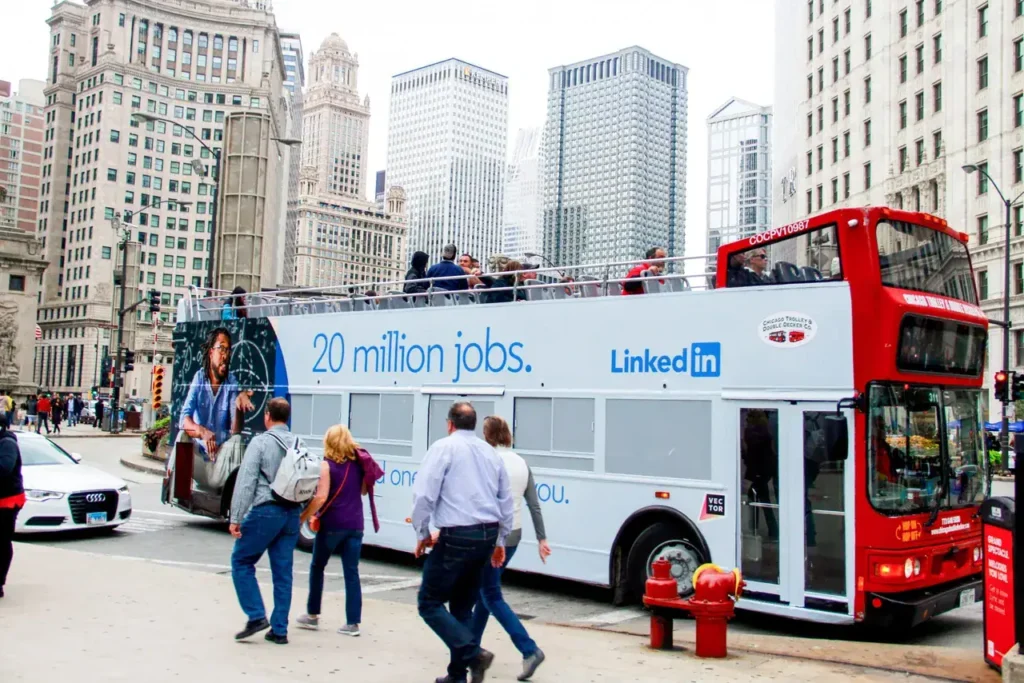
Bus advertising puts your brand on moving vehicles that travel the same routes through the same neighborhoods every day. A single wrapped bus in a dense urban market generates 30,000 to 50,000 daily impressions based on field measurements our team has tracked across campaigns in New York, Chicago, Los Angeles, Miami, and Atlanta. A fleet of 15 buses on targeted routes can saturate a metro market’s awareness faster and more efficiently than most fixed placement strategies at equivalent cost.
Our team at American Guerrilla Marketing has integrated bus advertising into hundreds of multi-format campaigns — pairing transit media with wheatpaste installations, brand ambassador deployments, and sidewalk activations to create the kind of surround-sound market presence that builds brands fast. This guide covers every format, how to think about route selection, what it actually costs in 2026, and how transit advertising combines with ground-level guerrilla tactics for maximum campaign impact.
This is not a beginner’s overview of bus advertising. This is the playbook our team uses when a brand needs to own a market — fast, efficiently, and with documentation that proves the investment delivered.
Why Bus Advertising Works in 2026
The screens-everywhere argument that outdoor advertising was dead missed something fundamental: people still move through physical space. They take the same commute routes. They wait at the same bus stops. They sit on the same transit lines. And when a bus carrying your brand message travels their route six times a day, five days a week, for four weeks — that message is part of their environment in a way no digital ad can replicate.
Frequency and Geographic Reach
A bus running a fixed route logs 60 to 100 miles per day in a major urban market. It passes through multiple neighborhoods, crosses multiple demographic segments, and delivers impressions to pedestrians, motorists, cyclists, and transit riders simultaneously. The route is predictable and repeatable — the frequency of impression builds over a campaign flight in a way that isolated OOH placements cannot match.
CPM Efficiency vs. Other Urban Formats
Transit advertising consistently delivers among the lowest CPMs in outdoor advertising. In major markets, bus advertising CPM runs $0.50 to $2.00 depending on format and market. That compares favorably to digital display ($2 to $5 CPM for broad audiences), broadcast radio ($5 to $15 CPM), and most premium OOH formats. When you need to build awareness efficiently in an urban market, bus advertising is hard to beat on a cost-per-thousand basis.
Bus Advertising Formats and What Each Costs
Transit advertising offers multiple format options, each with different creative dimensions, impression patterns, and cost structures. Here is how the main formats break down:
Full Bus Wraps
A full bus wrap covers the entire exterior of the vehicle with your campaign creative. It is the highest-impact format in transit advertising — a wrapped bus is essentially a moving billboard that stops traffic (sometimes literally) in target neighborhoods. Wraps cover side panels, rear panel, and often the roof in a continuous graphic that turns the entire vehicle into a brand statement.
Full wrap costs in major markets: $3,000 to $8,000 per vehicle per four-week period, depending on market, transit authority, and whether illuminated sections are included. Production of the wrap vinyl adds $1,500 to $3,000 per vehicle for materials and application. Multi-vehicle wrap campaigns (3 to 10 buses) typically receive volume pricing. Lead time for wrap production and approval runs 3 to 5 weeks from artwork approval.
King-Size Exterior Panels
King-size panels (30 inches by 144 inches) run on the driver’s side of the vehicle — the curbside-facing panel when the bus is traveling on the right side of the street. These are the most common transit advertising format and the standard buy for brands that want exterior presence without committing to a full wrap.
King-size panel rates: $500 to $2,000 per bus per four-week period in major markets. Packages of 20 to 50 panels across a route network are the typical minimum buy for brands trying to build meaningful market coverage.
Queen-Size Exterior Panels
Queen-size panels (30 inches by 88 inches) are placed on the curb side of the vehicle — the passenger door side. They are smaller than king-size panels and typically priced lower, but they face the sidewalk directly, making them high-impact for pedestrian audiences at bus stops. Queen-size placements are often bundled with king-size packages for total vehicle exterior coverage.
Tail Panels
The rear panel of the bus — commonly called a tail panel — faces the traffic directly behind the bus during its route. For markets where your audience drives or takes vehicles that follow bus routes, tail panels deliver sustained impressions to drivers stuck behind the bus in traffic. Creative for tail panels should be simple, legible, and attention-grabbing — drivers have 5 to 15 seconds of sustained exposure each time they are behind the bus at a stop or in slow traffic.
Interior Car Cards
Interior cards are displayed inside the bus above the windows or on vertical supports between seats. They reach transit riders during their entire ride duration — average transit ride times in major cities run 15 to 25 minutes, giving interior cards dramatically higher dwell time than any exterior format. Interior placements work best for messages that require reading time: detailed product descriptions, QR code activations, multi-step promotional mechanics, or category-level education content.
Interior card rates: $100 to $400 per card per four-week period. A full interior takeover of all card positions on a single bus runs $800 to $2,000 per vehicle per period. Interior takeovers create an immersive brand environment for the duration of each rider’s trip.
Route Selection: The Variable That Determines Campaign Success
Buying bus advertising without careful route selection is like buying digital ads without audience targeting. The inventory exists. The impressions are real. But if the routes run through neighborhoods where your audience does not concentrate, the campaign delivers volume without value.
How to Identify the Right Routes
Start with your audience profile — demographics, geography, daily movement patterns. Where do they live? Where do they work? What transit routes connect those origins and destinations? Transit authority ridership data, cross-referenced with neighborhood demographic profiles and mobility data from platforms like Replica or Streetlight Data, gives you a route-level audience map before you make a single placement decision.
In practice, this analysis often reveals that 3 to 5 high-priority routes in a market deliver the majority of your target audience impressions — while a broad market buy across 20 routes dilutes spend across many routes with minimal target audience coverage.
Matching Route Characteristics to Campaign Objectives
Express routes (limited stops, high speed) maximize reach across a geographic corridor but minimize dwell at any single location. Local routes (frequent stops, slower speed) build frequency with neighborhood-level audiences and create more stop-and-linger moments for pedestrians at bus stops. Select express routes when your campaign objective is broad market awareness; select local routes when your objective is deep penetration in specific target neighborhoods.
Combining Bus Advertising with Street-Level Guerrilla Tactics
The campaigns that generate the most brand impact in urban markets combine transit advertising’s reach with the close-contact engagement of ground-level formats. Here is how our team typically structures these combined campaigns:
Transit + Wheatpasting for Neighborhood Saturation
Bus routes and wheatpaste installations create a complementary coverage pattern. Buses build awareness at market scale — thousands of daily impressions across a transit corridor. Wheatpaste clusters in key neighborhoods create the up-close, street-level presence that converts awareness into engagement. Riders who see the bus campaign and then encounter wheatpaste in their neighborhood experience a doubling of brand presence that accelerates recognition and recall.
Transit + Brand Ambassadors for Conversion Events
For product launches, app releases, or event promotions, pairing bus advertising with brand ambassador deployments at key transit hubs creates a full-funnel street-level campaign. The bus builds awareness. Ambassadors at the bus stop or transit station create the human touchpoint that drives the action — a sample, a download, a ticket purchase. We have executed this format for CPG brands, entertainment companies, and tech startups. The conversion lift versus bus advertising alone is consistently significant.
Transit + LED Trucks for Event Days
LED billboard trucks provide the flexibility to concentrate presence at specific locations on specific days — event venues, product launch sites, retail locations. When an ongoing bus advertising campaign creates baseline awareness across the market, deploying LED trucks at key conversion events creates concentrated impact at exactly the right moment. The brand presence builds through the transit campaign; the LED truck delivers the peak experience at the event itself.
Production Requirements and Lead Times
Bus advertising production requires more lead time than most advertisers expect. The transit authority review and approval process alone typically takes 7 to 14 business days. Production of vinyl wrap materials for a full bus wrap adds 5 to 10 business days. Installation scheduling through transit authority approved vendors adds additional time. Plan for a minimum 4 to 6 week runway from campaign kickoff to first bus on the street.
Artwork Specifications by Format
Each transit format has specific artwork dimensions and file requirements. King-size panels: 30 by 144 inches, full bleed. Queen-size panels: 30 by 88 inches, full bleed. Tail panels: 21 by 70 inches typically, though this varies by market and vehicle type. Interior car cards: 11 by 28 inches standard, 11 by 42 inches super card format. Full wraps require vehicle-specific templates — templates must be sourced from the transit authority or its approved vendor network.
All files should be delivered as print-ready PDF or TIFF at 100 DPI at 1:1 scale. Color mode: CMYK. Request the vendor’s production guide before finalizing creative — specifications vary by transit authority and market.
Markets Where AGM Sources Transit Advertising
Our team sources and manages transit advertising placements in major markets across the United States. New York City MTA routes across all five boroughs, LA Metro and LADOT DASH routes throughout Los Angeles, CTA routes in Chicago, MARTA routes in Atlanta, MDT routes in Miami, King County Metro routes in Seattle, RTD routes in Denver, and transit networks in 40+ additional markets.
For multi-city transit campaigns, we coordinate with transit authorities and approved vendors in each market simultaneously, managing production, approval, installation, and documentation from our headquarters at Industry City, Brooklyn, NY. Multi-city transit buys coordinated through a single point of contact save significant time and administrative friction compared to approaching each market independently.
Frequently Asked Questions
How much does bus advertising cost?
Bus advertising costs vary by market, format, and duration. King-size exterior panels typically run $500 to $2,000 per bus per four-week period in major markets. Full bus wraps cost $3,000 to $8,000 per vehicle per four-week period plus $1,500 to $3,000 for wrap production. Interior cards run $100 to $400 per card per period. Multi-bus packages in major markets typically start at $15,000 to $30,000 for a meaningful 4-week campaign. Contact our team at (646) 776-2770 for current market rates and availability.
What are the different formats for bus advertising?
Bus advertising formats include full wraps (covering the entire vehicle exterior), king-size panels (30 by 144 inches on the driver’s side), queen-size panels (30 by 88 inches on the curb side), tail panels (rear of the bus), bus shelter displays, interior car cards, and digital interior screens. Each format offers different impression patterns, dwell times, and creative constraints. Full wraps deliver the highest per-vehicle impact; interior cards deliver the highest dwell time and message depth.
How do I select which bus routes to advertise on?
Route selection should be driven by your target audience’s travel patterns. Identify where your target customers live, work, shop, and commute. Cross-reference those neighborhoods with available routes. High-ridership express routes maximize total impressions; neighborhood routes maximize frequency with specific demographics. We recommend working with a media buyer who can access transit authority ridership data by demographic segment to validate route selection before committing budget.
Can I target specific neighborhoods with bus advertising?
Yes. Transit authorities in major cities allow advertisers to select specific routes, which are tied to specific neighborhoods and corridors. By selecting routes through your target neighborhoods, you can concentrate impressions where your audience actually is rather than buying broad market coverage that includes many irrelevant areas. We build neighborhood-specific route maps for every transit campaign we execute.
How does bus advertising compare to billboard advertising?
Bus advertising delivers moving impressions across multiple neighborhoods rather than sitting in one fixed location. This mobility provides geographic reach that fixed billboards cannot match. Billboards offer higher frequency for drivers who travel the same corridor repeatedly. Bus advertising tends to perform better for total market saturation in urban areas; billboards perform better for building frequency-based awareness along specific travel routes. For maximum coverage, combining both formats is more effective than either alone.