
November 3, 2026
Box Truck Advertising: How It Actually Works
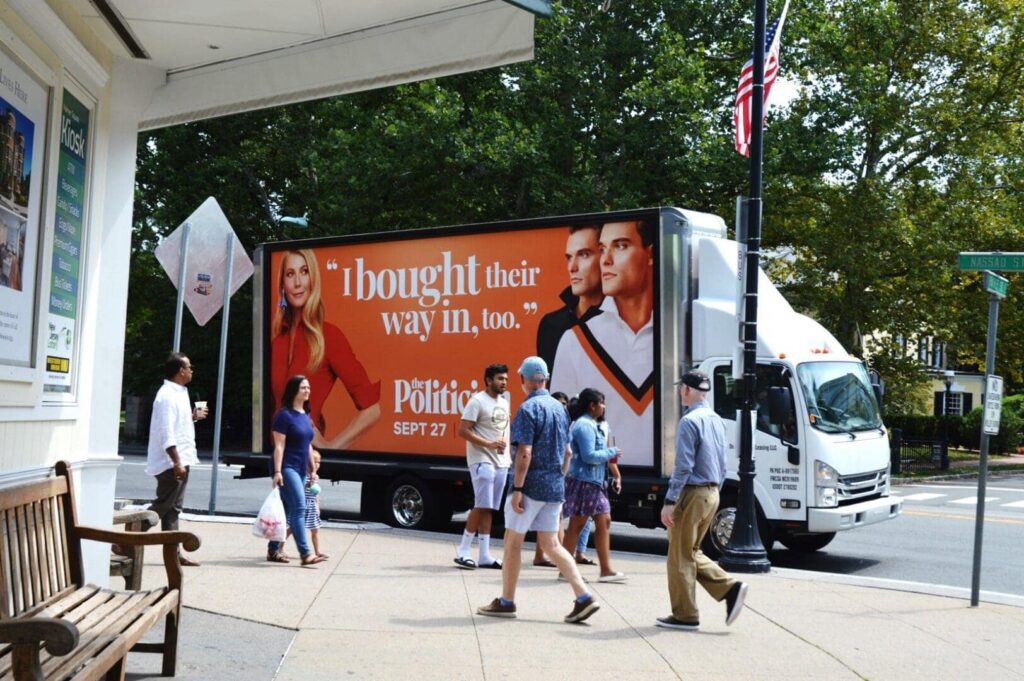
Most people who call us about box truck advertising have already pictured the thing in their head. A clean white truck, a huge graphic down the side, driving slowly past the exact crowd they want. They picture it parked somewhere useful. They picture people looking.
That picture is mostly right. What it leaves out is everything that decides whether the campaign works: where the truck is allowed to sit, how long it can sit there, how the driver handles a route that turns into a parking lot, and what happens when the venue you were orbiting lets out forty minutes earlier than the schedule said.
I have run these routes. I have watched a perfectly good graphic get swallowed by a scaffold shadow for three hours because nobody checked the block in person.
So this is the operator version. What a box truck campaign actually is, how it runs, what it is genuinely good at, what it is bad at, and the times we tell a client to spend the effort on something else.
What box truck advertising actually is
A box truck is a straight truck with a rigid cargo body, the squared-off shape you see on every moving and delivery route in the country. In advertising terms it gives you three large flat planes: two long sides and a rear door face. Sometimes a fourth if the front of the box is visible over the cab.
Those planes are the product. They are big, they are flat, they are at eye level for anyone on a sidewalk, and they move.
There are two broad ways the graphic gets onto the truck.
The first is a printed vinyl wrap or panel applied directly to the box. This is the version most buyers imagine. It looks like a billboard bolted to a vehicle because functionally it is one.
The second is a frame system mounted to the box that holds a changeable printed face. This matters more than it sounds. A frame lets you swap creative between flights without re-wrapping, which changes what kind of campaign the format can support.
Then there is the category people often mean when they say box truck but are actually describing something else: an LED truck. That is a box truck chassis carrying illuminated digital screens instead of printed panels. Same vehicle class, completely different behaviour after dark, completely different operating constraints. I will come back to that, because the choice between printed and illuminated is the single most consequential decision in this format and most buyers make it for the wrong reason.
The three jobs this format is genuinely good at
I will be blunt about the limits in a minute. First, where it earns its place.
Putting a message where no fixed inventory exists. Static outdoor inventory sits where somebody built it, often decades ago, usually along arterial roads and highway approaches. A lot of the places a brand actually wants to reach have no inventory at all. Dense retail corridors. Campus edges. Convention districts. Event perimeters. Neighbourhoods where the planning environment never allowed structures. A truck goes where the structure is not.
Owning a moment instead of a month. Fixed outdoor sells time. A truck sells presence at a specific hour in a specific place. If your objective is tied to a day, a doors-open time, a conference, a product drop, a game, a truck can be exactly where the crowd is for exactly as long as the crowd exists, then leave.
Being obviously deliberate. A static board is part of the landscape and people filter it. A vehicle carrying one message, orbiting a block people are standing on, reads as intentional. It gets photographed. That is a real effect and it is the reason a lot of launch work uses the format.
Those three things are what you are buying. If your objective is not one of them, keep reading, because I am probably about to argue you out of it.
How a campaign actually gets built
Here is the real sequence, in the order it happens.
Route design comes before creative
This is backwards from how most buyers approach it and it costs them.
Before anyone designs a graphic, we want to know the route. Not a vague area. The actual loop: which streets, which direction, which hours, where the dwell positions are, where the truck turns around, where it refuels, where the driver can legally stop to use a bathroom on a ten hour shift.
Route design is physical work. Somebody has to look at the corridor, ideally on the ground and at the time of day the campaign will run. Satellite imagery lies about current conditions. It does not show the construction hoarding that went up last month, the bus lane that now runs where you planned to crawl, the loading restrictions painted on the kerb, or the fact that the left turn you need has been banned at peak.
We check for height restrictions the same way. A box truck is tall. Parking structures, older underpasses, certain downtown service streets and a lot of historic districts are simply out. Finding that out on the day is a wasted shift.
Then the creative gets designed to the route
Once the route exists, the creative brief writes itself, because the viewing distance is now known.
A truck crawling a dense sidewalk corridor is read from maybe a lane away, by someone walking. You can use more detail, a smaller logo, a real line of copy. A truck holding a position across a wide plaza or moving on a multilane arterial is read from much further and at speed. Then you are down to a few words and a shape.
The single most common creative failure in this format is designing one file and running it on both kinds of street. It is unreadable on one of them.
Other hard-won creative rules.
Put the important element high on the panel. The bottom band of a box side gets blocked constantly by parked cars, street furniture, bollards, bus shelters, other traffic and people. Anything load-bearing that sits low will be hidden for a large share of the campaign.
Design the rear door face separately. It is a different aspect ratio and it has a completely different audience: drivers stopped behind you, who have longer dwell than anyone on the sidewalk. That face can carry more information than the sides.
Respect the body hardware. Box bodies have rivets, seams, door tracks, rub rails, lights and hinges. A face across a door gap will split. A fine typeface over a rivet line degrades. We mark the hardware before artwork is finalised.
Then the build
A full wrap application is a controlled job, not a parking lot job. It wants a clean indoor space, a stable temperature, surfaces degreased properly, and time for the adhesive to set before the vehicle goes out in weather. Vinyl applied cold or onto a contaminated panel lifts at the edges, and once an edge lifts, airflow at road speed finishes it.
Frame-mounted printed faces are quicker and are the better answer when creative changes mid-flight or when the same vehicle serves multiple campaigns.
Build time is the part of the schedule clients compress and then regret. Print, finish, application and cure all take real days. Coming to us the week before a launch usually means either a frame system or a reduced footprint, because we are not going to apply a wrap badly to meet a date.
Crew, hours and what a shift actually looks like
A printed box truck campaign is typically one driver per vehicle per shift. That is the baseline.
The moment the campaign involves anything other than driving, the crew grows. Street Teams working alongside the vehicle, sampling, scanning, handing something out, managing a queue, those are additional people with their own briefing, their own timing and their own supervision. We staff that separately and we say so, because a driver cannot run a route and manage a crowd at the same time.
Shifts are built around when the audience exists, not around a tidy workday.
Daytime retail and business district routes generally run mid-morning through evening, with the real value concentrated in a few windows: morning arrival, lunch outflow, evening release. The hours in between are transit time, and honest route planning accepts that.
Event work is the opposite shape. Long staging period, short period of intense value, then a scramble. Arrive early, hold a position while it is still easy to get one, work the inflow, hold through the event, then be positioned for the outflow. Outflow is usually the best twenty minutes of the entire shift and it is the part most often missed, because the truck went for fuel.
Night work changes the format completely. A printed panel at night is only as visible as the ambient light falling on it. Under good street lighting it reads fine. On a dark stretch it is a grey rectangle. This is the single honest argument for illuminated vehicles, and it is the one I will make.
Printed panels or LED screens
Buyers usually choose between these on the basis of which looks more impressive in a photograph. Wrong criterion. Choose on when your audience is outside.
Printed panels are the right answer for daytime campaigns. They are legible in direct sun, they have no power dependency, nothing on the vehicle can fail in a way that blanks your message, and the full panel area is yours. A wrap works the same at hour one and hour nine.
LED Trucks and Mobile Billboards are the right answer when the audience is out after dark, when the campaign needs motion or multiple sequential messages, or when the vehicle has to compete with a bright environment like an entertainment district where every surface is already lit. A lit screen in a dark corridor is not comparable to a printed panel. It dominates.
The trade-offs on LED are real and I would rather state them than sell around them. Screens draw power, which means a generator and fuel logistics. Direct sun washes out a screen far more than people expect, so the daytime advantage is smaller than the pitch suggests. The usable screen area is generally smaller than a full printed side. And there is more to fail.
The honest default: daytime and all-day coverage, print. Evening and night, dark environments, or motion in the creative, LED. Campaigns that genuinely span both sometimes want both, and if the scope only supports one vehicle, we pick for the hours that matter most to the objective and say plainly what is being given up.
If you want the full operational picture on the illuminated side, that is our LED Trucks & Mobile Billboards service line and it is written with the same level of detail as this.
Permissions, ordinances and the grey area
I am not a lawyer and nothing here is legal advice. What I can describe is how this works operationally and what we see market to market.
Mobile advertising sits in a grey area in a lot of the country. The vehicle is on a public road, legally registered, insured and driven like any other commercial vehicle. That part is unremarkable. The question that varies is whether a municipality treats a vehicle whose primary purpose is carrying advertising as a vehicle or as a sign.
Some cities have specific provisions addressing advertising vehicles. Some address stationary parking of them. Some restrict certain districts, certain hours, or illuminated displays near residential frontage. Many have nothing specific at all and the matter is handled through ordinary parking and traffic enforcement. Enforcement is inconsistent even inside a single city, and it can vary by precinct, by event, by who is on duty.
So the honest framing is this: it varies by municipality, it depends on how the vehicle is being used, and it is a grey area rather than a settled yes or no.
What we do about it is concrete.
We research the specific jurisdictions on a route before the route is confirmed, and we flag the ones where the posture is restrictive or unclear.
We design routes around movement rather than prolonged stationary display where the local posture is uncertain. A moving vehicle is far less contentious than a parked one almost everywhere.
Where a campaign genuinely needs the truck to hold a position for a long stretch, we look for private property with an owner who can grant permission. A lot with a cooperative owner on the right corner beats a kerbside position you are going to be moved off. Permission in hand changes the whole character of the activation.
We brief drivers to comply immediately and without argument if asked to move. There is no campaign objective worth escalating a street interaction over.
We document the campaign as it runs with timestamped photography, which protects everyone.
And we tell clients when the thing they are asking for is likely to generate friction, rather than taking the booking and letting them find out.
What goes wrong
Every format has characteristic failures. Here are this one’s.
Traffic eats the route. The corridor you chose because it has the most people also has the most congestion. A truck stuck motionless in a jam is not a campaign. We plan loops with genuine escape options and we accept lower theoretical exposure on a route that actually flows.
Shadow and sun angle. Dense downtown corridors are in shadow for much of the day. Print handles this far better than screens, but a dark corridor plus a dark creative is still a weak combination. We look at which side of the street the route runs on and at what time, and sometimes reverse the loop direction for that reason alone.
Weather. Heavy rain does not damage a properly applied wrap but it empties sidewalks, which is the actual problem. Wind is a consideration for any added rigid signage. Extreme cold makes vinyl brittle and makes application impossible outdoors. Extreme heat softens adhesive and punishes any edge that was not fully sealed. Summer in the south and winter in the north both shrink the usable application window.
Edge lift. The classic wrap failure. It begins at a corner, a seam or a door edge, usually from a rushed application or an unclean panel, and road speed does the rest. Inspected at the start of each shift, caught early, it is a small repair. Ignored, it costs a panel.
Route drift. Over a long flight, drivers naturally optimise for easier driving rather than for exposure. Without route discipline and check-ins, week three looks nothing like week one. We track it.
The schedule nobody verified. Events start late, let out early, move gates, and change entry flow. If the plan assumed a published schedule and nobody confirmed on the ground, the truck is in the right city on the right day in the wrong place.
What we talk clients out of
This is the part I think is actually worth your time.
Covering a whole metro with one truck. One vehicle covers one corridor well or several corridors badly. Spreading a single truck across a large market produces a route that is mostly transit between places where nobody sees it. If the scope supports one vehicle, we would rather own one corridor convincingly.
Long static-equivalent flights. If the objective is sustained presence in a defined area over weeks, a truck is an expensive and fragile way to achieve it. Posters across a corridor are in position every hour of every day without a driver, without fuel and without traffic risk. That is when I point people to Wheatpasting & Poster Campaigns instead, and sometimes that is the whole recommendation.
Dense creative. Four lines of copy, a QR code the size of a coaster, three logos and a hashtag. On a moving vehicle this is noise. One idea, large, high on the panel.
A QR code as the primary response mechanism on a moving side panel. People do not scan a moving target. On the rear door, stopped in traffic, a code can work. On a side panel in motion it is decoration. Say the name instead.
Illuminated screens for a daytime campaign. Covered above. Buyers want the screen because it photographs well in the proposal. If the audience is out at noon, print is better and more reliable.
Last-minute full wraps. If the date cannot move and the wrap cannot be done properly, we offer a frame system or a reduced application rather than rushing adhesive. A wrap that fails in week one is worse than a smaller wrap that holds.
How it fits with everything else
Box trucks are strongest as the moving element inside a campaign that also has fixed elements.
The pattern that works: posters build the corridor over the run so the message is present constantly, a truck adds pressure on the days that matter, and a street team converts attention into something measurable at the moment of peak density. Each format covers another one’s weakness. Posters have no staff and cannot answer a question. A truck has reach but no dwell. A team has dwell but no scale.
Ground-level formats fill the remaining gap. Sidewalk Decals & Stencils reach people looking down at a crossing, which is where a surprising share of urban attention actually is, and they work at a size and distance no vehicle panel can match. For evening work in districts where the audience only appears after dark, projection and LED carry the hours when print goes quiet.
I would rather sell a smaller truck component inside a campaign that holds together than a bigger one standing alone.
Frequently asked questions
How many trucks do I need for one city?
It depends on corridor count, not city size. One vehicle covers one busy corridor properly across a shift. If your objective touches a downtown core, a campus edge and a stadium district on the same day, that is three separate routes and one truck cannot serve them. We would rather run one corridor convincingly than three thinly.
Can the truck park and stay in one spot all day?
Sometimes, and it depends entirely on location and permission. Kerbside stationary display is the part of this format most likely to attract attention from local enforcement, and the posture varies by municipality and is inconsistently applied. Where a campaign needs a long hold, we seek private property with owner permission instead of relying on a public kerb.
How long does a printed wrap last?
A properly applied wrap on a clean, prepared surface holds through a normal campaign flight and well beyond, often through multiple seasons. Failures are almost always application failures rather than material failures: a contaminated panel, an unsealed edge, or application in cold. We inspect edges at the start of every shift and repair early.
Is an LED truck better than a printed one?
Neither is better. They suit different hours. Print wins in daylight, costs nothing in power, and cannot blank out. LED wins after dark, in brightly lit districts, and when creative needs motion or multiple messages. Choose based on when your audience is actually outside, not on which looks better in a proposal deck.
What creative works best on a box truck?
One idea, placed high on the panel, readable at the distance your route creates. The bottom third gets blocked by parked cars and street furniture, so nothing important goes there. Design the rear door face separately, since drivers stopped behind you have real dwell time and can absorb more detail than anyone on a sidewalk.
How quickly can a campaign launch?
Frame-mounted printed faces move fastest because there is no adhesive cure. Full wraps need print, finish, application and cure time, and that sequence does not compress safely. Route research adds time in unfamiliar markets, since corridors need checking on the ground. Bring us in earlier and you get the route you want rather than the one that is left.
Request a campaign quote
If you are weighing box truck advertising for a launch, an event or a corridor you cannot reach with fixed inventory, tell us the objective and the dates rather than the format. We will tell you honestly whether a truck is the right tool, whether posters or ground-level work would serve you better, and what the route would actually look like on the ground.
Request a campaign quote and we will come back with a real plan: corridors, hours, crew and the constraints we already know about in your market.

Ready to Run Your Campaign?
Call us or email us. We’ll tell you exactly what we can do in your market and what it costs.
Related Services
Explore similar advertising solutions offered by American Guerrilla Marketing.
American Guerrilla Marketing — Los Angeles
Street-level campaigns in Los Angeles and nationwide. Wheatpasting, LED trucks, street teams, and more.
(646) 776-2770
Related Articles
-
LED Trucks & Mobile Billboards in Knoxville, TN
November 4, 2026
-
Trailer Billboard Advertising Formats: How Installs Work
November 4, 2026
-
Digital Billboard Truck: How It Actually Works
November 3, 2026
-
Mobile Billboard Campaign Minimums: An Honest Breakdown
November 3, 2026
-
Renting vs Buying an LED Truck: Where Each One Works
November 3, 2026