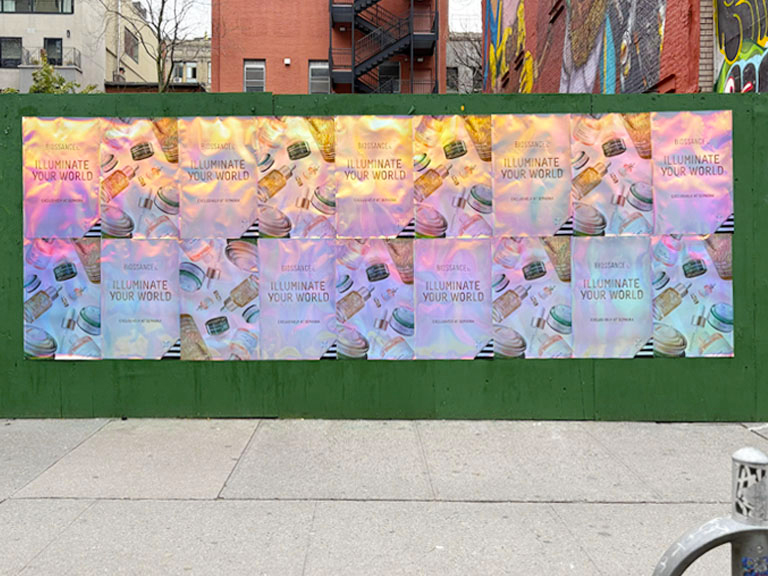
Wheat Paste Poster Campaigns NYC | American Guerrilla Marketing
We have been running wheat paste poster campaigns across New York City for years. Our crews know every scaffolding run on Bedford Avenue in Williamsburg, every plywood barrier lining the Canal Street construction corridor, every wide-open wall on Wyckoff Avenue in Bushwick. We have applied posters in January sleet and August heat. We have scouted corners at noon and installed them at 2 AM. This is street-level brand work done by people who actually know the streets.
A wheat paste poster campaign puts your brand in front of the people who live, work, and move through the neighborhoods you care about. It does not get scroll-past. It does not disappear behind an ad blocker. It sits on the wall your audience passes every morning on the way to the subway. That kind of daily repetition builds recognition in a way that a single digital impression simply cannot match.
This guide covers the mechanics, geography, pricing, and creative strategy behind wheat paste poster advertising in New York City. If you are thinking about your first campaign or trying to decide how to structure your next one, that’s where to start.
What Wheat Paste Poster Advertising Actually Delivers
How the Format Works
Wheat paste is a flour-and-water adhesive that has been used to apply printed materials to surfaces for more than a century. Our crews mix fresh batches before every installation run. We apply paste to the surface with a wide brush, press the poster into the paste, smooth it flat, and apply a topcoat to seal the edges. When done properly, a wheat paste poster bonds to the surface and holds up to weather, foot traffic vibration, and the general hostility of a New York City exterior wall.
The surfaces that accept wheat paste best are construction hoarding, wooden scaffolding planks, painted plywood barriers, and certain concrete walls. Our scouting team evaluates every proposed location before a campaign map is finalized. We do not put placements on surfaces that will not hold. That pre-campaign work is why our posted locations stay up for the duration of the run.
Why the Format Works in 2026
People walk more in New York than almost anywhere else in the country. A person living in Bushwick who commutes to Manhattan walks past several dozen advertising surfaces every single day. A wheat paste poster at eye level on the scaffolding between their apartment and the L train gets seen seven days a week, sometimes multiple times a day. That accumulated exposure is the core of what wheat paste poster campaigns deliver: frequency in a defined geography.
We run wheat paste poster campaigns alongside digital campaigns for a lot of our clients. The combination works well. Someone who sees your brand on a screen and then sees it on the wall of a block they walk every day experiences a different kind of brand encounter. The street presence makes the brand feel real. It shows up in the physical world where they actually live, more than in the algorithmic spaces where their attention is being competed for by hundreds of other messages at the same time.
Brand recall data consistently shows that repeated physical exposure to a message at a fixed location outperforms single-exposure digital exposures on recognition metrics. We cite this not to make a case against digital, but to explain why clients who integrate street poster campaigns into their media mix report stronger brand lift numbers than those running digital alone.
Who Uses Wheat Paste Poster Campaigns
Our wheat paste poster clients range from streetwear brands launching a single colorway to multi-national consumer goods companies doing neighborhood-level geo-targeted campaigns. Film distributors use wheat paste poster runs to build awareness for limited theatrical releases in the weeks before opening. Restaurant groups use them to build buzz before a new location opens. Music labels use them around album drops and tour announcements. Tech companies use them for product launches and app downloads. Nonprofits use them for community awareness and event promotion.
The format is accessible at a range of budget levels. A focused neighborhood campaign of 30 to 50 locations in a single Brooklyn or Manhattan corridor can be executed for a fraction of what a transit shelter buy costs, and it delivers higher frequency per dollar in the target geography than almost any other outdoor format.
Where Our Crews Run Wheat Paste Poster Campaigns in NYC
Lower Manhattan and SoHo
Our most requested Manhattan campaign zone covers SoHo, Tribeca, and the Canal Street corridor. The primary focus area runs from Canal Street north to Houston Street, and from the West Side Highway east to the Bowery. This zone captures the creative and retail traffic that flows through SoHo’s gallery and boutique district every day.
The anchor locations in this zone include the scaffolding on Broadway between Prince and Spring Streets, the hoarding on Canal between Broadway and Mercer, the plywood barriers on Grand Street near Wooster, and the construction surfaces along Lafayette Street between Canal and Houston. Scaffolding turns over frequently in this zone due to ongoing building renovation, which creates fresh surfaces that take paste cleanly.
We run campaigns here for fashion and footwear brands, gallery openings, film releases, and consumer goods clients targeting the downtown creative and retail audience. Daily foot traffic in the SoHo core exceeds 40,000 pedestrians on the primary blocks.
Brooklyn’s Highest-Traffic Corridors
Our Brooklyn wheat paste poster operations concentrate on four corridors. The Bedford Avenue strip from North 7th Street to Grand Street in Williamsburg is our highest-demand Brooklyn zone. This strip carries the foot traffic of the L train at Bedford Avenue, the boutiques and cafes along the avenue, and the weekend crowd moving toward the Williamsburg waterfront. Scaffolding on this stretch holds campaigns well and gets seen by a diverse mix of residents, visitors, and commuters.
The second Brooklyn corridor is Flatbush Avenue between Atlantic Avenue and Empire Boulevard, covering the Crown Heights and Prospect Lefferts Gardens neighborhoods. This corridor has seen significant new commercial activity over the past several years and now carries daily pedestrian counts in the high tens of thousands. Clients targeting a Brooklyn-wide audience find that Flatbush Avenue placements cover a demographic range that the Williamsburg corridor alone does not.
Our third Brooklyn zone centers on the Wyckoff Avenue and Myrtle Avenue intersection in Bushwick, extending east along Flushing Avenue toward the Rheingold development area. Bushwick’s outdoor art culture means that street-level poster campaigns fit naturally into the visual environment of the neighborhood. Our crews find good surfaces here consistently, and campaigns in this zone tend to generate organic social media pickup from residents who photograph and share the installations.
The fourth Brooklyn corridor is Smith Street in Carroll Gardens from Atlantic Avenue to 9th Street. This dense strip of restaurants, bars, and boutiques carries strong evening and weekend foot traffic from the Carroll Gardens and Cobble Hill residential base. For food, beverage, and lifestyle brands targeting Brooklyn’s southern neighborhoods, Smith Street placements consistently outperform reach-based media buys on a cost-per-impression basis.
Manhattan Neighborhoods Beyond SoHo
The Lower East Side is one of our most active Manhattan campaign zones outside of SoHo. The Orchard Street and Rivington Street corridors from Houston to Delancey carry a mix of longtime residents, weekend visitors, and the nightlife-oriented foot traffic that makes the Lower East Side one of the city’s most culturally dense neighborhoods. Scaffolding on Orchard Street between Stanton and Delancey is a reliable location for campaigns targeting the streetwear and music audience.
In Harlem, we concentrate wheat paste poster campaigns on the 125th Street corridor between Frederick Douglass Boulevard and Lenox Avenue. This stretch includes the Apollo Theater, major retail and restaurant anchors, and some of Manhattan’s highest foot traffic counts north of Midtown. For brands targeting a Harlem-specific or upper Manhattan audience, 125th Street placements are the anchor location.
Washington Heights placements along 181st Street between Fort Washington Avenue and Broadway reach a dense commercial and residential corridor served by the A and 1 train stops at that intersection. This area is underserved by traditional outdoor advertising buys and delivers strong frequency for campaigns targeting the northern Manhattan community.
Queens and The Bronx
Our Queens wheat paste poster campaigns concentrate on two corridors. Roosevelt Avenue from 74th Street to 90th Street in Jackson Heights carries some of the borough’s highest pedestrian density, driven by the 7 train at 74th Street and the dense commercial strip along that stretch. Steinway Street in Astoria between 31st Avenue and Astoria Boulevard is our second primary Queens location, serving the Astoria residential base and the commercial anchor tenants along Steinway.
In The Bronx, Fordham Road between the Grand Concourse and Jerome Avenue is our primary campaign zone. This corridor serves one of the borough’s densest commercial intersections and carries foot traffic driven by retail, transit, and the nearby Fordham University campus. Consumer goods brands targeting Bronx-based audiences find consistent performance from Fordham Road placements.
The Wheat Paste Poster Campaign Process From Start to Finish
Campaign Briefing and Location Scouting
Every campaign starts with a briefing call. We want to know who your audience is, which neighborhoods they live and move through, what your campaign message is, and how long you want to run. From that conversation, we build an initial campaign map with proposed locations in each target zone.
Before the map is finalized, our scouting team walks every proposed location. We are looking at surface condition, paste compatibility, viewing angle from the sidewalk, and existing poster density. We document every approved location with GPS coordinates and photographs. If a surface changes between the scout and the installation date, which happens regularly in active construction zones, we activate backup locations from the same corridor so the campaign coverage stays intact.
Print Production and Material Selection
We manage print production in-house or through our Long Island City production partners, depending on volume and format requirements. Standard campaigns use 60 lb or 80 lb uncoated stock, which accepts paste and topcoat well and holds up to weather for the standard two-to-four-week campaign window. High-moisture locations or longer campaign durations call for heavier stock or a laminated face sheet that extends poster life.
Print turnaround is typically three to five business days from approved files. We provide detailed print specifications to any client supplying their own files, and we proof-check every file before sending to production. A print error discovered at the installation stage costs time and money for everyone. We check carefully to avoid it.
Installation Night Operations
Our installation crews work overnight, typically starting between midnight and 1 AM and finishing before the morning commute. Two-person crews handle each van: one person applies the paste, one positions the poster and smooths it flat. An experienced crew covers 30 to 50 installation sites per night depending on location density and driving time between stops.
Every installation is documented with a geo-tagged photo and timestamp. Clients receive a full installation report within 24 hours of the first campaign night. The report includes photos of every posted location, a map of all placements, and GPS coordinates for each site. We use this documentation internally for maintenance scheduling and share it with clients who want to see their campaign in the field.
Campaign Maintenance and Monitoring
Wheat paste posters in active New York City environments get covered by other posters, worn by weather, or compromised by surface changes over the course of a campaign. We include one maintenance pass in every standard campaign package, scheduled at the campaign midpoint. Longer campaigns of four weeks or more include two maintenance passes. We prioritize maintenance on the anchor locations in each campaign zone, the highest-traffic corners and scaffolding runs where fresh coverage matters most.
Our monitoring team photographs all campaign locations weekly and flags sites that need early maintenance. If an anchor location deteriorates significantly before the scheduled maintenance pass, we send a crew to refresh it ahead of schedule. Clients do not need to track this. We handle it as part of the campaign management service.
Wheat Paste Poster Sizes, Formats, and Pricing
Standard Format Options
Our most commonly requested wheat paste poster format is the 24×36 inch single sheet. This size fits the majority of scaffolding panels and plywood barriers in New York City construction zones. It is readable from 20 feet in good light and visible from across a two-lane street. For brands running their first wheat paste poster campaign, the 24×36 format is our standard recommendation.
The 27×40 inch one-sheet format, sized to match the standard film industry poster dimensions, offers more creative space for complex layouts and is our second most requested size. It works well on taller panels and scaffolding sections where vertical space is available.
For higher-impact placements on wide scaffolding runs, our 48×72 inch double-panel format creates a unified image across six feet of wall space. We execute these on extended scaffolding stretches on blocks like Houston Street in SoHo or Flatbush Avenue near Atlantic Terminal, where long hoarding runs give us the horizontal space to build them properly.
Our largest standard format is the 4×8 foot single-sheet poster, printed on wide-format equipment. This size delivers exceptional visual impact on corner locations and wide exterior walls, and it draws attention from a half-block away on clear days.
Campaign Pricing Overview
Wheat Paste Poster Campaign Pricing, New York City
Format
Dimensions
Best Surface
Starting Price (50 locations, 2 weeks)
Standard Single Sheet
24×36 in
Scaffolding, hoarding, walls
$3,500
Film One-Sheet
27×40 in
Tall scaffolding sections
$4,200
Double Panel
48×72 in
Wide scaffolding runs
$5,800
Large Format
4×8 ft
Corner walls, wide barriers
$7,500
Multi-Panel Build
Custom
Extended scaffolding runs
From $12,000
All prices include location scouting, paste mixing, overnight installation by a two-person crew, geo-tagged installation documentation report, and one midpoint maintenance pass. Print production is quoted separately based on quantity, format, and material specifications. We can provide an all-in budget estimate that includes both production and installation once we have a location count and format confirmed.
Comparing Wheat Paste Posters to Other Outdoor Formats
Wheat paste poster campaigns deliver the strongest cost-per-impression numbers in targeted neighborhood zones. When your objective is building brand recognition in a specific corridor, the format outperforms broader-reach options on budget efficiency. When your objective is citywide reach, transit shelter or digital OOH formats are more appropriate and we can help you plan those buys as well.
Creative Strategy for Wheat Paste Poster Campaigns
Designing for the Street-Level Perspective
Your audience encounters a wheat paste poster from a moving sidewalk. They are walking, usually at a pace that gives them two to three seconds of contact time with any single surface. Your creative needs to communicate the essential message in that window. Complex layouts with fine print and layered visual information underperform at street level. Bold, simple, high-contrast designs consistently outperform them.
Our core design recommendations for wheat paste poster formats are these: use strong contrast between background and foreground, limit the layout to one primary visual idea, make the brand mark readable from 20 feet, and put any call-to-action element at chest height where it can be read without slowing down. If a QR code is part of the layout, it needs to be large enough to scan from a standing position at arm’s length.
Color choices matter more at street level than on screen. High-saturation colors, neon palettes, and bright primaries cut through the ambient visual noise of a busy New York block. Muted, sophisticated palettes can work when the typography is strong and the layout is clean, but they require a more deliberate approach to remain legible against the visual competition of a commercial corridor.
Matching Creative to Neighborhood
The visual culture of each New York City neighborhood is distinct. A campaign running in Bushwick can use a more graphic, art-informed aesthetic and it will fit naturally into the visual environment. The same design running on a Midtown scaffolding run might feel incongruous with the surrounding commercial signage. We brief every campaign with neighborhood context in mind and flag when we think a creative direction is likely to underperform in a particular zone.
Campaigns that feel local consistently outperform campaigns that feel imported. Referencing specific blocks, subway lines, or neighborhood landmarks in the copy adds a layer of relevance that a generic citywide message misses. We have seen significant differences in social media pickup between campaigns with location-specific copy and identical campaigns with generic messaging. The local version gets photographed and shared more often. That earned reach is worth building into your creative strategy.
Campaign Timing and Seasonal Considerations
New York City foot traffic patterns shift significantly by season. Spring and summer campaigns in outdoor-heavy neighborhoods like the Williamsburg waterfront area, the SoHo retail corridor, and the Harlem 125th Street strip benefit from the increased pedestrian density that warm weather brings. Fall campaigns around product launches and seasonal retail moments are among our busiest. Winter campaigns are viable in high-traffic indoor-adjacent locations like subway entrance corridors and transit-adjacent hoarding, where foot traffic remains strong regardless of temperature.
We factor seasonal foot traffic patterns into our campaign location recommendations. A summer campaign for a food brand might emphasize outdoor restaurant-adjacent locations in Park Slope and Williamsburg. The same campaign in January would shift emphasis to transit corridor placements and indoor-adjacent walls in the same neighborhoods.
Frequently Asked Questions
How long do wheat paste posters stay up?
In typical New York City conditions, a well-applied wheat paste poster holds for two to four weeks. High-traffic locations in SoHo and central Williamsburg see faster turnover because those surfaces attract more competing poster activity. Quieter side-street locations in residential neighborhoods often hold for the full campaign duration without maintenance intervention. Our standard campaign packages can include maintenance passes when longer coverage is required.
What surfaces work best for wheat paste poster installation?
Construction hoarding, wooden scaffolding planks, painted plywood barriers, and rough-textured concrete walls are the most receptive surfaces. Smooth metal, glass, and factory-sealed surfaces do not hold paste reliably. Our pre-campaign scouting process identifies which specific surfaces in the target zone will perform, so every location on the campaign map is one we have confirmed will hold a poster properly.
How many locations do you recommend for a first campaign?
For a first campaign targeting a single Brooklyn or Manhattan neighborhood, we recommend a minimum of 30 locations. At that density, your audience in the target zone encounters the campaign multiple times per week as they move through their daily routine. Campaigns below 30 locations in a single neighborhood tend to feel sparse and miss the frequency effect that makes the format work. Our standard campaign recommendations are adjusted based on the target area, audience, and campaign objectives.
Can you manage print production and installation together?
Yes. We manage print production through our Long Island City production partners and handle every step from file prep to proofing to delivery. Clients receive a single invoice covering production and installation. If your brand has a preferred print vendor, we coordinate directly with them using our standard technical specifications.
How fast can you launch a campaign?
With print-ready files in hand, we can launch a campaign within five to seven business days of contract execution. Campaigns requiring print production from client-supplied creative assets typically need ten to fourteen days from file receipt to first installation night. Rush timelines are possible for some formats and locations. Contact us to discuss your specific launch date and we will tell you what timeline is realistic for the campaign.
What documentation do you provide after installation?
Every campaign includes a full installation report delivered within 24 hours of the first installation night. The report contains geo-tagged photographs of every posted location, timestamp records for each installation, and a map showing the full campaign coverage area. Maintenance passes receive the same documentation treatment so clients can track campaign condition throughout the run.
Can wheat paste poster campaigns run alongside other marketing formats?
We design and execute multi-format campaigns regularly. Wheat paste poster runs pair effectively with street team distribution, branded projection, mural advertising, outdoor event activations, and digital out-of-home. Clients planning a neighborhood-level product launch or retail opening often combine a poster run with street team activity to cover both the ambient visual layer and direct consumer engagement.