Poster Size Examples: Real-World Guide to Every Format
Concrete examples of how every standard poster size gets used in the real world. From 11×17 bulletin boards to 36×48 transit panels, here’s what each size actually looks like in practice.
Concrete examples of how every standard poster size gets used in the real world. From 11×17 bulletin boards to 36×48 transit panels, here’s what each size actually looks like in practice.
Looking at a list of poster sizes with dimensions is useful. But what makes the sizes click is seeing real-world examples of where and how each size gets used. That context turns an abstract set of numbers into a practical decision-making framework.
We run poster campaigns for a living. Our crews are on the streets of New York, Los Angeles, Chicago, and other major cities placing posters of all sizes for brands, musicians, event promoters, and agencies. The examples in this guide come from direct experience, not theory.
The 11×17 is the smallest size most people call a poster. Here are concrete examples of where this size appears in the real world.
Community Bulletin Board Announcements
Walk into a coffee shop in Park Slope in Brooklyn, a laundromat in Pilsen in Chicago, or a community center in Silver Lake in LA. The bulletin boards in these places are covered in 11×17 notices. Local bands advertising shows. Tutoring services. Dog walkers. Community events. The 11×17 is the lingua franca of the community board because it’s cheap, easy to carry, and fits on the board without dominating it.
Campus Posting Campaigns
Universities and colleges have specific posting areas where 11×17 is the standard. A student organization advertising a speaker event or a campus group promoting a fundraiser prints a few hundred 11×17 sheets and covers the approved posting areas. This format works because it’s affordable at scale and fits within posting area size limits.
Inside Venue Corridor Displays
Some venues display 11×17 posters on inside corridor walls or inside bathrooms. These are close-viewing locations where the 11×17 is entirely adequate. The viewer is standing 2 to 4 feet away. At that distance, an 11×17 reads as well as a 24×36 would from 20 feet.
11×17 in practice: This size works when you need volume and cost is a primary concern. Print 500 of these for the price of 100 to 150 at 18×24. Use it for distribution-heavy campaigns where saturation matters more than individual piece impact.
18×24 Poster Size Examples
The 18×24 is the most widely used indoor poster size in US advertising. Here’s where you see it.
Venue Window Promotion
Every bar, club, and music venue in every major US city uses 18×24 for window promotion. A club on Dekalb Avenue in Fort Greene, Brooklyn posts 18×24 posters announcing upcoming shows. A venue on Colfax in Denver posts 18×24 for its monthly events. This is the universal format for venue window work across the country. The size fits the snap frames that venues install in their windows as permanent display infrastructure.
Retail Point-of-Sale Displays
Inside retail stores, the 18×24 handles point-of-sale advertising. A clothing store on Bedford Avenue in Williamsburg uses 18×24 to announce a sale. A bookstore on North Clark in Lincoln Square uses 18×24 for author signing events. A record store on Haight Street in San Francisco uses 18×24 for new release displays. The size is right for the viewing distance inside most retail spaces.
Gallery Opening Announcements
Art galleries in Chelsea, the Lower East Side, Culver City, and the River North area of Chicago use 18×24 for opening announcements in their windows and adjacent businesses. These posters are often printed on higher-quality stock than typical event posters because the visual quality of the print piece reflects on the gallery itself.
Restaurant Promotion Inserts
Restaurants use 18×24 for window promotions: happy hour specials, prix fixe dinner announcements, brunch promotions. The format fits the existing window display hardware at most restaurant storefronts. It’s readable from the sidewalk at normal pedestrian viewing distance.
24×36 Poster Size Examples
The 24×36 is the primary format for street-level advertising in the US. Here’s where you see it in specific locations.
Building Facade Campaign Rollouts
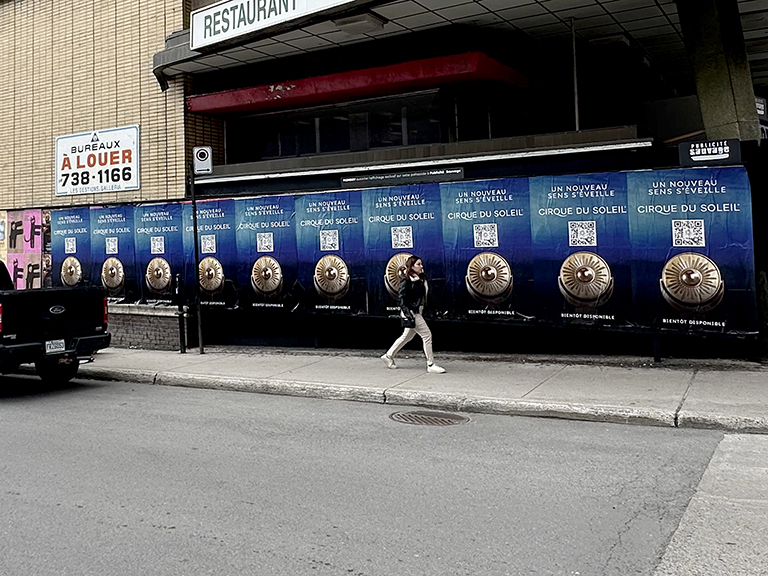
A major album release in New York. The night before release week, our crews hit the streets with 400 to 600 of these. They go on plywood hoardings around construction sites on Houston Street and Canal Street. On vacant storefronts in Williamsburg and the South Bronx. On the side walls of buildings in Crown Heights and Bushwick. The 24×36 is what covers the city in a campaign rollout.
Construction Hoarding Advertising
The temporary plywood and metal barriers around construction sites in every major city are a canvas for 24×36 posters. These surfaces are designed for it. The hoardings often run for the full block length, creating opportunities for dozens of adjacent posters. A campaign that saturates a construction hoarding with 24×36 in a neighborhood creates unmistakable visual presence.
Brand Activation Announcements
A fashion brand opening a pop-up store in the Meatpacking District uses 24×36 to seed the surrounding neighborhood in the weeks before opening. A new app launch targeting urban millennials uses 24×36 across Lower Manhattan, SoHo, and Williamsburg. The format has enough presence to build anticipation in a dense urban environment.
Tour Postering
Music tours use 24×36 for street-level advance work. In the week or two before a major show at a venue like Terminal 5 in New York or the Aragon Ballroom in Chicago, a postering run places 24×36 pieces within a mile or two radius of the venue. Fan awareness goes up. The artist’s presence in the physical environment of the city becomes visible.
24×36 in practice: This is the most versatile and widely used street-level advertising size. For any campaign going up on building surfaces, construction hoardings, or storefronts in a US city, 24×36 is the default. Design at this size first, then adapt to other sizes as needed.
27×40 Poster Size Examples
The 27×40 one-sheet is the standard for the entertainment industry. Here’s where it lives.
Theater Lobby Display Cases
Every multiplex cinema in the US has display frames specifically sized for 27×40. The poster case outside the auditorium door, the frames along the lobby walls, the display near the ticket counter. All of them are 27×40. This is why any major film release has a 27×40 one-sheet: it’s the size the infrastructure is built for.
Performing Arts Center Displays
Concert halls, opera houses, and performing arts centers use 27×40 for their lobby displays. Lincoln Center in New York, the Kennedy Center in DC, the Ryman Auditorium in Nashville. The lobby display format at major performance venues mirrors the cinema standard.
Entertainment District Outdoor Work
In entertainment-heavy neighborhoods like Times Square, the Hollywood Walk of Fame area, the Las Vegas Strip, or the Theater District in Chicago, the 27×40 appears on outdoor placements as well as in lobby contexts. The size is associated with major entertainment and carries that connotation into street-level work.
36×48 Poster Size Examples
At 36×48, you’re in large-format territory. The design approach changes significantly.
Bus Shelter Advertising Panels
Transit shelter advertising in major US cities uses panels at or near 36×48 inches. These panels are lit from behind (backlit) in many installations, which amplifies the visual impact significantly. The design for these panels is extremely simple: one dominant visual element and minimal text, visible from 30 feet or more.
Large Retail Window Displays
Major retailers with large storefront windows use 36×48 for display pieces that need to fill the space. A flagship athletic wear store on 5th Avenue uses 36×48 for seasonal campaign imagery. A major electronics retailer on Michigan Avenue uses 36×48 for product launch announcements in its floor-to-ceiling window displays.
Academic Conference Research Posters
Scientific and academic conferences use 36×48 portrait format as the standard for research poster presentations. Every conference with a poster session specifies this format. Attendees walk the room and stop to read posters that interest them from about 3 to 5 feet away. The 36×48 gives researchers enough space to present methodology, findings, and conclusions in a readable format.
Poster Size Examples in Music and Entertainment Marketing
The music and entertainment industries have developed the most codified and consistent poster size conventions of any marketing sector. These conventions exist because music and entertainment marketing has been executed at street level for over a century. Standard sizes have proven their effectiveness through decades of real campaigns in real cities.
Concert Advance Postering: The Classic 11×17 and 18×24 Combination
Concert promotion has used the combination of 11×17 and 18×24 posters since every major show was announced through street-level postering. The 11×17 goes on bulletin boards in record shops, coffee shops, bars, and music venues in the neighborhoods surrounding the venue. The 18×24 goes on building walls, construction hoardings, and outdoor surfaces in the broader reach zone. Together, they cover both the indoor community board circuit and the outdoor street visibility zone with two scales of the same design.
In New York’s Lower East Side, a mid-size venue like Bowery Electric typically has the surrounding blocks covered with 11×17 flyers in every venue and shop window plus 18×24 placements on plywood construction hoardings on Delancey and brick walls on Orchard Street in the week before a significant show. The density of the combined campaign creates the sense that the show is everywhere, which drives ticket urgency in a way a single large placement cannot.
Album Release Campaigns: The 24×36 Street Saturation
Major album releases use 24×36 as the primary format for street saturation campaigns. In the 48 to 72 hours before a release, crews can place several hundred 24×36 posters across target neighborhoods in a single city. The artist’s face or album artwork at that scale, on walls throughout the neighborhoods the target audience lives in, creates a physical presence no digital announcement can replicate. The campaign lands in the consumer’s actual environment. That changes how they encounter it.
FAQ: Poster Size Examples
Poster Size Examples for Multi-Format Campaigns
The strongest poster campaigns are not single-format. They use multiple sizes to cover different placement environments and different viewing distances within the same campaign. Here is what a well-designed multi-format poster campaign looks like across the major US standard sizes.
The Indoor/Outdoor Duo: 18×24 + 24×36
This is the most common multi-format campaign configuration for urban markets. The 18×24 covers indoor placements: bars, coffee shops, music venues, university bulletin boards, retail windows. The 24×36 covers outdoor placements: construction walls, building surfaces, outdoor display boards. Both formats share the same visual design at proportionally appropriate scales. The headline type size is proportionally larger on the 24×36 to maintain readability at outdoor viewing distances. This configuration gives a campaign both indoor consumer touchpoints and outdoor awareness reach at the most common scale for each environment.
The Triple Format: 11×17 + 18×24 + 24×36
High-volume urban campaigns in competitive markets like New York’s downtown Manhattan or Chicago’s River North add the 11×17 tabloid size for maximum indoor coverage. The 11×17 is the cheapest per-unit format and fits the widest range of indoor display locations. Adding it to a 24×36 outdoor campaign doubles the indoor coverage at a fraction of the cost per additional placement. The three-format campaign maximizes reach across indoor, window, and outdoor environments at the same time.
The Entertainment Campaign: 11×17 + 27×40
Entertainment campaigns for music, film, theater, and events typically use 11×17 for high-volume venue distribution and 27×40 for premium large-format placements. The 27×40 one-sheet format is the standard entertainment poster size. It commands the most visual authority in entertainment contexts because the consumer has been trained to recognize the one-sheet format as the visual signal for a significant entertainment release.
The Premium Campaign: 24×36 + 36×48
Premium brands and major product launches that want maximum visual impact in key markets combine the standard 24×36 for general campaign coverage with 36×48 for premium high-visibility locations. A 36×48 poster on the side of a building in SoHo or on a construction hoarding on North Michigan Avenue in Chicago creates a presence that 24×36 placements in the same market cannot match in visual scale and awareness impact.
Frequently Asked Questions
What is a real-world example of a 24×36 poster?
A 24×36 poster is the size you see on building walls in urban neighborhoods during a music album rollout or a brand activation campaign. Our crews post these across New York, LA, and Chicago regularly. The poster is two feet wide and three feet tall. It’s visible from across the street in typical city conditions.
What does an 18×24 poster look like in real life?
An 18×24 poster is what you see in bar and venue windows promoting upcoming shows and events. It’s 1.5 feet wide and 2 feet tall. It fits the snap frame display hardware installed in most venue windows. It’s the size of a standard kitchen cutting board, roughly, though poster proportions are taller than that.
What is an example of an 11×17 poster use?
An 11×17 poster is what a local band prints for a show and puts up on community bulletin boards, stapled to telephone poles, or taped in coffee shop windows in the area around the venue. It’s two sheets of standard letter paper side by side. Most standard copy shops can print 11×17 without a special printer.
What does a 27×40 movie poster look like in real life?
The 27×40 is the size of the framed movie posters in cinema lobbies. It’s slightly wider than a 24×36 and taller. At 27 inches wide and 40 inches tall, it’s a substantial piece of print that commands attention in a lobby or entertainment space. It’s the size most people picture when they think of a “movie poster.”
Can you give examples of campaigns that used 24×36 posters?
Major music release campaigns routinely use 24×36 for street-level advance work. Brand activations from streetwear companies, tech companies, and entertainment brands regularly use 24×36 for urban market campaigns. Concert and music festival promotion uses 24×36 in the areas around venue and festival locations. These are the most common real-world examples of 24×36 poster campaigns.
What is an example of a 36×48 poster in everyday life?
The backlit advertising panels inside bus shelters in major cities are typically 36×48 or close to it. The large window display at a flagship retail store is often 36×48. Research posters at academic conferences are standardized at 36×48. These are the three most common everyday examples of 36×48 posters.
What size poster examples would a brand use for a NYC campaign?
A typical NYC brand campaign uses 24×36 for building-surface placements in neighborhoods like SoHo, Williamsburg, the Lower East Side, and Crown Heights. It adds 18×24 for window placements in partner venues and retail locations. The two sizes working together give the campaign both street presence and interior reach across the target areas.