Landscape Poster Dimensions: Every Standard Size in Horizontal Format
environment orientation flips the standard poster format on its side. Here is what that means for dimensions, surfaces, and campaign design from a team that plans these placements every week.
Most people think of posters as vertical. Tall and narrow. Portrait orientation. And for good reason. The majority of poster surfaces in urban environments are taller than they are wide. Walls, doors, poles, and construction barriers all favor vertical placement.
But environment poster dimensions open up a completely different range of surfaces and design options. Wide walls. Bus shelters. Window spans. Trade show backdrops. Counter displays. Horizontal banners. These applications call for posters that are wider than they are tall.
Our team works with both orientations regularly. This guide covers environment dimensions for every standard poster size, what surfaces each format fits, and how to make smart decisions when your campaign calls for horizontal placement.
What environment Orientation Means for Poster Dimensions
environment orientation means the width is greater than the height. Take any standard poster size and flip the numbers. A 24×36 poster in portrait orientation is 24 inches wide and 36 inches tall. In environment orientation, it becomes 36 inches wide and 24 inches tall.
The physical dimensions do not change. The relationship between width and height does. That shift changes everything about how the poster sits in space and what surfaces it fits.
When we plan environment placements, we start with the available width of the surface. A bus shelter panel might be 48 inches wide and 36 inches tall. Portrait orientation leaves dead space above and below. environment fills the panel correctly. Matching the orientation to the surface is basic production work, but we have seen campaigns waste entire print runs because someone printed portrait when the surface needed environment.
Standard environment Poster Dimensions
These are the standard sizes in environment (width x height) format. Most of these are simply portrait dimensions reversed.
environment Size (W x H)
Portrait Equivalent
Area (sq in)
Common Application
17 x 11 in
11 x 17
187
Counter displays, menus, small signage
24 x 18 in
18 x 24
432
Window displays, wide wall sections
28 x 22 in
22 x 28
616
Retail horizontal POP displays
36 x 24 in
24 x 36
864
Wide wall placements, event backdrops
40 x 27 in
27 x 40
1,080
Wide cinema displays, horizontal kiosks
60 x 40 in
40 x 60
2,400
Large wall campaigns, building wraps
48 x 36 in
36 x 48
1,728
Trade show panels, horizontal backdrops
environment Dimensions for Street Campaigns
Street campaigns in portrait format are the norm. environment is the exception. But in certain urban environments, environment placements are common and effective.
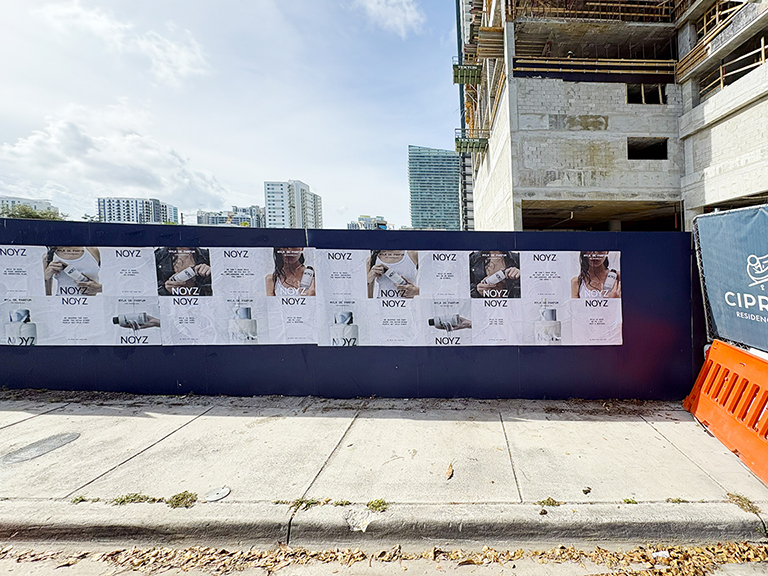
Construction hoarding panels along city sidewalks often run environment. The barrier is typically 8 feet wide and 4 to 6 feet tall. A 24×36 portrait poster placed in the center looks undersized. Tiling 36×24 environment posters across the barrier creates a horizontal visual band at eye level that reads as a unified campaign.
We have used environment formats extensively on Broadway between 23rd and 34th Streets in Manhattan, where construction hoarding provided long horizontal runs. A grid of 36×24 environment posters created a continuous 50-foot visual field that individual portrait posters would not have achieved.
Retail storefront windows are another environment territory. Most retail windows are wider than they are tall. A environment 36×24 or 40×27 fills a standard storefront window correctly. Portrait posters in wide windows float awkwardly in the middle of too much empty glass.
The Case for environment on Wide Surfaces
In Williamsburg along Bedford Avenue, we have worked with storefront spaces where the window glass runs 48 to 60 inches wide and 36 inches tall. Portrait posters in these windows look like they do not belong. environment 36×24 fits perfectly and reads at walking pace. Always measure the surface before choosing orientation.
environment Dimensions for Trade Shows and Events
Trade shows are environment territory by default. Most trade show displays are horizontal. The floor-to-ceiling backdrop panels, tabletop displays, and hanging banners all use environment proportions.
Standard trade show inline booths are 10 feet wide and 8 feet tall. A backdrop print for this space runs approximately 120×96 inches (10×8 feet) in environment. Individual display graphics within the booth are often 36×48 or 48×36 in environment orientation.
Tabletop displays for trade shows typically run in environment format. The most common tabletop banner sizes are 60×24 (standard tabletop retractable banner in environment) or custom horizontal prints that match the table width.
For event marketing, step-and-repeat backdrops are almost always environment. The standard step-and-repeat is 8×8 feet or 8×10 feet. The wider the backdrop, the more prominent the branding coverage for photos and media capture.
How environment Orientation Affects Design
environment orientation changes how you lay out text, images, and hierarchy. The horizontal read direction feels more like reading a page or watching a screen. It is comfortable for viewers who scan left to right.
Headlines in environment posters typically run along the top third of the design. Supporting visuals or body copy fill the lower two-thirds. This matches natural reading patterns and allows the poster to be read quickly at normal walking or driving speeds.
For automotive campaigns, we almost always recommend environment orientation. Cars are horizontal subjects. environment posters allow a car image to fill the full width of the poster without cropping. We have produced automotive campaigns in Manhattan that used 36×24 environment prints on parking garage entries along Seventh Avenue. The horizontal format matched the subject and the surface perfectly.
Portrait orientation forces a horizontal subject into a narrow vertical frame. The result is usually either heavy cropping or a lot of empty space. environment solves this. Match the orientation to the subject.
ISO environment Poster Dimensions
International ISO sizes in environment orientation are widely used outside the United States. For US campaigns that need international equivalents, here are the key ISO environment dimensions.
ISO Size (environment)
Dimensions (mm)
Dimensions (inches)
Closest US environment
A3 environment
420 x 297 mm
16.5 x 11.7 in
17 x 11 (tabloid environment)
A2 environment
594 x 420 mm
23.4 x 16.5 in
24 x 18
A1 environment
841 x 594 mm
33.1 x 23.4 in
36 x 24
A0 environment
1189 x 841 mm
46.8 x 33.1 in
48 x 33 (no direct match)
environment vs. Portrait: When to Choose Horizontal
Use environment dimensions when:
The surface is wider than it is tall (wide walls, bus shelters, storefront windows, retail counters)
The subject is inherently horizontal (cars, environment photography, panoramic cityscapes)
The placement runs along a horizontal band at eye level (construction hoarding grids, horizontal banner sequences)
The event or trade show environment is built around horizontal display systems
The design includes a wide headline that reads better without wrapping
Use portrait dimensions when:
The surface is taller than it is wide (standard street walls, poles, doors)
The subject is vertical (standing figures, tall buildings, product shots of tall items)
The viewer is walking past at close range and needs to scan vertically
The campaign is distributing individual posters for placement on mixed surfaces
Check the Surface First
Our crews scout every placement location before print specs are confirmed. Orientation is determined by the surface, not by preference. If the surface calls for environment, we print environment. No exceptions. Printing portrait when the surface needs environment wastes the print budget and diminishes campaign impact.
environment Poster Dimensions for Specific Campaign Environments
Different campaign environments favor specific environment dimensions. Here is how we approach size selection for real locations.
Subway and transit environments
New York City subway car interior cards run 11×28 inches in environment. Station platform posters in the two-sheet format run approximately 46×60 in environment. The horizontal format in transit environments is a deliberate design choice by the operators. Transit passengers have time to read. Wide formats let you stretch a headline across the full width of the visible surface.
In Chicago’s L system, station posters run in a variety of environment formats depending on the station. Many older stations use 28×44 horizontal formats. Newer stations have digital displays that accept environment content at 16:9 ratios, roughly 48×27 at physical print scale.
Bar and venue back walls
The back wall behind a bar is almost always a environment surface. It is wider than it is tall. In venues across the Lower East Side in New York, the Mission in San Francisco, and Wicker Park in Chicago, we have placed environment 36×24 and 40×27 prints on back walls above and behind the bar. These placements get viewed for extended periods because people sit facing that wall.
A well-placed environment poster on a bar back wall gets more sustained viewing than almost any other interior placement. People stare at it while waiting for their drinks. It rewards a more complex design than a street poster, because viewers have time to engage.
Parking garage entries and exits
Parking garage entries are wide and low. The clearance bar runs horizontally. The signage above the entrance is always environment. We have placed environment 60×24 and 48×18 formats at parking garage entries in Midtown Manhattan, downtown Los Angeles along Figueroa Street, and in River North in Chicago. Drivers slow down at these points. Passengers look up. The environment format matches the architecture of the space.
Hotel corridors and elevator lobbies
Hotel corridors use environment placement for the panels flanking elevators and the signage above fireplace mantels and seating areas. A 36×24 environment poster fits most hotel corridor display cases. A 48×36 environment suits larger lobby environments. These are premium placements for luxury brand campaigns where the audience demographics match an upscale traveler profile.
Bleed, Margins, and Safe Zones for environment Posters
Production-ready environment poster files need proper bleed and safe zone setup. The specifics don’t change based on orientation, but the dimensions do, and getting this wrong with a wide horizontal format is expensive.
Bleed
Standard bleed for environment posters is 0.125 inches (1/8 inch) on all four sides. For a finished 36×24 environment poster, the file should be 36.25 x 24.25 inches with bleed. Any background color, texture, or image that extends to the edge of the design must extend into the bleed area. Printing without bleed on a wide environment format creates white edges when the poster is trimmed, which looks unprofessional.
Safe zone
Keep all critical text and logos at least 0.25 inches inside the trim edge. On a 36-inch wide environment poster, this means important content starts no closer than 0.25 inches from the left or right edge after trim. For very wide formats (48 inches or wider), increase the margin to 0.5 inches to account for any trim variance.
Resolution
Wide environment prints require the same 300 DPI resolution at final print size as portrait prints. For a 36×24 environment print at 300 DPI, the file needs to be at minimum 10,800 x 7,200 pixels. Large-format prints that will be viewed from more than 3 feet away can work at 150 DPI. Always confirm resolution requirements with your print vendor, as different print technologies have different native resolutions.
Color mode
Submit files for commercial printing in CMYK color mode. RGB files will be converted during RIP processing, and the conversion can shift colors in ways you did not expect. Blues often shift purple. Greens can shift toward yellow. Set your file to CMYK at setup, not as a final step before sending, so you see accurate colors throughout the design process.
What to Expect When Ordering environment Poster Prints
Ordering environment posters from a commercial printer requires clear communication. Most ordering systems default to portrait orientation. Here is what to specify to avoid errors.
State the dimensions explicitly: Write “36 inches wide x 24 inches tall” rather than “24×36 environment.” Some vendors interpret “24×36” as always portrait.
Attach a proof: A low-resolution proof or mockup image showing the horizontal layout eliminates ambiguity. It takes one minute to create and prevents reprinting costs.
Specify substrate: For outdoor environment placements, specify weatherproof substrate. 8 mil polypropylene or 13 oz vinyl hold up outdoors. Standard matte paper does not.
Confirm finishing: For environment formats that will be displayed on walls, grommets along the top edge allow easy hanging. Specify grommet placement when ordering. For wide formats, grommets every 24 inches prevent sagging.
Order overruns: For street campaigns, print 10 to 15% more units than you plan to place. Damaged prints, surface changes, and placement revisions always require extra stock. Running short on a wide-format environment print that needs a second print run is expensive and slow.
Our production team handles all of this for campaign clients. We confirm specs with the print vendor, review proofs before the full run, and inspect prints before delivery to our field crews. Getting the production details right is unglamorous work, but it is the difference between a campaign that looks great in every placement and one that has visible quality problems at half the locations.
environment posters present specific production considerations that portrait formats do not.
Roll stock width limits environment print dimensions. Wide-format inkjet printers run on rolls that are typically 24, 36, 42, or 60 inches wide. For a environment 36×24 poster, the 36-inch dimension runs along the roll. The 36-inch roll is the correct roll width. The 24-inch height is cut from the roll as needed.
This becomes a problem for very wide environment prints. A 60×40 environment print needs a 60-inch roll. Not every print shop has a 60-inch wide printer. Confirm roll width capability with your print vendor before committing to an extra-wide environment format.
Transport and handling for environment posters also differs from portrait. Wide environment prints are more susceptible to curling along the long edge. Transport flat whenever possible. Rolling a 36-inch wide environment print creates a large-diameter roll that can be difficult to unroll without cracking or creasing. Flat transport in reinforced carriers is the right call for large environment formats.
Frequently Asked Questions
What is the environment version of a standard 24×36 poster?
The environment version of a 24×36 poster is 36 inches wide by 24 inches tall. The physical dimensions are identical. Only the orientation changes. The width and height values are swapped.
What is the most common environment poster size?
For street-level campaigns, 36×24 (environment 24×36) is the most common. For retail and trade show use, 48×36 and 60×24 banner formats are frequently used. Tabloid environment (17×11) is common for menu boards and small counter displays.
Do most print shops produce environment poster dimensions?
Yes. Any shop that prints portrait posters can print environment at the same sizes. Wide-format inkjet printers run both orientations. Just specify the dimensions (width x height) clearly in your print order to avoid confusion.
What environment poster size fits a standard bus shelter?
Bus shelter advertising panels vary by city and vendor. Common interior dimensions are 48×69 inches for vertical placements and 48×22 or 48×36 for horizontal placements. Always confirm the specific panel dimensions with the operator before printing.
Is environment orientation better for photography-heavy posters?
environment orientation works better for wide-angle photography, cityscapes, and horizontal subjects. Portrait orientation works better for vertical subjects, standing figures, and tall objects. Match the orientation to the primary visual element in the design.
What is the environment dimension of an A1 poster?
A1 in environment orientation is 841 x 594 mm, or approximately 33.1 x 23.4 inches. This is the ISO standard A1 size with width and height swapped from the standard portrait orientation of 594 x 841 mm.
How do I specify environment orientation when ordering prints?
Specify dimensions as width x height in your order. For a environment 24×36, write “36 inches wide by 24 inches tall” to make the orientation explicit. Attaching a proof or mockup showing the horizontal orientation prevents production errors.