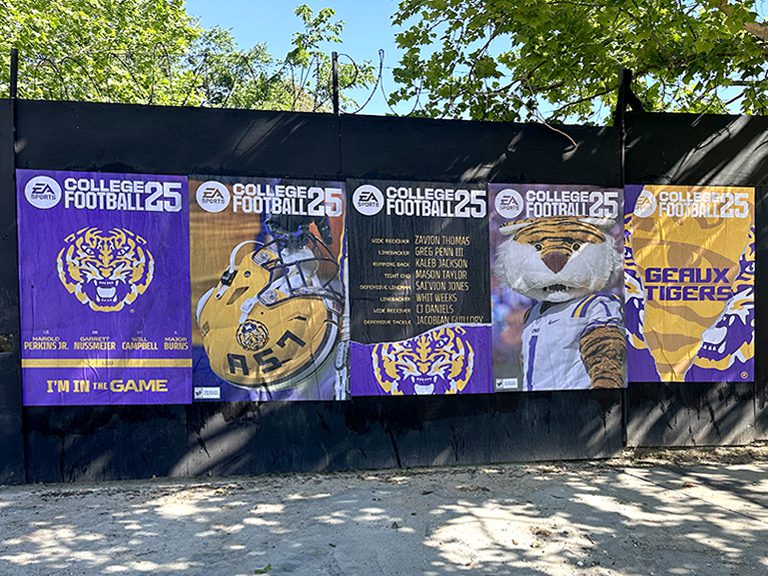
Campus OOH advertising occupies a unique position in college marketing because it operates in the one place where students cannot block, mute, or skip it: the physical world they move through every day. The streets between their apartment and classroom. The coffee shop district around the corner. The main pedestrian corridor between the transit stop and the library. The sidewalks they walk every morning. These are the spaces where well-placed, well-designed outdoor advertising reaches students with the kind of genuine attention that no digital format can replicate.
At American Guerrilla Marketing, based at Industry City in Brooklyn, our team builds campus OOH campaigns for brands that want to reach the 18-to-24 demographic in the physical environment of campus life. We deploy wheatpasted poster art in campus neighborhoods, LED billboard trucks on campus-adjacent streets, and sidewalk stencils at the pedestrian crossings students use daily.
This article explains why campus OOH advertising works, the specific formats that perform best near college campuses, and how to structure a campaign for maximum student reach.
The Physical World Advantage in College Marketing
College students have more sophisticated digital advertising resistance than virtually any other demographic. They use ad blockers. They scroll past sponsored content. They have deeply developed pattern recognition for paid promotion and automatically discount it. The digital advertising network has become significantly less effective at reaching them with every passing year.
What has not declined is their responsiveness to the physical world. A beautifully designed poster in the neighborhood where they live their daily life is seen every day. A striking sidewalk stencil on the crosswalk they use to get to class surprises them with genuine novelty. An LED truck driving past them on the street creates the kind of real-world spectacle that no digital format can replicate.
Campus OOH advertising works precisely because it operates outside the digital environment where students have learned to ignore brand messages. It is physical, unexpected, and present in the spaces where their attention is naturally available rather than guarded.
Wheatpaste Poster Art in Campus Neighborhoods
The residential and commercial neighborhoods surrounding most college campuses are among the richest environments for wheatpaste poster campaigns. Students walk these streets constantly: to and from campus, between their apartments and dining destinations, along the routes to their social venues. A well-placed wheatpaste installation in these corridors generates multiple exposures per day from the same students over the course of weeks.
Our team identifies the specific streets, corners, and placement opportunities in each campus neighborhood based on pedestrian traffic patterns and the concentration of student residential and social activity. We secure surface permissions in advance, prepare weather-resistant materials, and place art that meets a genuine creative standard.
For campus neighborhoods, the creative tone matters. Students are aesthetically sophisticated and respond to work that is genuinely interesting rather than generic promotional design. Poster art that is beautiful enough to be photographed and shared organically generates additional social amplification beyond the direct impression count. We develop creative direction for campus campaigns with this standard in mind.
LED Billboard Trucks on Campus-Adjacent Streets
LED billboard trucks on the main commercial streets adjacent to campus deliver high-visibility brand exposures to the student population in the streets they use most frequently. These vehicles carry full-color, large-format LED displays that are clearly visible from significant distances and command attention in the campus neighborhood environment.
We time routes to coincide with the highest student traffic windows: morning class change periods, lunch and early afternoon when students move between campus and the commercial district, and evening hours when students are moving between campus and their off-campus social life. These windows concentrate student pedestrian traffic on the streets we are routing through.
For major campus events, Back to School activations, or other high-concentration student moments, truck routes can be expanded to cover more of the campus neighborhood at higher frequency. The flexibility of mobile advertising allows us to concentrate vehicle time in the highest-value locations and windows rather than purchasing fixed placements that may not align with actual student traffic patterns.
Sidewalk Stencils at Campus Pedestrian Crossings
Sidewalk stencils are among the most genuinely surprising elements of a campus OOH campaign. Students do not expect to find brand creative on the sidewalk they walk every day. When they do, the unexpectedness generates real attention and often leads to photographing and sharing the discovery with their networks.
We place stencils at the specific crossings and corridor sections that see the highest student foot traffic. Campus gates and main entrances, the crosswalks between major buildings, the pedestrian approaches to transit stations, and the sidewalks in front of key social venues in the campus neighborhood are all high-value positions.
For campaigns that include ambassador programs, sidewalk stencils near ambassador operating positions give students something to notice and ask about before an ambassador initiates conversation. The stencil functions as a conversation starter and visual context-setter that makes subsequent ambassador interactions feel like part of a larger, coordinated brand presence.
Location Research and Campus Mapping
Effective campus OOH requires specific knowledge of the pedestrian geography of each target campus and its surrounding neighborhood. Our team conducts location research in advance of each campaign, mapping:
Student traffic corridors: The specific streets and pedestrian pathways students use most frequently in their daily movement between home, campus, and social destinations.
Residential concentration zones: The apartment and residential streets where the student population is most concentrated, creating high-density OOH reach in the places students start and end each day.
Commercial and social districts: The coffee shops, restaurants, bars, and retail areas where students congregate outside campus, representing high-dwell-time environments where poster art will be seen repeatedly during extended periods.
Transit corridors: The routes students use to access campus from public transit, often heavily pedestrianized and highly concentrated in student traffic during commute windows.
This location research informs placement maps that are campus-specific rather than generic, ensuring that OOH investment is concentrated where it will generate the maximum number of student exposures.
Back to School OOH Campaign Strategy
The Back to School window (late August through September) is when campus OOH campaigns generate their highest returns. This is when the student population is at its annual concentration peak, when brand awareness formed is most likely to establish lasting habits, and when social energy on campus is at its highest point.
We recommend launching wheatpaste campaigns in campus neighborhoods one to two weeks before students return, so that by the time the student population arrives and begins moving through the neighborhood, the brand art is already part of the visual environment. Students encounter it as a feature of the neighborhood they are moving into rather than as new advertising that appeared after they arrived.
LED truck routes during Back to School events, orientation periods, and the first weeks of classes reach the student population at maximum concentration. Sidewalk stencils placed in the highest-traffic areas before the semester begins are encountered repeatedly by students in their first weeks of establishing their campus movement patterns.
Integrating OOH with Ambassador Programs
Campus OOH and ambassador programs generate their strongest combined results when they run simultaneously. OOH builds visual brand familiarity with the student population. When ambassadors then approach those students directly, they are approaching people who have already encountered the brand in their neighborhood environment. The brand recognition creates a warm reception for ambassador interactions that would otherwise require more work to establish from a cold approach.
We coordinate OOH placements and ambassador operating locations so that the two elements reinforce each other. Ambassador positions near wheatpaste installations create natural interaction starters. Sidewalk stencils near ambassador operating zones give passersby something to notice and inquire about before an ambassador initiates conversation.
What is campus OOH advertising?
Campus OOH (out-of-home) advertising is any brand messaging placed in the physical outdoor environment near or surrounding college campuses to reach the student population. This includes wheatpasted poster art in campus neighborhoods, LED mobile billboard trucks on campus-adjacent streets, sidewalk stencils at key pedestrian crossings, and any other physical brand presence in the spaces students inhabit.
Why does OOH advertising work better than digital for college students?
College students are highly ad-literate and have sophisticated digital ad filtering behaviors. Physical advertising in the real-world spaces they move through daily cannot be blocked or scrolled past. OOH formats that are visually interesting and well-placed in high-traffic student areas generate attention and brand recall that digital exposures rarely achieve with this demographic.
What are the best OOH formats for campus advertising?
Wheatpasted poster art in the apartment streets and commercial districts surrounding campus is the most sustained format for building brand familiarity with the student population. Sidewalk stencils at the key pedestrian crossings students use daily add unexpected ground-level touchpoints. LED billboard trucks on campus-adjacent streets during high-traffic hours deliver high-visibility moving exposures.
How do we identify the best OOH placement locations near a specific campus?
Our team conducts location research for each campus, identifying the pedestrian corridors most used by students, the commercial districts where they eat and socialize, the transit corridors they use to move on and off campus, and the residential streets where they live. These locations form the placement map for each campus-specific OOH campaign.
Can campus OOH campaigns run year-round or are they seasonal?
Campus OOH can run year-round, though timing should reflect the academic calendar. The highest-value windows are Back to School (August through September) and spring semester (January through April). We help clients design OOH calendars that align with the academic engagement patterns of their target campuses.
How does campus OOH integrate with ambassador programs?
OOH advertising and ambassador programs work together to create a surround-sound brand experience. OOH builds visual familiarity so that when ambassadors approach students, the brand is already recognizable from campus neighborhood posters or street stencils. Ambassador interactions are more warmly received when the brand has already established a physical neighborhood presence.
Does AGM manage site-approval planning for campus OOH placements?
Yes. Our team handles all site approval research and applications for wheatpasting, sidewalk activations, and vehicle routes in the areas surrounding each target campus. We navigate city-specific site rules and ensure all placements are fully aligned with site rules. Clients do not need to manage this site-approval planning complexity independently.
Campaign Architect – American Guerrilla Marketing
Frequently Asked Questions
What is campus OOH advertising?
Campus OOH (out-of-home) advertising is any brand messaging placed in the physical outdoor environment near or surrounding college campuses to reach the student population. This includes wheatpasted poster art in campus neighborhoods, LED mobile billboard trucks on campus-adjacent streets, sidewalk stencils at key pedestrian crossings, and any other physical brand presence in the spaces students inhabit.
Why does OOH advertising work better than digital for college students?
College students are highly ad-literate and have sophisticated digital ad filtering behaviors. Physical advertising in the real-world spaces they move through daily cannot be blocked or scrolled past. OOH formats that are visually interesting and well-placed in high-traffic student areas generate attention and brand recall that digital exposures rarely achieve with this demographic.
What are the best OOH formats for campus advertising?
Wheatpasted poster art in the apartment streets and commercial districts surrounding campus is the most sustained format for building brand familiarity with the student population. Sidewalk stencils at the key pedestrian crossings students use daily add unexpected ground-level touchpoints. LED billboard trucks on campus-adjacent streets during high-traffic hours deliver high-visibility moving exposures.
How do we identify the best OOH placement locations near a specific campus?
Our team conducts location research for each campus, identifying the pedestrian corridors most used by students, the commercial districts where they eat and socialize, the transit corridors they use to move on and off campus, and the residential streets where they live. These locations form the placement map for each campus-specific OOH campaign.
Can campus OOH campaigns run year-round or are they seasonal?
Campus OOH can run year-round, though timing should reflect the academic calendar. The highest-value windows are Back to School (August through September) and spring semester (January through April). We help clients design OOH calendars that align with the academic engagement patterns of their target campuses.
How does campus OOH integrate with ambassador programs?
OOH advertising and ambassador programs work together to create a surround-sound brand experience. OOH builds visual familiarity so that when ambassadors approach students, the brand is already recognizable from campus neighborhood posters or street stencils. Ambassador interactions are more warmly received when the brand has already established a physical neighborhood presence.
Does AGM manage site-approval planning for campus OOH placements?
Yes. Our team handles all site approval research and applications for wheatpasting, sidewalk activations, and vehicle routes in the areas surrounding each target campus. We navigate city-specific site rules and ensure all placements are fully aligned with site rules. Clients do not need to manage this site-approval planning complexity independently.
How early should a brand start planning?
For most campaigns, the smart move is to start planning at least two to four weeks before the launch window so production, routing, staffing, and reporting are all lined up.
What makes one market perform better than another?
Market fit depends on audience density, neighborhood behavior, route efficiency, and whether the creative belongs in that setting. The busiest city is not always the best city.
Can AGM bundle this with other services?
Yes. AGM often combines this work with supporting formats so the campaign has stronger repetition and cleaner reporting across the whole run.
How does AGM quote pages like this?
We quote from official rate cards where they apply, then scope the remaining production, staffing, and routing details to the actual job.