A national tour lives or dies city by city. The show in Denver does not benefit from a strong campaign in Boston. Each market on the route needs its own promotional presence, its own street-level impact, its own reason for the local audience to pay attention. National tour advertising is the discipline of executing that presence across dozens of cities without losing speed, quality, or consistency. It is one of the most operationally demanding things in the out-of-home advertising world, and it is something American Guerrilla Marketing has been doing for a long time.
Based in Industry City, Brooklyn, our team manages tour marketing campaigns that span the full United States tour circuit. We have worked on everything from twenty-city music tours to national promotional road trips for consumer brands, and we have developed the operational infrastructure to handle the logistics that national tour advertising requires. This guide covers what national tour advertising actually involves, which tactics travel best across markets, how to coordinate production and execution at scale, and what separates a campaign that fills venues from one that just puts up posters and hopes.
The Scope of a National Tour Advertising Campaign
A national tour advertising campaign is not a single campaign. It is a series of market-specific campaigns, coordinated under a unified creative system, executed with timing that follows the tour route. Each city requires its own site selection, its own site approval research if exterior placements are involved, its own production or local sourcing of materials, and its own installation and documentation.
At the same time, the campaign needs to feel coherent. A fan who sees the poster campaign in New York and then sees it in Chicago should immediately recognize it as the same tour, the same brand, the same creative identity. The visual system needs to be strong enough to maintain recognition across markets and strong enough to be adapted for city-specific information without losing its character.
Managing both the unity and the specificity of national tour advertising is a project management challenge as much as a creative one. Our team maintains a central campaign management system that tracks every element by market and by date, ensuring that production, shipping, installation, and documentation all happen on schedule in each city without requiring the client to track individual market details.
Out-of-Home Formats That Scale Nationally
Not every advertising format translates well to a national tour campaign. Some formats require long lead times, significant fixed infrastructure, or market-specific relationships that make them impractical at tour scale and pace. The formats that work best for national tour advertising are the ones that combine impact with operational flexibility.
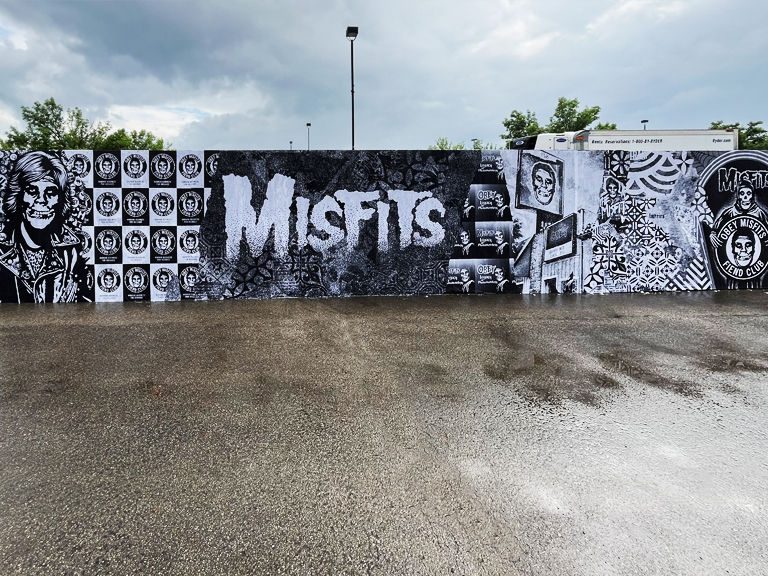
Wheatpasted poster campaigns are the backbone of national tour advertising for music and entertainment tours. Posters travel well: they can be produced centrally and shipped to each market, or produced locally from shared design files for faster turnaround. They can be installed quickly, adapted to available wall spaces in each city, and documented easily for proof-of-performance reporting. Wheatpasting is culturally resonant for the entertainment categories most associated with touring, and a strong poster presence in the right neighborhoods in each city creates a visual statement that moves audience awareness.
LED billboard trucks are the mobile format of choice for national tour advertising. Our LED truck network reaches major markets across the country, and trucks can be positioned anywhere in each city based on where the audience concentrates. Unlike fixed outdoor advertising, which requires long-term commitments and produces value in one location, LED trucks actively seek out the audience and meet them where they are.
Brand ambassador street teams provide the human dimension of national tour advertising. In each market, ambassadors engage directly with potential ticket buyers in music neighborhoods, arts districts, and entertainment corridors, creating personal encounters that reinforce the tour’s presence in that city’s cultural life.
Sidewalk stencils near venues extend the campaign’s visual footprint in the immediate venue environment at a cost point that makes them accessible even in markets where the budget does not support larger activations. Sidewalk graphics near transit stops and venue entrances are a high-impact, low-cost way to claim territory in each city.
The Production and Logistics of National Tour Advertising
The logistics of national tour advertising are where campaigns break down if they are not managed carefully. The most common problems are production delays that cause materials to arrive after the window when they would have maximum impact, site approval issues that block exterior placements in key markets, and installation quality inconsistencies that undermine the campaign’s visual standard from city to city.
Our approach to national tour production starts with a complete production plan developed before any creative goes to press. This plan maps every market’s material requirements, production source (centralized production and shipping or local sourcing), shipping schedules, arrival windows, and installation dates. Every market is mapped against the show date with enough buffer to absorb production or shipping delays without missing the campaign window.
site approval research for each market is integrated into the production plan from the start. Some cities require site approvals for certain types of street-level advertising, and the application timelines vary. We research site approval requirements in every market at the beginning of campaign planning, not as an afterthought, so we know exactly what is possible in each city and can plan around any restrictions.
Installation quality is maintained through detailed installation briefs that travel with the materials to each market, combined with photo documentation requirements that give us visibility into how the work was executed. Our local installation partners are briefed on our quality standards, and any significant deviations from the brief are addressed before the materials in question become part of the campaign documentation.
Timing a National Tour Advertising Campaign
National tour advertising campaigns run on a rolling schedule that follows the tour route. As the tour moves from city to city, the campaign moves with it, typically launching in each market three to five weeks before the show date and intensifying as the date approaches. This rolling structure requires constant coordination but also creates the opportunity to learn from earlier markets and apply those learnings to later ones.
The timing structure within each market follows the same general framework: an awareness phase where the initial placements build the tour’s presence in the city, a momentum phase where additional placements and ambassador activity amplify the existing awareness, and a peak phase in the final days where everything concentrates around the venue and the highest-traffic locations for the target demographic.
One of the advantages of a national tour campaign over a single-market campaign is the ability to track what is working across markets and adjust. If poster campaigns in the first five cities are generating strong social sharing but LED truck routes need to shift to better neighborhoods, those adjustments can be built into the remaining twenty-five cities on the route. That kind of iterative refinement is one of the underappreciated benefits of running a tour as a long campaign rather than a series of independent short campaigns.
Budgeting for National Tour Advertising
Budget planning for national tour advertising requires thinking about scale in a specific way. The per-city cost of most tactics does not decrease proportionally as the number of cities increases, because each city has its own production or local sourcing costs, its own installation labor, and its own market-specific variables. The efficiency of national scale comes from centralized creative and production management, not from per-unit cost reductions in each market.
We help clients think about national tour advertising budgets in terms of priority tiers. Not every city on the tour route deserves the same level of investment. Major markets with large venues, highly competitive media environments, and significant audiences get higher investment. Secondary markets with smaller venues and less competitive environments get scaled-down campaigns that still create meaningful presence without diverting resources from the markets where impact matters most.
This tiered approach to budgeting is one of the most important strategic decisions in national tour advertising planning, and it is one of the areas where our market knowledge adds real value. Knowing which cities punch above their size in terms of audience enthusiasm for specific genres and tour types helps us allocate budget where it will drive the most ticket sales.
Working With Venue Teams and Promoters Across Markets
National tour advertising campaigns work best when they are coordinated with the venue marketing teams and local promoters in each market. These relationships give us access to venue-adjacent placement opportunities, coordination on timing to avoid conflicts, and intelligence about local market conditions that we might not have from our own research alone.
Our team has established working relationships with venue operations contacts in major tour markets and approaches new venue relationships as a collaboration rather than a parallel effort. When the national tour advertising campaign and the venue’s own marketing push are aligned, the combined effect in the market is significantly greater than either campaign running independently.
What Success Looks Like in National Tour Advertising
The ultimate measure of success for national tour advertising is venue sell-through. Shows sell out. Shows that were on the fence get pushed over. Secondary ticket market prices increase, which signals genuine demand. These are the outcomes that matter.
On the way to those outcomes, the intermediate markers of campaign success include strong poster presence in the right neighborhoods, LED truck encounters in high-traffic areas during peak hours, ambassador-driven conversations that generate word-of-mouth, and social media activity that shows the physical campaign generating earned reach. Our reporting captures all of these intermediate indicators, giving clients a clear view of campaign performance in each market before the final ticket count confirms whether it worked.
Frequently Asked Questions
What is national tour advertising?
National tour advertising is an out-of-home and street-level promotional campaign that runs sequentially or simultaneously across multiple cities on a tour route. It includes poster campaigns, LED billboard trucks, street teams, and environmental advertising coordinated to build market presence before and during each tour stop.
How do you maintain consistency across national tour advertising markets?
Consistency comes from centralized creative and production management combined with localized execution. We build a master visual system that travels the tour route, adapting only the location-specific information while keeping all visual brand elements consistent from market to market.
What is the typical cost of national tour advertising?
Costs vary depending on the number of markets, the mix of tactics, venue size, and how much street-level saturation is desired in each city. We build campaigns at a range of investment levels. Contact our team to discuss what a national tour advertising campaign can look like for your specific tour.
How does national tour advertising work with digital media?
The best national tour campaigns run physical advertising in coordination with geo-targeted digital advertising in each market. Physical placements build awareness and cultural credibility; digital advertising reaches the audience online and drives direct ticket purchases. The two channels reinforce each other when timed correctly.
How many cities can AGM cover for a national tour advertising campaign?
We have active execution capabilities in all major U.S. tour markets and can source local execution partners in secondary and tertiary markets through our established network. There is no fixed limit on the number of cities we can cover; we build the campaign infrastructure to match the scope of the tour.
What lead time is needed for national tour advertising?
For a complete national tour advertising campaign, planning should begin six to eight weeks before the first market’s campaign launch. This allows time for creative development, production, site approval applications in each city, and logistics coordination. Rush timelines are possible but may limit options in markets with longer site approval processes.
Can national tour advertising be adapted as the tour progresses?
Yes. We build flexibility into every national tour campaign to accommodate date changes, added markets, dropped stops, and shifts in strategic priorities based on what is working best as the tour progresses. Real-time campaign adaptation is part of our standard operating approach.
How early should a brand start planning?
For most campaigns, the smart move is to start planning at least two to four weeks before the launch window so production, routing, staffing, and reporting are all lined up.
What makes one market perform better than another?
Market fit depends on audience density, neighborhood behavior, route efficiency, and whether the creative belongs in that setting. The busiest city is not always the best city.
Can AGM bundle this with other services?
Yes. AGM often combines this work with supporting formats so the campaign has stronger repetition and cleaner reporting across the whole run.
How does AGM quote pages like this?
For more on this, explore our experiential marketing. We quote from official rate cards where they apply, then scope the remaining production, staffing, and routing details to the actual job.