Food festivals are among the most accessible, densely attended, and brand-friendly events in any city’s calendar. From the New York City Wine and Food Festival to neighborhood farmers market events scaled to thousands of attendees, food festivals concentrate a specific and valuable audience in a specific place, at a specific time, in a genuinely receptive state of mind. People at food festivals are hungry in every sense: for new flavors, new experiences, and new brands they might not have found otherwise.
Industry City, Brooklyn, NY 11232
At American Guerrilla Marketing, we have executed food festival marketing campaigns across markets from New York to Los Angeles. Our approach is built around a fundamental observation: the best food festival marketing happens in the streets and corridors around the event, not just inside it. The brands that invest only in interior booth presence often overpay for a fraction of the audience. The brands that build a presence in the environment their audience moves through, from the subway exit to the festival entrance to the surrounding neighborhood bars, reach more people, more times, at a fraction of the cost per impression.
This guide covers how to build a food festival marketing strategy that works, from outdoor festival advertising to brand ambassador programs to the street-level tactics that create brand presence throughout the entire audience process.
Why Food Festival Audiences Convert
Food festival audiences are not passive. They came specifically to discover and try things. The mental framework of a food festival attendee is: I am here to find something new. That mindset is the single biggest reason food festival marketing converts at higher rates than most other event-based campaigns.
Compare this to, say, a trade show audience, who came with specific business objectives and are often resistant to being interrupted by off-agenda marketing. Or a concert audience, who are primarily there for the music and may find aggressive brand work intrusive. Food festival attendees are, almost by definition, in discovery mode. A product sample, a brand story well told, or an interesting brand interaction fits naturally into what they expected the day to be.
The demographic profile of food festival attendees is also consistently attractive for consumer brands. Food festivals draw adults, typically 25 to 55, with above-average income and a demonstrated interest in food, lifestyle, and quality. They are category buyers for food and beverage, but also for cooking equipment, lifestyle apps, travel, home goods, and a range of other adjacent categories. For brands in or adjacent to the food and culinary space, this audience is worth significant investment to reach in this context.
Outdoor Festival Marketing: The Perimeter Advantage
Every food festival has a perimeter. The two blocks around the entrance. The parking structures where attendees leave their cars. The transit stations where they arrive. The restaurants and bars where they gather before and after. These zones are where outdoor festival marketing creates its most efficient exposures, because the audience is concentrated, moving predictably, and has not yet been saturated by the brand activity inside the festival.
Our approach to outdoor festival marketing at food events is built around the audience process: mapping every point from where attendees start their experience to where they end it, and assigning the right tactic to each point.
At the approach: sidewalk stencils on the walking routes from transit to the festival entrance, creating brand awareness at eye level in the moments when people are in transit and genuinely looking at their environment.
At the entrance: brand ambassador teams working the queue and the immediate approach area, engaging attendees in the minutes before they enter when dwell time is guaranteed and attention is available.
On the approach streets: LED billboard trucks running the primary vehicle and foot traffic corridors, creating high-visibility brand exposures for everyone arriving and departing.
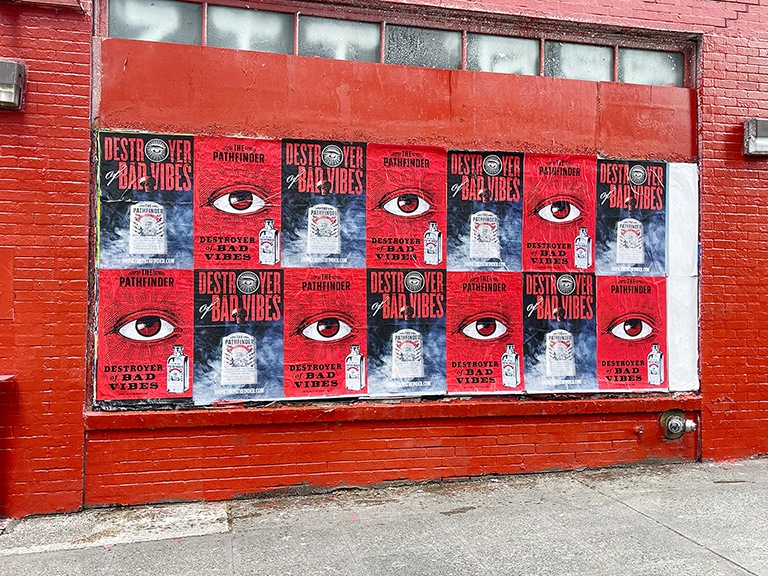
In the surrounding neighborhood: wheatpaste poster campaigns on the walls of the blocks around the venue, creating ambient brand presence that persists for days before and after the event.
Product Sampling at Food Festivals: The High-Conversion Play
No food festival tactic generates more direct conversion than well-executed product sampling. Giving someone something to taste, smell, or hold creates a physical experience that no digital impression can replicate. For food and beverage brands specifically, the sample is often the entire marketing argument: if the product is good, the sample converts. The ambassador’s job is to get the sample in the right hands with the right context.
Effective food festival sampling follows principles we have developed through execution at dozens of events:
Position where traffic stops, not just where it flows. Moving traffic is hard to sample. Stationary or slow-moving traffic is ideal. Entrance queues, transit wait areas, and post-event gathering spots all create the dwell time needed for a sampling interaction to land properly. We identify these zones before every event and station teams accordingly.
Brief for the one-sentence pitch. Food festival attendees encounter hundreds of things in a few hours. A sample that comes with a three-minute brand story will be remembered less than one that comes with a crisp, honest ten-word description and an invitation to try. We train ambassador teams to deliver the core message in the time it takes to hand something over, then let the product speak.
Give them something to take away. The sample consumed is the impression created in the moment. The card or QR code they keep is the impression that can generate a later purchase. Every sampling program we execute includes a takeaway element: a card with a URL, a discount code, a recipe card, or another piece of collateral that travels home with the person and extends the marketing window beyond the festival day.
Food Festival Advertising: Building Awareness Before the Event
The food festival audience begins anticipating the event days or weeks in advance. Ticket sales, social media promotion, and neighborhood buzz create a window of heightened attention that begins well before the event opens. Brands that enter this window with street-level advertising have a significant advantage over those that only show up day-of.
In the two to three weeks before a major food festival, we deploy wheatpaste campaigns in the neighborhoods where the audience is concentrated. For a food festival in a specific neighborhood, this means the surrounding streets, nearby restaurant and bar districts, and the transit corridors that feed into the area. The posters create ambient brand presence in the environments the audience already inhabits, so when they encounter the brand again at the festival itself, it feels familiar.
Sidewalk stencils in the days before the festival reinforce the street-level presence and create a visible marker of the brand in the immediate festival environment. Unlike posters, stencils work at foot level, catching the eye of people who are looking down at their phones or simply at the sidewalk in front of them. In a dense urban food festival environment, this ground-level visibility is often unoccupied by competing brands, making it one of the most distinctive tactics available.
Mobile Billboards: The Food Festival Perimeter Play
LED billboard trucks are the most efficient single tool for reaching food festival attendees who arrive by vehicle. In markets where food festivals draw attendees from across the metro area, the parking corridors and vehicle approach routes carry thousands of cars in a compressed window on event days. A truck running those corridors during the two to three hours of peak arrival can reach a meaningful fraction of the total festival attendance.
For major food festivals in New York, Los Angeles, Chicago, and other large metro markets, we route LED billboard trucks on the streets around the festival venue, timed to the peak arrival and departure windows. The truck carries brand creative that is visually strong enough to register in the compressed attention of a driver or passenger, and is changed between the arrival and departure windows to carry different messages at each touchpoint.
The cost of a full-day LED billboard truck campaign is a fraction of a full-festival interior sponsorship, and the exposures generated by a well-routed truck on a high-traffic event day often exceed what an interior booth achieves in the same window. For brands with constrained budgets who want maximum reach, the truck is the place to start.
Brand Ambassadors: The Human Layer of Food Festival Marketing
Every outdoor festival marketing campaign benefits from a human layer. LED trucks create visibility. Wheatpaste creates ambient presence. Brand ambassadors create conversations that convert visibility into memory and memory into action.
At food festivals, the ambassador’s role is to find the moments of natural connection between the brand and what people are already doing. A beverage brand’s ambassadors catch people between vendor lines when they are thirsty and looking for something to drink. A cookware brand’s ambassadors engage people who have just purchased ingredients and are already thinking about cooking. A food app’s ambassadors approach people who are photographing their food, because those people are already behaving as the app’s natural users.
The best ambassador interactions at food festivals feel like encounters with knowledgeable, friendly people who happen to have something relevant to offer, not like marketing. We invest heavily in ambassador briefing and selection to ensure that the people representing your brand in these environments can sustain genuine conversations and navigate the full range of reactions they will encounter, from enthusiastic engagement to polite indifference.
For major food festivals, we staff ambassador teams based on the event scale, typically two to five people for neighborhood events and eight to fifteen for large metro food festivals with multiple venues or stages. Teams are equipped with product, collateral, and any required site approvals before arriving on-site.
Non-Food Brands at Food Festivals: Making the Connection Work
Food festivals are dominated by food and beverage brands, but they are not exclusive to them. The audience at a major food festival is food-oriented adults with disposable income and an interest in experiences, which is a target demographic for a much wider range of categories than strictly culinary ones.
The key for non-food brands is finding the authentic connection to the food festival context. A travel brand can connect through the idea of culinary tourism: the places you go specifically for the food. A home goods brand can connect through the kitchen and the table. A fintech brand targeting young professionals can connect through the shared interest in experiences and spending. A streaming service can connect through cooking content, food documentaries, or the cultural conversation around cuisine.
The brands we have seen succeed at food festivals without a food product are the ones who built their presence around a genuine connection to what the audience cares about in that specific context, not brands that simply bought space and hoped proximity would create relevance. Our team works with non-food brands to find that connection and build activations that feel native to the food festival environment rather than out of place within it.
Measuring Food Festival Marketing Results
Our food festival marketing campaigns include built-in measurement across all deployed tactics. For LED billboard truck campaigns, we provide GPS-tracked route reports with estimated impression counts based on traffic data. For ambassador programs, we track interactions, samples distributed, QR code scans, and any direct conversion actions recorded in the field. For wheatpaste and stencil campaigns, we provide location documentation with photos confirming placement.
For brands with existing customer research programs, we can coordinate pre- and post-campaign brand awareness surveys to measure recall and attitude shift attributable to the festival activation. These surveys, conducted in the markets where the campaign ran, provide the clearest picture of the campaign’s impact on brand recognition and purchase intent.
Brands that run multiple food festival campaigns in a market over a season consistently see compounding effects on awareness metrics. The audience encounters the brand at event one, recognizes it at event two, and is a familiar name by event three. Festival marketing is not a one-event tactic. It is a seasonal presence strategy that builds over time.
Multi-Event Food Festival Calendars
Most cities with a meaningful food culture have multiple food festival opportunities across a single calendar year. New York alone hosts dozens of food-focused events annually, from small neighborhood tastings to large-scale events with tens of thousands of attendees. For brands that want to build sustained awareness in a specific market, a multi-event calendar approach is significantly more effective than a single event activation.
We help brands build annual food festival calendars in their target markets, identifying the events where their audience is most concentrated, planning campaigns for each one, and building a creative arc that carries consistent brand messages across the season with tactical variations that keep each event’s execution fresh.
A brand that shows up at four food festivals in a market in a single season builds the kind of ambient brand familiarity that paid media can rarely achieve. The street-level exposures, the ambassador conversations, the samples in people’s hands: these accumulate in the market and in the memory of the audience in a way that creates genuine brand equity over time.
Ready to Launch Your Campaign?
FAQ: Food Festival Marketing
What is food festival marketing?
Food festival marketing is any brand activity designed to reach and engage the audience of a culinary event, from outdoor advertising and mobile billboards around the venue to brand ambassador teams distributing samples and engaging attendees in the surrounding streets and neighborhoods. It includes both official sponsorship activation and independent campaigns that require no festival relationship.
What brands benefit most from food festival marketing?
Food and beverage brands have the most natural fit, but cookware, kitchen tech, CPG brands, lifestyle apps, and any brand whose target audience is food-oriented adults will find food festival environments highly productive for awareness and sampling campaigns.
How do we market at a food festival without a booth?
LED billboard trucks on approach routes, brand ambassador teams in the surrounding neighborhood, wheatpaste campaigns on nearby walls, and sidewalk stencils on the approach corridors all create effective brand presence without requiring an interior booth or official sponsorship.
What is outdoor festival marketing?
Outdoor festival marketing refers to brand campaigns executed in the public spaces surrounding or leading to festival venues, including mobile OOH advertising, sidewalk stencils, wheatpasting, ambassador programs, and sampling in the approach corridors and surrounding neighborhoods.
How early should we plan food festival marketing?
Six to eight weeks before the festival date is the minimum for a well-executed campaign. Ambassador staffing, print production, and any applicable site approvals all have lead times that compress your options if you wait. For large events like the NYC Wine and Food Festival, 10 to 12 weeks is recommended.
Can non-food brands market at food festivals?
Yes, with the right connection to the audience. Food festival attendees are food-oriented adults with discretionary income and an interest in experiences. Lifestyle brands, fintech, home goods, and travel brands that can credibly connect to that interest profile can perform well in these environments with the right activation concept.
What is the difference between a food festival sponsorship and a guerrilla campaign?
A food festival sponsorship gives you official placement inside the event, typically at significant cost. A guerrilla campaign operates in the public spaces surrounding the event, often at a fraction of the cost, reaching the same audience at the approach and departure points where attention is high and competition is low.
Related: Wheatpasting & Poster Campaigns | Guerrilla Marketing Services | Sidewalk Stencils | LED Billboard Trucks | Brand Ambassador Agency
Ready to Launch Your Campaign?
Millie Phillips
Campaign Architect , American Guerrilla Marketing
Email: [email protected]
Office: (646) 776-2770
Official Wheatpaste Pricing
We only quote from AGM’s published rate cards or from a custom scope tied to the actual market, route, staffing plan, and production load.
- 24×36 wheatpaste campaign, 100 posters: $4,500
- 24×36 wheatpaste campaign, 200 posters: $5,500
- 48×72 wheatpaste campaign, 100 posters: $10,500
- 48×72 wheatpaste campaign, 200 posters: $13,500
- Optional maintenance for the final two weeks of a monthly run: $3,500
If your campaign needs a different city mix, custom fabrication, or rush timing, contact AGM for a quote built from the same rate-card logic.
How AGM scopes Food Festival Marketing: How Brands Win at Culinary Events
Every wheatpaste deployment plan starts with the same field questions. Where will the audience actually see the work, how long will the message stay in view, what kind of crew does the job need, and what proof will the client want after the run is live. We scope those answers before we talk about volume. That keeps the program grounded in real conditions instead of broad theory. For food festival marketing: how brands win at culinary events, the planning work matters because one weak choice at the start can waste the whole run. A strong route, a realistic install pace, and a clean recap process are what make the campaign feel sharp in the street instead of rushed.
What changes performance in the field
Performance usually comes down to placement, timing, and repetition. The best campaigns do not chase every possible block. They pick the blocks, venues, walls, stations, storefronts, or pedestrian paths that line up with the right audience behavior. We watch how people move through a neighborhood, what side of the street they face, how long they dwell, and what else is competing for attention. For food festival marketing: how brands win at culinary events, that means the visible details, sightline, lighting, install condition, and recap quality all matter. Good field work looks obvious after the fact, but it only feels obvious because the plan was tight before the crew ever rolled.
Budget and timing without guesswork
AGM does not pad numbers with vague ranges. We tie budgets to rate cards where a public rate exists, then fill in the rest with real production needs, staffing, route density, timing, and market conditions. That keeps the conversation honest. On food festival marketing: how brands win at culinary events jobs, timing is often shaped by access windows, weather, production lead time, and how much documentation the client wants back. If a project is simple, the schedule stays simple. If it has many neighborhoods, many surfaces, or several city teams moving at once, the schedule expands because the work on the ground expands. That is a normal operations decision, not filler.
How we document results
Clients do not just need the work done. They need to know where it landed, how it looked, and whether the rollout matched the brief. Our recap process is built around timestamped photos, neighborhood notes, route summaries, and clear proof of completion. On food festival marketing: how brands win at culinary events work, recap quality often decides whether a client books the next run. Clean reporting also helps the next wave because the team can see what held up, what drew the strongest response, and which placements deserve a second pass. The recap is not an afterthought. It is part of the product.
Common mistakes brands make with Food Festival Marketing: How Brands Win at Culinary Events
The most common mistake is chasing surface area without enough planning. Brands sometimes assume that more units or more neighborhoods always means better results. In practice, sloppy spread kills recall. Another mistake is forcing creative that is too dense for the setting. Street work needs clear hierarchy, strong contrast, and a message that makes sense at the distance where the audience sees it. A third mistake is underestimating production details. The stock, finish, weather window, shift timing, and recap expectations all shape the outcome. Strong campaigns respect the boring details because the boring details decide whether the visible work looks premium.
Why this topic matters to AGM clients
Clients hire AGM because they need people who understand street conditions, not just ad concepts. Food Festival Marketing: How Brands Win at Culinary Events is valuable when it turns a broad brand idea into something that holds up in a real place, in front of moving people, with real constraints. That is where execution matters. A page like this should leave you with a clear sense of what the work involves, what can go wrong, and what a disciplined rollout looks like. If the campaign needs city selection, route design, crew planning, printing, fabrication, staffing, reporting, or a combined package, AGM can scope it from one operating plan instead of handing the job off across five vendors.
Frequently Asked Questions About Food Festival Marketing: How Brands Win at Culinary Events
How early should a brand start planning?
For most campaigns, the smart move is to start planning at least two to four weeks before the launch window so production, routing, staffing, and reporting are all lined up.
What makes one market perform better than another?
Market fit depends on audience density, neighborhood behavior, route efficiency, and whether the creative belongs in that setting. The busiest city is not always the best city.
Can AGM bundle this with other services?
Yes. AGM often combines this work with supporting formats so the campaign has stronger repetition and cleaner reporting across the whole run.
How does AGM quote pages like this?
We quote from official rate cards where they apply, then scope the remaining production, staffing, and routing details to the actual job.
Frequently Asked Questions