Bike Share Advertising | American Guerrilla Marketing
Bike share advertising operates at a scale that individual billboard bikes cannot reach. The major bike share systems in American cities, Citi Bike in New York, Divvy in Chicago, Metro Bike in Los Angeles, Capital Bikeshare in Washington DC, have hundreds or thousands of docking stations distributed across entire city grids. A brand that places advertising on those stations, on the bikes themselves, or on the digital touchpoints within the system reaches commuters, tourists, and urban residents at every point where they interact with the system throughout the day.
We are American Guerrilla Marketing. We help brands navigate bike share advertising opportunities and integrate them with broader mobile advertising programs that include dedicated billboard bikes, street teams, and brand ambassador activations. Bike share advertising and dedicated bike advertising are complementary formats that together cover different parts of the urban media environment. This guide explains both, and how they work together.
Bike share advertising encompasses two distinct approaches that operate through different mechanisms and deliver different types of brand contact.
Paid Sponsorship Advertising on Bike Share Systems
The major bike share systems in American cities offer paid advertising opportunities to brands. These can include naming rights sponsorships (Citi Bike carries Citi’s brand in its name), station panel advertising, branded bike panels, app-based advertising within the bike share mobile application, and digital display advertising on smart docking stations. These placements reach the full user base of the system, which in systems like Citi Bike numbers in the tens of millions of rides annually.
Accessing these placements requires working directly with the bike share system operator. Lyft operates Citi Bike and Divvy. Each system has its own advertising rates and sponsorship structures. These are significant media buys at the system scale. We can advise on how to integrate these placements with guerrilla marketing programs but we do not broker the system-level sponsorship deals directly.
Independent Bike Advertising in Bike Share Markets
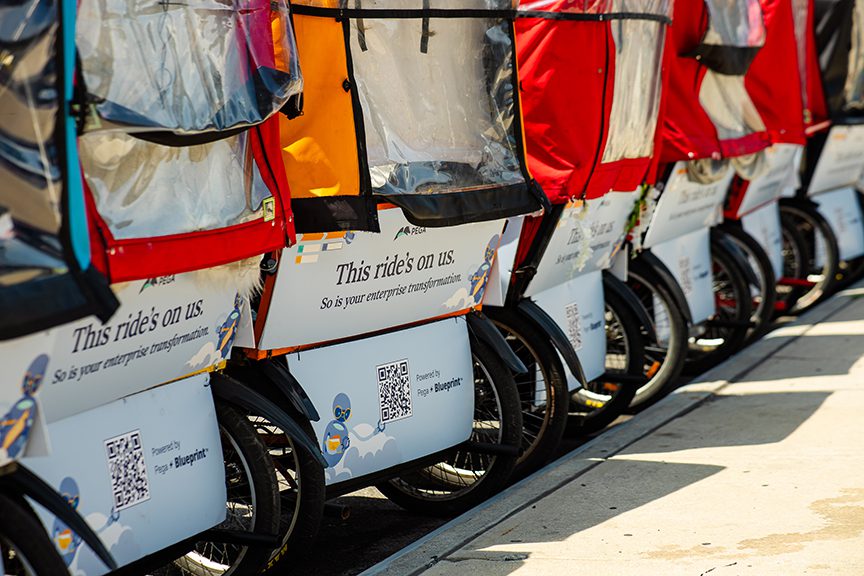
This is where we operate directly. We deploy branded billboard bikes, LED display bikes, and cargo bikes with sampling capability in the same geographic markets and environments where bike share systems operate. Our independent bicycle advertising program is not tied to the bike share system infrastructure. It is a parallel program that we plan, execute, and manage independently with our own fleet, our own riders, and our own route planning.
Independent bike advertising in bike share markets reaches audiences in the same premium environments as bike share users but with a dedicated brand message, precisely planned routes, and full creative control. It is a complement to system-level bike share advertising, not a substitute for it.
AGM Field Note: The most effective approach we have seen for brands serious about bike share market presence is the combination of system-level advertising through the official bike share operator and independent guerrilla bike advertising through us. The system-level placements create broad ambient brand presence across the entire network. The independent guerrilla program creates specific, high-quality brand encounters in the premium environments where bike share users and cyclists are most receptive.
Bike Share Markets and Their Advertising Landscapes
Each major bike share city has a different system scale, different operator relationships, and different environment for brand advertising within and adjacent to the system. Here is how we think about the major markets.
New York: Citi Bike
Citi Bike is the largest bike share system in the United States, with over 25,000 bikes and more than 1,600 stations across New York City and parts of New Jersey. The system carries an enormous daily ridership and the stations are distributed across some of the highest-value urban neighborhoods in the country. Advertising through Citi Bike reaches a premium urban professional demographic at every station touchpoint in the system.
Independent bike advertising in New York’s Citi Bike market reaches the same consumer demographic in Central Park, the Hudson River Greenway, the Brooklyn waterfront, and the major outdoor market environments where Citi Bike users and cyclists gather. We have extensive experience executing in all of these environments and our route planning is built around the specific geographic zones where the target audience is most concentrated.
Chicago: Divvy
Divvy serves Chicago and Evanston with thousands of stations across the city. The system is integrated with Chicago’s public transit infrastructure, making it a natural commuter supplement. Advertising within the Divvy system reaches both regular commuters and occasional recreational users. Independent bike advertising in Chicago’s Divvy market focuses on the Lakefront Trail corridor, Grant Park, Millennium Park, and the North Side neighborhood corridors where Divvy ridership concentrates on weekends.
Washington DC: Capital Bikeshare
Capital Bikeshare covers Washington DC, Arlington, Alexandria, and Montgomery County with hundreds of stations. The system is heavily used by both commuters and tourists, creating a dual-audience opportunity for advertisers. Independent bike advertising in DC focuses on the National Mall, the Rock Creek Park trail, and the waterfront areas where the tourist and active resident populations overlap.
Los Angeles: Metro Bike Share
Metro Bike Share in Los Angeles is more concentrated than the systems in other major cities, focused on downtown LA, Hollywood, Westside, and the beach communities. For bike advertising in the beach cities, our independent program operating on the Strand from Santa Monica through Hermosa Beach reaches a pedestrian and cycling audience that Metro Bike Share’s inland stations do not fully cover.
Integrating Bike Share Advertising with Independent Bike Campaigns
The most comprehensive approach to bike advertising in major markets combines system-level bike share advertising with an independent guerrilla bike program. Each element covers different aspects of the target consumer’s urban experience.
System-level bike share advertising creates a persistent ambient presence everywhere the consumer interacts with the system: at the docking station when they pick up a bike, on the bike itself as they ride, in the app when they plan their route. This is reach across the full system infrastructure over an extended period.
Independent guerrilla bike advertising creates specific, high-quality brand encounters in the premium environments where cyclists and active urban consumers gather. The billboard bike in Central Park, the cargo bike at the farmers market, the LED bike at the waterfront event: these encounters are more intentional, more creative, and more memorable than ambient system-level placements.
The two programs reinforce each other. A consumer who has been registering the brand at Citi Bike stations throughout the week has a more positive response to the brand ambassador encounter at the Saturday market. The repeated ambient contacts create the recognition that makes the direct encounter feel familiar rather than intrusive.
Advertising Type
Coverage Area
Contact Type
Best For
Bike share system sponsorship
Full system grid
Ambient, repeated
Broad brand awareness across city
Bike share station panels
Selected stations
Static display
High-traffic location targeting
Independent billboard bike
Planned routes in target zones
Mobile, active
Premium environment access
Independent cargo/sampling bike
Market, event, neighborhood routes
Mobile plus direct
Brand awareness and product trial
Planning an Independent Bike Advertising Campaign in a Bike Share City
When we plan an independent bike advertising campaign in a city with a major bike share system, we consider both the system’s geographic footprint and the premium-access environments adjacent to or within that footprint.
The bike share system tells us where cycling is culturally normalized in that city. The areas with high station density are the areas where cyclists and active pedestrians are most concentrated. We plan independent bike routes to overlap with these high-cycling-culture zones while specifically targeting the environments within them where independent bikes can provide access that the fixed-station system cannot: parks, greenways, markets, and events where bike share users go but where system stations may not be present.
This approach gives us the benefit of the cycling-culture density that bike share systems cultivate while adding the premium-access advantage that only a dedicated, freely routed advertising bike can provide.
AGM Field Note: We frequently get asked whether independent bike advertising is still effective in cities with very mature, well-branded bike share systems. The answer is yes, because the two formats serve different functions in the same market. A city-branded Citi Bike station is ambient infrastructure. A branded billboard bike in Central Park is an active, designed brand encounter. Both have value. They create different types of brand contact that complement rather than substitute for each other.
Pairing Bike Share Area Advertising with Street Teams
Bike share stations in high-traffic areas, particularly major transit hubs, park entrances, and commercial corridors, create natural anchor points for street team activations. A brand that is advertising on or near a bike share station can pair that placement with a street team operating in the same area to add a direct engagement layer to the ambient awareness the station creates.
A street team member positioned near a high-traffic bike share station during peak hours reaches the same consumer demographic that the station advertising reaches, but in a direct, personal, two-way interaction mode rather than a passive visual mode. The combination is one of the most cost-effective direct-plus-ambient awareness structures available in urban guerrilla marketing.
Street team rates through American Guerrilla Marketing run from $389.99 per six-hour shift for a standard member to $589.99 per shift for a premium member. Pairing a street team with an independent billboard bike in the same zone doubles the brand contact types that reach the target consumer in a single deployment day.
Build Your Bike Advertising Program in a Bike Share City
Whether you are evaluating official bike share system advertising, planning an independent guerrilla bike campaign, or looking to combine both for comprehensive urban coverage, we can help you structure the program that fits your brand, your market, and your budget. Call us and let’s talk through the options.
How American Guerrilla Marketing Approaches This Work
We are a New York-based guerrilla marketing agency with national reach. We plan every program around a clear objective and a specific target audience. We execute with trained, briefed, supervised teams. We report honestly on what we delivered. And we build long-term relationships with clients who want a marketing partner that treats their budget as seriously as they do.
Our pricing structure is transparent. Street team members run from $389.99 to $589.99 per six-hour shift depending on tier. Brand ambassadors run the same range. Product demonstration specialists run the same range. We do not hide fees or build surprise add-ons into program invoices. We tell you what the program costs upfront based on the specific scope you need.
We operate in all major U.S. markets and have executed programs across more than forty cities. Our primary strength is in New York, Chicago, Los Angeles, Miami, Boston, Washington DC, Philadelphia, Atlanta, and San Francisco. In each of these markets, we have established rider relationships, retailer relationships, event access protocols, and local market knowledge that materially improves the quality and efficiency of program execution compared to a national agency deploying generic teams to unfamiliar markets.
We are honest about what field marketing can and cannot do. It is not a replacement for advertising. It is not a shortcut to brand building. It is a powerful complement to other marketing channels when it is strategically designed, professionally executed, and measured honestly. We do our best work when clients treat us as strategic partners, bring us into campaign planning early, give us honest briefs, and evaluate performance against realistic expectations for what field marketing programs deliver.
If you are looking for a field marketing partner who will tell you what you need to hear rather than what you want to hear, who will build a program that fits your budget and serves your objectives, and who will execute that program at a professional standard in the field, we are that partner. Call us and let’s have a direct conversation about your brand, your market, and what we can build together.
Building a Program That Delivers in the Real World
The gap between a field marketing program that delivers genuine results and one that generates an expensive activity report with nothing to show for it comes down to three variables: strategic clarity in the brief, professional quality in the execution, and honest accountability in the reporting. When all three are present, field marketing programs create meaningful, measurable brand outcomes. When any of the three is missing, the budget gets spent without proportional returns.
We start every program engagement with a strategic conversation, not a price negotiation. We need to understand the brand deeply enough to make genuinely useful strategic recommendations. That means understanding the product, the target consumer, the competitive environment the brand operates in, the specific market we are activating in, and the specific outcome the client needs the program to produce. Without that understanding, we can execute tactics competently but we cannot build a program that is strategically sound.
Professional execution is what we are known for and what we protect as the foundation of every client relationship we have. Our field teams are trained, briefed, supervised, and held to clear performance standards. We do not deploy teams without field management. We do not finalize programs without creative review. We do not accept sample quality that does not represent the brand accurately. We do not allow route drift without field supervisor intervention. These standards exist because field marketing quality is the only thing that determines whether a program generates genuine consumer impact or generates the appearance of activity.
Honest reporting is the accountability mechanism that makes the whole system function. We deliver reports that tell clients what actually happened: where the program was strong, where it was weak, what we did to address problems when they arose, and what we recommend for the next program cycle based on what we learned. We do not optimize our reports for optics. We optimize them for usefulness. A client who gets an honest, useful report from a program that underperformed in specific areas can make better decisions with that information than a client who gets a glowing report that conceals what went wrong.
Field Marketing Program Economics: Getting Value from Your Investment
Field marketing programs are an investment, and like any investment, they require a clear-eyed view of what they return relative to what they cost. Here is how we think about the economics of field marketing across the main program types we execute.
Street team programs generate a specific type of value: direct, human-scale brand encounters with the target consumer in the physical environments where they spend their time. The cost of a six-hour shift with a trained, briefed, supervised street team member running from $389.99 at the standard tier to $589.99 at the premium tier reflects the cost of a professional who represents your brand competently in every interaction they conduct during that shift. The return on that investment is the number and quality of direct brand encounters generated during the shift and the downstream brand recognition and purchase consideration that those encounters produce over time.
Sampling programs generate a different type of value: direct product trial among the target consumer in contextually appropriate environments. The cost of a sampling program includes specialist staffing, sample production and logistics, equipment, field management, and reporting. The return is measured in trial volume, purchase intent lift, retailer velocity data, and long-term brand adoption among the consumers who had a positive first product experience. For brands with genuinely strong products, the ROI on well-executed sampling programs is among the highest in the marketing mix.
Mobile advertising programs, including billboard bikes, LED display bikes, and vehicle-based advertising, generate the value of brand presence in premium access environments. The cost reflects the unique access value of the format: being in Central Park, on the Lakefront Trail, at a major outdoor market is not the same as being on a commercial street. The premium access environment is what the format delivers and what justifies the investment relative to static or vehicle-restricted formats.
Across all program types, the most reliable way to maximize return on investment is to be specific about the objective, design the program specifically to achieve that objective, execute at a professional standard, and measure against the specific outcome the program was designed to produce. Generic programs generate generic results. Specifically designed, professionally executed programs generate the specific outcomes they were built for.
Common Questions We Get from Brands Starting Field Marketing Programs
We have introductory conversations with brands evaluating field marketing programs every week. Here are the questions we hear most often and the honest answers we give.
“How much does a field marketing program cost?” It depends entirely on the scope. A two-person street team for one week in one market is a modest investment. A twenty-city sampling program with twenty specialists per market and full field management is a significant one. We size programs based on objectives and build budgets based on the specific scope required to achieve them. We do not have a standard package price because no two programs are the same.
“How do I know if field marketing will work for my brand?” We evaluate fit based on the brand, the product, the target consumer, and the specific objective. For consumer brands with genuinely strong products targeting specific urban demographics in environments where field marketing operates effectively, it almost always works when it is executed at quality. For brands where the fit is less clear, we say so and recommend whether a test program or a different approach makes more sense.
“How do you ensure the team represents our brand appropriately?” Through recruitment based on genuine product-audience fit, thorough pre-deployment training, active field management throughout every shift, and honest performance reporting that holds teams and supervisors accountable for quality. We have multiple layers of accountability built into every program precisely because brand representation quality is the non-negotiable foundation of field marketing value.
“What if we are not happy with the results?” We have a direct conversation about it. We review the program data together, assess what worked and what did not, and make a recommendation about how to adjust the next program cycle to address the shortcomings of the current one. We do not tell clients that disappointing results are an inherent limitation of the format. We assess whether the issue was strategic, creative, or executional and address it specifically in the next program design.
Why Brands Choose American Guerrilla Marketing
We are a guerrilla marketing agency that has been executing field campaigns in New York and across the United States for years. We are not a large agency with a field marketing division and a hundred other service lines. Field marketing and guerrilla activation is what we do. It is the focus of our team, our systems, our relationships, and our expertise. That focus produces consistently better results than the same service delivered by a generalist agency with many competing priorities.
Our team includes field marketing strategists who have planned and executed programs in every major market in the country, riders and brand ambassadors who represent our clients with professionalism and genuine brand knowledge, field supervisors who manage every deployment with active oversight rather than passive check-ins, and account managers who maintain client communication throughout every program with the transparency and responsiveness of a genuine partner.
We do not have a minimum program size that prevents smaller brands from working with us. We have worked with single-location restaurants, emerging food brands with three grocery store placements, and campaign-stage startups launching their first product. We have also worked with national CPG companies, major entertainment brands, and Fortune 500 companies running simultaneous programs in twenty markets. The program structure scales. The quality standard does not vary by client size.
Our rates are straightforward and transparent. Street team and brand ambassador programs run from $389.99 per six-hour shift for standard members to $589.99 per shift for premium members. Product demonstration programs run the same range. Add-ons including overtime at $65 per hour, travel days at $275 per day, and hotel per diem at $65 per day are billed separately when applicable. There are no hidden fees. The program cost you agree to at the start is the program cost on the invoice at the end.
We operate in all major U.S. markets with primary strength in New York, Chicago, Los Angeles, Miami, Boston, Washington DC, Philadelphia, Atlanta, and San Francisco. In secondary markets, we work with established local execution partners whose quality standards we have verified and whose work we manage directly. Every program we run regardless of market gets the same strategic input, the same training standards, and the same reporting quality that defines our programs in our primary markets.
Our reporting is honest, specific, and delivered on time. We do not celebrate mediocre results or hide field problems behind polished photography. When a program encounters issues, we document them, explain what we did about them, and recommend how to avoid them in the next program cycle. Clients who work with us on an ongoing basis get better programs over time because our reporting gives both parties the information needed to continuously improve the strategy and execution.
If you are looking for a field marketing partner who takes your brand as seriously as you do, who delivers professional execution in the field, and who reports honestly on what the program accomplished, we are ready to have that conversation. Call us at (646) 776-2770 or email [email protected]. We will respond quickly and give you the direct, useful answers you need to make a good decision about your next field marketing program.
Frequently Asked Questions
How do we buy advertising on a bike share system?
System-level bike share advertising is purchased directly through the operator, typically Lyft for the major systems in New York and Chicago. Each system has a media or partnerships contact who handles advertising inquiries. We can advise on how to structure these conversations and how to integrate system-level placements with a broader guerrilla marketing program, but we are not the buyer or broker for system-level deals.
Can we advertise on individual Citi Bike or Divvy bicycles?
Branded bike coverage is available through official system sponsorships at the major bike share programs. Individual bike panel advertising is not available as a standalone purchase in most systems. Full system coverage of the bike fleet is typically part of a larger sponsorship package. Contact the system operator directly for sponsorship options.
What is the difference between bike share advertising and independent bike advertising?
Bike share advertising reaches consumers through the infrastructure of the official bike share system, at stations, on bikes, in the app, and through system sponsorships. Independent bike advertising uses our own bikes and riders to deliver brand messages on planned routes through target environments. The two approaches are complementary, not competitive, and we recommend using both for brands seeking comprehensive bike-media coverage in a major city.
How do we measure the results of a bike share advertising program?
System-level bike share advertising is typically measured by the operator through ride and station interaction data. Independent bike advertising is measured through GPS route data, field documentation, and any digital tracking from QR codes or URLs on the creative. We deliver comprehensive reporting for all independent programs we execute. For system-level placements, the operator delivers performance data according to their standard reporting framework.
Is bike advertising effective in cities without a major bike share system?
Absolutely. Independent bike advertising does not depend on the presence of a bike share system. It operates effectively in any market with sufficient cycling culture, park infrastructure, and pedestrian-friendly environments. Many of our most productive campaigns have run in markets without major bike share systems, including secondary cities with strong outdoor lifestyle demographics.
Can bike share advertising be combined with other outdoor advertising formats?
Yes. Brands that use bike share advertising as one component of a broader out-of-home program, combining it with transit advertising, digital out-of-home displays, and independent guerrilla bike campaigns, create multiple contact points with the target consumer across different environments and different times of day. The combination of formats is always more effective than any single format alone.
What demographics does bike share advertising reach?
Bike share users skew toward urban professionals aged 25 to 45, higher-income households, daily commuters who live and work in urban cores, and active-lifestyle consumers who use cycling as both transportation and recreation. This demographic profile aligns strongly with the target audience for many consumer brands, particularly food and beverage, fitness, financial services, technology, and urban lifestyle categories.
Does AGM do both bike share consulting and independent bike advertising execution?
We provide strategic guidance on how to integrate bike share advertising with broader guerrilla marketing programs. For independent bike advertising execution, we handle everything: route planning, rider recruitment, creative review, field management, and reporting. We are execution specialists, not consultants who recommend work and leave. We build and run the campaigns we recommend.