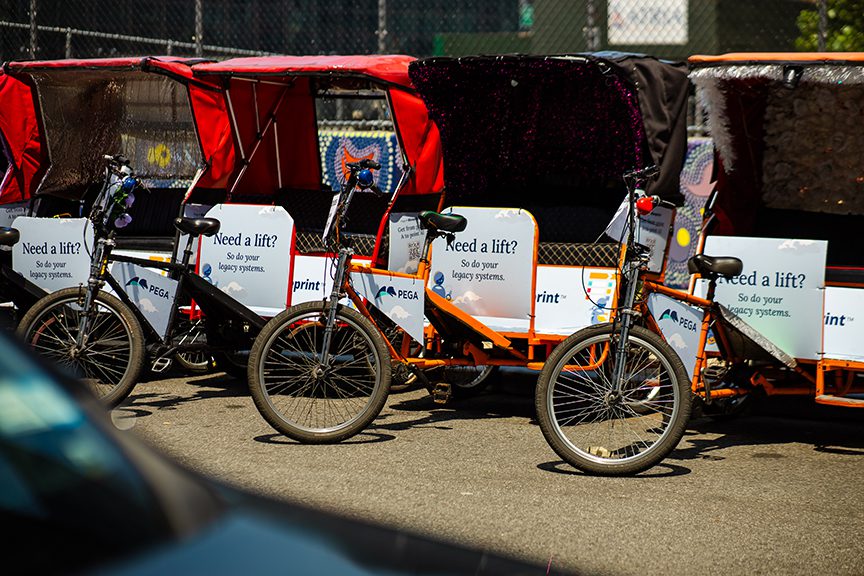
Bike advertising works. That is the plainest thing we can say about it and the truest. When planned correctly, with strong creative, well-chosen routes, trained riders, and proper field management, a bike advertising campaign reaches urban consumers in the specific environments where they are most receptive to brand messages at a cost that most brands find compelling relative to the access it provides.
We are American Guerrilla Marketing. We have been running bike advertising campaigns in New York and across the United States for years. We know what separates effective campaigns from ones that look good on paper and disappoint in the field. We know which markets, which routes, which creative approaches, and which campaign structures deliver results and which ones waste money. This is a practitioner’s guide built from actual field experience, not from theoretical frameworks.
Bike advertising is a mobile outdoor advertising format. A bicycle equipped with a brand display, printed or electronic, is operated by a trained rider on planned routes through target areas. Everyone who sees the bike and is within visual range sees the brand message. The format is mobile, which means the brand message reaches multiple locations and multiple audience concentrations throughout a single deployment day. It accesses environments that vehicles cannot enter. It operates without the fixed route constraints of transit advertising or the static location limitations of billboard advertising.
Bike advertising is not a saturation format. It does not reach every person in a zip code. It does not deliver raw coverage numbers at the scale of broadcast media or large-format outdoor advertising. What it does deliver is precise access to specific audiences in specific environments at specific times, and it delivers that access in environments that no other mobile advertising format can reach. That precision and that exclusivity of access are the format’s genuine competitive advantages.
A brand that wants to reach every person in a city should look at transit advertising, digital out-of-home, or broadcast media. A brand that wants to reach a specific type of urban consumer in the parks, markets, greenways, and neighborhoods where that consumer actually spends their weekend should strongly consider bike advertising as the right tool for that specific objective.
AGM Field Note: The most common misuse of bike advertising we see is deploying it in environments where vehicle advertising would work just as well, or where the target audience is not actually concentrated. Bike advertising’s value is specific access. Using it on a commercial street where wrapped vehicles operate and bus stop ads are present is not using the format’s advantage. Using it in a park where no other advertising can go is the format at its best.
The Anatomy of an Effective Bike Advertising Campaign
Every effective bike advertising campaign we have run shares the same structural elements. Here is how we build them.
A Clear, Singular Objective
Bike advertising campaigns work when the objective is clear: build brand recognition in this neighborhood, reach this demographic at this event, launch this product in this market. Campaigns that try to accomplish multiple objectives simultaneously tend to compromise on route selection, creative focus, and deployment structure. We start every campaign planning conversation by getting the objective down to one thing.
Audience Geography That Is Actually Mapped
We need to know specifically where the target audience is in the target market before we build a route. Not where they live in aggregate according to a demographic report. Where they actually are on a Saturday morning. Which park. Which market. Which neighborhood corridor. This mapping is the single most important pre-production investment in a bike advertising campaign. It determines whether the bike is in front of the right people or the wrong people for an entire deployment day.
Creative That Works at Two Seconds
Five words maximum. Logo dominant. High contrast color. One visual element. No fine print. We have covered this in other guides but it bears repeating because it is the most frequently violated principle in bike advertising creative. Every additional word, every additional design element, every complexity added to a bike ad creative reduces its effectiveness in the field. We enforce simplicity at every creative review.
Riders Who Are Briefed and Prepared
The rider is the brand’s physical representative in the field. In an environment where bike advertising generates public curiosity, which is frequently, the rider is often the first human brand interaction a consumer has. We brief riders on the brand, the campaign messaging, the routes, and how to handle common interaction scenarios before every deployment. Rider preparation is not optional. It is integral to campaign quality.
Field Supervision and Real-Time Management
Every campaign we run has a field supervisor who manages the deployment in real time. The supervisor tracks rider positions, monitors route execution, captures documentation, and makes adjustments when conditions change. Without field supervision, a bike advertising deployment is a rider operating on honor system. With field supervision, it is a managed media deployment with accountability and real-time adaptability.
Reporting That Gives the Client Something Useful
A campaign report that shows where the bikes were, when they were there, what they looked like in the field, and how digital elements performed gives the client something they can actually use to evaluate the campaign and plan the next one. We deliver GPS route data, field photography, supervisor logs, and performance data for any digital tracking elements in every campaign report.
Bike Advertising in New York: The Premier Market
New York is the highest-quality market for bike advertising in the United States by almost any measure. The park system, the cycling infrastructure, the neighborhood density, the quality of the target consumer demographics in accessible outdoor environments, and the cultural openness to creative street-level marketing all combine to make New York the benchmark market for the format. Here is how we approach New York specifically.
Central Park
The flagship deployment environment. Weekend vehicle closures create pure pedestrian and cycling zones on the 6-mile loop. A bike advertising deployment on the Central Park loop on a Saturday morning operates in front of hundreds of thousands of park visitors across a two-to-four-hour peak window. We stage bikes at the 72nd Street transverse, the Bethesda Fountain plaza, and the southern loop near Columbus Circle depending on the campaign’s target demographic within the broader park audience.
Hudson River Greenway
The busiest urban cycling and pedestrian path in the United States. The Greenway runs from Battery Park to the northern tip of Manhattan along the Hudson River, carrying commuters, recreational cyclists, and pedestrians daily. We plan Greenway routes around the highest-pedestrian sections: the Pier 45 area in the West Village, the Pier 84 area at 44th Street, and the Riverside Park sections between 72nd and 96th Street. These sections combine recreational pedestrian density with access to the Hudson River Park amenity areas where people stop and linger rather than just passing through.
Prospect Park and the Brooklyn Waterfront
Brooklyn’s Prospect Park is the second-strongest park environment for bike advertising in New York. The park closes to vehicles on weekends and the Grand Army Plaza entrance at the northern edge of the park is among Brooklyn’s highest-foot-traffic outdoor locations on weekend mornings. The adjacent neighborhoods of Park Slope, Prospect Heights, and Crown Heights provide additional corridor opportunities for campaigns targeting the Brooklyn professional demographic.
Williamsburg and Greenpoint
The East River waterfront from Williamsburg through Greenpoint carries heavy weekend foot traffic from the 25-to-38 urban professional demographic. Domino Park, the Kent Avenue corridor, and the approach to Brooklyn Bridge Park from the north are all strong deployment points. This zone is particularly productive for food and beverage brands, lifestyle brands, and any brand targeting the Brooklyn-specific creative professional demographic.
Outdoor Markets
Union Square Greenmarket on Wednesdays and Saturdays. Smorgasburg in Williamsburg and Prospect Park on Saturdays and Sundays. The Bryant Park Market. The Brooklyn Flea. New York has an extraordinary density of outdoor market environments that draw concentrated consumer audiences in a pedestrian-first, vehicle-restricted context. Bike advertising at or adjacent to these markets reaches a specific, high-value demographic in the most appropriate format available.
New York Zone
Best Days/Times
Primary Demographic
Format Recommendation
Central Park
Sat-Sun, 8am-2pm
Active urban professionals, families
Billboard bike or LED bike
Hudson River Greenway
Weekdays 7-9am, weekends 10am-1pm
Commuters, active lifestyle
Billboard bike
Williamsburg Waterfront
Sat-Sun, 12pm-6pm
Brooklyn creative professional
Cargo bike with sampling
Prospect Park
Sat-Sun, 9am-1pm
Brooklyn families, active adults
Billboard bike
Union Square Market
Wed-Sat, 8am-6pm
Health-conscious urban shoppers
Cargo bike with sampling
Bike Advertising in Other Key Markets
New York is our primary market but we operate in all major American cities. Here is how bike advertising maps to other key markets.
Chicago
The Lakefront Trail from Evanston through Hyde Park is the backbone of bike advertising in Chicago. Summer weekends on the lakefront carry enormous crowds with a strong fitness-conscious, active professional demographic. Grant Park and Millennium Park serve as anchor locations for event-adjacent campaigns. The Chicago Riverwalk provides a complementary downtown corridor. Spring through fall is the primary operating season, with summer weekends representing the highest-value deployment windows.
Los Angeles
The Venice Beach boardwalk, the Santa Monica Pier area, and the beach path between Santa Monica and Manhattan Beach are the premier bike advertising corridors in Los Angeles. The year-round warm weather and extreme weekend pedestrian density on the coast make this corridor one of the highest-value environments in the country for the format. For brands targeting inland LA demographics, the Silver Lake Reservoir path and the Griffith Park trails provide alternative corridors.
Miami
South Beach, the Art Deco Historic District, and the Venetian Causeway pedestrian path are the strongest bike advertising environments in Miami. The flat terrain, warm climate, and high pedestrian density during peak season from November through April make Miami one of the most operationally consistent markets for bike advertising in the country. Early morning deployment is preferred in summer months.
San Francisco
The Embarcadero, Golden Gate Park, and the Marin Headlands approach trail are the strongest bike advertising environments in San Francisco. The city’s strong cycling culture and extensive bike lane network provide rich corridor options beyond the major park and waterfront environments. The Mission District, Hayes Valley, and Dolores Park areas provide strong neighborhood-level deployment zones for campaigns targeting San Francisco’s urban professional demographic.
AGM Field Note: Market knowledge is the differentiator in bike advertising. The difference between a good route in Central Park and a mediocre one is knowing which sections of the park carry which demographics at which times. That knowledge comes from spending time in the market, deploying in it repeatedly, and tracking results across many campaigns. We have that knowledge in our primary markets. In markets we are less familiar with, we invest pre-campaign time in on-the-ground assessment before finalizing routes. Route quality is too important to guess at.
Bike Advertising Pricing: What to Expect
Bike advertising pricing depends on the format, the number of bikes, the number of deployment days, the market, and whether field management and reporting are included. Here is a practical framework for understanding the cost components.
The base cost components in a bike advertising campaign include: panel production (printed or LED), rider fees per shift, field supervisor fees, equipment rental or amortization, and post-campaign reporting. Additional costs may include travel for campaigns outside primary markets, multi-city coordination for national programs, and premium format charges for LED display or custom form bikes.
When bike advertising is paired with a street team, which we typically recommend, street team rates run from $389.99 per six-hour shift for a standard member to $589.99 per shift for a premium member. The combination of bike coverage and street team engagement creates a campaign structure that consistently outperforms either format alone.
We do not publish a fixed price list because the right campaign for each client is different. What we do is take the time to understand your specific objectives, your market, your timeline, and your budget, and build a proposal that fits all four. If the budget does not support what the objective requires, we say so and recommend either adjusting the objective or adjusting the scope.
Launch Your Bike Advertising Campaign
We are a working guerrilla marketing agency, not a consulting firm. We plan campaigns, execute them in the field, and report on results. If you want to explore what bike advertising can do for your brand in a specific market, call us. We will have a direct conversation about what is realistic for your situation and how to build a campaign that delivers what you need.
The Tactical Execution of Bike Advertising: Day-of Operations
The quality of bike advertising results is determined as much by day-of tactical execution as by the strategic planning that precedes it. Here is how a well-managed bike advertising deployment actually operates, from the moment riders arrive at staging through end-of-shift debrief.
Staging and equipment check: riders meet the field supervisor at a designated staging location before the deployment begins. Equipment is inspected: panels are verified to be correctly printed, securely mounted, and visually intact. Riders check bikes for safety: tires, brakes, lights if needed for the deployment conditions. The field supervisor reviews the route plan, the timing windows, and any special instructions for the specific deployment day.
Deployment briefing: before any rider moves, the field supervisor conducts a five-to-ten-minute briefing that covers the brand, the key message, the routes for the day, any specific locations that are priority coverage points, how to handle public interactions, and how to report any notable observations from the field. This briefing is not a formality. It is the last step before the brand’s message enters the market, and it is treated with the same seriousness as the pre-deployment preparation in any professional field marketing program.
Live deployment and monitoring: riders execute their routes while the field supervisor tracks positions through GPS, maintains communication through mobile devices, captures field photography, and manages any real-time adjustments. When a route segment is underperforming due to low traffic, the supervisor redirects the rider to an alternative high-traffic location. When a rider encounters an unexpected access restriction, the supervisor identifies and approves an alternative approach. The field supervisor’s real-time management keeps the deployment on plan while maintaining the flexibility to respond to actual field conditions.
Mid-shift check and course correction: at the midpoint of a six-hour shift, the supervisor conducts a mid-shift check with all riders. Route performance is assessed, any issues from the first half of the shift are addressed, and the second-half plan is confirmed or adjusted. This structured mid-point assessment ensures the program makes productive use of the full deployment window rather than discovering only at day’s end that a section of the shift underperformed.
End-of-shift debrief and documentation: riders return to the staging location at the end of the shift. Equipment is inspected and stored. The field supervisor completes the day’s report: routes covered, locations highlighted, notable interactions, photo documentation, and any observations relevant to creative performance or route optimization for future deployments. The debrief is as important as the briefing because it is where the data that improves future deployments is captured.
Bike Advertising Campaign Management for Multi-Week Programs
Multi-week bike advertising programs require active campaign management throughout the deployment period, not just at the beginning and end. Here is how we manage ongoing programs to maintain quality and adapt to changing conditions.
Weekly performance reviews: at the end of each deployment week, we review the week’s field data, photography, and supervisor reports and assess performance against the program objectives. We identify what worked well, what can be improved, and any adjustments to routes, timing, or creative that would improve the remaining weeks of the program.
Route evolution: we do not fix routes for the full program duration and ignore what the data tells us. If a particular corridor is consistently delivering stronger audience concentration than the route plan anticipated, we weight more deployment time toward that corridor. If a planned route segment is consistently underperforming, we reassign that time to better-performing alternatives. The program improves throughout its duration as we learn from actual field data.
Creative performance monitoring: if the program includes a digital tracking element like a QR code, we monitor scan data throughout the program and can identify which deployment locations and time windows generate the highest digital engagement. This data informs route and timing decisions for the remaining program period and gives the client early insight into where the creative is performing most effectively.
Client communication: we provide brief weekly update reports throughout multi-week programs so clients have visibility into program performance on an ongoing basis rather than waiting for the end-of-program report. These updates highlight the week’s key observations, any notable interactions or outcomes, and any adjustments made to the program plan during the week. Regular communication keeps the client engaged and enables informed decisions about any mid-program adjustments they might want to authorize.
Extending the Program: Multi-City and Multi-Season Execution
The field marketing programs that deliver the strongest long-term brand results are the ones that run consistently across multiple markets and multiple seasons rather than concentrating all of the investment in a single activation window. Here is why sustained programs outperform single-burst activations and how we structure multi-city and multi-season programs.
Brand recognition builds through repeated exposure. A consumer who encounters a brand in the field once may or may not retain the brand. A consumer who encounters the brand in the field three times over the course of a month in the same neighborhood or the same set of environments is significantly more likely to retain the brand and to recognize it in a retail context where the purchase decision is made. The compound awareness effect of repeated field contacts is one of the most consistent findings in our program performance data.
Multi-city programs amplify this effect across markets simultaneously. A national consumer brand that maintains field presence in its top five markets simultaneously creates a brand momentum that single-market programs cannot generate. The social sharing from each market reinforces the brand’s presence in the others. The retail velocity lift from sampling programs in multiple markets generates stronger national distribution data than single-market programs can produce. And the brand’s sense of presence, the feeling that it is everywhere at the same time, builds the kind of market credibility that concentrated single-market programs cannot create.
We manage multi-city programs with centralized coordination and local execution expertise. Creative standards, team training protocols, and reporting frameworks are consistent across all markets. Local market knowledge, route planning, and audience geography expertise are market-specific. The combination produces programs that are nationally consistent in quality and locally optimal in execution, which is the standard that delivers results across a national or regional program portfolio.
For brands considering their first field marketing program, we recommend starting with one market executed at the highest possible quality level rather than spreading a limited budget across multiple markets at reduced quality. A program that delivers genuine results in one market builds the internal case for expanding to additional markets. A program that spreads a limited budget across too many markets at too thin a quality level delivers mediocre results everywhere and makes it harder to build the case for continued investment in the format.
Next Steps: Building Your Program with AGM
Field marketing programs start with a conversation. Call us at (646) 776-2770 or email [email protected] and we will schedule a direct discussion about your brand, your target market, your campaign objectives, and your timeline. We will ask specific questions about the program you need and give you honest answers about what the right approach looks like for your situation.
From that initial conversation, we build a program recommendation that reflects genuine strategic thinking about how to achieve your specific objective in your specific market with your specific target consumer. We do not deliver a one-size-fits-all proposal and invite you to pick the package that is closest to what you need. We design programs from the ground up based on what each client’s situation actually requires.
Our production timelines are realistic. We tell you what we need from you at each stage of production and when we need it. We tell you what the program will cost before we begin. We execute to the plan we have agreed to and we communicate transparently when real-world conditions require any adjustment to that plan. We deliver the program report within five business days of the final deployment day.
We are a team of people who care about field marketing done right. Not because it is a job, but because we have seen what well-executed guerrilla and field marketing programs accomplish for the brands we represent and we take pride in being the team that delivers those results. We invite you to experience that difference directly. Call us today.
Frequently Asked Questions
How do I know if bike advertising is the right format for my campaign?
If your target consumer spends meaningful time in urban outdoor environments like parks, greenways, markets, or campuses, and if your brand message can be communicated with a bold visual and minimal copy, bike advertising is likely a strong fit. If your objective requires broad saturation coverage across a large geography, other formats may serve better. We are happy to evaluate your specific situation honestly.
How many riders does a typical bike advertising campaign use?
Single-rider campaigns work for highly localized activations. Two to five riders operating coordinated routes in the same zone is the most common structure for awareness campaigns. Larger events or major market programs may use more. We recommend the right number based on the specific geography and objectives rather than a default count.
What is the lead time to launch a bike advertising campaign?
Two to three weeks from approved creative to deployment is the standard timeline for a printed panel campaign. LED display campaigns may require additional lead time. For campaigns tied to specific events or dates, we work backward from the required deployment date to build the production schedule. Four weeks of lead time gives us comfortable margin for all quality checks.
Can bike advertising campaigns run in multiple cities simultaneously?
Yes. We manage multi-city campaigns from a central project management team with local execution in each market. Creative standards, route quality, and reporting are consistent across all markets in a multi-city program. We have fielded simultaneous campaigns in as many as ten cities for national consumer brands.
Do bike advertising campaigns work for alcohol or tobacco brands?
We review brand category requirements on a case-by-case basis. Alcohol brands operating within standard outdoor advertising guidelines are generally feasible for bike advertising in appropriate environments. We assess each brand category request based on the specific deployment environment and any relevant deployment context considerations.
What is the best way to measure bike advertising campaign effectiveness?
GPS route data, field documentation, QR code or short URL performance tracking, and pre/post brand awareness surveys in the target area are the primary measurement tools. We build measurement approaches based on the specific campaign objective. A brand awareness campaign uses awareness metrics. A trial campaign uses trial metrics. A QR code or URL campaign uses digital engagement metrics. One measurement approach does not fit all objectives.
Can bike advertising be used for hyper-local neighborhood campaigns?
Yes, and this is actually one of the format’s strongest applications. A bike operating on a planned route through a specific neighborhood daily for a week creates a brand presence that the neighborhood community notices and talks about. For local businesses, new restaurant openings, neighborhood-specific service brands, and community-targeted products, hyper-local bike advertising is an exceptionally cost-effective awareness tool.
What types of creative perform best in bike advertising?
The highest-performing bike advertising creative we have seen consistently shares three characteristics: a dominant brand logo, bold high-contrast color, and minimal copy (five words or fewer). Within those constraints, striking imagery and unexpected color combinations tend to generate the most attention and recall. We review all creative against these standards before approving production.
How do you handle rider availability and reliability?
We maintain a vetted roster of trained riders in our primary markets and have established recruiting protocols in secondary markets. All riders go through a standard briefing process before any campaign deployment. We build scheduling redundancy into all multi-day campaigns so a single rider availability issue does not compromise the full campaign. Field supervisors manage any day-of logistics issues in real time.
Can we use bike advertising to promote a specific location, like a pop-up shop or event?
Yes. Location-specific campaigns are a strong use case for bike advertising, particularly when the location is in or near the environments where the bikes can operate. A bike advertising program running in the blocks and corridors surrounding a pop-up shop or event location drives foot traffic from people who are already in the area and likely to divert to the location if the invitation is clear and compelling. We plan these campaigns specifically around the traffic patterns most likely to direct pedestrian flow toward the target location.