Advertising on Vehicles for Companies | American Guerrilla Marketing
Advertising on vehicles for companies is one of the oldest and most effective forms of outdoor brand building. A vehicle moving through a target market with a brand message reaches every person in its path who looks up, and in urban environments, a great deal of people look up. Whether the format is a full vehicle wrap on a cargo van, a magnetic door panel on a company car, a billboard mounted to a truck, or a branded bicycle moving through a park, vehicle advertising keeps a brand visible and mobile simultaneously.
We are American Guerrilla Marketing, and we build and deploy vehicle advertising campaigns for companies across the United States. We work with formats ranging from single wrapped vehicles to coordinated multi-vehicle swarm programs. We plan routes, manage field execution, capture documentation, and deliver reporting that gives brands real data on campaign performance. This guide covers everything companies need to know about advertising on vehicles, from format selection through execution strategy.
Companies have more options for advertising on vehicles than at any previous point in the history of the format. Here is a comprehensive look at the main vehicle advertising formats we work with and when each is the right choice.
Full Vehicle Wraps
A full wrap covers the entire exterior of a vehicle, including all body panels, windows, and roof where applicable, with a printed vinyl graphic. A full wrap turns a van, truck, car, or bus into a moving billboard. It is the highest-visibility format in vehicle advertising and the most durable in terms of production life. Full wraps are effective for long-term brand presence, fleet programs, and companies that want their vehicles to serve as permanent brand assets.
Full wrap production for a standard cargo van runs between $5,200 and $8,500 per vehicle depending on vehicle size, wrap complexity, and market. For fleet programs, per-vehicle costs typically decrease with scale.
Partial Vehicle Wraps
A partial wrap covers significant portions of the vehicle exterior without the full wrap footprint. Partial wraps are cost-effective for companies that want strong visual presence without full wrap investment, or for vehicles where certain panels are not suitable for wrap application. Partial wrap production runs $3,000 to $4,600 per vehicle.
Magnetic Vehicle Panels
Magnetic panels attach to vehicle doors and side panels and can be removed without leaving residue. This format is ideal for companies that use vehicles for multiple purposes and want advertising present during specific operational contexts without permanent branding. Magnetic panels are cost-effective but deliver lower visual impact than a full or partial wrap.
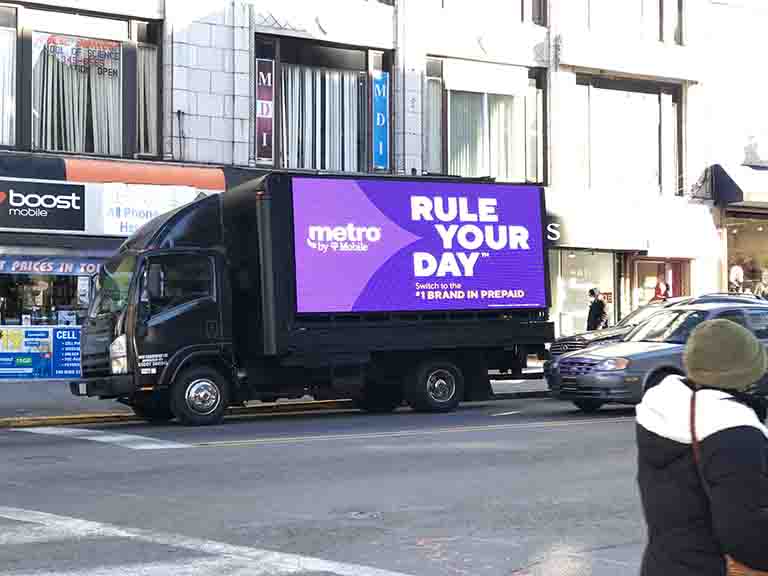
LED Mobile Billboard Trucks
Flatbed or box trucks equipped with large LED display panels on the sides, rear, or both. LED billboard trucks can display video content, animated graphics, or rotating static messages. They are among the highest-visibility formats in vehicle advertising and work particularly well for event support, launches, and campaigns where the goal is maximum attention generation in a concentrated area.
Swarm Vehicle Programs
Multiple wrapped vehicles operating coordinated routes in the same market simultaneously. A swarm creates a brand presence that feels pervasive rather than occasional. A consumer who sees the same brand on three different vehicles during a single afternoon in a target neighborhood develops a stronger brand memory than a consumer who sees it once. We offer swarm programs from three-vehicle packages through twenty-vehicle fleet deployments.
A three-vehicle swarm runs $14,000 to $21,000. Five-vehicle swarms run $22,500 to $32,000. Ten-vehicle swarms run $42,000 to $60,000. Twenty-vehicle swarms run $82,000 to $120,000. Complete campaign estimates including wraps, staffing, and routing range from $39,750 to $309,000 depending on scale.
Bicycle Advertising for Companies
Billboard bikes, cargo bikes, and LED display bikes extend vehicle advertising into environments that standard vehicles cannot access. Parks, greenways, campuses, and pedestrian markets are all environments where bicycle advertising delivers for companies that want mobile brand presence in premium access zones.
AGM Field Note: The most effective vehicle advertising campaigns we run for companies combine two or three formats simultaneously. A wrapped van operating in commercial corridors, a billboard truck at peak event locations, and a bicycle in the park: these three formats collectively reach the target audience across their full daily geography rather than in just one environment. The combination effect consistently outperforms any single-format campaign at the same total budget level.
Format
Best Application
Approximate Cost Range
Duration
Full vehicle wrap
Long-term fleet branding
$5,200-$8,500 per vehicle
Multi-year
Partial vehicle wrap
Selective fleet presence
$3,000-$4,600 per vehicle
Multi-year
LED billboard truck
Events, launches, high-impact
By campaign (quote)
Campaign-based
3-vehicle swarm
Market saturation
$14,000-$21,000
Campaign-based
10-vehicle swarm
Major market dominance
$42,000-$60,000
Campaign-based
Bicycle advertising
Premium access environments
By campaign (quote)
Campaign-based
Strategic Planning for Vehicle Advertising Campaigns
The difference between vehicle advertising that delivers meaningful results and vehicle advertising that is an expensive logo on a moving vehicle is strategic planning. We approach vehicle advertising campaigns with the same level of strategic rigor we apply to any other media placement. Here is how.
Defining the Coverage Objective
What does the company want its vehicles to cover? Brand saturation in a specific neighborhood? Presence in commercial corridors where the target customer works and shops? Visibility at specific events and in event-adjacent areas? Presence in the environments where competitors are not yet advertising? The coverage objective shapes route planning, timing, and format selection.
Audience Geography Mapping
Before routing any vehicle, we map where the target consumer spends time in the target market. Not just where they live, but where they work, shop, exercise, eat, and gather. The vehicle needs to be in those places during the windows when the consumer is present. Good vehicle advertising is not about driving around and hoping. It is about being in the right place at the right time with the right message.
Route Optimization
Routes are built to maximize time in the highest-concentration zones for the target audience during peak windows. We use real-time traffic data, event calendars, and local market knowledge to optimize routes continuously throughout a campaign. Static routes that do not adapt to real-world conditions waste significant portions of every deployment day.
Multi-Vehicle Coordination
When multiple vehicles are operating in the same market, we coordinate their routes to ensure coverage without redundancy and to create the right frequency of brand contact in specific zones. Spacing vehicles to create a layered presence in a target area requires active coordination and real-time adjustment throughout the deployment.
GPS Tracking and Reporting
Every vehicle we deploy carries GPS tracking. At the end of every deployment day, we can show exactly where each vehicle was, for how long, and at what times. This data is part of every campaign report and gives companies actual evidence of campaign execution rather than estimates or assumptions.
Vehicle Advertising for Specific Company Types
Different types of companies use vehicle advertising for different strategic purposes. Here is how we tailor the approach by company category.
Local Service Businesses
Plumbers, electricians, HVAC companies, landscapers, and other local service businesses use vehicle advertising primarily as a persistent brand presence in their service area. A wrapped service vehicle operating in a target neighborhood every day builds name recognition among the households in that area over time. For local service businesses, the vehicle is often the highest-ROI advertising asset they own.
Consumer Product Brands Launching in a New Market
A consumer brand entering a new city market uses vehicle advertising to establish name recognition quickly across the target consumer geography. A swarm of wrapped vehicles or a combination of vehicle types covering the market’s key neighborhoods and corridors during the launch period creates brand awareness faster than any single static format. Vehicle advertising is particularly effective for launch campaigns because it is impossible to miss and impossible to turn off.
Event and Entertainment Companies
Event promoters, entertainment brands, and experiential marketing companies use vehicle advertising to drive awareness in the days and hours leading up to events. A wrapped vehicle or a mobile billboard truck in the neighborhoods and corridors near the event venue creates ambient awareness that translates into walk-in attendance and social media mentions.
Real Estate Developers and Brokers
Real estate companies use vehicle advertising to build name recognition in the specific neighborhoods where they are active. A wrapped vehicle operating in a target neighborhood with clear contact information and a simple value message creates a consistent presence that builds trust over time. For new development projects, a vehicle campaign in the surrounding neighborhood during the pre-launch period drives awareness of the development among the most directly relevant potential buyer base.
Food and Beverage Brands
Food and beverage brands use vehicle advertising, particularly cargo bikes and wrapped vehicles with sampling capability, to combine brand awareness and direct product trial in a single mobile format. A branded vehicle that dispenses samples along a planned route creates a brand encounter that is both visual and sensory. The combination of seeing the brand and tasting the product is among the most powerful trial mechanisms available in guerrilla marketing.
AGM Field Note: The companies that get the most value from vehicle advertising are the ones that treat it as a strategic media placement rather than a logistics decision. Wrapping your delivery vans is a logistics decision. Planning the routes, timing, and market zones for a coordinated vehicle advertising program is a media strategy. The difference in results between the two approaches is significant.
Vehicle Advertising Plus Street Teams: The Standard Combination
Vehicle advertising covers ground. Street teams cover people. The two formats serve different functions and they serve those functions better together than apart.
A vehicle with a brand message moving through a target area creates ambient awareness. A street team working within that same area creates direct consumer contact. The consumer who encounters the street team having already registered the vehicle brand is in a warmer state than a consumer who encounters the team cold. The vehicle has done the first-impression work. The team does the relationship-building work.
We regularly build campaigns that combine a vehicle advertising program with a ground-level street team. The combination is scalable: one vehicle and one street team member for a smaller campaign, multiple vehicles and multiple team members for a major activation. Street team rates run from $389.99 per six-hour shift at the standard tier to $589.99 at the premium tier. The coordination adds field management overhead but produces campaign results that neither format alone can match.
Let’s Build Your Vehicle Advertising Campaign
We work with companies across every size range and every industry. Whether you are wrapping a single service vehicle or deploying a twenty-vehicle swarm in a new market, we bring strategic planning and professional execution to the format. Call us to talk about your brand, your market, and what you want to accomplish.
Building a Program That Delivers in the Real World
The gap between a field marketing program that delivers genuine results and one that generates an expensive activity report with nothing to show for it comes down to three variables: strategic clarity in the brief, professional quality in the execution, and honest accountability in the reporting. When all three are present, field marketing programs create meaningful, measurable brand outcomes. When any of the three is missing, the budget gets spent without proportional returns.
We start every program engagement with a strategic conversation, not a price negotiation. We need to understand the brand deeply enough to make genuinely useful strategic recommendations. That means understanding the product, the target consumer, the competitive environment the brand operates in, the specific market we are activating in, and the specific outcome the client needs the program to produce. Without that understanding, we can execute tactics competently but we cannot build a program that is strategically sound.
Professional execution is what we are known for and what we protect as the foundation of every client relationship we have. Our field teams are trained, briefed, supervised, and held to clear performance standards. We do not deploy teams without field management. We do not finalize programs without creative review. We do not accept sample quality that does not represent the brand accurately. We do not allow route drift without field supervisor intervention. These standards exist because field marketing quality is the only thing that determines whether a program generates genuine consumer impact or generates the appearance of activity.
Honest reporting is the accountability mechanism that makes the whole system function. We deliver reports that tell clients what actually happened: where the program was strong, where it was weak, what we did to address problems when they arose, and what we recommend for the next program cycle based on what we learned. We do not optimize our reports for optics. We optimize them for usefulness. A client who gets an honest, useful report from a program that underperformed in specific areas can make better decisions with that information than a client who gets a glowing report that conceals what went wrong.
Field Marketing Program Economics: Getting Value from Your Investment
Field marketing programs are an investment, and like any investment, they require a clear-eyed view of what they return relative to what they cost. Here is how we think about the economics of field marketing across the main program types we execute.
Street team programs generate a specific type of value: direct, human-scale brand encounters with the target consumer in the physical environments where they spend their time. The cost of a six-hour shift with a trained, briefed, supervised street team member running from $389.99 at the standard tier to $589.99 at the premium tier reflects the cost of a professional who represents your brand competently in every interaction they conduct during that shift. The return on that investment is the number and quality of direct brand encounters generated during the shift and the downstream brand recognition and purchase consideration that those encounters produce over time.
Sampling programs generate a different type of value: direct product trial among the target consumer in contextually appropriate environments. The cost of a sampling program includes specialist staffing, sample production and logistics, equipment, field management, and reporting. The return is measured in trial volume, purchase intent lift, retailer velocity data, and long-term brand adoption among the consumers who had a positive first product experience. For brands with genuinely strong products, the ROI on well-executed sampling programs is among the highest in the marketing mix.
Mobile advertising programs, including billboard bikes, LED display bikes, and vehicle-based advertising, generate the value of brand presence in premium access environments. The cost reflects the unique access value of the format: being in Central Park, on the Lakefront Trail, at a major outdoor market is not the same as being on a commercial street. The premium access environment is what the format delivers and what justifies the investment relative to static or vehicle-restricted formats.
Across all program types, the most reliable way to maximize return on investment is to be specific about the objective, design the program specifically to achieve that objective, execute at a professional standard, and measure against the specific outcome the program was designed to produce. Generic programs generate generic results. Specifically designed, professionally executed programs generate the specific outcomes they were built for.
Common Questions We Get from Brands Starting Field Marketing Programs
We have introductory conversations with brands evaluating field marketing programs every week. Here are the questions we hear most often and the honest answers we give.
“How much does a field marketing program cost?” It depends entirely on the scope. A two-person street team for one week in one market is a modest investment. A twenty-city sampling program with twenty specialists per market and full field management is a significant one. We size programs based on objectives and build budgets based on the specific scope required to achieve them. We do not have a standard package price because no two programs are the same.
“How do I know if field marketing will work for my brand?” We evaluate fit based on the brand, the product, the target consumer, and the specific objective. For consumer brands with genuinely strong products targeting specific urban demographics in environments where field marketing operates effectively, it almost always works when it is executed at quality. For brands where the fit is less clear, we say so and recommend whether a test program or a different approach makes more sense.
“How do you ensure the team represents our brand appropriately?” Through recruitment based on genuine product-audience fit, thorough pre-deployment training, active field management throughout every shift, and honest performance reporting that holds teams and supervisors accountable for quality. We have multiple layers of accountability built into every program precisely because brand representation quality is the non-negotiable foundation of field marketing value.
“What if we are not happy with the results?” We have a direct conversation about it. We review the program data together, assess what worked and what did not, and make a recommendation about how to adjust the next program cycle to address the shortcomings of the current one. We do not tell clients that disappointing results are an inherent limitation of the format. We assess whether the issue was strategic, creative, or executional and address it specifically in the next program design.
Why Brands Choose American Guerrilla Marketing
We are a guerrilla marketing agency that has been executing field campaigns in New York and across the United States for years. We are not a large agency with a field marketing division and a hundred other service lines. Field marketing and guerrilla activation is what we do. It is the focus of our team, our systems, our relationships, and our expertise. That focus produces consistently better results than the same service delivered by a generalist agency with many competing priorities.
Our team includes field marketing strategists who have planned and executed programs in every major market in the country, riders and brand ambassadors who represent our clients with professionalism and genuine brand knowledge, field supervisors who manage every deployment with active oversight rather than passive check-ins, and account managers who maintain client communication throughout every program with the transparency and responsiveness of a genuine partner.
We do not have a minimum program size that prevents smaller brands from working with us. We have worked with single-location restaurants, emerging food brands with three grocery store placements, and campaign-stage startups launching their first product. We have also worked with national CPG companies, major entertainment brands, and Fortune 500 companies running simultaneous programs in twenty markets. The program structure scales. The quality standard does not vary by client size.
Our rates are straightforward and transparent. Street team and brand ambassador programs run from $389.99 per six-hour shift for standard members to $589.99 per shift for premium members. Product demonstration programs run the same range. Add-ons including overtime at $65 per hour, travel days at $275 per day, and hotel per diem at $65 per day are billed separately when applicable. There are no hidden fees. The program cost you agree to at the start is the program cost on the invoice at the end.
We operate in all major U.S. markets with primary strength in New York, Chicago, Los Angeles, Miami, Boston, Washington DC, Philadelphia, Atlanta, and San Francisco. In secondary markets, we work with established local execution partners whose quality standards we have verified and whose work we manage directly. Every program we run regardless of market gets the same strategic input, the same training standards, and the same reporting quality that defines our programs in our primary markets.
Our reporting is honest, specific, and delivered on time. We do not celebrate mediocre results or hide field problems behind polished photography. When a program encounters issues, we document them, explain what we did about them, and recommend how to avoid them in the next program cycle. Clients who work with us on an ongoing basis get better programs over time because our reporting gives both parties the information needed to continuously improve the strategy and execution.
If you are looking for a field marketing partner who takes your brand as seriously as you do, who delivers professional execution in the field, and who reports honestly on what the program accomplished, we are ready to have that conversation. Call us at (646) 776-2770 or email [email protected]. We will respond quickly and give you the direct, useful answers you need to make a good decision about your next field marketing program.
Frequently Asked Questions
What is the most cost-effective vehicle advertising format for a small business?
For a small business with one or a few vehicles, a full or partial wrap on a vehicle that already operates in the target service area is typically the most cost-effective option. The vehicle is already on the road. Adding a wrap turns every trip into an advertising deployment at no additional operational cost. The wrap pays for itself in brand recognition over the vehicle’s operating life.
How do we choose between a full wrap and a partial wrap?
If the vehicle will be a primary brand ambassador, the full wrap delivers stronger visual impact and more complete brand coverage. If cost is the primary constraint or the vehicle serves multiple non-branded functions, a partial wrap is a good compromise. We can show you mock-ups of both options on your specific vehicle type before production.
How long does vehicle wrap production take?
Standard vehicle wrap production takes five to ten business days from approved artwork to finished installation. Complex designs, large vehicles, or multi-vehicle programs may take longer. We build production timelines into campaign schedules from the first planning conversation.
Can we track where our advertising vehicles go?
Yes. All vehicles we deploy carry GPS tracking. Route data is available in post-campaign reporting. For longer-term programs, we can provide more frequent route data summaries. We are transparent about vehicle routes because we build campaigns around strategic route planning and we want clients to be able to verify that the campaign ran as planned.
What is the minimum campaign size for a vehicle swarm program?
Our standard swarm package starts at three vehicles. Single-vehicle campaigns are available but do not generate the saturation effect that makes swarm programs particularly effective. We discuss the right program size based on the target market geography, the campaign duration, and the brand’s awareness objectives.
How does vehicle advertising compare to digital advertising for local businesses?
Vehicle advertising and digital advertising serve different functions. Vehicle advertising builds local name recognition through repeated physical presence in the community. Digital advertising reaches consumers on their devices with targeting precision. Both are more effective together than apart. A vehicle operating in the neighborhood and a targeted digital campaign running to households in the same geographic area compound each other’s effectiveness.
Can advertising on company vehicles generate social media sharing?
Well-designed vehicle advertising in interesting environments does generate organic social sharing. LED display vehicles and highly distinctive wraps in visually interesting contexts are the most likely to be photographed and shared. We design vehicle advertising with social shareability as an explicit consideration when the client has a social amplification goal for the campaign.
What is the lifespan of a vehicle wrap?
High-quality vehicle wraps typically last three to five years depending on exposure conditions, how the vehicle is garaged, and the quality of the vinyl and laminate used. We use commercial-grade materials for all wraps and advise on care and maintenance to maximize production life.
Do you handle all aspects of a vehicle advertising campaign or just production?
We handle the full campaign: strategy, route planning, production, field management, documentation, and reporting. We are not just a wrap shop. We are a guerrilla marketing agency that uses vehicle advertising as one of several tools in coordinated campaigns. If you want just the wrap, we can do that. If you want a complete vehicle advertising campaign, we do that too.