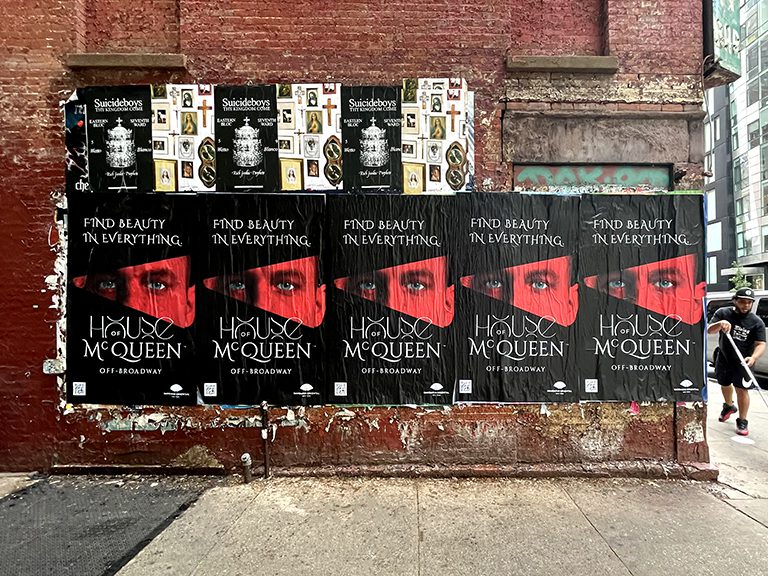
Fly Posters: Street Poster Campaigns That Build Real Buzz
Fly posters create neighborhood-scale brand presence by saturating target areas with high-frequency street placements. Here is how to plan, produce, and execute a campaign that actually sticks.
Fly posters are printed graphics placed on outdoor surfaces in urban neighborhoods to create repeated, street-level brand exposure. The term covers both the individual poster and the campaign practice of placing multiple posters across a concentrated geographic area. When a brand places 200 posters in a 12-block radius, every pedestrian who moves through that area encounters the same message multiple times over the course of a day, a week, or a campaign window. That density of exposure is the defining characteristic of a fly poster campaign and the reason the format continues to work in an era of pervasive digital advertising.
At American Guerrilla Marketing, we plan, produce, and execute fly poster campaigns in New York City and major markets across the United States. This guide covers the full campaign picture: how fly poster campaigns are structured, where they perform best, how they are designed and produced, and what results they generate for brands, events, and organizations across industries.
A fly poster campaign operates on a simple principle: the more times a consumer sees the same message in their physical environment, the more likely they are to register and remember it. This is not a new idea. It is the same principle that drives repetition in radio advertising, frequency in digital display, and high-volume direct mail campaigns. What makes fly posters distinct is the medium: the physical urban environment.
A consumer moving through their neighborhood over the course of a normal day will walk the same blocks multiple times. They will pass the same construction barricade on the way to the subway and on the way home. They will see the same outdoor board from the street and from the window of the coffee shop where they work remotely. The physical permanence of a poster in a known location means that each encounter is reinforced by the memory of previous encounters in the same spot. That is a form of brand building that no digital format can replicate because no digital format occupies the same physical location in a consumer’s daily route.
The geographic specificity of fly poster campaigns also allows for targeting precision that traditional out-of-home formats cannot match. A brand that wants to reach the creative community in Williamsburg, Brooklyn, can place fly posters specifically in Williamsburg. A campaign targeting the hip-hop audience in Harlem can concentrate placements in the blocks around 125th Street. A venue operator promoting a weekly night in the East Village can saturate the pedestrian routes around the venue and the residential blocks where their audience lives. That neighborhood-level geographic precision is the second defining characteristic of a fly poster campaign.
Fly Poster Campaign Formats and Sizing
The format and size of the poster affects every aspect of the campaign: production cost, placement options, design requirements, and street visibility. Choosing the right format for a specific campaign objective is part of the planning work we do with every client before print production begins.
Format
Size
Best Campaign Type
Typical Placement
One-Sheet
24 x 36 in
Events, concerts, album releases, brand launches
Boards, barricades, building walls
Half-Sheet
22 x 14 in
High-density saturation, neighborhood blanketing
Small surfaces, utility structures
18 x 24
18 x 24 in
Retail windows, urban boards
Business windows, panel boards
11 x 17
11 x 17 in
Maximum quantity, tight routing
Poles, narrow surfaces, stairwells
27 x 41
27 x 41 in
Film releases, anchor placements
Large boards, construction panels
Double-Sheet
48 x 36 in
Maximum impact, high-traffic locations
Long construction barricades, large walls
Most campaigns use a primary format for the majority of placements and a secondary format for specific high-visibility anchor locations. A campaign might run 200 one-sheet posters for neighborhood saturation and 10 double-sheets at the highest-traffic locations along the primary corridor. The combination creates broad coverage with a few standout placements that anchor the campaign visually.
Planning a Fly Poster Campaign: The Key Decisions
A successful fly poster campaign starts with clear answers to a small set of planning questions. The answers to these questions determine every production and execution decision that follows.
Who Is the Target Audience and Where Do They Live?
The foundation of placement strategy is understanding where the target audience physically moves. Not where they consume media, not where they follow social accounts, but where they physically walk, commute, shop, eat, and spend their leisure time. A fly poster campaign reaches people where they are in the physical world. Defining that location as precisely as possible is the first planning task.
For an event campaign, this typically means mapping the blocks around the venue and the residential neighborhoods where the target demographic is concentrated. For a brand launch, it means identifying the retail corridors and community gathering points in the neighborhoods with the highest density of target consumers. For a political or advocacy campaign, it means mapping the district boundaries and the highest-density pedestrian corridors within the target area.
What Is the Campaign Timeline?
Fly poster campaigns have a fixed production and execution timeline. Location scouting, design review, print production, and field scheduling all have lead times that cannot be compressed below a minimum. We typically recommend booking two to three weeks in advance of the desired installation date. Rush timelines are possible when creative assets are confirmed on day one and production runs in parallel with location scouting.
What Is the Poster Quantity?
Quantity is determined by the geographic scope of the campaign and the density of coverage desired within the target area. A single-neighborhood campaign that covers a 10-block radius typically runs 150 to 300 posters. A multi-neighborhood campaign across three to five neighborhoods in the same city runs 400 to 800 posters. A multi-city campaign adds a full neighborhood quantity for each additional market.
What Is the Creative Concept?
The creative concept for a fly poster campaign needs to be finalized before production begins. Changes after the print run starts generate significant cost and timeline impacts. We provide creative review as a standard service before any file goes to print. The review covers format, resolution, typography scale, contrast, color mode, and bleed. If the creative has issues that will affect street performance, we identify them before the press run rather than after installation.
AGM Field Note: The campaigns that underperform on the street almost always have one thing in common: the creative was designed for a screen, not for a wall. Screen design and street design are not the same discipline. What reads clearly on a 27-inch monitor at desk distance may be illegible on a 24×36 poster at 20 feet. We can catch this before print if you let us review the file early.
NYC Fly Poster Neighborhoods: A Market Guide
New York City is the strongest fly poster market in the United States and the market we know best. Here is a neighborhood-by-neighborhood breakdown of the key fly poster areas and what makes each one effective for specific campaign types.
Williamsburg, Brooklyn
Williamsburg is the most consistent fly poster market in New York. Bedford Avenue from North 7th to Metropolitan is the primary posting corridor. The density of music venues, bars, independent retail, creative studios, and residential population creates an environment where poster campaigns accumulate cultural weight. The Williamsburg audience is young, culturally engaged, and accustomed to encountering street-level promotions. Campaigns for concerts, art events, fashion launches, and consumer brands aimed at the 21 to 35 creative demographic perform strongly here.
Bushwick, Brooklyn
Bushwick is the complement to Williamsburg for campaigns targeting the Brooklyn arts community. The area around Jefferson Street, Wyckoff Avenue, and the cluster of gallery and studio buildings has heavy weekend foot traffic and a demographic profile that overlaps significantly with Williamsburg but with slightly higher engagement with visual arts and independent culture. Bushwick is a strong secondary market for Williamsburg-anchored campaigns and a primary market for campaigns specifically targeting the visual arts audience.
Lower East Side, Manhattan
The Lower East Side has been a premier fly poster neighborhood for music and nightlife promotion for 30 years. The concentration of music venues, bars, and late-night culture creates an audience that is accustomed to engaging with street-level promotions. Rivington Street, Delancey Street, and the blocks around Bowery Ballroom and Mercury Lounge are the core posting corridors. The LES demographic skews toward music fans, nightlife consumers, and young urban professionals with high cultural engagement.
East Village, Manhattan
The East Village maintains a strong poster culture rooted in its history as a center of punk, no wave, and underground art movements. St. Marks Place, Avenue A, and the surrounding blocks carry pedestrian traffic from a demographic that spans multiple generations and engages deeply with music, food, and independent culture. The East Village is a strong market for campaigns across a wider age range than Williamsburg or Bushwick, with particularly strong performance for campaigns connected to music, food, and independent retail.
Harlem, Manhattan
The 125th Street corridor in Harlem is the highest foot-traffic retail and cultural street in upper Manhattan. It reaches a broad demographic with deep community roots and high local spending. For campaigns targeting Black urban consumers, hip-hop and R&B audiences, or campaigns with broad popular culture appeal, 125th Street is a premium fly poster location with no equivalent in Manhattan in terms of the demographic profile and pedestrian density.
Astoria, Queens
Astoria carries a diverse and dense residential population with strong foot traffic on Steinway Street and Ditmars Boulevard. It is a strong secondary market for campaigns targeting young Greek, Middle Eastern, and broader multicultural urban consumers. Restaurant, entertainment, and lifestyle campaigns perform well in Astoria because the neighborhood has strong local consumer loyalty and a high density of independent businesses that generate pedestrian traffic throughout the week.
Multi-Market Fly Poster Campaigns
We coordinate fly poster campaigns across multiple cities simultaneously. A national brand launch, a multi-city tour, or a streaming release that needs street presence in multiple markets can be executed through a single campaign plan with city-level placement maps and local field crews in each market.
We have active field capabilities in New York, Los Angeles, Chicago, Miami, San Francisco, Philadelphia, Austin, and other major markets. Each city campaign is managed from a unified brief but executed with location intelligence specific to that market. A placement that works in Williamsburg has a Los Angeles equivalent in the Arts District or the Fairfax corridor. The logic of neighborhood selection is consistent across markets even when the specific locations differ.
AGM Field Note: Multi-market campaigns require more lead time than single-market campaigns because location scouting has to happen in parallel across all cities. We build multi-market timelines with a minimum of three weeks from confirmed brief to first installation. If you are running a campaign in five cities on the same launch date, book us four to five weeks out. The extra time pays off in placement quality.
Fly Posters and Digital Campaign Integration
Fly poster campaigns perform best when they are connected to digital campaign activity running in parallel. The physical presence created by street posters can be reinforced and amplified through coordinated digital placements, and the street campaign can generate organic digital content that extends its reach beyond the physical placement locations.
The most common integration patterns we see in well-executed campaigns:
Geo-targeted social advertising: Digital ads targeting the same neighborhoods where fly posters are placed create multi-channel exposure to the same consumer. The physical poster creates the initial impression; the digital ad reinforces it in the same consumer’s social feed.
Organic social documentation: Consumers who encounter the posters on the street often photograph and share them. A distinctive poster in a desirable neighborhood generates organic social content that extends campaign reach beyond the placement locations.
QR code integration: Posters that include a QR code create a bridge between the physical placement and digital destinations including event registration, product pages, and playlist links. We track QR scan activity from campaign-specific codes to measure engagement from physical placements.
Influencer seeding: Coordinating influencer seeding in the campaign neighborhoods during the campaign window allows influencers to authentically document the street presence and share it with their audiences.
Campaign Documentation and Reporting
Every fly poster campaign we execute is documented comprehensively. The documentation package delivered after each campaign includes:
GPS-tagged photographs of every placement, organized by location and date
A complete placement map showing all locations hit during the campaign
Poster format and quantity breakdown by neighborhood
Campaign timeline record from installation to monitoring completion
Notes on any placement variations from the original map due to field conditions
This documentation serves as proof of execution for clients who need to demonstrate campaign delivery to internal decision-makers, as source material for post-campaign analysis, and as a reference for planning future campaigns in the same markets.
Fly Posters and Organic Social Amplification
One of the consistent secondary effects of well-executed fly poster campaigns in culturally active neighborhoods is organic social amplification. When a strong poster appears in a neighborhood with a high density of social media-active consumers, those consumers photograph it and share it. The campaign’s physical placement generates digital distribution that extends reach beyond the geographic boundaries of the posting area.
This effect is not guaranteed, but it is consistently present in campaigns that meet two conditions: the creative is genuinely distinctive, and the posting neighborhood has a high density of culturally engaged, social-media-active consumers. Williamsburg, Bushwick, the Lower East Side, and the Fairfax corridor in Los Angeles are all neighborhoods where this effect is reliably present for campaigns with strong creative. The Arts District in Los Angeles and Wynwood in Miami produce similar organic sharing patterns for the right campaign creative.
Brands that want to encourage organic amplification can design campaigns specifically for this effect: creating visually bold, shareable creative that gives consumers a reason to photograph and post it, including a QR code or URL that the photographer and their audience can follow, and coordinating the campaign with influencers who are likely to be in the neighborhood during the posting window. An influencer who genuinely discovers the poster on the street and photographs it authentically is a more credible endorsement than a paid influencer post with no physical context.
We advise clients on organic amplification potential as part of the campaign brief process. If the creative is not strong enough to generate organic social interest, we say so. If the neighborhood selection is right for this effect, we factor it into the campaign plan as a realistic secondary outcome. We do not promise organic sharing because we do not control consumer behavior, but we design campaigns with the conditions for it in place when the brief and creative support it.
Timing Strategy for Fly Poster Campaigns
When a fly poster campaign runs is as important as where it runs. The timing of installation relative to the event date, product launch, or campaign objective window determines how much useful dwell time the campaign gets in front of its target audience. Here is how to think about timing for the most common campaign scenarios.
Event Promotion Timing
For concert, event, and festival campaigns, the optimal posting window is 10 to 21 days before the event date. This window is long enough for the campaign to build frequency with the neighborhood audience through multiple encounters over daily routines, but short enough that the campaign is still highly visible and not over-papered by competing campaigns at the moment of peak ticket purchase intent. Posting more than three weeks before a small to medium event date typically means the campaign is at its weakest point visually when purchase intent peaks in the final week.
For large events with long sales cycles, particularly festivals and major concerts with tickets that go on sale weeks or months in advance, an earlier posting window can make sense as part of a phased campaign. An initial posting run announces the event when tickets first go on sale, and a second run in the two weeks before the event reinforces the campaign as the date approaches.
Product Launch Timing
For consumer brand launches and product releases, the posting window typically starts five to seven days before the availability date and runs for two to three weeks after. The pre-launch phase creates neighborhood awareness before the product is available. The post-launch phase maintains street presence during the initial availability window when consumer purchase decisions are most active. A campaign that disappears from the street the day the product launches misses the two to three weeks when that presence would be most useful to conversion.
Sustained Awareness Timing
For sustained brand awareness campaigns not tied to a specific event or launch date, timing is determined by the campaign window rather than a specific action deadline. These campaigns typically run in monthly cycles with refreshed creative and adjusted placement maps that target different neighborhoods or corridors in each cycle. The goal is to build cumulative neighborhood familiarity with the brand over time, cycling through the target market’s key areas to reach a broad cross-section of the audience across multiple campaign windows.
Measuring the Impact of a Fly Poster Campaign
Every client asks some version of the question: how do we know if the fly poster campaign worked? The honest answer is that physical street advertising does not have the same click-through measurement infrastructure as digital advertising, and anyone who claims it does is misrepresenting the medium. What fly poster campaigns produce is measurable in different ways, and the measurement framework for this format needs to match what the format actually does rather than importing metrics from digital channels where they do not apply.
The primary measure of campaign delivery is placement documentation: GPS-tagged photographs of every posted location. This is the campaign delivery record. Every placement we promise to execute is documented and delivered to the client. This documentation is not a proxy for consumer response, but it is the baseline proof that the campaign happened as specified.
Secondary performance signals for fly poster campaigns include: geographic web traffic from the posting neighborhoods during the campaign window (measurable via Google Analytics geographic segmentation), event ticket sales velocity during the campaign window versus comparable pre-campaign windows, social media mentions from within the posting neighborhoods during the campaign window, and direct audience feedback from venues, retailers, and community partners in the area. These signals are directional rather than precise, but they provide a consistent framework for assessing campaign impact across multiple campaigns over time.
The most reliable measurement framework is to run fly poster campaigns consistently for multiple cycles and track the secondary performance signals across each cycle. Campaigns that show consistent positive signal movement across multiple cycles in the same neighborhoods provide strong evidence of campaign contribution to brand performance goals.
Fly Posters for Political and Advocacy Campaigns
Political campaigns, voter registration efforts, community advocacy organizations, and issue-based nonprofits have a long history of using fly poster campaigns to reach dense urban populations. The format is particularly well-suited to this use case because of its ability to achieve high neighborhood-level frequency at a cost point that fits campaign budgets that cannot access premium outdoor advertising inventory, and because the physical presence of street-level materials signals genuine community investment in a way that digital advertising cannot replicate.
For voter registration campaigns specifically, the street-level presence of registration information in the specific neighborhoods being targeted has a demonstrated positive effect on registration rates. Consumers who encounter the campaign multiple times in their daily physical environment register the information more reliably than those who encounter it only through digital channels. The repetition of the physical encounter builds a sense of urgency and social normativity around the registration act that digital advertising struggles to create at the same neighborhood specificity.
Advocacy campaigns that are trying to build community awareness of an issue benefit from fly poster campaigns because the street-level presence of the campaign message signals that the issue is being taken seriously by people in the community. When consumers see the same campaign on multiple walls in their neighborhood, they perceive it as a community-level concern rather than a fringe position. The physical saturation of the neighborhood with campaign materials creates a social proof effect that digital reach cannot produce.
We plan and execute fly poster campaigns for political and advocacy clients using the same professional standards and placement documentation practices we use for commercial clients. If your campaign has a civic or community focus, we approach the planning with the same care and the same commitment to execution quality that we bring to every campaign category.
Written by the American Guerrilla Marketing field team. AGM has designed and executed street-level poster campaigns for brands, record labels, venues, and agencies across New York City and the United States since 2008.
Frequently Asked Questions
What are fly posters?
Fly posters are printed graphics placed on outdoor surfaces in urban environments to create street-level brand presence. They are adhered using wheat paste and designed for high-frequency, neighborhood-scale exposure in target markets over a defined campaign window.
How many fly posters do I need for a neighborhood campaign?
A single-neighborhood saturation campaign typically runs 150 to 300 posters. Multi-neighborhood campaigns run 400 to 800 or more depending on the number of markets and the geographic scope. We recommend quantity based on the specific neighborhood density and the coverage goal.
What neighborhoods in NYC are best for fly posters?
Williamsburg, Bushwick, the Lower East Side, the East Village, Harlem, Astoria, and Crown Heights are among the most productive fly poster neighborhoods in New York City based on pedestrian density, cultural engagement, and our placement network coverage in each area.
How far in advance should I book a fly poster campaign?
We recommend booking at least two to three weeks in advance of your desired installation date. This allows time for location scouting, design review, print production, and field crew scheduling. Rush timelines are possible with confirmed creative assets and an expedited print schedule.
Can fly posters be placed in multiple cities at the same time?
Yes. We coordinate simultaneous multi-market campaigns in New York, Los Angeles, Chicago, Miami, San Francisco, and other major cities. Each market has its own placement map and field crew. Campaign documentation from all markets is consolidated into a single report.
What is the best time of year for fly poster campaigns?
Fly poster campaigns run year-round. Spring and fall are peak season for event-related campaigns. Summer campaigns perform strongly in outdoor entertainment neighborhoods. Winter campaigns work well for the right product or event, though cold and wet conditions require adjusted adhesive formulations for optimal surface adhesion.
How do fly posters compare to digital advertising?
Fly posters create physical presence in a specific geographic location that digital advertising cannot replicate. A consumer who sees your poster on their block encounters it in isolation, in their physical environment, without competing stimuli. The two formats are complementary rather than interchangeable and work best when coordinated.
Do you supply the wheat paste or does the client?
We supply and prepare all adhesive compounds. Wheat paste is mixed to the correct consistency for the specific surface type and weather conditions on installation night. The client is responsible only for providing the approved printed poster files.
Can I run fly posters concentrated around a specific event venue?
Yes. We build placement maps concentrated around a specific venue, event location, or retail address, placing posters in the blocks immediately surrounding the target location and along the primary pedestrian approach routes. This venue-radius approach is a common strategy for concert and event promotion.
Contact us at (646) 776-2770 or [email protected]. We start with your target neighborhood, campaign objective, and timeline, then build the placement plan, manage print production, and handle field execution and documentation.