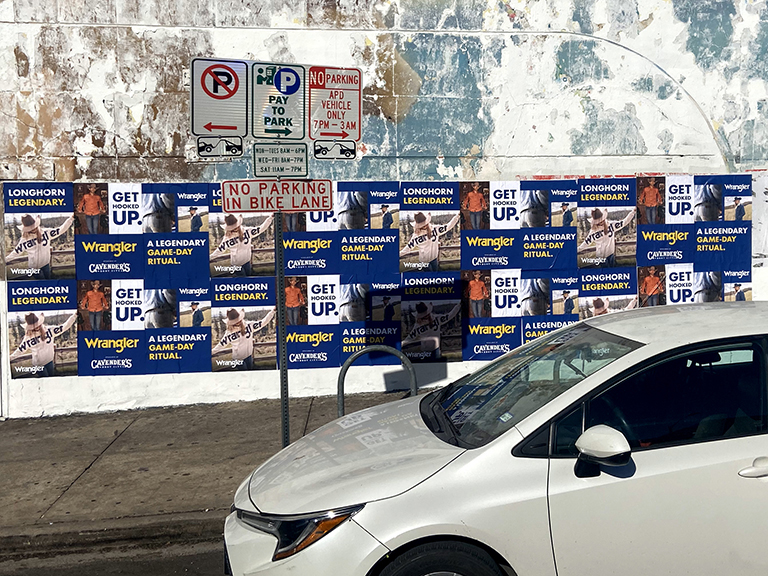
Most guides to making wheatpaste are three paragraphs long and give you a recipe that works about 70% of the time under average conditions. This is not that guide. What follows is the technical version, written from experience making paste for professional campaigns across dozens of markets — January in New York, August in Miami, dry desert heat in Las Vegas, damp Pacific Northwest fall. It covers the chemistry behind why the basic recipe works, the specific process steps most guides skip or get wrong, formulation adjustments for different weather and surface conditions, and how the math changes when you scale from a gallon to a 20-gallon campaign batch.
If you’re making paste for 10 posters in your neighborhood, the basic recipe below is sufficient. If you’re running a 50-location campaign in Miami in July or preparing 300 posters for a simultaneous multi-city launch, you need the full version.
Why the Basic Recipe Works: The Chemistry Behind It
Wheat flour contains starch — specifically, a mix of amylose and amylopectin granules. When these starch granules are suspended in water and heated, they absorb water and swell until they rupture, releasing starch chains that form a gel network as the mixture cools. This gelatinization process is what transforms flour and water from a thin slurry into a thick, adhesive paste.
The gel strength — and therefore the adhesive quality of the paste — is determined by the concentration of starch (flour-to-water ratio), the cooking temperature and duration (affecting how completely gelatinization occurs), and any additives that modify the gel structure (PVA glue is the most important of these).
Understanding this lets you diagnose paste problems rather than guessing at them. Paste that’s too thin: either the flour concentration is too low or the paste was undercooked. Paste that’s lumpy: the flour wasn’t pre-dissolved before adding to hot water. Paste that dries and cracks: likely undercooked or too high flour concentration for the humidity conditions.
The Standard Wheatpaste Recipe: Stovetop Method
This is the baseline recipe for temperate conditions — roughly 45 to 70 degrees Fahrenheit, moderate humidity. It produces working paste for most campaign environments.
Ingredients (makes approximately 1 gallon)
- 1 cup all-purpose white flour (not whole wheat, not bread flour)
- 4 cups water, divided
- 1 tablespoon white PVA glue (Elmer’s School Glue or equivalent)
Process
- Pre-dissolve the flour: Combine flour with 1 cup cold water in a bowl or measuring cup. Whisk vigorously until no lumps remain. This is the most important step to skip at your peril — flour added directly to hot water lumps and never fully dissolves. The pre-slurry ensures even gelatinization.
- Bring water to boil: Bring remaining 3 cups of water to a full boil in a heavy-bottomed pot. A heavy pot distributes heat evenly and prevents scorching at the bottom.
- Add the slurry: Pour the flour-water slurry into the boiling water while stirring constantly. The mixture will initially thin as it hits the hot water, then thicken rapidly as gelatinization begins.
- Cook: Reduce to medium heat. Stir constantly for 5-8 minutes. The paste is done when it coats the back of a spoon and holds a line drawn through it. It should have the consistency of heavy cream. Under-cooked paste (still slightly starchy-tasting) has weaker adhesion and shorter wall life.
- Add PVA: While the paste is still hot, stir in PVA glue. The heat helps distribute the PVA evenly through the gel structure. Do not skip this step if you are running a professional campaign.
- Cool before use: Allow paste to cool to approximately 100-110 degrees F before use. Very hot paste will dampen paper immediately on contact and make positioning and smoothing difficult. Cool paste reaches working consistency and is easier to apply cleanly.
The PVA Upgrade: Why It Matters
Adding PVA glue to wheatpaste is the single most impactful improvement to the basic recipe. Pure wheatpaste is water-soluble — rain softens it and can release poster edges within days. PVA modifies the gel structure to create a more water-resistant bond after curing. A properly PVA-modified paste can produce installations that last 4-6 weeks on the right surface in rain-exposed conditions. Pure flour paste on the same surface might peel within a week of the first significant rain.
Use white PVA (school glue) rather than yellow carpenter’s glue. The yellow PVA is more rigid after curing and can cause poster cracking. White PVA cures more flexibly, accommodating the natural movement of paper in changing humidity without delaminating.
Weather-Specific Formulations
Hot and Humid: Miami Summer, New Orleans, Houston August
High heat and humidity are the most challenging conditions for wheatpaste campaigns. The primary problems: paste thins in heat (reducing effective working viscosity), paper dampens more readily in humidity (making handling harder), and rapid surface drying in direct sunlight creates edge curl before adhesion sets.
Formulation adjustment: Increase flour to 1.25 cups per 4 cups water. The higher concentration compensates for heat-induced thinning and produces paste that maintains working viscosity through the hottest part of a deployment.
Process adjustments: Work in the early morning (6-9 AM) or evening (after 7 PM). Avoid application in direct sunlight — find shaded walls first. Apply the base coat, allow 60 seconds for initial tack, then position the poster and apply the top coat immediately. Don’t let the base coat dry before posting in hot conditions.
Cold and Dry: NYC January, Chicago Winter
Cold conditions affect paste viscosity (cold paste thickens rapidly and becomes difficult to brush) and adhesion (cold surfaces reduce the temperature-dependent bonding mechanisms in the starch gel). The primary risk is paste that sets before the poster is fully adhered.
Formulation adjustment: Reduce flour to 0.85 cups per 4 cups water for a thinner paste that remains workable at low temperatures. Adding a small amount of salt (1/4 teaspoon per gallon) lowers the freezing point slightly and helps in near-freezing conditions.
Process adjustments: Keep paste containers in a heated vehicle. Work with smaller batches carried in insulated containers. Apply the poster quickly after the base coat — cold paste sets faster than warm paste. Check adhesion more frequently and press edges firmly.
Hot and Dry: Las Vegas, Dallas Summer, Phoenix
The challenge in hot, dry conditions is rapid surface evaporation — the paste dries almost immediately on contact with a hot, sun-exposed wall, reducing the available time for poster positioning and adhesion. The base coat can set before you can apply the poster.
Formulation adjustment: Reduce flour slightly to 0.9 cups per 4 cups water for lower viscosity that spreads faster. Work at night or before sunrise when ambient temperatures are lowest. In extreme conditions (above 105 degrees), consider moving to wheat dextrin (see below) which has better working properties in dry heat.
Mild and Dry: Los Angeles Fall/Spring, Bay Area
The most forgiving conditions for wheatpaste. The standard recipe works well without major modification. The primary adjustment needed is accounting for the relatively porous surfaces common in LA’s mixed stucco and painted-concrete environment — slightly higher PVA concentration (1.5 tablespoons per gallon) improves penetration into porous surfaces and extends adhesion.
Scaling Up: From 1 Gallon to 20 Gallons
Campaign-scale paste production requires attention to equipment and process consistency. A 20-gallon batch is not simply twenty times the 1-gallon recipe — the cooking dynamics change at scale.
Equipment for Large Batches
- Heavy-bottomed stock pot (12-16 quart minimum for 5-gallon batches)
- Long-handle paddle or commercial stirring spoon
- Dairy or candy thermometer for monitoring temperature
- Large food-grade buckets with lids for transport and storage
Scaling Considerations
Large batches take significantly longer to reach gelatinization temperature and longer to complete cooking. Plan 20-25 minutes of active cooking time for a 5-gallon batch versus 5-8 minutes for a 1-gallon batch. Stir continuously — large batches scorch on the bottom if left unattended even briefly. Use a thermometer to confirm the paste reaches 185-200 degrees F throughout rather than relying on visual cues.
For multi-day campaigns, make fresh paste each day rather than storing large cooked batches. The quality difference between day-1 and day-3 paste is significant, especially in warm weather where fermentation accelerates.
Wheat Dextrin: The Professional Alternative
Wheat dextrin paste is a pre-gelatinized starch product that dissolves in warm water without cooking. It produces consistent, stable paste with excellent adhesion and is particularly useful in contexts where cooking large batches on-site is impractical — hotel conference room production sessions for multi-city tours, for example, or campaigns where kitchen access isn’t available.
Dextrin is more expensive than flour but more consistent in results and faster to prepare at scale. For campaigns where production logistics are constrained, the cost premium is often justified by the consistency and time savings. Professional campaign operations at AGM use dextrin for large-scale productions where consistency across a multi-day rollout is critical.
Common Failure Points and How to Avoid Them
- Lumpy paste: Always pre-dissolve flour in cold water before adding to hot. Lumps that form in hot water cannot be fully broken down by stirring.
- Paste too thin: Either increase flour concentration or extend cooking time. Undercooked paste never achieves proper gel strength.
- Paste that peels within days: Probably low PVA content or poorly bonded surface. Increase PVA ratio and assess surface quality — heavily painted or non-porous surfaces need surface scoring or a primer coat of thinned paste.
- Edge lifting: Usually a top-coat issue. The top coat should fully cover all poster edges with particular attention to corners. Edge lift typically starts at the corners — press them firmly and apply extra paste to corners as a final step.
- Poster wrinkling: Too much paste applied too wet before positioning. The base coat should be tacky, not wet, before the poster goes down.
FAQ
What is the basic wheatpaste recipe for street posters?
Standard wheatpaste: 1 cup all-purpose white flour to 4 cups water. Dissolve flour in 1 cup cold water first to prevent lumps. Bring remaining 3 cups water to boil, then add flour slurry while stirring constantly. Cook 5-8 minutes until the consistency of heavy cream. Add 1 tablespoon PVA glue per quart while still hot. Cool before use.
Why do you add PVA glue to wheatpaste?
PVA significantly improves adhesion strength, extends paste lifespan on the wall, and improves water resistance after curing. A paste with PVA added holds through rain and humidity significantly better than flour-and-water alone. It is the single most impactful upgrade to the basic recipe.
How do you adjust wheatpaste for hot and humid weather?
In hot, humid conditions, increase the flour ratio to 1.25 cups per 4 cups water to produce a thicker paste that won’t thin excessively in heat. Apply in early morning or evening when temperatures are lower. Avoid application in direct sunlight as rapid drying creates edge curl before the paste bonds fully.
How do you adjust wheatpaste for cold weather?
In cold conditions, reduce flour to 0.85 cups per 4 cups water for a thinner paste that remains workable at low temperatures. Keep paste containers in a heated vehicle and work in smaller batches that can be consumed before they cool and set.
How long does wheatpaste last in storage?
Fresh wheatpaste lasts 2-3 days refrigerated. At room temperature, it begins to degrade within 12-18 hours in warm weather. Make only what you need for a single campaign day unless you have reliable refrigeration.
Can you use whole wheat flour instead of white flour for wheatpaste?
White all-purpose flour is strongly preferred. Whole wheat flour contains bran particles that don’t fully gelatinize and produce a grainy paste that applies unevenly. For large-format posters where smooth application is critical, whole wheat flour creates visible texture problems.
How much wheatpaste do you need per poster?
For a standard 24×36 poster, plan on roughly 3-4 fluid ounces of paste per application (base coat plus top coat). A 1-gallon batch produces enough paste for approximately 30-40 standard posters with proper technique.
Frequently Asked Questions
What is how to make wheatpaste?
American Guerrilla Marketing provides how to make wheatpaste services across 50+ U.S. markets. Every campaign is planned, scouted, executed, and GPS-documented by our field teams. We work with regional brands and Fortune 500 companies on campaigns that require real street-level execution and documented proof of performance.
How does AGM approach make wheatpaste?
Our process starts with a market consultation to understand your goals, target audience, and budget. We then scout locations, handle any required permissions or permits, coordinate production and installation with our local crews, and provide a full GPS-tagged photo report after the campaign runs.
What markets does American Guerrilla Marketing cover for make wheatpaste?
We operate in 50+ U.S. markets including New York, Los Angeles, Chicago, Miami, Houston, Atlanta, Seattle, Denver, Boston, and dozens of secondary markets. Contact us to confirm availability and pricing for your specific market.
How much does a make wheatpaste campaign cost?
Campaign pricing depends on market, format, quantity, and duration. We work with budgets ranging from targeted single-market runs to national rollouts across multiple cities. Use our RFP Builder or contact us directly for a custom quote based on your specific campaign requirements.
How do I get started with make wheatpaste through AGM?
The fastest way to get started is to submit your campaign details through our RFP Builder at americanguerrillamarketing.com, or contact us directly at [email protected] or (646) 776-2770. Our team typically responds within one business day with availability and initial pricing.