Alabama’s college market is one of the most passionate and culturally defined in the country. The University of Alabama in Tuscaloosa and Auburn University in the Plains share a state with a combined enrollment of more than 70,000 students and a football rivalry that defines the state’s social calendar from late August through November. For brands seeking access to an intensely engaged, highly visible student audience, Alabama’s college towns deliver concentration and passion that few markets can match.
Student marketing in Alabama is inseparable from SEC football culture. The University of Alabama’s Crimson Tide program is one of the most successful in college football history, with a home stadium that fills to 100,000+ on game days and a student section that is among the largest and most visible in the country. Auburn’s Jordan-Hare Stadium draws 87,000 per home game in a college town where the Tigers are the entire economy and social identity. Both campuses offer marketing opportunities that go far beyond the game itself, encompassing the week’s worth of pregame programming, alumni activity, and media attention that surrounds each home game.
American Guerrilla Marketing executes student marketing campaigns across Alabama’s campus markets with the same GPS-documented, permit-managed approach we apply in every market. We know Tuscaloosa’s campus layout, understand Auburn’s downtown commercial structure, and have the operational infrastructure to coordinate multi-campus Alabama campaigns efficiently. Here is a complete guide to student marketing in Alabama and how to build a campaign that produces results.
Alabama’s College Market: Campus Profiles and Audience Demographics
University of Alabama, Tuscaloosa
The University of Alabama enrolls approximately 38,000 students in Tuscaloosa, a city where the university is the dominant economic and cultural institution. The Ferguson Student Center is the campus hub. The Quad, a sprawling outdoor space at the heart of campus, serves as the primary gathering point for students between classes and during campus events. Greek life at Alabama is extraordinarily robust, with one of the largest Greek systems in the country. The Greek houses along Sorority Row and the fraternity complexes on campus function as social anchors that influence purchasing decisions, event attendance, and brand associations across the entire student body.
Tuscaloosa’s commercial district on University Boulevard and the adjacent Strip running parallel to campus concentrate student dining, entertainment, and retail activity. Poster placements in these commercial zones, ambassador presence in the Strip’s bars and restaurants, and street team activations on the Quad during peak class transition hours generate direct reach into the Alabama student daily routine. Our guerrilla marketing programs at Alabama are built around these high-traffic zones and the game-day activation windows that make Tuscaloosa one of the highest-impact college marketing environments in the South.
Auburn University, Auburn
Auburn has approximately 33,000 students in a classic college town where the university’s presence is total. Haley Center, the main academic building at the heart of campus, and the Foy Student Union are the primary activation zones. Toomer’s Corner, where Auburn fans roll the oak trees with toilet paper after major victories, is the cultural centerpiece of Auburn’s campus identity. The commercial district on College Street adjacent to campus concentrates student activity in bars, restaurants, and retail. Auburn’s passionate athletics culture, particularly around football and baseball, creates sustained event-based marketing opportunities throughout the fall and spring semesters.
University of Alabama Birmingham (UAB)
UAB is Alabama’s urban research university, embedded in the heart of Birmingham with 22,000+ students and a nationally recognized medical center. UAB’s student body is more diverse and more professionally focused than Tuscaloosa or Auburn, with significant graduate and medical student enrollment. The Hill Student Center is the main hub. UAB’s campus in Birmingham’s Five Points South and Southside neighborhood gives it access to a thriving young professional and student social ecosystem beyond the campus boundary. Street team activations in the Southside commercial district reach UAB students alongside the broader Birmingham young professional demographic.
Alabama State University, Montgomery
Alabama State is the state’s flagship HBCU, with approximately 4,000 students in Alabama’s capital city. ASU’s student body has deep roots in Montgomery’s Black community and the state’s civil rights heritage. The Tullibody Student Center is the campus hub. Campaigns at ASU require culturally authentic approaches with ambassador recruitment from within the campus community and creative that respects ASU’s historical significance and community identity.
Student Marketing Tactics That Work in Alabama
Brand Ambassador Programs
Alabama and Auburn both have highly social student cultures where peer recommendation carries significant weight. Brand ambassador programs at both campuses leverage Greek life networks, athletics supporter communities, and student organization structures that amplify brand messages far beyond individual ambassador follower counts. At Alabama, an ambassador with strong Greek life connections can seed brand awareness through sorority and fraternity social networks that collectively reach the majority of the campus’s most socially active students.
Game-Day Street Team Activations
Alabama and Auburn home game days are among the highest-density student audience events in the country. Street teams positioned in Alabama’s tailgate zones around Bryant-Denny Stadium and in Auburn’s game-day gathering areas around Jordan-Hare reach massive concentrated audiences during the pre-game window. We plan game-day teams well in advance, coordinate with campus event staff, and position activations at maximum-impact locations throughout the tailgate and post-game windows.
Poster Campaigns
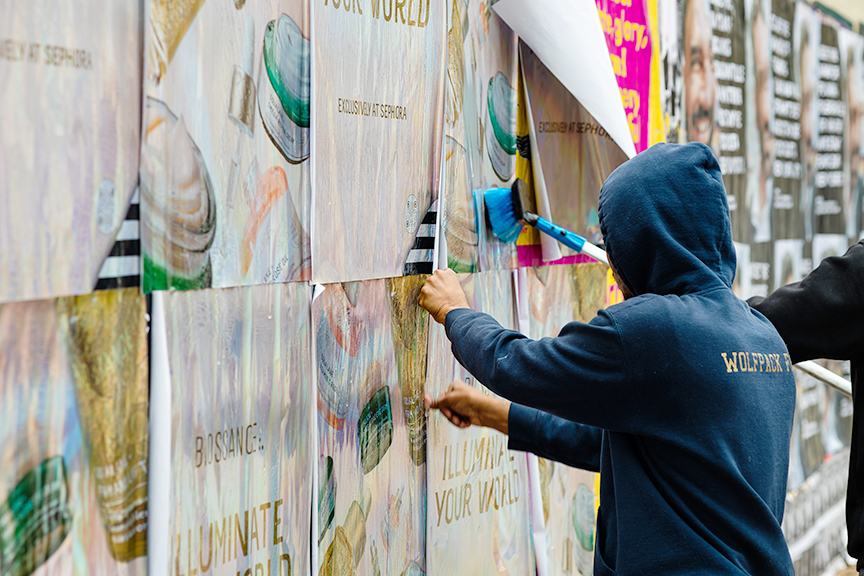
Poster campaigns on Alabama’s approved posting surfaces, on Auburn’s campus kiosks, and in the commercial districts adjacent to each campus create sustained brand visibility. The Strip in Tuscaloosa and College Street in Auburn are particularly effective off-campus posting zones that reach students in their leisure environment. We handle all placement permissions and document every location with GPS-tagged photography.
Sidewalk Stencil Campaigns
Sidewalk stencil placements at Alabama’s Quad crossings and Auburn’s Haley Center pathways create repeated brand impressions for students who use the same routes daily. Alabama’s warm climate makes stencil campaigns viable through most of the academic year outside of January’s occasional cold weeks. We apply water-soluble compounds at approved locations and document every placement with GPS and time-stamped photography.
LED Billboard Trucks
LED billboard trucks routed through Tuscaloosa’s University Boulevard and campus perimeter on game days generate enormous impressions during the highest-traffic windows of the Alabama academic year. In Auburn, routes along Magnolia Avenue and College Street during home game weeks reach students and the game-day visitor audience simultaneously. We plan routes to maximize coverage of the highest-density student corridors during each deployment window.
Industries and Categories That Perform Best in Alabama’s College Markets
Athletic Lifestyle and Fan Gear Adjacent Brands
Alabama’s SEC football culture makes athletic lifestyle brands one of the consistently highest-performing categories in the state’s college market. Students at Alabama and Auburn spend significantly on athletic apparel, footwear, fan accessories, and outdoor recreation gear. Brands that can align with the athletic identity of each campus without infringing on official team licensing generate sustained brand association tied to the emotional intensity of SEC football. Ambassador programs at Alabama recruiting from the student athletic support community and Greek life, where Crimson Tide loyalty is a defining social characteristic, reach peer networks with exceptionally high athletic lifestyle purchasing activity compared to general student populations.
Food and Beverage at Game Day Scale
Alabama’s game day culture creates sampling and trial opportunities for food and beverage brands at a scale that is almost unparalleled in college marketing. The Grove at Ole Miss, the Junction at Mississippi State, and the tailgate areas surrounding Bryant-Denny Stadium at Alabama all host tens of thousands of people for hours before each game. Street team sampling programs positioned in tailgate zones during game days generate product trials in volumes that would require months of standard street team deployments to replicate. Energy drinks, snacks, non-alcoholic beverages, and food product launches routinely use SEC tailgate activations as their market entry vehicle precisely because the density and engagement level of the game day audience is matched nowhere else in student marketing.
Financial Services and Banking for First-Generation Success Stories
Alabama State University and UAB serve student populations that are disproportionately first-generation college students, students from families with limited prior banking relationships, and students entering the professional workforce for the first time in their family history. Financial services brands with genuine commitments to financial inclusion and first-time banking products find these campuses particularly receptive when campaigns combine authentic financial literacy value with brand awareness. Programs at ASU that connect to the university’s community development mission, and UAB programs that align with the city of Birmingham’s economic mobility agenda, outperform generic financial services campaigns that approach these campuses without acknowledging their specific community context.
Multi-Campus Alabama Coordination
The Tuscaloosa-Auburn Axis
The University of Alabama and Auburn University are approximately 150 miles apart, connected by I-85 through Montgomery. A campaign team executing activations at both campuses in a single week can complete Alabama Tuscaloosa activations Monday and Tuesday, travel through Montgomery for a potential UAB or Alabama State stop Wednesday, and arrive in Auburn for Thursday and Friday activations. This I-85 corridor approach creates a natural multi-campus Alabama campaign structure that covers the state’s primary college markets in a single efficient travel week, reducing per-campus logistical overhead and allowing multi-campus budgets to go further.
Navigating the Rivalry in Campaign Creative
Any brand operating at both Alabama and Auburn must navigate the intense intra-state rivalry carefully in campaign creative. Content that favors one team’s identity over the other is noticed immediately on both campuses and creates negative brand associations in the rival market. Campaigns designed for the dual-campus Alabama market use neutral athletic lifestyle framing, campus-specific creative assets that acknowledge each campus’s distinct identity separately, and ambassador teams recruited from each campus independently. We build Alabama multi-campus creative strategies that respect the rivalry rather than ignoring it, because in Alabama, ignoring the rivalry is itself a brand positioning error.
Alabama Student Marketing: Timing and Campaign Calendar
Early Move-In: Mid-August
Alabama and Auburn both start their academic years earlier than most Northern schools, with move-in typically occurring in the second week of August. This early start means Alabama campaign materials need to be produced and deployed slightly ahead of the national student marketing calendar. The move-in window is the year’s most valuable targeting moment, capturing students who are actively forming brand relationships and exploring their new environment.
SEC Football Season: Late August Through November
The SEC football season is Alabama’s dominant marketing window. Alabama typically plays six to seven home games per season, each drawing 100,000+ to Tuscaloosa. Auburn plays a similar number of home games in the Plains. The four months of football season create a sustained, high-energy marketing environment that no other Alabama seasonal window can match. We schedule ambassador programs, street team activations, and billboard routes to align with the specific home game calendar for each campus.
The Iron Bowl: Late November
The Alabama-Auburn rivalry game, known as the Iron Bowl, is one of the most emotionally charged events in American sports. Played alternately in Tuscaloosa and Auburn, the game draws national media attention and creates a week of heightened campus energy at both schools. Brands positioned at both campuses during Iron Bowl week benefit from the amplified social media activity and heightened emotional engagement that accompanies the rivalry.
Spring Semester: January Through May
Spring semester brings baseball season (Auburn’s program is perennially strong), spring football practices, and the social programming that restarts after winter break. Alabama’s mild late-winter climate makes outdoor programming viable from March through May. Spring campaigns face lower competition for student attention than fall campaigns, often delivering stronger per-dollar reach among brands willing to invest in the spring window.
Measuring Performance and Documenting Alabama Campus Campaigns
Game-Day Documentation Standards
Game-day activations at Alabama and Auburn generate the most visually dramatic and documentarily rich campaign records of any format we execute in the state. Aerial photography near tailgate zones, ground-level team position documentation, crowd density estimates from deployment locations, and QR scan logs from team card handouts all combine to provide brands with a multi-format performance record that demonstrates the scale of game-day activation reach. We document Alabama game-day campaigns with both standard GPS-tagged activation photography and extended narrative reporting that contextualizes each deployment within the specific game-day environment, providing brand teams with a clear picture of exactly what execution looked like on the ground.
Ambassador Social Content Metrics
Alabama’s ambassador programs at the University of Alabama and Auburn University include weekly social content reporting that tracks follower reach, engagement rates, and organic amplification for each ambassador’s content throughout the program. The Crimson Tide and Tigers athletics cultures generate unusually high organic engagement rates for brand content that aligns authentically with campus athletics identity, meaning Alabama ambassador content consistently outperforms benchmark engagement rates from other SEC campus markets on content tied to game-day programming and athletic culture. This performance data is included in weekly ambassador program reports delivered throughout each semester-long program.
Long-Term Brand Equity in Alabama’s Passionate Fan Markets
Alabama’s college market is unusual in that brand associations formed during the college years carry extraordinary longevity through the alumni networks of both the University of Alabama and Auburn. Alabama and Auburn alumni remain intensely loyal to their university identities decades after graduation, maintaining social networks and brand associations tied to their campus experiences in ways that are structurally different from less culturally intense university markets. Brands that build genuine campus presence at Alabama or Auburn during a student’s college career are not simply generating four years of purchase behavior; they are building brand associations that will be reinforced, discussed, and maintained through alumni networks for twenty to thirty years after graduation.
Frequently Asked Questions: Student Marketing in Alabama
What is student marketing in Alabama?
Student marketing in Alabama targets college students at the University of Alabama in Tuscaloosa, Auburn University, UAB in Birmingham, Alabama State, and Troy through tactics including street team activations, brand ambassador programs, poster campaigns, and SEC football game-day activations.
Which Alabama campuses are best for student marketing?
The University of Alabama and Auburn University are the two flagship targets. Their intense rivalry creates exceptional dual-campus marketing opportunities. UAB provides access to Alabama’s largest city and a more urban, diverse student demographic. Alabama State is the primary HBCU target in Montgomery.
When is the best time to run student marketing campaigns in Alabama?
Move-in week in mid-August, SEC football season from late August through November, and spring semester launch in January are the primary windows. The Iron Bowl in late November is the highest-profile single-day event in the state for brand activations. Alabama’s warm climate supports outdoor activations through most of the academic year.
How much does student marketing in Alabama cost?
Single-campus activations at Alabama or Auburn typically range from $3,000 to $8,500. A combined dual-campus campaign runs $14,000 to $35,000. Contact our team for a custom quote based on your specific campus targets and campaign goals.
Does American Guerrilla Marketing operate in Alabama?
Yes. We execute student marketing campaigns in Tuscaloosa, Auburn, Birmingham, Montgomery, and other Alabama markets. Our team manages all permits, staffing, materials, and GPS-documented proof of performance for every campaign we run in the state.
What student marketing tactics work best in Alabama?
Brand ambassador programs leveraging Greek life networks, game-day street team activations, poster campaigns, sidewalk stencils, and LED billboard truck routes all perform well. Alabama’s SEC football culture creates some of the most concentrated student audience events in the country for brands that activate around home game days.
Frequently Asked Questions
What is student marketing alabama?
American Guerrilla Marketing provides student marketing alabama services across 50+ U.S. markets. Every campaign is planned, scouted, executed, and GPS-documented by our field teams. We work with regional brands and Fortune 500 companies on campaigns that require real street-level execution and documented proof of performance.
How does AGM approach marketing alabama?
Our process starts with a market consultation to understand your goals, target audience, and budget. We then scout locations, handle any required permissions or permits, coordinate production and installation with our local crews, and provide a full GPS-tagged photo report after the campaign runs.
What markets does American Guerrilla Marketing cover for marketing alabama?
We operate in 50+ U.S. markets including New York, Los Angeles, Chicago, Miami, Houston, Atlanta, Seattle, Denver, Boston, and dozens of secondary markets. Contact us to confirm availability and pricing for your specific market.
How much does a marketing alabama campaign cost?
Campaign pricing depends on market, format, quantity, and duration. We work with budgets ranging from targeted single-market runs to national rollouts across multiple cities. Use our RFP Builder or contact us directly for a custom quote based on your specific campaign requirements.
How do I get started with marketing alabama through AGM?
The fastest way to get started is to submit your campaign details through our RFP Builder at americanguerrillamarketing.com, or contact us directly at [email protected] or (646) 776-2770. Our team typically responds within one business day with availability and initial pricing.