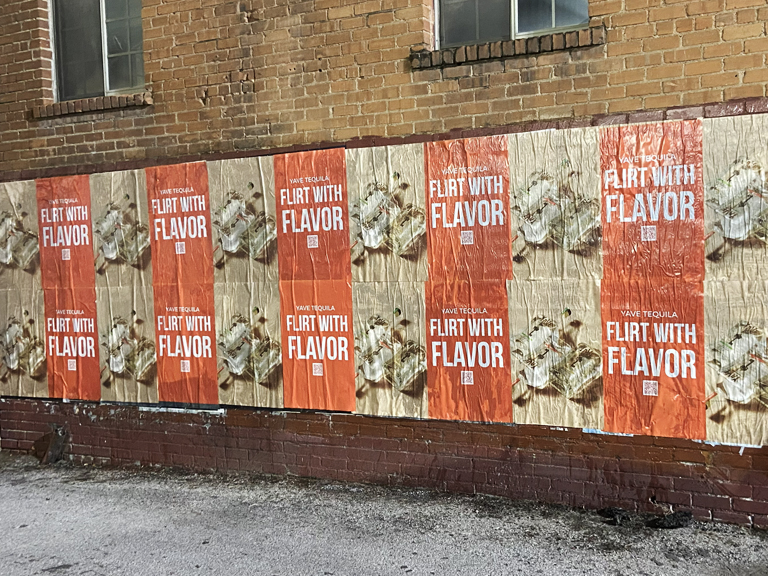
Wheatpaste posting and augmented reality represent one of the most compelling intersections in outdoor advertising today: physical street presence that triggers a digital layer visible only through a phone screen. A pedestrian stops at a poster on Bedford Avenue in Williamsburg, opens an AR app or scans a marker, and the static image comes alive, a product demo plays in the air above the poster, a character walks out of the frame, or a portal opens to branded content that extends the message far beyond what any printed surface can deliver. American Guerrilla Marketing has integrated AR elements into wheat paste campaigns across New York, Los Angeles, and Chicago, and the format consistently outperforms standard poster campaigns on both engagement rate and social sharing volume.
This guide covers how wheatpaste AR campaigns work technically, what the integration adds to a standard posting campaign, how to brief and produce the AR layer, and the specific use cases where the combination generates results that neither format achieves alone.
How Wheatpaste Posting and Augmented Reality Work Together
The physical poster serves as the anchor point for the AR experience. When a viewer’s phone camera detects the poster’s visual trigger, either through a QR code, an AR marker printed in a corner of the design, or image-recognition technology that tracks the poster itself, the AR layer renders in real time over the camera view. The poster doesn’t need any special printing or materials beyond the visual trigger, it’s the same 100 lb. gloss coated stock we use for standard campaigns, printed at 300 DPI with the AR trigger integrated into the design.
The trigger mechanism has evolved significantly in 2026. QR codes remain the most reliable and universal option, every smartphone camera natively scans QR codes without a dedicated app. Image-recognition AR (where the camera recognizes the whole poster rather than a code) is now functional through WebAR platforms that run in a mobile browser without app download, which removes the friction that killed earlier AR campaigns. When a viewer scans the poster’s QR code or holds their phone to the image, the AR experience opens in the browser, no installation required.
What AR Adds to a Wheatpaste Campaign
Engagement Depth
A standard wheat paste poster creates a visual impression in 2–7 seconds. A poster with a working AR trigger creates an engagement of 45–180 seconds as the viewer interacts with the digital layer. That additional engagement time represents a fundamentally different quality of brand contact, the viewer is not passively receiving an impression but actively exploring the brand experience. Neurologically, active engagement encodes brand memory more durably than passive exposure.
Social Amplification
AR experiences on street posters are inherently social-shareable. A viewer who triggers an animation on a street poster almost always records the screen or captures the moment. When that content is shared, on Instagram, TikTok, or Snapchat, it documents both the physical poster and the AR layer, multiplying the campaign’s reach beyond the immediate pedestrian audience. In campaigns we’ve run in Williamsburg and Silver Lake, poster-triggered AR content has been shared at rates 3–5x higher than the organic social documentation of comparable non-AR poster campaigns.
Measurable Attribution
The AR trigger also solves a longstanding measurement challenge for outdoor poster campaigns. When a viewer scans the QR code that launches the AR experience, that scan is captured as a data point, timestamped, geolocated, and device-attributed. These scans provide direct evidence of poster engagement that goes far beyond estimated foot traffic impressions. For campaigns that need to demonstrate ROI to internal stakeholders, scan-based attribution data is the most defensible metric available in the outdoor format.
AR Wheatpaste Campaign Formats That Work in 2026
Product Reveal and Demo
When a viewer scans the poster, a 3D product model appears in the space above it, rotating, scaling, and demonstrating features in a way that no static image can achieve. For product launches, this format generates earned media from the novelty of the interaction and demonstrates the product in a context (the neighborhood where the target audience lives and walks) that creates a more relevant brand association than a generic digital ad. We’ve used this format for consumer electronics, footwear, and apparel launches in New York and Los Angeles.
Character and Brand Mascot Activation
A brand character, mascot, or spokesperson “steps out” of the poster frame into the real world, visible through the viewer’s phone as if standing on the sidewalk. This format is particularly effective for entertainment, gaming, and youth-market campaigns where the unexpected appearance of a beloved character in the viewer’s physical environment creates an immediate emotional response and almost guaranteed social documentation.
Portal and Environment Extensions
The poster becomes a doorway: scanning it opens a branded environment that the viewer appears to be looking through, into, or entering. For luxury, travel, hospitality, and entertainment brands, the portal format positions the poster as an invitation to experience something beyond the immediate physical space. An activating hotel brand might show the interior of a resort property through a wall in Bushwick. A streaming service might reveal a scene from its latest series through a portal on Melrose Avenue.
Gamified AR Experiences
The AR trigger launches a brief interactive game, the viewer catches branded items that fall from the sky, pops targets that float in their camera view, or completes a simple challenge to open up a discount or exclusive content. Game mechanics generate significantly longer engagement duration than passive AR experiences and create a social sharing incentive (completing the challenge creates a shareable score or badge). For campaigns with a direct-response objective, game mechanics with prize redemption at the end of the experience create a measurable conversion path from poster impression to customer action.
Technical Requirements for AR Wheatpaste Campaigns
AR Platform Selection
The AR platform determines the viewer experience quality, the trigger mechanism, and the production requirements. The primary platform categories in 2026:
- WebAR (browser-based): The most accessible format, no app download required. Leading platforms include 8th Wall, Zappar, and Niantic’s WebAR tools. The viewer scans a QR code, the browser opens the experience, and the AR renders through the native camera. Works on iOS and Android. Recommended for mass-market campaigns where minimizing friction is the priority.
- Social AR (Snapchat Lens, Instagram Effect, TikTok Effect): AR experiences built for specific platforms, triggered by scanning the poster’s marker through the platform’s camera. Advantages: native sharing within the platform’s ecosystem, audience familiarity with the interface. Disadvantages: requires the viewer to have the specific platform app and to scan through it rather than the native camera.
- Native App AR: The highest-fidelity AR experiences, but requiring viewers to download a dedicated app. Best for campaigns where the brand has an existing app with an established user base that can trigger the poster experience through the app camera.
Poster Design Requirements
The physical poster design must accommodate the AR trigger without compromising the campaign’s visual impact. Best practices from our campaigns:
- QR codes should be placed in a corner of the poster at minimum 2-inch square size, large enough for reliable scanning at 3–5 feet viewing distance
- The QR code area should have high contrast background (white or near-white) to ensure scanning reliability on any screen type
- The poster should include a brief activation prompt (“Scan to bring this to life” / “Point your camera here”) that contextualizes the QR code for viewers who haven’t seen AR-enabled posters before
- The visual trigger area (if using image-recognition rather than QR) should be a high-contrast graphic element in a consistent, undistorted region of the poster
AR Content Production
The AR layer must be produced separately from the physical poster and built to the specifications of the chosen platform. This typically involves: 3D modeling (for object and character formats), video production (for portal and experience formats), interaction programming (for game formats), and platform deployment and testing. Production timelines range from 1–2 weeks for simple animation formats to 4–8 weeks for complex interactive experiences.
AGM coordinates the full production chain, poster design, AR layer production, platform deployment, and campaign testing, through a unified workflow. Brands don’t need to manage separate poster design, AR development, and platform relationships independently.
Where AR Wheatpaste Campaigns Perform Best
The AR layer performs best in environments where pedestrians have time to stop, orient their phone, and engage with the experience. Transit-adjacent locations, outdoor seating areas, and neighborhood retail corridors with genuine dwell time deliver the highest scan rates. In our Williamsburg deployments, posters adjacent to the L train entrance at Bedford Avenue and near the outdoor seating cluster on North 7th Street consistently achieve scan rates 2–3x higher than posters on through-pedestrian walls.
Weekend afternoons in destination commercial neighborhoods, Silver Lake’s Sunset Junction, Chicago’s Wicker Park, Miami’s Wynwood, produce the highest scan and share rates because the audience is in a leisure mindset, unhurried, and predisposed to discovery experiences. Commuter-focused placements during rush hours deliver lower scan rates because the audience is in transit mode.
Measurement and Reporting for AR Wheatpaste Campaigns
AR-enhanced campaigns produce richer measurement data than standard wheat paste campaigns. Metrics available through the AR platform’s analytics dashboard:
- Scan count: Total QR code or trigger scans, broken down by date and time
- Engagement duration: Average and total time viewers spent in the AR experience
- Completion rate: For interactive formats, percentage of triggered viewers who completed the full experience
- Share rate: Viewers who shared the AR experience to social platforms from within the experience
- Device and OS data: Useful for understanding the demographic profile of engaged viewers
- Geolocation data: Which poster locations generated the highest engagement volume
Combined with AGM’s standard GPS-tagged photo documentation and impression estimates, these metrics give brands a complete view of campaign performance at both the macro (total reach) and micro (individual engagement quality) levels.
Contact us at americanguerrillamarketing.com/contact to discuss integrating AR into your next wheat paste campaign.
Frequently Asked Questions
Wheatpaste Posting and Augmented Reality: The Next Level of Street Marketing generates better results when placement, timing, creative, and local execution all work together in New York. These questions cover the details brands usually need before launch, during rollout, and while evaluating performance.
For wheatpaste in New York, the strongest campaigns usually come from tight geographic targeting, message discipline, and enough repetition to be remembered. Market conditions, neighborhood flow, event calendars, commuter behavior, and production logistics all change how the tactic performs, so the planning details matter as much as the idea.
Does the viewer need to download an app to experience the AR?
Not with WebAR. Browser-based AR platforms (8th Wall, Zappar) run through the viewer’s mobile browser after scanning a QR code, no download required. This is our recommended approach for mass-market campaigns where minimizing friction is essential. Social AR platforms (Snap, Instagram) require the respective app but offer native sharing advantages for campaigns targeting audiences who actively use those platforms.
How much does an AR wheatpaste campaign cost vs. a standard campaign?
AR campaigns carry additional production costs for the AR layer (3D modeling, interaction development, platform deployment) on top of standard poster production and installation costs. Contact AGM at americanguerrillamarketing.com/contact for a full breakdown based on your campaign format, AR complexity, and market.
What AR formats generate the most social sharing?
Character and mascot activations that appear to walk out of the poster into the real world generate the highest spontaneous social documentation, the unexpected nature of seeing a familiar character in an unexpected physical context triggers immediate share behavior. Gamified formats with scores or badges create a sharing incentive. Product reveals and portal formats generate strong sharing when the visual quality is high enough to make the screen recording impressive on its own.
How long does AR production take?
Simple animation AR (a product rotating above the poster) typically takes 1–2 weeks for production and deployment. Character animation and portal experiences: 2–4 weeks. Complex interactive games with prize redemption flows: 4–8 weeks. Plan your campaign timeline with AR production factored into the lead time before poster installation.
Can AR be added to an existing poster campaign?
Yes, with modifications to the poster design to accommodate the QR trigger. If existing poster files don’t include a QR code, updated files can be produced and new posters installed to replace or supplement the existing run. Contact AGM to assess whether your existing campaign design can accommodate AR integration efficiently. AR-enhanced wheatpaste performs best when it’s integrated into a multi-touchpoint campaign rather than deployed as a standalone stunt. The physical poster builds awareness for the AR trigger: pedestrians who see the poster and don’t scan it still receive the brand impression. Pedestrians who scan it receive a dramatically deeper brand experience. And the social content generated by those who scan and share extends the campaign’s reach beyond its physical footprint to digital audiences who were never near the posting zone. A typical AGM AR wheatpaste campaign integration looks like this: 100–150 wheat paste posters installed across the target neighborhood with AR trigger built into the design, paired with a Sling or social advertising campaign targeting devices in the deployment zone with a “look for our posters in [neighborhood]” message that creates pre-awareness of the AR experience before pedestrians encounter the physical poster. This pre-awareness dramatically increases scan rates, pedestrians who have already seen the digital “find our AR poster” message are primed to engage when they encounter the physical piece. We’ve seen scan rate increases of 3–5x in campaigns using this awareness pre-seeding approach versus campaigns where the AR trigger is encountered cold. The AR content layer also generates content that works on social media independently of the activation context. A video of a brand character walking out of a poster on Bedford Avenue in Williamsburg is compelling content to someone in Los Angeles who has never been to Williamsburg, the visual is inherently interesting regardless of geographic context. AR content captured during activations regularly extends campaign reach to digital audiences across the country and internationally, particularly for entertainment, fashion, and lifestyle brands whose audiences follow them regardless of geography. The richer measurement capability of AR-enhanced campaigns is one of the most compelling reasons to add the AR layer to a wheat posting campaign. Standard wheat paste campaigns provide GPS-tagged installation documentation and estimated impression counts based on foot traffic data. AR-enhanced campaigns add: scan count (total QR triggers), scan rate (scans as a percentage of estimated passing traffic at the posting location), engagement duration (average time spent in the AR experience), completion rate (percentage of triggered users who completed the full experience), and share rate (users who voluntarily shared the AR content from within the experience). This data allows optimization across the campaign run, placements with low scan rates can be assessed for creative adjustment or location change, while placements with high scan rates can be prioritized for refresh cycles to maintain freshness. The result is a wheat paste campaign that improves in performance over its run rather than simply holding static from installation day to removal. Contact AGM at americanguerrillamarketing.com/contact to discuss AR integration for your next posting campaign. Choosing the right AR platform for a wheat paste campaign requires balancing reach (how many viewers can access the experience without friction) against fidelity (how sophisticated and visually impressive the experience can be). WebAR platforms like 8th Wall and Zappar work in any mobile browser without app download, maximum accessibility, with visual quality sufficient for most brand campaign objectives. Social AR platforms (Snapchat Lens, Instagram Filter, TikTok Effect) require the respective platform’s app but offer native sharing within those ecosystems and access to the platform’s engaged creative community who actively seek out and share AR filters. Native app AR delivers the highest visual quality and most complex interactions but requires app download, appropriate only for brands with an established app and user base large enough to justify the access friction. For most brand poster campaigns in 2026, WebAR is the recommended default: maximum accessibility, adequate visual quality for standard product reveal, character, and portal formats, and QR-trigger compatibility that works with any smartphone camera. Upgrade to Social AR when the target audience is heavy platform users and native sharing is a primary campaign objective. Consider native app only when the brand app has 100,000+ active users in the target market. Contact AGM at americanguerrillamarketing.com/contact to discuss the right platform choice for your AR campaign.
How does augmented reality change a wheatpaste campaign?
AR adds a second layer to a format that already works visually on the street. It lets a poster trigger motion, product views, audio, or a direct action without forcing that complexity into the printed design.
Do people actually scan posters for AR experiences?
They will if the payoff is clear and the interaction is fast. Curiosity alone is not enough. The poster needs to show why the scan is worth it.
What kind of AR experience works best with wheatpaste posters?
Short experiences usually work best, such as animation, a product reveal, a ticket drop, or a simple game. Street interactions need to load quickly and make sense in seconds.
Should the poster design explain the AR feature directly?
Yes. A small prompt, icon, or line of instruction helps people understand that there is something extra to open up. Without that cue, many people will never try it.
What are the technical risks with AR poster campaigns?
Load speed, device compatibility, poor lighting, and weak mobile data coverage can all hurt performance. The experience should be tested in the real environment before launch.
Related Pages and Articles