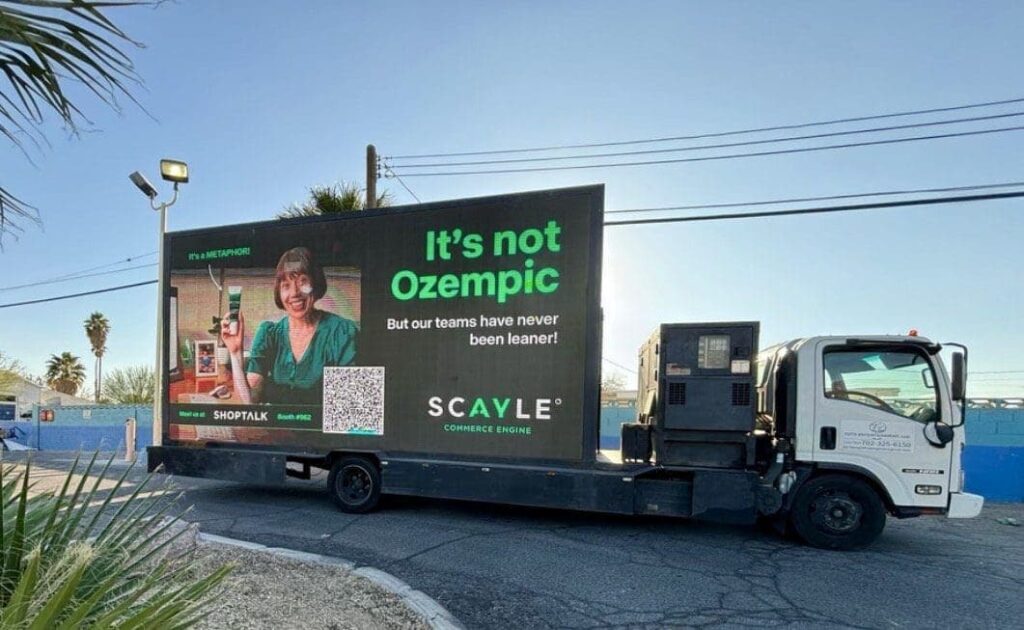
Advertising has always been a battle for attention. Traditional formats fight that battle by placing a message somewhere consumers will eventually pass by. LED mobile billboard trucks flip the equation: instead of waiting for your audience, you go to them. The truck moves through the neighborhoods, events, and corridors where your target consumers are concentrated, bringing the brand message directly into their field of vision rather than hoping they happen to walk past a fixed location.
This mobility is the core advantage, and it is more significant than it first appears. A static billboard in a high-traffic corridor reaches whoever happens to drive that route. An LED truck with a strategically designed route reaches your specific target audience at specific moments, at the stadium before a game, at the concert venue at showtime, on the blocks surrounding a competitor’s location, or in the residential neighborhoods where your target demographic is most concentrated.
American Guerrilla Marketing operates LED mobile billboard trucks and has deployed mobile billboard campaigns across 30+ markets in the U.S. and Canada. This guide breaks down exactly why LED trucks work, how to deploy them effectively, and what results to expect.
How LED Mobile Billboard Trucks Work
The hardware is straightforward. A truck-mounted LED panel, typically 10 feet by 22 feet or larger, is loaded with your campaign content digitally. The truck then follows a pre-planned route designed to maximize impressions within a target demographic area or around a specific event. Content can include still images, animated graphics, and full-motion video, all displayed at brightness levels that maintain visibility in direct sunlight.
The digital content loading system means creative can be updated without reprinting anything. A campaign can run multiple messages on a rotation, display time-sensitive offers that expire, or switch creative based on neighborhood context. This flexibility is something static vinyl billboards simply cannot offer.
At night, LED trucks shift from competitive to dominant in the visual environment. The contrast between a full-color LED display and the dark environment around it creates an attention pull that most other advertising formats cannot match. Night routing around entertainment districts, bars, restaurants, and event venues takes advantage of this visibility premium.
Why LED Mobile Billboards Outperform Static Formats
You Control Where the Audience Is
Static billboard placement depends on which locations happen to be available and which happen to have traffic patterns that align with your target demographic. You take what you can get. With an LED truck, you plan the route to go exactly where your audience is: outside a stadium during game day, in the entertainment district on a Friday night, in the neighborhood where your target demographic lives, or around a competitor’s location on a weekday when purchase decisions are being made.
Event-Adjacent Density
Major events create temporary concentrations of target consumers that static billboards cannot capitalize on unless they happen to be located nearby. An LED truck can be positioned to circle a venue for hours before and after an event, reaching the same audience repeatedly at one of the highest-attention moments of their week. The impression-to-cost ratio during event windows is among the highest available in out-of-home advertising.
Competitive Conquesting
One of the more tactically sophisticated applications: routing an LED truck around a competitor’s retail location, event presence, or headquarters. The brand message lands in exactly the context where the consumer is considering a competing option. Combined with a relevant offer or comparison message, competitive conquesting via LED truck can measurably affect consumer choice at the point of decision.
Creative Flexibility
Static vinyl requires physical reprinting for any creative change. LED trucks update instantly. Campaigns can rotate through multiple messages, A/B test creative in real time, feature countdown timers, and run different content in different neighborhoods based on demographic data. This creative agility is increasingly valuable as brands operate in faster campaign cycles.
What Campaigns Work Best with LED Mobile Billboard Trucks
Product Launches
New product launches need rapid awareness generation in a concentrated time window. An LED truck saturating a target market across multiple days during launch week creates broad, repeated exposure that accelerates awareness more efficiently than most alternative formats at equivalent budget.
Event Marketing
Sports events, concerts, festivals, trade shows, and political events create high-density target audience concentrations. LED trucks adjacent to these events reach more relevant impressions per hour than almost any other format. Our experiential marketing campaigns frequently incorporate LED truck activation around events as a high-visibility complement to ground-level ambassador programs.
Grand Openings and Local Business Launch
A new restaurant, retail location, or service business needs to generate local awareness fast. An LED truck routing through the surrounding neighborhoods over a launch week covers the geographic area efficiently and with high creative impact.
Political Campaigns
Candidate name recognition, district-level saturation, and get-out-the-vote messaging are all applications where LED mobile billboards deliver high impressions at lower cost-per-thousand than most alternatives. The ability to route through specific precincts and avoid others makes this format particularly precise for political use.
Competitive Defense
When a competitor opens nearby or launches an aggressive campaign in your market, an LED truck creates a visible counter-presence that signals brand strength and intercepts consumer attention at critical decision points.
Routing Strategy: The Difference Between Good and Great Campaigns
Impression counts from LED truck campaigns vary enormously based on route quality. A truck idling on a low-traffic side street generates a fraction of the impressions of the same truck on an optimized route through a high-density corridor. Route planning is where professional operators separate from amateur ones.
Effective routing incorporates:
- Traffic density data: Volume by time of day and day of week for target corridors
- Demographic alignment: Routes that pass through neighborhoods where the target consumer concentration is highest
- Event timing: Positioning near venues before, during, and after events for maximum exposure density
- Dwell time optimization: Strategic pausing at high-traffic intersections and pedestrian-heavy zones to extend individual impression duration
- Night routing: Shifting to entertainment districts and nightlife corridors as daylight visibility advantage decreases
Our team plans every LED truck route using this framework, with GPS tracking that confirms routes were followed as planned and provides documentation of impression zones for client reporting.
LED Billboard Trucks and Multi-Channel Campaign Integration
LED trucks work well in isolation but perform significantly better as part of a multi-channel campaign. In a typical integrated deployment, poster placements go up in target neighborhoods the week before the truck deploys, building familiarity with the brand visual before the truck makes the impression memorable through motion and scale. Street teams can operate in the same zones the truck routes through, creating ground-level touchpoints that complement the aerial visibility of the truck.
Our wheatpasting and poster campaigns are frequently deployed alongside LED truck activations for exactly this compounding effect. Consumers see the poster, then encounter the truck in the same neighborhood, then interact with an ambassador. Each touchpoint reinforces the others.
For brands running sidewalk stencil campaigns, the same logic applies. The stencil is at eye level when walking. The truck is at eye level when driving. Together, they create brand presence across multiple consumer vantage points in the same geographic zone.
What to Expect: Impressions, Documentation, and Results
A single LED mobile billboard truck on an optimized urban route typically generates 30,000 to 70,000 impressions per day in a mid-to-major U.S. market. Event-adjacent deployment during high-attendance windows can generate significantly more in compressed time periods. Multi-truck deployments running simultaneous routes multiply these figures proportionally.
AGM provides GPS-tracked documentation for every LED truck campaign, including route logs, timestamped photo documentation, and a post-campaign recap with market-by-market impression estimates. Clients know what ran, where, when, and for how long, rather than relying on estimates.
Cost and ROI Framework for LED Mobile Billboard Campaigns
LED mobile billboard truck campaigns typically range from $500 to $2,000 per day per truck depending on market, campaign duration, and content complexity. Compared to static billboard monthly costs in major markets (which can run $5,000 to $25,000+ per month for a single location), LED trucks offer competitive CPM rates with the added advantage of geographic targeting and creative flexibility.
For brands evaluating ROI, the relevant comparison is not just cost-per-impression but cost-per-relevant-impression. An LED truck on a route specifically designed around your target demographic delivers a higher percentage of relevant impressions than a static billboard in a fixed location that reaches everyone who happens to drive past.
Frequently Asked Questions About LED Mobile Billboard Trucks
Why use a LED mobile billboard truck instead of a static billboard?
LED mobile billboard trucks follow your audience wherever they are, while static billboards are fixed to one location. Mobile trucks target specific events, neighborhoods, and competitor locations that static placements cannot reach, and they display video and animated content that static vinyl cannot.
How does an LED mobile billboard truck work?
A truck-mounted LED panel displays your advertising content as the vehicle moves through pre-planned routes. The display is typically 10×22 feet or larger, visible in daylight and highly visible at night. Content is loaded digitally and can be updated without reprinting anything.
What does an LED mobile billboard truck campaign cost?
Campaigns typically range from $500 to $2,000 per day depending on market, duration, and content complexity. Multi-day and multi-market campaigns qualify for volume pricing. Contact our team for a campaign-specific quote based on your market and objectives.
What types of campaigns work best with LED billboard trucks?
Event launches, concert and stadium campaigns, product launches, grand openings, competitive conquesting, political campaigns, and market saturation for new products are among the highest-performing use cases for LED mobile billboard trucks.
How many impressions does an LED mobile billboard truck generate?
On optimized routes in mid-to-major urban markets, a single truck generates 30,000 to 70,000 impressions per day. Event-adjacent routing near stadiums or concert venues can generate significantly higher counts in compressed time windows.
Does AGM operate LED mobile billboard trucks?
Yes. We operate LED mobile billboard trucks and have deployed mobile billboard campaigns across 30+ U.S. and Canadian markets. Our team handles route planning, content loading, driver coordination, and GPS-tracked documentation for every campaign.
Can LED mobile billboard trucks display video content?
Yes. LED panels support full-motion video, animated graphics, and dynamic content that static vinyl billboards cannot display. Video content on a moving truck creates a compounding attention effect that static formats cannot replicate, particularly effective during evening and nighttime routing.
Frequently Asked Questions
What is why use a led mobile billboard truck for your advertising needs?
American Guerrilla Marketing provides why use a led mobile billboard truck for your advertising needs services across 50+ U.S. markets. Every campaign is planned, scouted, executed, and GPS-documented by our field teams. We work with regional brands and Fortune 500 companies on campaigns that require real street-level execution and documented proof of performance.
How does AGM approach advertising needs?
Our process starts with a market consultation to understand your goals, target audience, and budget. We then scout locations, handle any required permissions or permits, coordinate production and installation with our local crews, and provide a full GPS-tagged photo report after the campaign runs.
What markets does American Guerrilla Marketing cover for advertising needs?
We operate in 50+ U.S. markets including New York, Los Angeles, Chicago, Miami, Houston, Atlanta, Seattle, Denver, Boston, and dozens of secondary markets. Contact us to confirm availability and pricing for your specific market.
How much does a advertising needs campaign cost?
Campaign pricing depends on market, format, quantity, and duration. We work with budgets ranging from targeted single-market runs to national rollouts across multiple cities. Use our RFP Builder or contact us directly for a custom quote based on your specific campaign requirements.
How do I get started with advertising needs through AGM?
The fastest way to get started is to submit your campaign details through our RFP Builder at americanguerrillamarketing.com, or contact us directly at [email protected] or (646) 776-2770. Our team typically responds within one business day with availability and initial pricing.