Los Angeles is a city of neighborhoods, and no two of them work the same way for marketing. The consumer who spends their Saturday morning at the Venice Beach boardwalk has a completely different profile, routine, and purchase mindset than the one browsing Melrose Avenue boutiques or grabbing coffee in Silver Lake. Effective flyer distribution in Los Angeles requires understanding this geographic diversity and building campaigns that match the right message to the right neighborhood with the right timing.
When flyer distribution is executed this way, it’s one of the highest-ROI local marketing investments available in the LA market. You’re not paying for impressions from consumers who will never visit your business or attend your event. You’re putting a physical piece of paper directly in the hands of people who already spend time in the exact neighborhood where your campaign is targeting, at the times when they’re most receptive to discovering something new.
This guide covers how flyer distribution works in Los Angeles, which neighborhoods deliver the strongest results by category, what makes an effective LA flyer campaign, and how to measure what your distribution is actually producing in terms of business outcomes.
Why Flyer Distribution Still Works in a Digital City
Los Angeles has one of the most sophisticated digital marketing ecosystems in the country. Social media influencers, performance marketing agencies, and entertainment-industry marketing teams drive some of the most advanced digital campaigns anywhere. And yet, flyer distribution in LA continues to deliver measurable results for brands and businesses that deploy it correctly.
The reason is rooted in the same basic dynamics that make physical distribution effective everywhere: it bypasses the filters, blockers, and algorithmic gatekeeping that increasingly limit digital reach. A flyer in someone’s hand in their own neighborhood doesn’t get scrolled past, blocked, or sent to spam. It exists in their physical environment for as long as they hold onto it, and even a brief scan creates stronger recall than a digital impression they didn’t actively choose to see.
Los Angeles’s outdoor culture amplifies this effect. The city’s walkable neighborhood commercial corridors, beach culture, and year-round outdoor activity create distribution environments where hand-to-hand contact is natural and welcomed rather than intrusive. A friendly distributor at the Melrose market or along the Silver Lake Reservoir jogging path encounters consumers who are relaxed, engaged with their environment, and receptive to discovering something new in their neighborhood.
Key Los Angeles Distribution Zones by Consumer Profile
Strategic neighborhood selection is the highest-leverage decision in any LA flyer distribution campaign. Here’s how the major distribution zones break down by consumer profile and category fit:
Venice Beach Boardwalk
One of the highest foot-traffic environments in Southern California, Venice Beach draws a consumer mix of tourists, fitness enthusiasts, local residents, and the broad demographic range that characterizes LA’s west side. This zone works for entertainment brands, fitness and wellness products, food and beverage, lifestyle brands, and anything with broad demographic appeal and a connection to outdoor or beach culture. Summer and weekend deployment windows generate the highest contact volumes.
Santa Monica’s Third Street Promenade
A permanently pedestrianized commercial corridor with heavy retail foot traffic from both locals and tourists. Third Street Promenade is effective for retail, entertainment, and consumer goods brands targeting a broad mid-to-upper income demographic. The presence of major retail flagships means the consumer arriving here is already in a shopping mindset, making conversion to in-store trial or purchase higher than purely recreational zones.
Melrose Avenue
Melrose is LA’s streetwear, vintage, and fashion corridor. The consumer profile here skews young, culturally engaged, fashion-forward, and highly social media active. Flyer distribution on Melrose works particularly well for entertainment events, pop-up retail, fashion and apparel brands, music, and nightlife. Unique, creative flyer design matters more here than anywhere else in LA because the audience has a well-trained aesthetic filter.
Silver Lake and Echo Park
North-east of downtown, Silver Lake and Echo Park concentrate LA’s creative class: musicians, artists, writers, designers, and the businesses that serve them. This is a receptive zone for indie entertainment, food and beverage brands, wellness, and cultural events. The neighborhood’s walkable main streets and coffee shop culture create natural distribution moments for hand-to-hand and passive venue placement formats.
WeHo’s Santa Monica Boulevard
West Hollywood’s Santa Monica Boulevard corridor serves a dense, active, nightlife-oriented consumer population with significant brand loyalty to businesses that market authentically within this community. For brands in entertainment, hospitality, lifestyle, and personal care that serve the WeHo consumer base, flyer distribution along this corridor and in surrounding residential blocks delivers strong recognition and response rates.
Downtown LA Arts District
DTLA’s Arts District has evolved from an industrial zone to a dense concentration of creative businesses, restaurants, galleries, and apartment buildings housing a young professional and creative class. Distribution here reaches a growing residential population that’s actively interested in new cultural, dining, and lifestyle options in their neighborhood.
Culver City
Culver City’s growth as a tech and entertainment company hub has created a dense professional population within a walkable commercial district. For brands targeting professionals, the lunch and after-work windows on Culver City’s main streets deliver efficient contact with a high-income demographic in a less competitively saturated distribution environment than west-side beach corridors.
Distribution Methods for LA Campaigns
Los Angeles’s geographic spread and neighborhood diversity mean that different distribution methods perform better in different contexts. Understanding the options helps brands build campaigns that match the right format to each target zone:
Hand-to-Hand Street Distribution
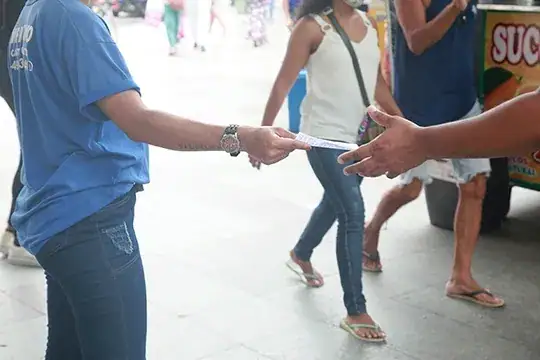
The highest-quality interaction format. Trained distributors position in high-foot-traffic corridors and hand flyers directly to passersby, creating a personal brand moment alongside the physical piece. This format works best in dense pedestrian zones like beach boardwalks, commercial streets, and market areas. LA’s outdoor culture makes this format particularly natural and effective.
Residential Door-to-Door Distribution
For businesses with a defined residential service area, door-to-door distribution saturates a neighborhood with physical brand presence. Restaurants, home service companies, fitness studios, and local retailers in LA use this method to reach households within their service radius. Given LA’s sprawling residential geography, route planning is essential to maintain cost efficiency.
Vehicle Distribution
Placing flyers under windshield wipers in parking lots serves a specific distribution niche in LA’s car-centric culture. While this method has lower interaction quality than hand-to-hand, it can reach consumers in specific venue contexts, such as gym parking lots, shopping center lots, or event venue parking, with reasonable geographic targeting. Local regulations govern this method in many LA areas.
Venue and Business Placement
Stacking flyers in complementary businesses, gyms, coffee shops, record stores, and community bulletin boards creates low-cost ambient distribution. This is most effective as a supplementary format alongside active distribution rather than as a standalone strategy, since pick-up rates from passive placements are lower than hand-to-hand delivery.
Designing Flyers That Perform in the LA Market
LA consumers are design-literate. This market is home to the entertainment industry, global fashion companies, and some of the world’s most talented creative professionals. Flyers that look generic or low-effort will be noticed for the wrong reasons. High-performing LA flyer campaigns share several design characteristics:
Strong Visual Hierarchy
Lead with the strongest visual element, whether that’s a striking photograph, a bold typographic treatment, or a compelling graphic. The primary visual should communicate the brand’s personality and the flyer’s purpose before any text is read. In the LA market, visual quality signals brand quality before the consumer processes any copy.
Minimal Copy, Maximum Clarity
One offer. One date or location if applicable. One call to action. One contact point. LA consumers walking or driving past a distributor have seconds to decide whether a flyer is worth keeping. Every word that isn’t essential is a distraction that reduces clarity and response rate.
Spanish-English Bilingual Execution
Los Angeles has a large Spanish-speaking population across many neighborhoods, particularly in East LA, the San Fernando Valley, and much of South LA. For businesses targeting these neighborhoods or seeking broad cross-demographic reach, bilingual flyer design is a practical investment that significantly expands the audience that will engage with the piece.
Trackable Response Mechanism
A unique promo code, QR code, or dedicated URL printed on flyers lets you measure which distributions are generating response. Without tracking, ROI measurement is impossible. With tracking, you can optimize future campaigns based on actual performance data by neighborhood and time window.
Integrating Flyer Distribution with LA Street Marketing
Flyer distribution delivers its strongest results as part of a coordinated campaign rather than as a standalone tactic. Our team regularly integrates distribution with other street-level elements for compound neighborhood impact:
Combining distribution with wheatpasting campaigns in the same neighborhood creates ambient brand familiarity before distributors arrive. When a consumer receives a flyer in an area where they’ve already seen large-format brand imagery on building walls, the flyer lands in a warmer context and generates higher response rates.
Sidewalk stencils along distribution routes create a breadcrumb trail of brand impressions that guide consumers toward your activation zone and prime them before they encounter your distributors. LED billboard trucks driving through the distribution zone during peak hours add a dynamic visual layer that compounds the neighborhood saturation effect.
Pairing flyer distributors with brand ambassadors creates a two-tier engagement model where distributors create broad reach and ambassadors engage the most interested consumers in deeper conversations. This combination is particularly effective for product launches and event promotion where conversion from awareness to action matters most.
Measuring Flyer Distribution Results in Los Angeles
Every LA distribution campaign we run is measured against quantifiable performance metrics. Here’s how we track results and calculate ROI for our clients:
Distribution volume verification through GPS tracking confirms that the correct quantity of flyers reached the planned locations during the planned time windows. Photo documentation from distribution sites provides visual proof of deployment for every campaign. Unique promo codes and QR codes on distributed materials track consumer response by neighborhood and time window. Post-campaign comparison of foot traffic, call volume, and sales data in distributed zip codes against pre-campaign baseline and non-distributed control areas quantifies incremental business generated by the campaign.
This accountability framework means our clients can calculate actual cost-per-acquisition from flyer distribution and compare it directly to their digital channel benchmarks. For most local businesses in Los Angeles, professional flyer distribution competes favorably with digital cost-per-acquisition metrics when executed in the right neighborhoods with the right creative and tracking mechanisms in place.
Frequently Asked Questions About Flyer Distribution Los Angeles
How does flyer distribution work in Los Angeles?
Flyer distribution in LA involves hand-to-hand delivery in high-foot-traffic areas, door-to-door residential distribution in target neighborhoods, venue placement in complementary businesses, and event-site distribution at LA’s active festival and entertainment calendar. Professional teams handle routing, staffing, and GPS-tracked documentation for every campaign.
Which Los Angeles neighborhoods are best for flyer distribution?
Top LA neighborhoods for flyer distribution include Venice Beach boardwalk, Santa Monica’s Third Street Promenade, Melrose Avenue, Silver Lake, Echo Park, WeHo’s Santa Monica Boulevard, Downtown LA’s Arts District, and Culver City. Neighborhood selection should always align with your target consumer demographic and campaign objectives.
How much does flyer distribution cost in Los Angeles?
Hand-to-hand flyer distribution in LA typically costs $30 to $75 per hour per distributor. Door-to-door residential distribution runs $0.05 to $0.20 per piece depending on volume and geographic density. Total campaign cost includes printing, staffing, management, GPS tracking, and documentation. Contact our team for a customized quote.
What permits are needed for flyer distribution in LA?
Distribution on public sidewalks generally does not require a permit in Los Angeles, though specific locations like parks, beaches, and near transit stations may have regulations. Private property distribution requires owner permission. Our team researches and handles all permitting considerations for every LA campaign we manage.
How do I design a flyer that works in the LA market?
LA consumers are highly visual and design-literate. Flyers that perform in this market are visually striking, use minimal text, lead with one clear offer or message, and feature high-quality imagery. Spanish-English bilingual flyers significantly expand reach in many LA neighborhoods. A unique tracking code or QR code is essential for measuring campaign performance.
Can flyer distribution be combined with other guerrilla marketing in LA?
Absolutely. Flyer distribution pairs effectively with wheatpasting, sidewalk stencils, brand ambassadors, and LED billboard trucks for layered neighborhood campaigns. Combined tactics in the same geographic zone create compound brand presence that dramatically outperforms single-tactic campaigns on both recall and conversion metrics.
Does American Guerrilla Marketing run flyer distribution campaigns in Los Angeles?
Yes. We deploy flyer distribution campaigns across Los Angeles and the broader Southern California market. Our LA operations include GPS-tracked staffing, photo documentation, and post-campaign analytics reporting for every deployment. Call us at (646) 776-2770 or contact our team to discuss your LA campaign.
Frequently Asked Questions
What is flyer distribution los angeles boosting your sales?
American Guerrilla Marketing provides flyer distribution los angeles boosting your sales services across 50+ U.S. markets. Every campaign is planned, scouted, executed, and GPS-documented by our field teams. We work with regional brands and Fortune 500 companies on campaigns that require real street-level execution and documented proof of performance.
How does AGM approach your sales?
Our process starts with a market consultation to understand your goals, target audience, and budget. We then scout locations, handle any required permissions or permits, coordinate production and installation with our local crews, and provide a full GPS-tagged photo report after the campaign runs.
What markets does American Guerrilla Marketing cover for your sales?
We operate in 50+ U.S. markets including New York, Los Angeles, Chicago, Miami, Houston, Atlanta, Seattle, Denver, Boston, and dozens of secondary markets. Contact us to confirm availability and pricing for your specific market.
How much does a your sales campaign cost?
Campaign pricing depends on market, format, quantity, and duration. We work with budgets ranging from targeted single-market runs to national rollouts across multiple cities. Use our RFP Builder or contact us directly for a custom quote based on your specific campaign requirements.
How do I get started with your sales through AGM?
The fastest way to get started is to submit your campaign details through our RFP Builder at americanguerrillamarketing.com, or contact us directly at [email protected] or (646) 776-2770. Our team typically responds within one business day with availability and initial pricing.