
November 3, 2026
Experiential Marketing Agency India: An Honest Breakdown of
Let me start with the thing most pages like this will not tell you.
If you are searching for an experiential marketing agency in India, we are not the crew for that job. American Guerrilla Marketing runs street level campaigns in the United States. Our teams, our vehicles, our surface relationships and our knowledge of which block works at which hour are all American. I am not going to pretend otherwise to keep you on the page.
What I can give you is the part that transfers, and a lot of it does. The operational questions that separate an experiential agency that delivers from one that sells you a deck are the same questions in Mumbai, Bengaluru, Delhi, Chicago or Atlanta. Crew reality does not change by passport. Neither does the way activations fail.
I have run Street Teams. I have stood at a sampling table at seven in the morning watching a crew of eight work a transit entrance. I have also watched a beautifully art directed activation produce almost nothing, because nobody asked where the audience would physically be standing at the hour we booked.
So this is an honest breakdown. What experiential marketing actually is once you strip the language off it, what you are really paying an agency to do, how to tell a real operator from a pitch deck, and where the format genuinely earns its place against simpler street formats.
If you are running your activation inside the United States, we can do the work. If you are running it in India, use this as a buyer's checklist for the conversations you are about to have.
What experiential marketing actually is, operationally
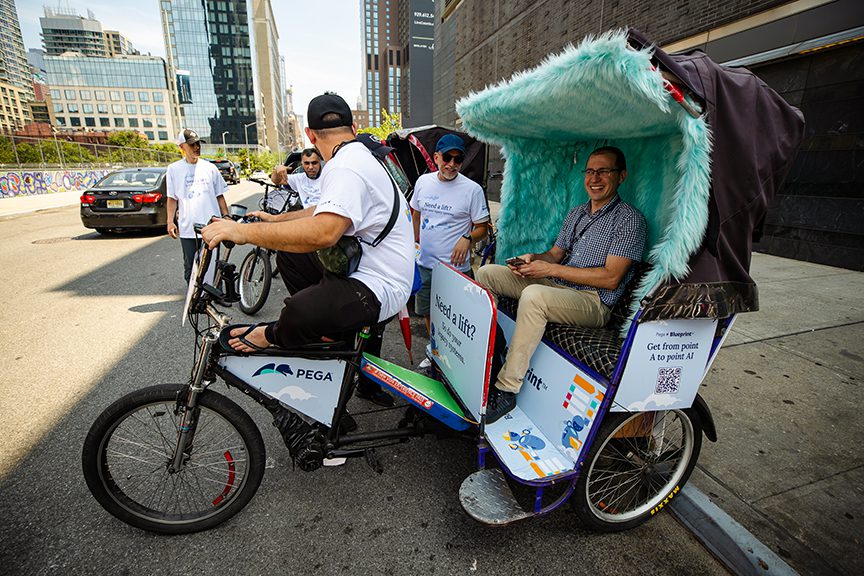
Strip the vocabulary away and experiential marketing is people, in a place, at a time, doing something with members of the public.
That is it. Everything else is detail on top of those four variables.
People. Brand ambassadors, demonstrators, samplers, performers, crew leads, supervisors. Recruited, briefed, trained, scheduled, managed on the day, paid.
Place. A street corner, a transit entrance, a campus quad, a festival footprint, a retail frontage, a market, a stadium approach. Public, semi public or private, each with a different permission picture.
Time. Day parts matter more than dates. The same corner is three different audiences at 8am, 1pm and 7pm. Getting this wrong is the most common reason activations underdeliver.
The thing you do. Sampling, demonstration, a photo moment, a game, a giveaway, a sign up, a conversation that ends in a download or a visit.
Everything an agency charges for sits under one of those headings, plus the production that supports them and the documentation that proves it happened.
When you read a proposal, map every line back to those four. Anything that does not map is usually atmosphere.
What you are actually paying an agency to do
Three things, in order of how often they get underestimated.
Staffing and management. This is the hard part and the part that is invisible in a deck. Recruiting people who will actually show up. Briefing them so they say the right thing. Having replacements ready when two people do not arrive, because two people never arrive. Supervising so that hour five looks like hour one, which it will not without a supervisor. An activation is only as good as its weakest ambassador at the tail end of a long shift.
Permission and logistics. Where the team can legally and practically stand. Who owns that pavement. Whether the kit can be stored overnight or has to be carried in and out daily. Where the stock is. Where the staff change and take breaks. Where the vehicle parks. None of this is glamorous and all of it decides whether the day runs.
Proof. Photos, video, counts, sign ups, scans, redemptions. An activation that is not documented may as well not have happened, because nobody in your organisation beyond the three people who attended will believe it worked.
Notice that creative is not on that list. Creative matters, but creative is the cheapest thing to fix and the easiest thing to admire. Operations is what you are buying.
How to tell an operator from a deck
I have sat on both sides of these meetings. Here is what I would ask.
Ask who actually staffs it. Does the agency employ or directly manage the field team, or is the whole thing passed to someone else once you sign? Neither answer is automatically wrong, but you want to know how many layers sit between you and the person holding the sample tray.
Ask for the day schedule, not the concept. A real operator can tell you what happens at every hour. Load in at this time. Team briefing at this time. First shift from here to here. Break rotation. Stock top up. Strike. If they cannot produce that, they have not run it in their head yet.
Ask what happens when it rains. The answer should be specific and already planned, not "we will be flexible."
Ask about the permission for the exact spot. Not the area. The spot. Who owns the ground, who has been spoken to, and what the arrangement is.
Ask what they would talk you out of. An agency that agrees with everything in your brief is selling, not advising. Every brief I have ever received had at least one thing in it that would not work.
Ask how it gets measured before you agree the idea. If measurement is designed after the creative, the measurement will be photographs and vibes.
Ask to see the escalation path. When a property manager asks the team to move, who makes the call and how fast?
Crew reality, which does not translate into a deck
A street activation that looks effortless had a specific shape behind it.
A simple sampling or flyering team on a busy corridor runs well with four to eight people, plus a supervisor who is not part of the count because the supervisor needs to be free to move. Below four, coverage breaks the moment somebody takes a break. Above eight on one footprint, people start getting in each other's way and the public starts feeling crowded.
Shifts of four to six hours work. Eight hour shifts on your feet, talking to strangers, produce a noticeably worse second half, and the public can feel it.
Load in is earlier than clients expect. If the team is live at 8am at a transit entrance, the crew lead is there by 6:30 and the kit arrived the night before or in a vehicle at 6:00.
Weather kills energy before it kills the schedule. A team in cold rain for three hours is not the same team that started. Shelter, rotation and hot drinks are not luxuries, they are output.
The single biggest operational variable is pedestrian flow direction. People moving toward a transit entrance in the morning are in a hurry and will not stop. The same people moving away from it in the evening will. Agencies that know this pick the evening side of the street.
Street activations and the permission grey area
Anywhere in the world, putting a team and a table on ground you do not own raises the same question: who said you could.
In the markets we work, the honest answer is that it is a grey area. Rules vary by municipality. Pavement and sidewalk use is often governed by local ordinances written for vending or obstruction rather than for brand activation. Enforcement is inconsistent, both between cities and between individual officers and property managers on a given day. A team that stood on a corner unbothered for three days can be asked to move on the fourth.
What reduces risk is the same everywhere.
Work from property owner permission. A private forecourt, a retail frontage, a licensed market pitch or a partner venue with written consent is worth far more than a dramatic public corner with no arrangement behind it.
Do not obstruct. Teams that block a doorway, a crossing or a transit flow attract complaints that teams standing clear of movement never attract.
Keep a named contact on site with the paperwork and the authority to relocate the team immediately rather than argue.
Clean up completely. Sampling produces litter, and litter is what turns a tolerant property manager into a hostile one.
Document everything, including the permission.
I will not tell you that any of this is legal or illegal in your jurisdiction. That depends on local ordinance, on surface ownership and on advice from someone qualified to give it in that country. Any agency that tells you flatly that street activation is fine, without asking who owns the ground, is not being careful with your brand.
What goes wrong, and where we push back
Wrong day part. The most common failure by a distance. Clients book the day that suits their calendar rather than the hours their audience is actually on that street. We will move a date rather than run a dead morning.
Footprint too small for the idea. A queueing mechanic on a narrow pavement creates an obstruction, which creates a complaint, which ends the activation. If the idea needs a queue, it needs a space that can hold one.
Too much to say. Ambassadors cannot deliver a four point message. One line, one action. If the brief has a paragraph in it, the paragraph becomes four different improvised versions by lunchtime.
Giveaways that attract the wrong crowd. A high value giveaway brings people who want the item and have no interest in the brand. The sign up numbers look good and convert at nothing.
Experiential as the entire campaign. This is the big one. An activation reaches the people who physically walk past it during the hours it runs. That is a real but narrow number. Clients who expect it to carry city wide awareness are buying the wrong format.
No pre or post presence. A team on a corner with no surrounding context is a stranger with a tray. The same team working a corridor that already carries the campaign on its walls gets a warmer reception, because people have seen the brand already that week.
That last point is the pairing I recommend most often. Street Teams & Experiential works best sitting on top of Wheatpasting & Poster Campaigns in the same neighbourhood. The posters build the recognition over days. The team converts it on the day. Run alone, each is weaker than the pair.
When experiential is the right answer and when it is not
It is the right answer when the product genuinely benefits from being touched, tasted, tried or demonstrated. When your conversion depends on a conversation. When you need sign ups, scans or trials rather than awareness. When there is a dense, predictable, capturable crowd, like a festival, a campus, a market or an event approach. When you need content with real people in it.
It is the wrong answer when you need broad reach across a city in a short window. When the message is simple enough to land from a wall. When your audience is dispersed rather than concentrated. When the timeline will not allow proper staffing and briefing, because a rushed team is worse than no team.
For broad, cheap to deliver, repeated visibility, static street formats and mobile formats like LED Trucks & Mobile Billboards do more work per day. For depth over breadth, experiential wins. Most good campaigns use both and let each do what it is actually good at.
So, is an experiential agency worth it?
Worth it is the wrong frame. The honest question is whether the agency in front of you is an operator or an intermediary, and whether the format fits the job.
An agency that directly manages its field staff, can describe your day hour by hour before you sign, has already asked who owns the ground, has a weather plan, and will tell you which part of your brief is wrong, is worth engaging. An agency whose strongest asset is the deck is worth a second meeting with harder questions.
And the format itself is worth it when your goal is depth, trial and conversion in a concentrated place. When your goal is to be seen widely, put the money somewhere it buys surfaces and miles rather than hours of staff time.
For activations inside the United States, that is the conversation we have with every client before anything gets booked. For India, take the checklist above into your meetings and keep asking until somebody gives you the hour by hour.
The brief that goes to the ambassador is not the brief you wrote
This is the gap that quietly decides most activations, and almost nobody inspects it.
You write a brief. The agency turns it into a plan. Somebody turns that plan into a one page sheet that gets handed to a team at 6:45 in the morning in a car park. Whatever is on that sheet is your campaign. Everything else was internal.
So ask to see the ambassador sheet before the day. Not the client deck. The sheet.
A good one is short. It has the opening line the team says, word for word, because an opening line that is left to improvisation becomes six different openings. It has the single action you want from the public. It has the two or three questions the public will definitely ask with the approved answers. It has what to do when somebody is rude, when somebody films them, when somebody asks who they work for. It has the supervisor's number and the exact boundary of where the team may stand.
A bad one is a brand values summary. Nobody on a pavement has ever used a brand values summary.
Briefing in person matters as much as the sheet. Fifteen minutes with the team before they go live, with someone demonstrating the approach rather than describing it, changes the first hour completely. Teams that are briefed by email start slow and some of them never find the rhythm.
Then check it mid shift. I walk the footprint at hour three and listen to what is actually being said. It has drifted. It always drifts. Catching the drift at hour three instead of reading about it in the wrap report is the difference between a supervised activation and an expensive one.
Frequently asked questions
Does American Guerrilla Marketing run experiential campaigns in India?
No. We operate across the United States, and our crews, vehicles, surface relationships and local knowledge are all American. We will not take an India brief and pass it down a chain we cannot supervise. If your activation runs in the United States we can staff and manage it directly. If it runs in India, use the operational questions in this article to assess local agencies.
What should I ask an experiential marketing agency before signing?
Ask who directly manages the field staff, and how many layers sit between you and the ambassador. Ask for the hour by hour day schedule rather than the concept. Ask who owns the exact ground the team will stand on. Ask what the wet weather plan is. Ask how it will be measured. Ask what part of your brief they would talk you out of.
How many people does a street activation need?
A single busy footprint usually works with four to eight ambassadors, plus a supervisor who stays free to move rather than counting toward coverage. Fewer than four and breaks leave gaps. More than eight on one footprint crowds both the team and the public. Shifts of four to six hours hold quality better than eight hour shifts on foot.
Is it allowed to run a street team on a public pavement?
That is a grey area and it varies by municipality. Local rules often come from ordinances about obstruction or vending rather than anything written for brand activation, and enforcement is inconsistent between cities and between individual officers. The practical protection is property owner permission, keeping clear of pedestrian flow, having a named contact on site, and relocating rather than arguing.
How do I measure whether an activation worked?
Decide the metric before the creative, not after. Depending on the goal that can be samples distributed, scans, sign ups, redemption of a unique code, or measurable footfall into a venue during the activation window. Photography and video matter for internal proof and reuse, but imagery alone is not measurement and should not be presented as if it were.
Should experiential run on its own or alongside other formats?
Alongside, in almost every case. An activation only reaches people who physically pass it during the hours it runs, which is a narrow and expensive form of reach. Pairing it with poster presence in the same neighbourhood over the preceding days means the team meets people who already recognise the brand, which lifts both conversation rate and overall campaign recall.
Talk to us about a United States activation
If your street team, sampling or experiential work is happening in an American city, we will tell you honestly whether the format fits, which day parts your audience is actually there, what the permission picture looks like on that specific ground, and what we would change in your brief.
Request a campaign quote with the city, the dates and what you need people to do.

Ready to Run Your Campaign?
Call us or email us. We’ll tell you exactly what we can do in your market and what it costs.
Related Services
Explore similar advertising solutions offered by American Guerrilla Marketing.
American Guerrilla Marketing — Los Angeles
Street-level campaigns in Los Angeles and nationwide. Wheatpasting, LED trucks, street teams, and more.
(646) 776-2770
Related Articles
-
Scottsdale Projection Advertising: How It Runs
November 3, 2026
-
Pop Up Stand Up: The Operator’s View
November 3, 2026
-
Projection Advertising Brightness at Night
November 3, 2026
-
Projection Advertising Per Night: What Drives Scope
November 3, 2026
-
OOH Campaign Flight Planning: An Honest Breakdown
November 3, 2026