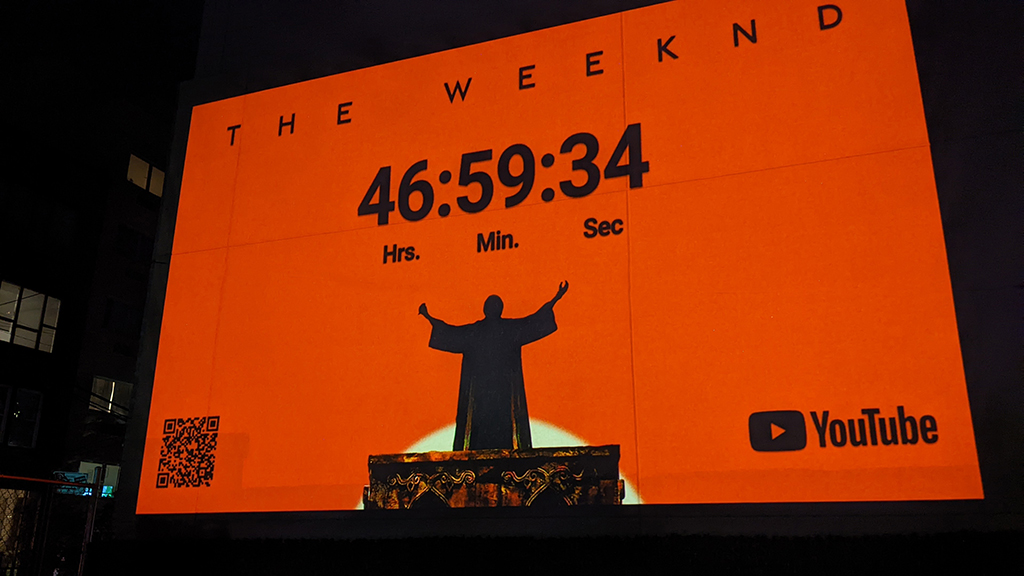
The conference hall closes at 6pm. The real conversations begin at 7pm. Every major professional conference has an evening social network , networking dinners, cocktail receptions, hotel bar gatherings, after-parties , where the most senior attendees relax, build relationships, and have the conversations that drive next-day purchasing decisions. Most brands disappear when the hall closes. The smart ones show up on the walls.
American Guerrilla Marketing deploys projection advertising at conferences that places large-format brand imagery on building facades near evening event venues. When conference attendees are walking to dinner, gathering at a hotel terrace, or heading into a networking reception , your brand is on the wall above them, in a scale and a context that no other format can match at night.
Why Evening Conference Hours Are Underused
Ask most brands how they market at conferences and they will describe a booth strategy, a street team program, maybe a truck route. Almost none of them think about what happens after 6pm. That absence creates an opportunity.
The evening hours at a major conference concentrate some of the most valuable professional interactions of the entire event. The attendees who are at the hotel bar and the networking dinner are often the most senior people at the conference , the ones whose schedules during the day are so full of meetings that they are the hardest to reach on the show floor. In the evening, they are accessible, relaxed, and open to the kind of longer conversation that leads to real commercial relationships.
Projection advertising at evening venues does not have the interactivity of a street team. What it has is scale and novelty. A large building projection creates a shared visual moment for everyone in the area , and shared moments get remarked upon, photographed, and shared on social media. The secondary reach generated by attendees posting a dramatic building projection can multiply the physical impression count substantially.
How Conference Projection Campaigns Work
A projection advertising campaign at a conference involves several coordinated elements. Location scouting identifies the evening venues where the conference attendee social scene concentrates , the hotel with the rooftop bar, the restaurant hosting the industry association dinner, the plaza where the official networking reception is held. We identify these venues during the planning phase, either from the conference program or from local knowledge about where conference attendees typically gather in each host city.
We then identify the best projection surfaces near those venues. Blank building walls facing a pedestrian approach, hotel exterior facades visible from the gathering point, parking structure walls alongside the walking routes between venues , each surface is evaluated for reflectance, accessibility for projector positioning, and sight line quality from the attendee’s vantage point.
Projectors are positioned and calibrated in advance, content is tested at the correct scale, and the campaign runs during the prime evening window when the maximum attendee concentration is present at each venue. We can run a single projector at one venue for the full evening, or rotate positioning to cover multiple venues as the evening event schedule progresses.
Projection Content for Professional Conference Audiences
The content that works best in conference projection advertising is bold, simple, and appropriately professional. A looping animated sequence with your brand identity, a key message, and a reference to the conference creates the strongest impact. Complex narrative content or dense text does not work , projection is viewed from a distance by people who are mid-conversation and moving.
Animation significantly increases the attention a projection captures. A static projection blends into the environment after a few minutes. A gently animated projection , a moving light effect, a rotating message, a simple animation that cycles every 20-30 seconds , continues to capture attention throughout the evening as new people arrive and existing attendees re-encounter it from new angles.
We recommend keeping the brand message simple and the visual identity prominent. The goal is brand recall, not communication of complex product information. A person who sees your logo on a building three stories above them and associates your brand with a dramatic visual experience is a person who is primed to engage seriously when they encounter you on the show floor the next morning.
Projection Advertising Combined with Evening Street Teams
Projection advertising’s greatest limitation is that it cannot have a conversation. It creates awareness and a visual experience, but it cannot capture leads or answer questions. Pairing a projection campaign with a brand ambassador team near the same venue overcomes this limitation.
When a team member is positioned near the projection site , at the entrance to the event venue, at the edge of the plaza where the projection is visible , they can engage attendees who are looking at the projection with a direct introduction: “That’s us up there. Can I tell you more about what we do?” The visual experience of the projection creates an opening for the human conversation that the team member closes.
This combination of projection-driven visual awareness and team-driven human interaction is one of the most effective evening conference marketing configurations we deploy. The projection gets the attention; the team member gets the lead.
Conference Cities Best Suited for Projection Advertising
Projection advertising at conferences works best in walkable urban environments where the evening social scene concentrates at a small number of venues within a short walking radius of the convention center. Cities where attendees drive from hotel to venue to dinner do not create the pedestrian density that makes outdoor projection effective.
Chicago, New York, San Francisco, Boston, Seattle, and similar walkable conference cities are excellent markets for conference projection advertising. Las Vegas, while a major convention market, is a more complex environment for projection because the Las Vegas Strip itself is so visually saturated that projection competes with an extraordinarily high baseline of existing visual stimulation.
We advise clients on the relative effectiveness of projection for each specific conference market and integrate projection into the campaign plan when the conditions support it.
Multi-Night Projection Campaigns
For multi-day conferences with multiple evening social events, projection campaigns can run across multiple nights, targeting different venues as the evening social calendar of the conference changes. Day one evening might target the hotel district near the convention center. Day two might target the restaurant row where the industry association dinner is being held. Day three might target the official closing reception venue.
This multi-night approach creates repeated evening brand encounters across different contexts and venues, building the kind of conference-week brand presence that makes your name genuinely recognizable by the final day , not just a logo on a banner that people walked past once.
How We Build Convention Campaigns That Actually Work
Our team at American Guerrilla Marketing has executed convention marketing programs at major trade shows across the country. We have deployed teams at shows in Las Vegas, New York, Chicago, Orlando, Atlanta, and every other major convention market. That field experience informs how we plan every new campaign: we know what works in the Javits Center neighborhood, how to navigate the hotel district around the Las Vegas Convention Center, and where to position teams for maximum impact at McCormick Place.
Every program we run is documented from start to finish. Before the show opens, we confirm every outdoor placement with geo-tagged photos. During the show, field supervisors submit timestamped shift logs that include deployment position, team size, and conversation or sample counts for each shift. After the show closes, we compile the full campaign documentation into a post-show report that gives clients proof of what was executed and the data they need to evaluate the program.
The documentation also creates the performance record that informs optimization of the next campaign. Which deployment locations generated the most qualified conversations? Which outdoor placements received the most engagement? Which shift timing produced the highest-quality audience encounters? These questions get answered over multiple campaigns, and the answers compound into a progressively more effective convention marketing program year over year.
Planning Your Convention Campaign Timeline
Convention marketing campaigns work best when they are planned against the full timeline: 8 to 12 weeks before the show for the most complex programs, 4 to 6 weeks for ambassador-only or outdoor-only programs. The earlier the planning begins, the more options are available for every element of the campaign.
The pre-show window (6 to 8 weeks out) is when pre-show meeting outreach campaigns should launch. Personalized outreach to registered attendees using the specific conference or show context achieves significantly higher response rates than generic outreach because the timing is immediately relevant to the recipient’s known upcoming plans. We build pre-show outreach sequences for clients as part of convention marketing engagements, segmenting by target buyer persona and show registration data where available.
Production of printed materials for wheatpaste campaigns and stencil programs requires 3 to 4 weeks from design approval to installation. LED truck route planning and driver coordination requires 1 to 2 weeks. Ambassador team recruitment and briefing requires 3 to 4 weeks for shows with specific professional audience requirements. Running all of these in parallel against the show date requires a planning timeline that starts at least 6 weeks before the first deployment day.
We provide campaign timeline planning as part of the proposal process: every proposal includes a production and deployment timeline that shows exactly what happens when, what deliverables are required from the client, and what our team is responsible for executing at each stage. This timeline planning prevents the last-minute scrambles that degrade campaign quality and limit creative options.
Working With American Guerrilla Marketing
Our team at American Guerrilla Marketing is based at Industry City in Brooklyn. We have been running street-level marketing campaigns for brands across every major consumer category for years. Our field operations experience spans New York, Los Angeles, Chicago, Miami, Austin, San Francisco, and dozens of other markets. That operational depth is what we bring to every client engagement, alongside the creative and strategic work that makes campaigns worth executing.
Our engagement process is straightforward. We start with a discovery call where we learn your brand, your audience, your market, and your campaign objectives. We turn that understanding into a campaign proposal with specific tactics, deployment plans, a timeline, and investment. Once approved, we handle every aspect of production and field management from start to finish. You receive documentation from every deployment day and a post-campaign report at close.
We work with brands at a wide range of budgets and campaign scales. A focused street team program in one neighborhood is as important to us as a multi-city multi-format program. Every campaign we run reflects the same standard of planning, execution, and documentation regardless of scale.
What is projection advertising at conferences?
Projection advertising at conferences uses high-powered projectors to display large-format brand imagery on building facades and other prominent surfaces near conference evening event venues, creating dramatic visual brand moments during the social hours after the conference hall closes.
When does projection advertising work best at conferences?
Projection advertising is most effective during conference evening hours , after the show floor closes and attendees gather at networking dinners, cocktail receptions, hotel bars, and official evening events. This is when the audience is relaxed, social, and receptive to visual experiences.
What surfaces work best for conference projection advertising?
Blank or lightly textured building walls, parking structure facades, and large flat surfaces near conference evening venues are ideal. Light-colored surfaces produce the sharpest imagery. We scout projection surfaces during advance location visits for each conference.
Do you need permission to project on a building at a conference?
Requirements vary by city and surface type. Projecting onto private property typically requires property owner permission. Projecting onto publicly visible surfaces from public space may require city site approvals in some jurisdictions. AGM researches and manages the necessary permissions and site approvals for each projection campaign.
How large is the projection image?
Projection images can range from 20 feet wide on a smaller building facade to 60+ feet wide on a large parking structure or hotel exterior. Size depends on the available surface, the projector power, and the throw distance.
Can projection advertising include motion or video content?
Yes. Modern projection equipment supports animated content and video loops. Motion in projection advertising significantly increases the attention it captures from passing pedestrians.
What conferences is projection advertising most effective at?
Large national conferences in walkable urban environments , where attendees gather at hotel bars and restaurants within walking distance of the convention center , are particularly well-suited to conference projection campaigns.
Campaign Architect – American Guerrilla Marketing
Frequently Asked Questions
What is projection advertising at conferences?
Projection advertising at conferences uses high-powered projectors to display large-format brand imagery on building facades and other prominent surfaces near conference evening event venues, creating dramatic visual brand moments during the social hours after the conference hall closes.
When does projection advertising work best at conferences?
Projection advertising is most effective during conference evening hours , after the show floor closes and attendees gather at networking dinners, cocktail receptions, hotel bars, and official evening events. This is when the audience is relaxed, social, and receptive to visual experiences.
What surfaces work best for conference projection advertising?
Blank or lightly textured building walls, parking structure facades, and large flat surfaces near conference evening venues are ideal. Light-colored surfaces produce the sharpest imagery. We scout projection surfaces during advance location visits for each conference.
Do you need permission to project on a building at a conference?
Requirements vary by city and surface type. Projecting onto private property typically requires property owner permission. Projecting onto publicly visible surfaces from public space may require city site approvals in some jurisdictions. AGM researches and manages the necessary permissions and site approvals for each projection campaign.
How large is the projection image?
Projection images can range from 20 feet wide on a smaller building facade to 60+ feet wide on a large parking structure or hotel exterior. Size depends on the available surface, the projector power, and the throw distance.
Can projection advertising include motion or video content?
Yes. Modern projection equipment supports animated content and video loops. Motion in projection advertising significantly increases the attention it captures from passing pedestrians.
What conferences is projection advertising most effective at?
Large national conferences in walkable urban environments , where attendees gather at hotel bars and restaurants within walking distance of the convention center , are particularly well-suited to conference projection campaigns.
How early should a brand start planning?
For most campaigns, the smart move is to start planning at least two to four weeks before the launch window so production, routing, staffing, and reporting are all lined up.
What makes one market perform better than another?
Market fit depends on audience density, neighborhood behavior, route efficiency, and whether the creative belongs in that setting. The busiest city is not always the best city.
Can AGM bundle this with other services?
Yes. AGM often combines this work with supporting formats so the campaign has stronger repetition and cleaner reporting across the whole run.
How does AGM quote pages like this?
We quote from official rate cards where they apply, then scope the remaining production, staffing, and routing details to the actual job.