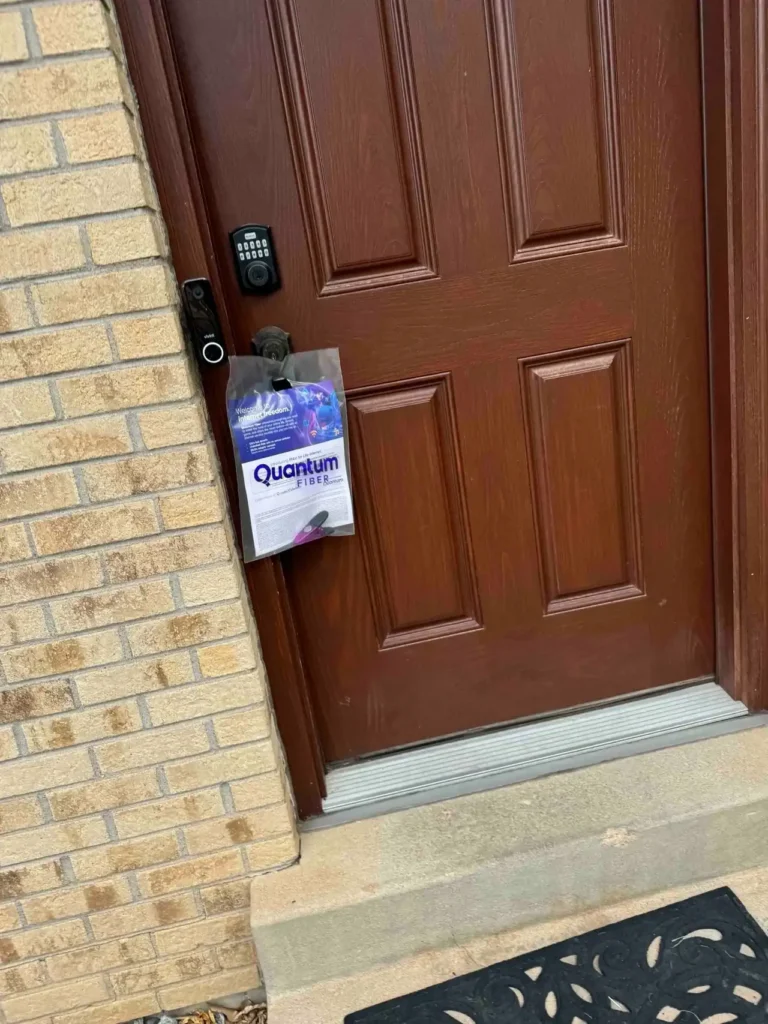
Washington state is one of the most diverse marketing environments in the country. Seattle and the Eastside tech corridor have household incomes and digital literacy rates that make consumers highly selective about the marketing they engage with. Tacoma, Everett, and the South Sound communities have working-class and trades-focused households that respond to direct, value-driven outreach. Spokane and Eastern Washington have community dynamics closer to a mid-size western city than to the Puget Sound metro. Door hanger promotions work across all of these environments because they deliver a message directly to a household, physically, without competing in a crowded inbox or feed.
American Guerrilla Marketing executes field-based marketing campaigns across Washington state. From Capitol Hill’s dense apartment blocks to Spokane Valley’s suburban residential streets, we plan, staff, and document door hanger campaigns with GPS tracking and post-campaign reporting that shows exactly what got done. No estimates, no assumptions, just verifiable documentation.
This guide covers the Washington state market landscape, which cities and neighborhoods drive the best door hanger campaign performance, which industries see the strongest results, and how our process delivers accountability from first hanger to final report.
Why Door Hanger Marketing Works in Washington State
Washington’s advertising market is competitive and expensive, particularly in the Seattle metro. Search advertising, social media, and OTT platforms are crowded with national and regional brands with large budgets. Local businesses often find themselves outspent on digital channels where they cannot match the creative output or bid rates of larger competitors. Door hanger campaigns bypass that competition entirely. A well-designed hanger in Fremont or Ballard is the only hanger in that neighborhood that week, regardless of what any competitor is spending on Google or Instagram.
High Residential Density Drives Campaign Efficiency
Seattle and its surrounding communities have residential density that makes door hanger distribution extremely efficient. Capitol Hill, the Central District, Rainier Valley, West Seattle, and Ballard all have high household density, which means a distribution crew can cover significant door counts in a single shift. That density drives per-door costs down and reach up, making Seattle one of the better value markets for door hanger campaigns despite its high overall cost of business.
Pacific Northwest Consumer Values Favor Direct, Local Marketing
Washington consumers, particularly in the Seattle area, have a well-documented preference for supporting local businesses and engaging with brands that demonstrate community presence. A door hanger that communicates local roots, a specific neighborhood service area, or a community-relevant offer plays well with Puget Sound consumer values. We help clients craft messaging that signals local relevance without feeling generic or opportunistic.
Washington’s Key Markets for Door Hanger Distribution
Washington’s population of roughly 7.7 million is heavily concentrated in the Puget Sound region, with Spokane as the dominant city east of the Cascades. Each major market has distinct neighborhood characteristics that shape how door hanger campaigns should be structured.
Seattle: High-Density, High-Income, High-Competition
Seattle’s core neighborhoods, including Ballard, Fremont, Queen Anne, Capitol Hill, the Central District, West Seattle, and Rainier Valley, offer some of the highest residential density on the West Coast. The city’s median household income exceeds $110,000, making it an attractive market for premium services, restaurants, fitness, and home improvement. The renter-heavy character of many Seattle neighborhoods means restaurant, delivery, fitness, and lifestyle services outperform home services in most core zones. Homeowner-focused campaigns are better targeted to single-family neighborhoods in Beacon Hill, Magnolia, or Broadmoor.
Eastside: Bellevue, Kirkland, Redmond, and the Tech Corridor
The Eastside represents some of the highest per-household income in the country, driven by Amazon, Microsoft, Valve, and the broader tech industry employment base. Door hanger campaigns targeting Bellevue’s Crossroads and Somerset neighborhoods, Kirkland’s Juanita and Bridle Trails areas, and Redmond’s residential zones reach households with exceptional discretionary spending power. Home improvement, premium restaurants, luxury auto services, and high-end wellness businesses see strong return in these markets. Our brand ambassador programs complement Eastside door hanger campaigns for brands wanting personal engagement alongside residential coverage.
Tacoma and the South Sound
Tacoma has undergone significant revitalization over the past decade. The Stadium District, Hilltop, and North End neighborhoods have attracted younger homeowners and renters who value local restaurants, fitness, and lifestyle services. The city’s working-class south end neighborhoods are strong targets for home service, auto, and value-oriented restaurant campaigns. Joint Base Lewis-McChord and the surrounding military community represent a distinct and substantial audience segment for services that cater to frequent movers and active-duty households.
Everett, Bellingham, and Olympia
Everett’s Boeing-anchored economy supports a stable working-class homeowner base that responds well to home services, auto, and family-oriented dining campaigns. Bellingham, as a university and outdoor-recreation-oriented city, has a younger, environmentally conscious consumer base that responds to sustainability-oriented messaging and local business support. Olympia, as the state capital, has government employment stability and proximity to outdoor recreation that creates demand for home services, fitness, and restaurant campaigns year-round.
Spokane: Eastern Washington’s Commercial Hub
Spokane is Washington’s second-largest city with approximately 230,000 residents and a metro approaching 600,000. The city has lower digital ad rates than the Seattle metro, which means door hanger campaigns in Spokane face less competition from well-funded digital advertisers. The South Hill, Shadle Park, and Browne’s Addition neighborhoods are strong residential targets for home service, healthcare, and restaurant campaigns. Gonzaga’s presence supports student-oriented marketing in specific zones.
Industries That See Strong Results With Washington Door Hanger Campaigns
Washington’s diverse economy supports a wide range of door hanger campaign applications. The following industries consistently perform well across Washington markets.
Home Services and Renovation
Washington homeowners face the ongoing costs of aging housing stock, Pacific Northwest weather conditions (moss, moisture, wood rot), and the premium that comes with keeping a high-value asset in top condition. HVAC, roofing, gutter cleaning, pressure washing, landscaping, pest control, and kitchen and bathroom remodeling businesses all find strong demand when they put their message on doors in established Seattle, Tacoma, and Spokane neighborhoods.
Restaurants and Food Delivery
Seattle’s restaurant market is competitive and sophisticated, but neighborhood-level door hanger campaigns still drive meaningful traffic for new openings, delivery launches, and promotional events. A restaurant opening in Georgetown or South Lake Union targeting the surrounding residential blocks in a one-mile radius can drive significant early-adopter traffic. QR codes linking to online ordering or reservation platforms are standard on food service hangers in tech-literate Seattle markets.
Fitness and Wellness
Washington consumers are among the most health-conscious in the country. Gym openings, yoga studios, personal training, physical therapy, and wellness-oriented businesses all see strong response from door hanger campaigns in the right Seattle, Eastside, or Tacoma neighborhoods. Membership drives and first-month discount offers perform particularly well as door hanger mechanics in fitness campaigns.
Healthcare and Dental
New medical and dental practices entering Washington markets use door hanger campaigns to build patient panels quickly. A family medicine practice opening in Burien or Puyallup can target the surrounding residential zip codes to drive new patient appointments without the delays and costs of digital search campaigns in a competitive healthcare market.
Real Estate
Washington real estate agents farm specific neighborhoods using consistent door hanger campaigns. In Seattle and Eastside markets where home values regularly exceed $700,000, a single listing generated by neighborhood farming can justify a year’s worth of door hanger campaign investment. Quarterly campaigns in a defined two-to-three block farm area build the name recognition that converts when homeowners decide to sell. We support campaigns with our full direct distribution services.
How AGM Executes Washington State Door Hanger Campaigns
Our Washington campaign process is built on the same documented, GPS-tracked foundation we apply across all 50-plus markets we serve. In a state where consumer sophistication and brand expectations are high, we hold our execution standards accordingly.
Campaign Zone Planning and Demographic Targeting
We start every Washington campaign with zone selection based on census data, neighborhood income and ownership profiles, and client vertical research. A Bellevue home improvement campaign targets homeowner-dominant blocks in the $150,000-plus household income range. A Capitol Hill restaurant campaign targets high-density renter blocks within walking distance of the business. We build distribution maps before any crew is deployed and review them with clients before launch.
Field Execution and GPS Verification
Our Washington field teams operate with GPS-enabled tracking devices that log every address visited. Supervisors monitor route progress in real time and adjust crew assignments if any zone falls behind pace. We comply with Seattle’s specific posting ordinances and any HOA or building management restrictions in multi-family zones. Photography documents hanger placement at regular intervals throughout every campaign day.
Post-Campaign Reporting
Campaign reporting includes GPS coverage maps, zone-by-zone door counts, timestamped photography, and documentation of any restricted or skipped areas. You receive a full data package showing exactly what happened, where your campaign ran, and how many doors were covered. This is not a certificate of completion. It is auditable documentation.
Pairing Door Hangers With Other Washington Marketing Channels
Washington state’s diverse consumer landscape benefits from integrated campaign approaches. For Seattle and Eastside markets, we recommend pairing door hanger distribution with geofenced digital ads targeting the same zip codes simultaneously. The combination of physical and digital contact in the same household zone drives significantly higher brand recall and response rates than either channel alone.
For larger Washington campaigns, mobile billboard trucks through high-traffic Seattle or Tacoma corridors on the day before door hanger distribution begins create advance impressions that prime households to engage with the hanger. Sidewalk stenciling in commercial pedestrian zones and LED billboard trucks at events or grand openings add additional touchpoints to the local marketing mix.
Measuring Washington State Campaign Performance
Washington’s sophisticated consumer base makes attribution especially important. Seattle and Eastside consumers are digitally literate and use multiple channels before making purchasing decisions. Building tracking mechanisms into your door hanger ensures you can measure the campaign’s contribution to your overall marketing performance rather than attributing all conversions to digital channels by default.
Unique Tracking Phone Numbers
A dedicated phone number that appears only on the door hanger gives you clean attribution for inbound calls. Services like CallRail or Google Voice provide call tracking numbers at low monthly cost. Every inbound call to that number is attributable to the campaign, allowing you to calculate a precise cost-per-lead. For home service businesses in Seattle and Eastside markets, where inbound call volume is a primary lead metric, this is the most direct attribution tool available.
QR Codes to Campaign Landing Pages
Washington’s tech-literate consumer base makes QR code adoption above-average compared to most U.S. markets. A QR code linked to a campaign-specific landing page with UTM parameters allows any analytics platform to separate door hanger-driven traffic from organic, paid, and direct sources. Restaurant campaigns using QR codes to link directly to online ordering platforms can measure both click-through rates and order conversion in one data stream, giving you a complete picture of campaign ROI from hanger placement to completed order.
Zone-Level Response Analysis
Running campaigns across multiple Washington neighborhoods or cities allows response rate comparison by zone. A business serving both Seattle and Bellevue that sees consistently different response rates between neighborhoods can adjust future distribution allocation based on empirical performance data rather than assumptions about which areas should perform better. Over multiple campaign cycles, zone performance data improves campaign efficiency with every subsequent run.
Common Door Hanger Distribution Failures and How AGM Prevents Them
Washington’s competitive and expensive business environment makes distribution mistakes costlier than in lower-cost markets. Every door hanger that misses its target is wasted spend in a market where marketing budgets are under scrutiny. Understanding the common failure modes before committing budget protects your investment.
Crew Accountability Without GPS Tracking
The door hanger distribution industry has a well-documented accountability problem. Crews without GPS oversight frequently skip routes, distribute in the wrong neighborhoods, or mark zones complete without finishing the work. In Seattle, where hourly labor costs are among the highest in the country, the temptation to cut corners is significant for low-margin distribution vendors. AGM’s GPS tracking at the individual crew member level eliminates this problem. Every address visited is logged in real time. Supervisors can see route progress on a live map. Post-campaign coverage maps show exactly what was and was not distributed. The data does not lie.
Zone Selection Without Audience Research
A home services company distributing in Capitol Hill apartment towers is wasting budget reaching renters who cannot authorize property work. A restaurant distributing in Bellevue’s tech corridor is reaching households whose dining patterns are dominated by corporate catering and expense account restaurants rather than neighborhood delivery. Zone selection in Washington’s complex, income-diverse market requires real demographic research, not default radius targeting. We build every Washington distribution zone based on census data, neighborhood income profiles, homeownership rates, and vertical-specific audience criteria before any crew is deployed.
Missing the Offer Clarity Test
Washington consumers encounter enormous amounts of marketing. They have developed fast filters for what gets attention and what gets ignored. A door hanger that does not pass the three-second test, communicating the offer clearly within a single glance, fails in a market where residents are practiced at dismissing marketing noise. Every hanger we put into Washington markets is reviewed for offer clarity, call to action visibility, and headline strength before production begins. We will not send poorly performing creative into the field.
Seasonal Timing for Washington Door Hanger Campaigns
Washington’s Pacific Northwest climate creates specific seasonal windows where campaign timing drives above-average response. Spring, from March through May, is peak season for landscaping, gutter cleaning, moss treatment, deck refinishing, and pest control campaigns as homeowners emerge from the rainy season ready to address outdoor maintenance that accumulated over winter. HVAC campaigns before the cooling season in June also perform well in this window. Summer campaigns in Seattle and the Eastside drive restaurant, fitness, and lifestyle business as dry weather brings residents outdoors. Fall is the most important window for roofing, gutter maintenance, heating system service, and weatherization campaigns in Western Washington, where homeowners know the rainy season is imminent and service demand is high. Eastern Washington’s Spokane market has colder, snowier winters that make fall heating campaigns even more time-sensitive than in the Seattle metro.
Frequently Asked Questions About Door Hanger Promotions in Washington
How much does a door hanger campaign cost in Washington state?
Washington campaigns typically range from $0.35 to $0.75 per door depending on market, volume, and distribution zone. Seattle and Tacoma’s high residential density keeps per-door costs competitive. AGM provides transparent per-door pricing with full GPS documentation included in every campaign package.
Which Washington cities does AGM cover for door hanger distribution?
We cover Seattle, Spokane, Tacoma, Bellevue, Everett, Renton, Kirkland, Redmond, Olympia, Bellingham, Vancouver, and communities throughout the state including Eastern Washington markets. Our team can staff campaigns in any Washington city where residential density supports efficient distribution.
How long does a Washington door hanger campaign take?
Seattle and Tacoma campaigns typically complete in 5 to 10 business days. High-density Seattle neighborhoods can be covered faster with larger crew deployments. Spokane campaigns of similar door counts generally complete in the same window. We provide a timeline during the planning phase before you commit to a launch date.
Does AGM provide proof of delivery for Washington campaigns?
Yes. Every campaign includes GPS route tracking data, timestamped field photography, and post-campaign coverage maps showing exactly where your hangers were placed. This documentation is delivered as a standard part of every campaign, not an additional service.
What types of businesses use door hanger marketing in Washington?
Home services, restaurants, fitness, healthcare, real estate, tech-adjacent service businesses, and retail all use door hanger campaigns effectively across Washington markets. The medium works well for any business with a geographic customer base and a clear, compelling offer.
Can AGM handle printing for my Washington door hanger campaign?
Yes. We offer turnkey services including print production and GPS-tracked distribution. Clients with existing materials can opt for distribution-only service. Either way, documentation standards are identical.
Does AGM comply with Seattle’s posting ordinances?
Yes. Our team is familiar with Seattle’s specific regulations around door-to-door distribution and complies with all applicable ordinances, HOA restrictions, and building management policies before any distribution begins in a specific zone.
Washington’s market also rewards businesses that demonstrate consistency. A single door hanger campaign builds awareness. A quarterly program in the same Seattle, Tacoma, or Spokane neighborhoods builds recognition. Over four to six campaign cycles, a brand running consistent physical marketing in a defined zone becomes the known local option in that neighborhood, a position that converts to repeat business and referrals in ways that episodic campaigns cannot achieve. We help Washington clients develop multi-quarter campaign calendars that build on each prior cycle rather than starting from zero with every distribution run.
Frequently Asked Questions
What is door hanger promotions washington?
American Guerrilla Marketing provides door hanger promotions washington services across 50+ U.S. markets. Every campaign is planned, scouted, executed, and GPS-documented by our field teams. We work with regional brands and Fortune 500 companies on campaigns that require real street-level execution and documented proof of performance.
How does AGM approach promotions washington?
Our process starts with a market consultation to understand your goals, target audience, and budget. We then scout locations, handle any required permissions or permits, coordinate production and installation with our local crews, and provide a full GPS-tagged photo report after the campaign runs.
What markets does American Guerrilla Marketing cover for promotions washington?
We operate in 50+ U.S. markets including New York, Los Angeles, Chicago, Miami, Houston, Atlanta, Seattle, Denver, Boston, and dozens of secondary markets. Contact us to confirm availability and pricing for your specific market.
How much does a promotions washington campaign cost?
Campaign pricing depends on market, format, quantity, and duration. We work with budgets ranging from targeted single-market runs to national rollouts across multiple cities. Use our RFP Builder or contact us directly for a custom quote based on your specific campaign requirements.
How do I get started with promotions washington through AGM?
The fastest way to get started is to submit your campaign details through our RFP Builder at americanguerrillamarketing.com, or contact us directly at [email protected] or (646) 776-2770. Our team typically responds within one business day with availability and initial pricing.