What Size Is a Typical Poster? Common Dimensions Explained | AGM
There’s no single answer to what a “typical” poster looks like in terms of size. Context determines everything. But two sizes come up more than any others: 18×24 and 24×36 inches.
When someone asks what size a typical poster is, they usually mean one of a few things: they’re ordering a print online and want to know what size to pick, they’re planning a campaign and need a starting point, or they saw a poster somewhere and want to know what size it probably was. The answer shifts depending on which of these questions is actually being asked.
We produce posters for campaigns across the United States. We know exactly what sizes appear in the wild, in which contexts, and why. This guide walks through what’s typical in every major poster application, from home decor to street advertising to academic conferences. By the end, you’ll know exactly which size to use for your specific situation.
The direct answer: a typical outdoor street poster is 24 x 36 inches. A typical indoor event or venue poster is 18 x 24 inches. A typical decorative wall poster ordered online is 18 x 24 or 24 x 36. A typical academic conference poster is 36 x 48 inches. The right answer for you depends on what you’re making the poster for.
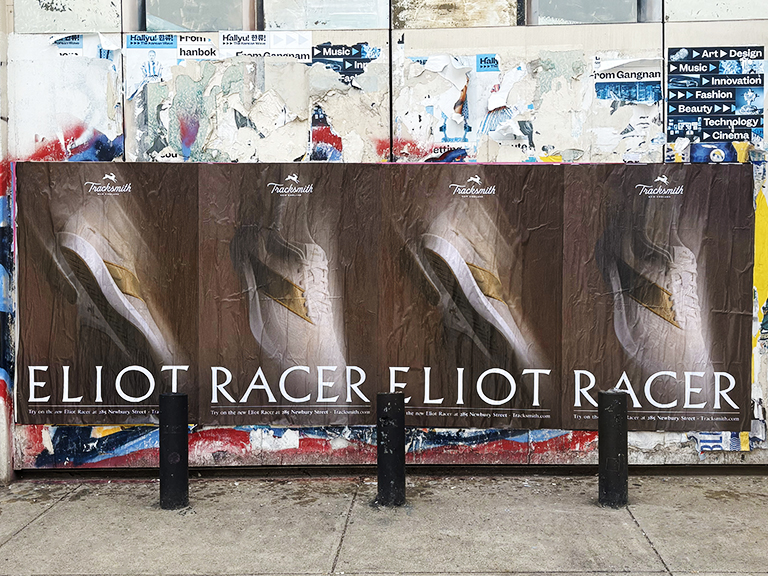
The 24 x 36 inch format is what most people picture when they think of a street campaign poster. It’s two feet wide and three feet tall. Large enough to see from across a street. Small enough for one person to handle during installation. It’s been the standard outdoor campaign size in the US for decades, cemented partly by the movie industry and partly by print infrastructure economics.
On the construction walls around Madison Square Garden in New York, on the hoarding surrounding new development along the LA River, on the fence lines bordering Chicago’s Fulton Market District, this is the format you see. Consistent. Repeatable. Scalable. A campaign that needs to cover 500 locations in a city works best at 24 x 36 because it fits more locations than any other large-format size.
For smaller locations (telephone poles, kiosk columns, tight wall spaces), the 11 x 17 inch format is what’s typically used. At higher volumes and lower costs, this size saturates a neighborhood fast.
What Is a Typical Indoor Venue Poster Size?
For interior campaigns in bars, music venues, coffee shops, independent retailers, and similar spaces, 18 x 24 inches is the typical format. This size is large enough to stand out on a cluttered bulletin board or a bar wall covered in other postings. It’s small enough to fit in the available space in most venues without requiring a focused wall section.
We use 18 x 24 as our default for interior venue campaigns in New York (Bowery, Williamsburg, the Village, the Lower East Side), Los Angeles (Echo Park, Los Feliz, Silver Lake, Highland Park), and Chicago (Wicker Park, Logan Square, Pilsen). Venue owners accept this size because it doesn’t take up too much wall real estate and it’s easy to tack or tape into place.
Typical Poster Sizes by Application
Application
Typical Size
Reason
Outdoor street campaign
24 x 36 in
Visible from 25-30 ft; standard campaign format
Indoor venue / bar / coffee shop
18 x 24 in
Fits most wall spaces; readable from 10-15 ft
Home wall art
18 x 24 in or 24 x 36 in
Most popular sizes from online print services
Movie theater lobby
27 x 41 in
Industry-standard one-sheet for theater cases
Retail store display
18 x 24 in or 22 x 28 in
Fits standard retail sign holders
Academic conference
36 x 48 in
Standard conference display board size
Small venue / telephone pole
11 x 17 in
Low cost; high volume; fits tight spaces
Transit advertising
Varies by format
Specified by media owner; 47.5×67.5 typical for shelters
What Makes a Poster “Typical” in the First Place?
The idea of a “typical” poster size is really a reflection of what print infrastructure produces efficiently and what display environments accommodate most easily. The 18 x 24 and 24 x 36 formats are typical because:
Large-format inkjet printers produce them cleanly from standard roll stock
Shipping tubes designed for 24 x 36 rolls are widely available and inexpensive
Sign holders and display frames in those sizes are sold at retail hardware and office supply stores
Print vendors have set pricing at scale for these sizes, making them cost-effective for campaigns
Enough of the physical world (walls, boards, windows) accommodates these dimensions without modification
A format becomes “typical” when everything around it is built to accommodate it. That’s true for 18 x 24 and 24 x 36 in the US. It’s why we default to them and why you’ll almost never go wrong starting with one of these two sizes.
Field reality check: We’ve received design files in dozens of non-standard sizes over the years. Some are close to standard (23 x 35 instead of 24 x 36). Others are completely custom (17.5 x 29, 21 x 33). Every non-standard size adds cost and sometimes delays because it requires custom setup on the press. If you’re working with a budget and a deadline, stick to 18 x 24 or 24 x 36. The slight flexibility of a custom size almost never justifies the extra cost.
Typical Poster Sizes for Home Decor
For home wall art ordered from services like Redbubble, Society6, IKEA, or Amazon, the typical sizes available are:
Small: 8 x 10 in or 11 x 14 in. These are framing-friendly sizes. Standard frames in these dimensions are sold at every big-box retailer.
Medium: 12 x 18 in or 16 x 20 in. A step up from small. Standard frames exist but are less universally available.
Large: 18 x 24 in. The most popular poster size for home use from most online services. Standard frames are available from Ikea and other retailers.
Extra large: 24 x 36 in. Large for a bedroom or living room wall but dramatic. Standard frames at this size are available but more expensive.
The typical home decor poster size is 18 x 24 inches. It’s what most people order when they want a “real” poster for their wall. It fits comfortably above a bed or desk, doesn’t overwhelm a standard-height room, and is available in standard frame sizes from most retailers at accessible price points.
How Viewing Distance Defines Typical Sizes
The reason certain poster sizes are “typical” for specific contexts comes back to physics. A poster needs to be large enough to read from the typical viewing distance for its location. Here’s how that breaks down:
5 to 10 Feet (Indoor Close Range)
At this distance, an 18 x 24 inch poster is easily legible. Body text at 24 pt reads without strain. This covers most interior venue, retail, and home decor contexts. The viewer is close enough that fine detail and secondary information come through.
10 to 25 Feet (Indoor Medium Range)
At this distance, you want at least 18 x 24 and preferably 24 x 36. The headline needs to be large (60 to 90 pt) to read from 25 feet. Body text becomes difficult to read at this distance for standard sizes. Bold, minimal designs with a single headline and visual work best.
25 to 50 Feet (Outdoor Short Range)
This is the typical viewing distance for street-level posters viewed from across the sidewalk or a quiet street. A 24 x 36 inch poster with a large headline reads at this distance. Body text generally doesn’t work at this range. The poster communicates through headline, image, and color rather than detailed copy.
50 to 200 Feet (Outdoor Long Range)
Beyond 50 feet, standard poster sizes stop working. You need large-format advertising: transit panels, bulletins, or billboards. These formats have their own dimension standards, but they’re in a different category from standard posters.
Practical advice: If you’re unsure which size to order, think about where the poster will be displayed and how far away the viewer will typically be. Use the distance-to-size matching above as your guide. If you’re still not sure, email or call us. Size selection is something we help clients work through every week.
Typical Poster Paper Weight and Finish
Knowing the typical size is only part of the picture. The paper weight and finish also affect what you end up with.
For typical indoor posters, 80 to 100 lb cover stock (200 to 270 gsm) in matte or satin finish is standard. Matte reduces glare under fluorescent lighting. Satin adds color vibrancy without the harsh reflection of gloss. Both are appropriate for typical venue and retail applications.
For typical outdoor posters, the paper needs to handle moisture and temperature variation. We use coated paper at 80 to 100 gsm with a light coat or uncoated stock at similar weight for applications where paste adhesion is required. For exterior applications without paste (banner frames, outdoor displays), we use synthetic or vinyl stock.
What counts as typical in poster campaigns varies slightly by market. Street infrastructure, venue culture, and local advertising norms all influence which sizes appear most often. Here’s what we see in the cities where we work most often.
New York
Construction walls on Houston Street, Canal Street, and across midtown use 24 x 36 as the standard outdoor campaign format. Interior venue posters in Williamsburg, the Lower East Side, and the East Village default to 18 x 24. On telephone poles throughout those neighborhoods, 11 x 17 is the dominant high-volume format. The typical poster in New York for a street campaign is 24 x 36 outdoors and 18 x 24 inside.
Los Angeles
Open concrete and stucco walls along Melrose, Fairfax, and Sunset favor the 24 x 36 outdoor standard. Some LA locations run 24 x 48 because viewing distance from vehicles rewards the extra height. Interior campaigns in Echo Park, Los Feliz, and Highland Park use 18 x 24 at bars and coffee shops. The typical outdoor poster in Los Angeles for a street campaign is 24 x 36, with some campaigns running larger at key locations.
Chicago
Fence lines in Wicker Park and Pilsen, and hoarding along the Loop edge, use 24 x 36 as the standard outdoor format. Interior venue campaigns in Logan Square and Wicker Park use 18 x 24. For large-scale cultural campaigns tied to art festivals or community events, 30 x 40 or 24 x 48 formats appear at key anchor locations. The typical poster in Chicago maps closely to the national standard: 24 x 36 outdoor, 18 x 24 indoor.
Typography Rules That Hold for Every Typical Poster Size
Design follows size. The typical poster sizes each have specific typography constraints that determine what content can actually be communicated and read at the intended viewing distance.
The One-Third Rule for Headlines
Your headline should take up roughly the top one-third of the poster’s height. On an 18 x 24 inch poster, that’s the top 8 inches. On a 24 x 36 inch poster, that’s the top 12 inches. Headlines that push into the lower half of the poster compete with body content for visual dominance and confuse the read sequence. Keep the headline in the upper third. Eyes enter a poster from the top and read down.
Minimum Legible Type Size by Viewing Distance
5 ft viewing distance (11 x 17 or 18 x 24 interior): Body text minimum 18 pt. Headlines at 48 pt or larger.
10 to 15 ft viewing distance (18 x 24 interior): Body text minimum 30 pt. Headlines at 72 pt or larger.
20 to 30 ft viewing distance (24 x 36 outdoor): Eliminate body text. Headline only, minimum 120 pt. Supporting text (URL, date) minimum 60 pt.
30 to 50 ft viewing distance (24 x 36 at wide street or transit exposure): Headline only. Minimum 180 pt. One line of supporting information if needed.
Color Contrast on Street Posters
High-contrast color pairings perform significantly better than subtle or tonal designs at outdoor viewing distances. Black text on yellow, white text on black, and black text on white are the standard outdoor pairings for maximum legibility. Design trends that favor muted palettes or low-contrast text work fine for phone screens and Instagram but disappear at 25 feet on a construction wall. If the poster needs to communicate information, contrast wins over aesthetics.
How to Confirm Your Size Before Printing
The best way to confirm the right size before committing to a print run is to do a quick physical test. Print a 1:1 scale template on regular paper (tile multiple sheets together if needed) and hold it against your intended mounting surface. This lets you see the actual physical footprint of the poster in the space before you spend money on the final print run.
For outdoor locations, photograph the space and mark the poster boundaries in your photo editing app. A 24 x 36 inch poster at a standard outdoor location takes up about 2/3 of the width of a standard sidewalk-facing wall section. A 18 x 24 indoor poster takes up roughly the same visual footprint as a 2019-era 13-inch laptop screen held vertically. These comparisons help clients visualize the size without needing to have seen the actual poster in person.
Frequently Asked Questions
What size is a typical poster?
A typical indoor poster is 18 x 24 inches. A typical outdoor campaign poster is 24 x 36 inches.
Is 24×36 a typical size for a poster?
Yes. The 24 x 36 inch format is one of the two most typical poster sizes in the US. It is the standard for outdoor campaign posters.