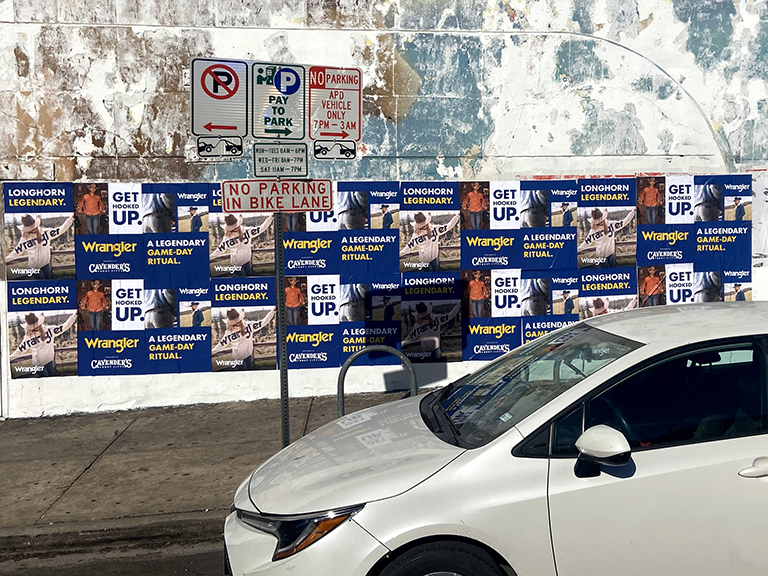
Poster sizing has evolved over more than a century of print production, and the result is a range of “standard” sizes that vary by application, industry, and regional convention. Whether you’re designing a retail display, an event poster, a movie one-sheet, or a large-format street campaign piece, the size you choose affects print cost, visual impact, and how the piece actually performs in its intended environment.
American Guerrilla Marketing uses large-format poster printing as a core component of our wheatpasting campaigns across 50+ U.S. markets. We print and install posters in New York, Los Angeles, Chicago, and every major city in our national footprint. We’ve worked with entertainment studios, consumer brands, record labels, and event organizers on poster campaigns ranging from single-location placements to multi-market programs covering hundreds of locations.
This guide covers every major poster format – dimensions, applications, print specifications, and how each size performs in its intended context. If you’re designing a poster or planning a campaign that uses poster formats, you’ll find the practical information you need here.
Standard Poster Sizes: The Core Formats
The following sizes are the most widely recognized standard poster dimensions in the United States. Each has typical applications and contexts where it’s most commonly used.
11×17 Inches (Tabloid / Small Poster)
The 11×17 format is the smallest commonly used poster size and the one most easily produced on office-grade large-format printers. It’s used for event flyers, concert promotions, in-store displays, neighborhood bulletin board posting, and any application where a modest print cost and small footprint are priorities. At this size, typography needs to be larger and the design needs to work at arm’s distance – fine detail doesn’t survive at 11×17.
18×24 Inches (Standard Poster)
18×24 is the most common general-purpose poster size and what most people picture when they imagine a “standard” poster. It’s widely used for event promotions, retail point-of-purchase displays, travel and destination marketing, and general promotional applications. At this size, you have enough real estate for a strong visual image plus readable headline text and supporting information. Print costs are moderate and this size fits standard poster display frames, tube shipping, and most display environments.
24×36 Inches (Large Poster / Movie Poster Standard)
24×36 is the dominant large-format poster size for entertainment marketing, street campaigns, and high-impact retail displays. It’s the standard size for most commercially distributed movie and entertainment posters, and the most common size used in wheatpasting and street marketing campaigns. At 24×36, a poster has enough visual presence to stop pedestrian traffic and enough surface area for bold visual treatment with strong brand impact at glance distance. This is the size that reads well on a wall from 10-15 feet.
27×40 Inches (One-Sheet / Movie Theater Standard)
The 27×40 one-sheet is the classic American movie theater poster format – the size that hangs in the display cases outside movie theaters and in lobby display boxes. It’s slightly larger than 24×36 and has a slightly different aspect ratio that accommodates the traditional movie poster layout: large image, prominent title, billing block at the bottom. For street marketing applications, 27×40 is less common than 24×36 because it doesn’t align with standard printing configurations as efficiently, but it’s worth specifying when working with entertainment clients who want the authentic movie poster format.
40×60 Inches (Transit Shelter / Bus Shelter Standard)
The 40×60 format is the standard for transit shelter advertising – the posters that appear inside bus shelter glass panels at street level. At this size, a poster is designed to be read by pedestrians and waiting passengers at close range (1-5 feet), which means different design considerations than billboard formats. Text can be smaller and more detailed, images can be more nuanced, and calls to action can include URLs and phone numbers that are readable at transit distances.
Large-Format Street and Outdoor Poster Sizes
Street marketing campaigns using wheatpasting, outdoor installations, and large-format placements often use non-standard sizes customized to specific wall dimensions and visual impact requirements.
48×72 Inches (4-Sheet Equivalent)
The 4-sheet format is approximately 48×72 inches and is one of the standard outdoor advertising sheet sizes. In urban guerrilla marketing contexts, this size or similar large-format prints are used to cover large wall sections for maximum visual impact. At 4 feet by 6 feet, a poster is visible from a significant distance and commands the visual attention of an entire block face when placed on a prominent wall. AGM uses large-format printing up to these dimensions for major wheatpasting campaigns in markets where large-wall placements are available.
Multi-Panel Configurations
Very large street poster installations are typically produced as multi-panel prints – multiple sheets installed edge-to-edge to cover a large surface. A building wall or construction hoarding might be covered with a 6-panel configuration that collectively spans 12 feet wide by 8 feet tall. Multi-panel installations require precise sizing to match the specific surface dimensions, which is why experienced street marketing operators always scout and measure target locations before producing materials.
Custom Sizes for Specific Locations
In professional street marketing campaigns, poster sizes are often customized to specific wall or surface dimensions identified during location scouting. A wall that’s 36 inches wide by 60 inches tall needs a different poster than one that’s 48 inches wide by 48 inches tall. Custom sizing ensures full surface coverage, maximizes visual impact, and prevents the visual degradation of posters that are the wrong size for their placement.
Poster Sizes by Industry and Application
Different industries have developed standard formats for specific applications. Understanding these conventions helps ensure your poster works in its intended context.
Entertainment and Music Posters
Entertainment industry poster standards are among the most codified. The one-sheet (27×40) is the dominant format for theatrical film releases. For music touring, 18×24 and 24×36 are the most common concert poster sizes, with 24×36 preferred for major venue and street distribution. The “half-sheet” (22×28) was once a common supplementary entertainment poster format and is still occasionally specified for specific display contexts. Blu-ray and streaming marketing sometimes uses non-standard formats for specific display units.
Retail and Point-of-Purchase
Retail poster sizes are often determined by display hardware – the frames, holders, and sign systems that stores use to display promotional materials. Common retail display sizes include 18×24, 22×28, and 24×36. If you’re designing retail posters, confirm the display hardware dimensions before finalizing your size – a poster that’s 1 inch off the frame size either won’t fit or will look messy.
Event and Festival Posters
Event posters range widely depending on distribution method and venue. For venue display (lobby, venue exterior), 18×24 and 24×36 are standard. For street distribution and neighborhood posting, 11×17 is common for low-budget productions while 18×24 and 24×36 are used for major events. Festival advertising in high-traffic areas often uses large-format wheatpaste pieces at 24×36 and larger to capture pedestrian attention in competitive visual environments.
Street Marketing and Wheatpaste Campaigns
For professional street marketing campaigns, 24×36 is the dominant format because it balances visual impact with print cost efficiency and manageable on-site handling. At this size, a single installer can place a poster efficiently, and the visual impact is strong enough to command attention on a busy urban wall or surface. For premium placements on large walls, larger formats up to 48×72 or multi-panel configurations are used. AGM’s production team determines optimal sizing for each location based on direct site measurement during the scouting process.
Poster Print Specifications: What You Need to Know
Producing posters that look professional and perform well in their intended environment requires understanding print specifications beyond just physical size.
Resolution (DPI)
Resolution requirements depend on viewing distance. Indoor posters viewed at close range (1-6 feet) should be designed at 150-300 DPI at final print size. Outdoor posters and large-format street prints viewed at distances of 10 feet or more can be produced at 72-100 DPI at final print size – the visual difference between 72 DPI and 300 DPI is not perceptible at these distances, but the file size difference is enormous. Always confirm DPI requirements with your print vendor before preparing files.
Color Mode
CMYK is the standard color mode for offset printing (commercial printing on press). RGB is standard for large-format digital printing (the type used for most street marketing and large-format poster production). Converting between color modes affects color appearance, sometimes significantly. Design in the color mode your printer requires, or provide files in both and let the printer select the appropriate version.
Bleed
Bleed is the extension of background color and design elements beyond the final trim size of the poster. Standard bleed is 0.125 inches (1/8 inch) on all sides for most commercial print jobs, though some large-format printers require 0.25 inches. If your poster has background color or images extending to the edge, bleed is required to prevent white edges from appearing if the trim cuts slightly off. If your poster has a white background, bleed is less critical.
Paper and Substrate
For street marketing applications, poster substrate matters for durability and installation performance. Standard uncoated paper is inexpensive but deteriorates quickly outdoors in wet conditions. Coated paper or polypropylene synthetic stock holds up better in outdoor conditions and produces more vibrant color output. Wheatpasting applications typically use lighter-weight paper stocks that absorb the paste and bond well to surfaces – heavy card stock can be difficult to apply smoothly and may bubble or peel.
How AGM Uses Poster Formats in Street Campaigns
Our team at AGM has worked with every major poster format across hundreds of campaigns in 50+ U.S. markets. Here’s how we approach format selection for street marketing programs.
Location scouting drives size decisions. Before we specify any print size for a wheatpasting campaign, our teams have walked and measured the target locations. We know the available wall dimensions, the sight lines, the competing visual elements, and the surface condition that will affect installation. That field knowledge determines whether a location takes a 24×36 single-sheet, a multi-panel 48×72, or something in between.
Visual impact at pedestrian scale is the design standard. Street posters need to work at 3-15 feet of viewing distance in cluttered visual environments. That means large, bold typography, high-contrast design, and a clear visual hierarchy that communicates the core message in 1-2 seconds. We brief clients on these design requirements before creative is finalized – because a poster designed for digital display often doesn’t translate directly to street poster performance.
Designing Posters for Different Environments
Understanding standard poster sizes is necessary but not sufficient. Designing posters that actually perform in their intended environments requires additional understanding of the specific conditions each format faces.
Indoor Retail and Event Environments
Indoor poster environments – retail displays, event lobbies, venue corridors – typically involve closer viewing distances (2-8 feet) and lower ambient visual competition than outdoor environments. These conditions allow for more detailed design: finer typography, more nuanced imagery, and more text information than outdoor formats should attempt. The 18×24 format is well-suited to most indoor retail and event applications because it provides enough visual presence to stand out in the environment while remaining manageable in standard display frames and holder systems.
Transit and High-Traffic Pedestrian Environments
Transit environments – subway stations, bus shelters, commuter corridors – require poster design that works at a range of distances and attention levels. A commuter approaching a bus shelter poster may view it from 20 feet walking toward it and from 2 feet while waiting. The design needs to communicate the primary message at the far distance (through visual clarity and large typographic hierarchy) while offering additional information at close range. This range-variable design discipline is different from designing for a single fixed viewing distance.
Street and Outdoor Guerrilla Contexts
Street-level outdoor poster contexts – walls, fences, construction hoardings, temporary structures – present the most varied viewing conditions. Viewing distances range from a few feet (pedestrians passing directly in front) to 30 feet or more (viewers across the street or from vehicle traffic). Street posters compete with enormous amounts of visual information in their environment. The design principle is extreme simplicity: a single dominant visual, a minimum of text, and a visual hierarchy that communicates brand and core message in one second or less. The 24×36 format is standard for street contexts because it provides enough surface area for visual impact while remaining manageable in production and installation.
Poster Production for Campaigns: Quantity and Scheduling
Campaign-scale poster production introduces quantity and scheduling considerations beyond individual format selection.
Print Run Planning
Poster print runs for marketing campaigns need to account for installation quantity, loss rate (posters damaged in transit, rejected from installation, or damaged post-installation), and reserve quantity for secondary placements or extended campaign windows. For a wheatpasting campaign covering 50 installation locations, a print run of 75-100 posters per design is typical – the additional quantity covers the loss rate and provides reserve. Print cost per unit drops significantly with larger quantities, so running slightly more than the minimum required is almost always economically justified.
Production Timeline
Standard large-format printing turnaround for campaign quantities (50-200 posters) is typically 3-7 business days from file approval. Rush production is available at premium pricing. For street marketing campaigns with specific launch dates, building print production into the campaign timeline with a minimum two-week buffer from file finalization to campaign launch provides the margin needed to address production issues without compromising the campaign timeline. Files submitted the week before launch create risk that files submitted three weeks before launch don’t.
Material Selection for Outdoor Durability
For outdoor street marketing applications, poster material selection significantly affects both visual quality and longevity. Standard uncoated paper produces good color reproduction and excellent paste adhesion for wheatpasting applications, but degrades quickly in wet conditions. Coated paper or polypropylene synthetic stock produces higher-impact color reproduction and greater weather resistance but costs more per unit and may require different adhesive approaches for installation. AGM’s production team specifies material based on the expected environmental conditions and campaign duration for each program.
What is the standard poster size?
The most common standard poster sizes are 18×24 inches (general purpose/small), 24×36 inches (large/movie poster standard), and 27×40 inches (one-sheet, classic movie theater format). For street marketing and outdoor campaigns, 24×36 is the dominant standard, with larger formats up to 48×72 used for premium wall placements. The “right” standard size depends on the application, viewing environment, and display requirements.
What size is a movie poster?
The classic US movie theater poster, called a one-sheet, measures 27×40 inches. For outdoor street campaigns and most commercial printing of entertainment materials, 24×36 is the standard movie and entertainment poster size. International formats vary – UK quad posters are 30×40 inches in landscape orientation, which is why international poster designs often look different from their US counterparts.
What is the standard size for a bus shelter poster?
Bus shelter posters in the US typically use the transit shelter standard of 40×60 inches (sometimes specified as 4-sheet at approximately 45×60 inches). Larger bus shelter advertising formats (30-sheet outdoor) measure approximately 12.25 x 24.5 feet. Specifications vary by transit operator and market – always confirm dimensions with the specific display network before producing materials.
What DPI should a large-format poster be?
Large-format posters viewed at close range (indoor retail, event displays) should be 150-300 DPI at final print size. For outdoor formats viewed at distance – street posters, bus shelters, billboards – 72-100 DPI at final print size is standard and sufficient because viewing distance makes higher resolution imperceptible. Always confirm DPI specifications with your print vendor before preparing final files.
What size are wheatpaste posters for street campaigns?
Wheatpaste posters for street campaigns commonly range from 24×36 inches for single-sheet placements to multi-panel configurations covering 4×8 feet or larger surfaces. The optimal size is determined by the specific wall or surface dimensions identified during location scouting. AGM’s wheatpasting campaigns use custom sizes matched to available surfaces in each market, with 24×36 as the default single-sheet standard.
What file format should a poster be for printing?
PDF is the most universally accepted format for print-ready poster files, with all fonts embedded and color profile set to CMYK for offset printing or RGB for large-format digital printing. AI and EPS files with outlined fonts are also widely accepted. Always confirm file format requirements with your specific print vendor before submitting – different large-format printers have different preferences for file types and color profiles.
How does AGM use posters in street marketing campaigns?
Campaign Architect — American Guerrilla Marketing
Frequently Asked Questions
What is the standard poster size?
The most common standard poster sizes are 18×24 inches (small/standard), 24×36 inches (large/movie poster standard), and 27×40 inches (one-sheet, the classic movie theater size). For street marketing and outdoor campaigns, larger formats like 24×36, 27×40, and wheatpaste-specific sizes up to 48×72 are commonly used.
What size is a movie poster?
The classic US movie theater poster, called a one-sheet, measures 27×40 inches. International one-sheets vary slightly – UK quad posters are 30×40 inches landscape format. For outdoor street campaigns and large-format printing, 24×36 is the most common movie and entertainment poster size.
What is the standard size for a bus shelter poster?
Bus shelter posters in the US typically use the 4-sheet format, which is 45×60 inches, or the more common transit shelter standard of 40×60 inches. Larger bus shelter formats (30-sheet) measure approximately 12.25 x 24.5 feet. Specifications vary by operator and market.
What DPI should a large-format poster be?
Large-format posters viewed at close range (indoor displays, retail) should be 150-300 DPI at final print size. For outdoor formats viewed at distance – street posters, bus shelters, billboards – 72-100 DPI at final print size is standard because the viewing distance means higher resolution is not perceptible. Always confirm DPI specifications with your print vendor.
What size are wheatpaste posters for street campaigns?
Wheatpaste posters for street campaigns commonly range from 24×36 inches for single-sheet placements to multi-panel configurations that can cover 4×8 feet or larger surfaces. The optimal size depends on the wall or surface being covered and the visual impact required. AGM’s wheatpasting campaigns use custom sizes matched to available surfaces in each market.
What file format should a poster be for printing?
PDF is the most universally accepted format for print-ready poster files, with all fonts embedded and color profile set to CMYK for offset printing or RGB for large-format digital printing. AI and EPS files with outlined fonts are also widely accepted. Always confirm file format requirements with your specific print vendor before submitting files.
How does AGM use posters in street marketing campaigns?
AGM uses large-format poster printing as a component of wheatpasting campaigns across 50+ U.S. markets. We handle location scouting, permitting, materials production, and installation – creating street-level visual presence for brands, entertainment releases, events, and consumer product launches in high-traffic urban locations.