If you’ve ever seen a billboard with a bright red diagonal banner reading “NOW OPEN” or “LIMITED TIME” layered over the main creative, you’ve seen snipe advertising in action. The technique is one of outdoor advertising’s most practical tools — a way to update, supplement, or add urgency to an existing campaign element without the cost and lead time of a complete creative replacement.
The term “snipe” is used in outdoor advertising with slightly different meanings depending on context. In the formal out-of-home industry, a snipe is a supplemental overlay element — a printed or digitally placed strip added to an existing display unit. In more informal guerrilla marketing usage, “sniping” can refer to the practice of adding supplemental messaging to existing poster installations, or more broadly to unauthorized street-level poster placement in general. Understanding the distinctions matters both for brands planning campaigns and for marketers trying to evaluate what they’re actually buying when an agency mentions snipe capabilities.
This guide provides a complete explanation of snipe advertising across its formal and informal uses, with practical examples of how the technique is applied, the legal and compliance considerations that govern it, and how it fits within a broader street marketing program.
Snipe Advertising in Formal Outdoor Advertising
In the formal out-of-home advertising industry, a snipe is a well-defined, commonly used creative element with specific production specifications and installation conventions.
The Standard Snipe Format
A formal snipe is a supplemental graphic element — typically a horizontal or diagonal banner strip — applied over the primary creative of a billboard, transit poster, or other outdoor display unit. Standard snipe dimensions for billboards are commonly 11.5 feet wide by 3 feet tall (a single “panel” strip across the base of a 14×48 foot bulletin), though dimensions vary by operator and display size. Snipes are printed on a substrate that can be applied over the primary face with adhesive, or displayed as a separate digital overlay element on digital units.
What Snipes Communicate
Snipes most commonly carry information that either changes frequently, is specific to a limited time window, or applies to multiple campaigns simultaneously. Common snipe messages include:
- Retail urgency: “SALE ENDS SUNDAY,” “NOW 30% OFF,” “LIMITED TIME”
- Location identifiers: Street address, intersection, “EXIT 12” for highway proximity signals
- Grand openings: “NOW OPEN” or “OPENING [DATE]” for new location launches
- Contact information: Phone numbers, URLs, or QR codes added after the primary creative was produced
- Event dates: Specific dates for performances, sales events, or promotional windows
Why Snipes Are Used
The core advantage of snipe advertising is cost and speed. Replacing a full billboard creative — new print production, new installation — requires 2–4 weeks lead time and full production cost. A snipe overlay updates specific campaign information in days rather than weeks, at a fraction of full replacement cost. For retailers with frequently changing promotional offers, franchises launching in new locations, or event promoters with date-specific urgency, snipes enable campaign flexibility that full creative replacement can’t economically support.
Snipe Production and Application
Physical snipes for billboard and transit formats are typically printed on vinyl or banner material with UV-resistant inks to match the outdoor durability of the primary display. Application is handled by the same installation crew that manages the primary display, working from a lift or cherry picker for billboard applications. Digital display operators can add snipe overlays in software without physical installation — a significant speed advantage for campaigns on digital inventory.
Snipe Advertising in Guerrilla and Street Marketing Contexts
Outside the formal OOH industry, the term “snipe” takes on related but distinct meanings in street marketing and guerrilla advertising practice.
Supplemental Poster Updates
In wheatpaste and street poster campaigns, sniping refers to adding supplemental text strips — typically printed on adhesive label stock or thin paper — to existing poster installations after initial deployment. A poster campaign installed for an album release might have snipe strips added in the week before release with “OUT NOW” messaging that wasn’t part of the original creative. A concert poster campaign might have snipe strips added with “SOLD OUT” or “NEW DATE ADDED” information that changes after initial posting.
This approach is efficient for campaigns where the underlying visual remains current but specific details need updating. Rather than replacing 100 posters at full production cost, a snipe update can be deployed by a small team with printed label strips in a fraction of the time. Our wheatpasting campaigns accommodate snipe update services for clients running extended campaigns with evolving messaging requirements.
The Informal Meaning: Unauthorized Poster Placement
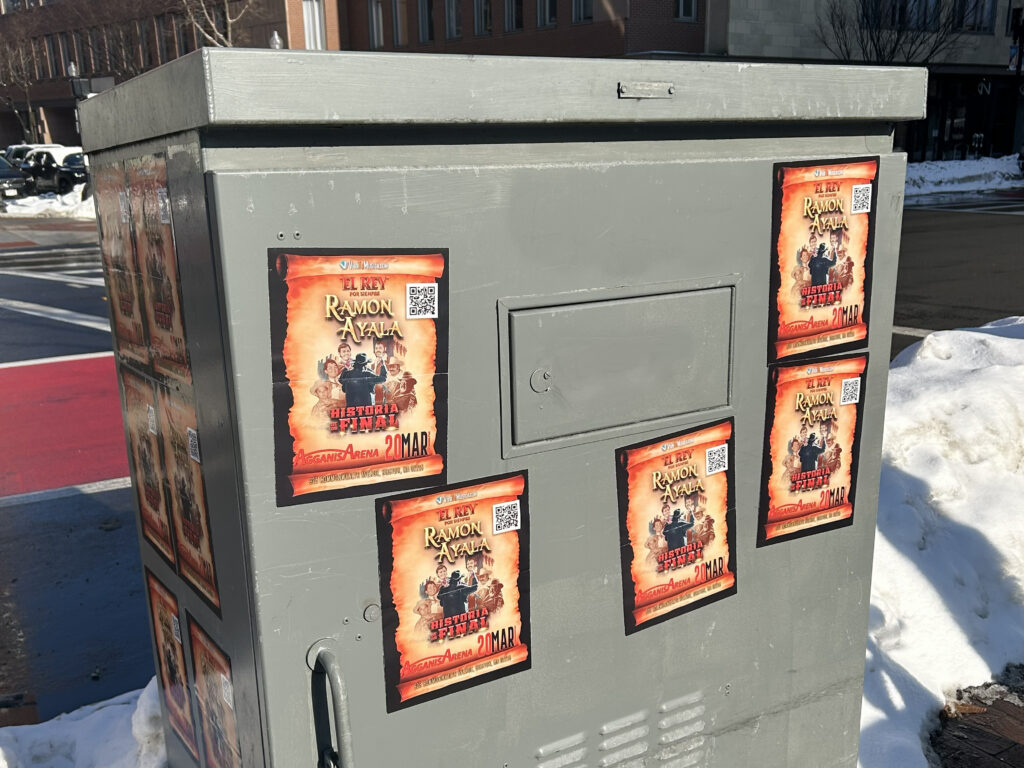
In some regional outdoor advertising vernaculars, “sniping” is used informally to describe unauthorized poster placement — putting up posters on surfaces without the property owner’s permission. This usage is more common in secondary markets and among independent promoters than in the professional brand advertising space. The legal risk is real: unauthorized placement is treated as vandalism in most jurisdictions and creates liability for both the person who places the poster and potentially the brand whose creative appears on it. Reputable agencies — including our team — don’t engage in unauthorized placement regardless of what informal industry terminology might suggest.
Digital Snipe Techniques
In digital out-of-home (DOOH) environments, snipe techniques have been adapted for dynamic content management. Programmatic DOOH platforms allow advertisers to add time-specific, location-specific, or condition-triggered overlay content to existing campaign creative without re-uploading full creative assets. A retail campaign might have a base creative that displays with a price snipe that changes weekly, or a weather-triggered snipe that activates a promotional message when temperature drops below a threshold. This flexibility makes digital snipe capability one of the most compelling features of DOOH inventory for promotional and retail advertisers.
Snipe Advertising Examples Across Campaign Types
Understanding how snipe advertising actually gets used in practice helps marketers evaluate whether the technique is appropriate for their specific campaign objectives.
Retail Promotional Campaigns
Retail chains running ongoing brand awareness campaigns frequently use snipe overlays to convert general awareness creative into promotional response creative without full creative replacement. The base campaign — brand imagery, core message, logo — remains consistent across the run. Snipes carry the specific promotional offer (“20% OFF THROUGH SUNDAY”), the participating location address, and any promotional code required for redemption. This structure allows the retailer to maintain brand consistency while accommodating the high-frequency promotional calendar that retail advertising typically requires.
Real Estate and Development Projects
Development project advertising — condominiums, commercial projects, new retail centers — commonly uses snipe techniques to manage project milestones. A campaign installed during pre-leasing might read “COMING 2026” as the primary message. A snipe overlay added when leasing launches reads “NOW LEASING.” A subsequent snipe reads “FULLY LEASED” or “PHASE 2 NOW AVAILABLE.” The visual identity remains consistent; the snipe carries the updated status. This is particularly efficient for projects with 12–24 month marketing timelines where underlying creative production would be wasteful.
Entertainment and Film Releases
Entertainment campaigns for film, television, and music releases are among the most active users of snipe advertising techniques. A film campaign installed weeks before release with a general date (“COMING SOON” or “THIS SUMMER”) receives a snipe update in the week of release reading “IN THEATERS NOW” or “NOW ON [STREAMING PLATFORM].” This phased approach allows campaigns to build anticipation before release while automatically converting to release-urgency messaging at the appropriate moment.
Concert and Event Promotion
Live event promotion relies heavily on snipe advertising for the urgency messaging that drives ticket sales. A base poster for a concert tour carries the artist, tour name, and general date range. Snipes are added with specific venue dates, presale codes, and urgency messaging (“FEW TICKETS LEFT,” “SOLD OUT — WAITING LIST AVAILABLE”). The combination of visual impact at scale with snipe-delivered urgency is one of the most effective formats in event marketing, particularly for tours with multiple dates in sequential markets.
Snipe Advertising vs. Alternative Street Marketing Formats
Brands considering snipe advertising should evaluate it within the context of alternative formats that may serve similar objectives — especially for campaigns where the underlying goal is street-level urgency or supplemental messaging rather than the specific snipe technique itself.
Full-Replacement Poster Campaigns
For campaigns where the underlying creative needs to change substantially between phases — not just a supplemental message strip — full poster replacement is more appropriate than snipe overlays. A launch campaign and a “now available” campaign may require different visual approaches that snipes can’t accommodate without obscuring the primary creative. Full replacement is also preferable when the snipe’s message is substantial enough to warrant full visual integration rather than overlay treatment.
LED Billboard Trucks for Dynamic Urgency
For brands that need urgency messaging with maximum flexibility — content that might change daily or is tied to dynamic conditions (inventory levels, weather, time-limited offers) — LED billboard trucks with content management systems provide urgency-driving capability that static snipes can’t match. The content on an LED truck can be updated remotely in minutes; a physical snipe requires production and installation time even for the most expedited processes.
Sidewalk Stencils for Event Directionals
When the snipe’s function is directional — pointing pedestrians toward a nearby location, event, or activation — sidewalk stencils in the surrounding blocks can serve the same navigational function at street level without adding to the visual complexity of an existing poster installation. Stencils can be deployed and refreshed more quickly than physical snipes and operate in the pedestrian’s direct line of sight rather than competing with other vertical elements.
Street Teams for Real-Time Messaging Updates
For campaigns where the urgency message needs to be delivered personally — with a human explanation, a sample, or a direct conversion moment — street teams deployed in the campaign zone carry urgency messaging directly in conversation. “This is the last weekend for 30% off” lands differently from a person than from a printed strip on a billboard — particularly for conversion-focused campaigns where consumer questions can be answered and purchase barriers addressed on the spot.
Legal and Compliance Considerations for Snipe Advertising
Snipe advertising’s compliance framework depends on whether the snipe is being applied to owned/licensed inventory or to surfaces the advertiser doesn’t control.
Licensed Inventory Snipes
Snipes applied to billboard and transit inventory under an active media contract are generally permitted within the operator’s creative specifications. Most operators have specific guidelines about snipe dimensions, application methods, and content restrictions. Confirm snipe compatibility with your media operator before creative production begins, as not all display units accommodate physical overlay applications and not all digital operators support overlay content in their CMS.
Owned Installation Updates
For brands running their own poster campaigns on surfaces they’ve licensed from property owners, snipe updates to existing installations fall within the scope of the original agreement provided the snipe doesn’t materially change the character of the installation (e.g., converting a non-commercial artistic installation to a commercial advertisement in a jurisdiction where those are treated differently).
The Unauthorized Placement Line
Any snipe application on surfaces that the advertiser doesn’t own, control, or have explicit permission to access is unauthorized and carries the same legal risk as unauthorized poster placement. This includes applying brand overlays to competitor advertising, government signage, or utility infrastructure. The reputational and legal risk far outweighs any potential campaign benefit. Our guerrilla marketing services operate exclusively within compliant frameworks that protect brand reputation while delivering street-level impact.
Frequently Asked Questions About Snipe Advertising
What is snipe advertising?
Snipe advertising refers to a supplemental strip or overlay added to an existing outdoor advertising unit to provide additional or updated information without replacing the full creative. Snipes typically carry pricing updates, promotional messages, location information, or urgency-driving copy layered over a primary advertisement. In informal usage, “sniping” can also refer to unauthorized street-level poster placement, though this usage varies by region and industry context.
What does a snipe look like in outdoor advertising?
In formal outdoor advertising, a snipe is a printed or digitally displayed banner — typically a horizontal or diagonal strip — overlaid on the primary billboard or poster creative. Common snipe messages include “Now Open,” “Limited Time Offer,” sale pricing, location addresses, phone numbers, or promotional deadlines. Snipes are typically in high-contrast colors like red, yellow, or black to stand out from the primary creative.
Is snipe advertising legal?
In formal outdoor advertising, snipes are legal when applied to inventory the advertiser controls and in compliance with media operator guidelines. Unauthorized snipe placement — adding overlays to advertising on surfaces you don’t own or haven’t licensed — is illegal in most jurisdictions and carries the same legal exposure as unauthorized poster placement or vandalism.
How is snipe advertising used in guerrilla marketing?
In guerrilla marketing contexts, sniping refers to adding supplemental messaging — event dates, QR codes, added copy — to brand-owned street-level poster installations after initial deployment. Some campaigns use snipe techniques to update campaign messaging without replacing entire poster installations, extending the life and relevance of the original campaign at lower cost than full reprints.
What alternatives to snipe advertising work for street-level urgency campaigns?
For time-sensitive street-level campaigns requiring urgency messaging, effective alternatives include full-replacement poster campaigns with countdown messaging, LED billboard trucks with dynamic content that can be updated daily, and sidewalk stencil campaigns that can be refreshed on short timelines. Each offers different cost and flexibility profiles depending on campaign requirements.
Does American Guerrilla Marketing offer snipe advertising services?
We offer comprehensive poster campaign services including supplemental overlay and update capabilities for brand-owned installations. Our campaigns include full poster replacement as well as snipe overlay options for clients running extended campaigns who need to refresh messaging without full reprints. Contact us at (646) 776-2770 or visit our Industry City, Brooklyn office to discuss your requirements.
Frequently Asked Questions
What is what is snipe advertising guide?
American Guerrilla Marketing provides what is snipe advertising guide services across 50+ U.S. markets. Every campaign is planned, scouted, executed, and GPS-documented by our field teams. We work with regional brands and Fortune 500 companies on campaigns that require real street-level execution and documented proof of performance.
How does AGM approach advertising guide?
Our process starts with a market consultation to understand your goals, target audience, and budget. We then scout locations, handle any required permissions or permits, coordinate production and installation with our local crews, and provide a full GPS-tagged photo report after the campaign runs.
What markets does American Guerrilla Marketing cover for advertising guide?
We operate in 50+ U.S. markets including New York, Los Angeles, Chicago, Miami, Houston, Atlanta, Seattle, Denver, Boston, and dozens of secondary markets. Contact us to confirm availability and pricing for your specific market.
How much does a advertising guide campaign cost?
Campaign pricing depends on market, format, quantity, and duration. We work with budgets ranging from targeted single-market runs to national rollouts across multiple cities. Use our RFP Builder or contact us directly for a custom quote based on your specific campaign requirements.
How do I get started with advertising guide through AGM?
The fastest way to get started is to submit your campaign details through our RFP Builder at americanguerrillamarketing.com, or contact us directly at [email protected] or (646) 776-2770. Our team typically responds within one business day with availability and initial pricing.