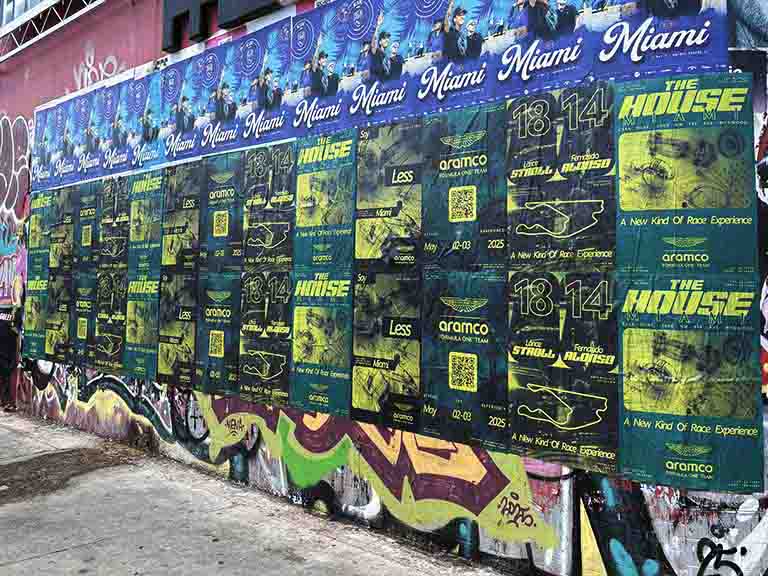
Mastering the art of wheat paste posting for maximum brand impact means understanding the three variables that determine whether a campaign generates genuine street presence or disappears into the visual noise: location selection, design quality, and installation execution. American Guerrilla Marketing has installed over 500,000 wheat paste posters across 50+ US and Canadian cities, from Bedford Avenue in Williamsburg to Melrose Avenue in Los Angeles, and the campaigns that perform best consistently solve all three variables rather than optimizing one while neglecting the others.
This guide covers the full tactical picture: how to scout locations that deliver audience reach and frequency, how to design creative that survives the outdoor environment and actually gets read, the technical adhesive and paper specifications that determine longevity, and the legal framework that separates professional wheat paste campaigns from amateur stunts that create brand liability.
How to Choose Wheat Paste Posting Locations That Deliver Results
Location selection is where most DIY campaigns fail and where most of the value in professional wheat paste posting lives. There is no universal “best wall” in any city, the best location is the one where your specific target audience walks, dwells, and returns repeatedly. Two walls 3 blocks apart in the same neighborhood can deliver dramatically different results based on pedestrian flow, sight lines, and the visual context of surrounding walls.
What AGM Looks for in a Posting Location
After executing campaigns in markets ranging from New York’s Lower East Side and Williamsburg to Chicago’s Wicker Park and LA’s Silver Lake, we’ve developed a consistent site evaluation framework:
- Pedestrian dwell time: Walls adjacent to bus stops, train entrances, crosswalks, outdoor seating, and retail queues produce longer viewer exposure than walls along purely transit routes. A poster next to the L train entrance on Bedford Avenue in Williamsburg gets seen at close range by 10,000+ people per day with an average dwell of 30–60 seconds. That’s a different exposure quality than a wall on a through-street where viewers pass in 2–3 seconds.
- Competitive visual context: A high-quality poster on a wall that already hosts quality street art or other brand posters reads as culturally credible. The same poster on an isolated, uncontextualized surface can look out of place and generate less engagement. We assess the visual neighborhood of each surface before committing it to a campaign.
- Sight line distance: Posters visible from 50+ feet away at the right angle to pedestrian movement generate significantly more total impressions than posters tucked into recesses or placed parallel to foot traffic. We map sight lines for every proposed surface.
- Surface quality: Brick, concrete, and smooth painted surfaces hold paste well and last 3–6 weeks in good weather. Rough or porous surfaces absorb paste unevenly and reduce adhesion. Metal and glass surfaces require different adhesive approaches and are typically not appropriate for wheat posting.
Best Neighborhoods by Market
Based on our campaign history across 50+ cities, these are the highest-performing posting zones for reaching culturally engaged urban consumers:
- New York City: Williamsburg (Bedford Avenue, N 7th to Metropolitan), Lower East Side (Delancey, Orchard, Ludlow), Bushwick (Flushing Avenue, Wyckoff Avenue), DUMBO (Washington Street).
- Los Angeles: Melrose Avenue (Fairfax to La Brea), Silver Lake (Sunset Boulevard), DTLA Arts District (Traction Avenue, 6th Street), Fairfax Avenue.
- Chicago: Wicker Park (Milwaukee Avenue), Pilsen (18th Street), Logan Square (Milwaukee and Armitage corridors), River North.
- Miami: Wynwood (NW 2nd Avenue, NW 24th–26th Streets), Little Havana (Calle Ocho), Brickell.
- Austin: East 6th Street, South Congress, Red River Cultural District.
How to Design Wheat Paste Posters That Actually Work
Outdoor poster design has different requirements than digital or print design. The most common failure is designing at desk scale and assuming it will scale. Posters that look clean and balanced on a monitor often lose all legibility at street level under varying lighting conditions, viewing angles, and weather exposure.
The Four Design Principles That Drive Wheat Paste Performance
1. One dominant visual element. A great wheat paste poster leads with one image or one graphic that commands attention from 30+ feet away. Complexity kills legibility. We’ve run A/B tests across multiple campaigns that consistently show single-dominant-element designs outperform multi-element compositions in spontaneous recall.
2. Maximum contrast. The outdoor environment includes variable sunlight, shadows, rain, and competing visual noise. Your poster must be readable in all of these conditions. Black on white, white on black, and brand-color-on-contrasting-background are the most reliable contrast combinations for outdoor longevity. Pastels and low-contrast gradients disappear under direct sunlight or overcast glare.
3. Minimum viable text. We recommend no more than 7 words of body text on a wheat paste poster, with headline text large enough to read from 15 feet. If your message requires more words than that to function, the message needs to be simplified, not the font size reduced. A headline, a URL or QR code, and a brand logo is typically the complete set of necessary text elements.
4. Size matters. The minimum effective size for a single-sheet wheat paste poster is 24″×36″. Larger is almost always better, our most memorable campaigns use stacked formats (two or three sheets vertically) that create a poster presence 4–6 feet tall, visible from a full block away. We print on 100 lb. gloss coated stock at 300 DPI CMYK for maximum color fidelity and weather resistance.
Adhesive and Installation: The Technical Variables That Determine Longevity
A poster installed correctly in good conditions lasts 3–6 weeks. A poster installed with the wrong paste, on an improperly prepared surface, or in cold weather without modified adhesive lasts 24–72 hours. The technical execution of the installation is where professional operators earn their fee, and where DIY attempts consistently fail.
Paste Specifications AGM Uses
We use commercial-grade wallpaper paste mixed to a consistency that allows full penetration of the poster paper without oversaturation. For warm weather (above 10°C): standard methylcellulose paste, mixed 24 hours before application for full hydration. For cold weather (0°C to -15°C): modified cold-weather formula with extended open time and accelerated cure rate. Below -15°C, installation is not recommended, the paste will not achieve adequate bond strength before freezing.
Surface preparation is non-negotiable. We clean and dry every surface before paste application, removing dust, grease, and loose material that would prevent adhesion. The paste goes on the surface first, then the poster, then a final coat of paste over the poster face to seal it. This three-layer application is the standard for campaigns that last. Operators who skip the surface prep or the top coat see dramatically shorter lifespans.
Installation Crew and Timeline
A standard AGM wheat posting crew consists of two people, one to apply paste and position the poster, one to smooth and seal. A two-person crew installs 50–80 posters per 8-hour day depending on surface type, poster size, and neighborhood density. For a 150-piece campaign across 6–8 locations in a compact market like Halifax or Williamsburg, we plan for a full installation day plus a 48-hour check to address any pieces that need re-application.
Tracking Your Wheat Paste Campaign
Wheat paste posting is often dismissed as unmeasurable. In our experience, this is a failure of campaign design rather than an inherent limitation of the format. We build trackable elements into every campaign:
- Campaign-specific QR codes that track scans by date and time, showing when and where the campaign generates digital engagement
- Custom landing pages with campaign-specific UTM parameters that attribute web traffic to the posting campaign
- Promo codes displayed on the poster that are redeemed at checkout, creating a clear conversion attribution
- GPS-tagged installation photos provided at campaign completion, every piece documented with location and timestamp
These elements don’t replace the inherent value of impressions, but they create a defensible record of the campaign’s reach and its downstream digital impact. Clients who use trackable elements consistently see clearer attribution and stronger case for repeat investment.
Legal Framework: Permitted vs. Unpermitted Posting
The wheat paste industry operates across a spectrum from fully permitted commercial campaigns to unpermitted street-art posting. AGM operates exclusively on the permitted end of that spectrum for client campaigns. Unpermitted posting on public surfaces creates legal liability, brand reputation risk, and campaign fragility, a campaign taken down in 24 hours by city workers delivers zero frequency, regardless of how well it was designed and installed.
Permitted surfaces include: private property with owner permission (typically documented through our established network of property managers in each market), designated public art surfaces in cities that have created them, and construction hoardings with property owner authorization. In some markets, AGM has exclusive arrangements with property owners on specific high-traffic surfaces, those surfaces are available to clients at premium positioning.
Contact us at americanguerrillamarketing.com/contact to discuss your campaign objectives, target market, and timeline. We’ll build a posting plan that covers the right surfaces in the right neighborhoods for your audience.
Frequently Asked Questions
Unleash Your Brand: Master the Art of Posting for Maximum Impact generates better results when placement, timing, creative, and local execution all work together. These questions cover the details brands usually need before launch, during rollout, and while evaluating performance.
For ar, the strongest campaigns usually come from tight geographic targeting, message discipline, and enough repetition to be remembered. Market conditions, neighborhood flow, event calendars, commuter behavior, and production logistics all change how the tactic performs, so the planning details matter as much as the idea.
How long do wheat paste posters last?
Properly installed wheat paste posters on suitable surfaces last 3–6 weeks in warm, dry weather. Cold weather, rain, and high-humidity conditions reduce longevity. AGM’s installation process, surface prep, three-layer paste application, and quality paper stock, consistently achieves the maximum lifespan for conditions in the target market.
What paper stock does AGM use for wheat paste posters?
We print on 100 lb. gloss coated stock at 300 DPI CMYK. This weight provides adequate rigidity for handling during installation, absorbs paste without tearing, and produces colors that remain vibrant after weathering. Lighter stock tears during installation and doesn’t hold up in rain.
How many posters does a typical campaign require?
Campaign size depends on the market, target neighborhood density, and desired reach and frequency. A focused single-neighborhood campaign might use 50–80 pieces. A complete multi-neighborhood campaign in a major market typically runs 150–400 pieces. We recommend volume based on your audience geography and campaign goals.
What is the minimum campaign size AGM runs?
Contact AGM at americanguerrillamarketing.com/contact for current minimums by market. Volume, market, and campaign complexity all affect pricing and minimums.
Can AGM handle campaigns in multiple cities simultaneously?
Yes. We’ve executed simultaneous wheat posting campaigns in 10+ markets through our national crew network. Multi-market campaigns are coordinated from a single account manager and delivered with unified GPS-tagged photo documentation across all markets.
How do I measure the effectiveness of a wheat paste campaign?
We build trackable elements into every campaign: campaign-specific QR codes, custom landing pages with UTM tracking, promo codes, and GPS-tagged installation documentation. These elements provide direct attribution data that connects street-level exposure to digital and conversion outcomes. Unleash Your Brand: Master the Art of Posting for Maximum Impact becomes much stronger when the article moves past surface level advice and into route logic, timing, crew decisions, and what buyers should expect before launch. That is where most campaigns win or lose. Good ideas are common. Clean execution in the right place at the right time is not. In practice, the first move is narrowing the audience into a physical map. That means identifying the streets, retail corridors, campus edges, transit entrances, event approaches, or nightlife clusters where attention piles up. Once that map is clear, the next step is deciding which format fits the movement pattern. Posters work best where people have a second to read. Snipes work when repetition matters. Stencils and decals are strongest where pedestrians slow down, wait, or make a decision about where to go next. Teams that skip that planning step usually spend money on visibility without building enough repetition to create recall. Teams that plan carefully can get more from the same budget because they are buying concentration, not just volume. That is the real difference between activity and impact. Every market has its own map of useful surfaces and high value foot traffic. In downtown cores, the best routes are usually the blocks between transit stops and the place people are actually trying to reach. Around campuses, it is the edge streets, dorm approaches, coffee runs, late night food corridors, and the walk between parking and class. Around events, it is the window from arrival through line formation, then the exit path where people are still talking about what they just saw. That is why local detail matters so much. A good plan names corners, not just cities. It names venue approaches, not just districts. It defines morning traffic, lunch traffic, post game traffic, and late night traffic as separate moments because they behave differently. When brands treat all movement as one audience, the campaign gets blunt. When they map those flows correctly, the same media spend starts to feel much larger. AGM usually builds this out with a route first, then layers creative on top of it. That order protects the campaign from a common mistake: falling in love with the visual before making sure the audience can actually encounter it often enough to remember it. When a page like this feels light, the missing pieces are almost always the same. Add named locations, examples of which formats fit those locations, the quantity needed to make the campaign visible, and the operational limits that buyers should know before launch. Add a realistic budget section. Add a stronger FAQ that answers the practical objections a client will raise on the phone. Those additions do not pad the page. They make it useful. That is also where trust is built. Readers can tell when a page only gestures at a topic. They can also tell when the writer understands the field side of the job. Specifics about route density, production timing, weather risk, crew count, proof photos, QR tracking, and refresh windows make the content stronger because they come from real execution questions. If a brand is using this topic to compare partners, those specifics matter even more. They make it easier to judge whether a vendor is selling a real plan or just a good sounding idea. Pricing depends on format, timing, print specs, route length, and how many placements a campaign needs to make a real impression. For street level media, brands usually do better when they fund enough placements to own a specific route instead of buying a thin layer across too much ground. A small run can look busy in a deck and still disappear on the street. AGM uses fixed pricing for several core services. 24×36 wheatpaste posters are $4,500 for 100 posters and $5,500 for 200 posters. 48×72 wheatpaste posters are $10,500 for 100 posters and $13,500 for 200 posters. Standard 9×12 snipes are $4,500 for 400 or $5,500 for 800. 11×14 jumbo snipes are $6,500 for 400 or $7,500 for 800. Sidewalk stencils are $2,855 for 5, $3,231 for 10, $3,989 for 20, $6,982 for 50, and $11,999 for 100. Sidewalk decals are $2,904 for 5, $3,404 for 10, $4,998 for 20, $8,709 for 50, and $14,466 for 100. LED trucks are $250 to $300 per hour with an 8 hour minimum. If the project needs a custom mix, AGM usually points brands to the RFP Builder so scope, city count, and production details line up before pricing is locked. That matters because the wrong quantity is often more expensive than the right format. A cheap campaign that is too small to be seen is not efficient. It is just forgettable.
How do I know if this topic is worth turning into a real campaign?
Start with audience location, not creative ideas. If you can name the blocks, venues, campus gates, stations, or event windows where attention is concentrated, the campaign can usually be built into something measurable. If the audience is vague, the spend drifts and results get fuzzy fast.
What usually makes a street campaign feel too small?
The most common issue is spread. Brands buy a handful of placements across too many neighborhoods instead of owning one route. A tighter footprint with stronger repetition beats a scattered footprint almost every time, especially for event promotion, launches, and local service awareness.
Should the message focus on awareness or action?
That depends on the traffic environment. Fast moving traffic calls for a short awareness message with one visual anchor. Slow pedestrian traffic can support a QR code, a stronger offer, and more direct response copy. The format should match the pace of the audience, not the other way around.
How long should a campaign stay up?
For event driven pushes, the best window is often the 7 to 14 days before the date. For evergreen brand building, two to four weeks works better because repetition does the heavy lifting. Weather, removals, and local conditions still matter, so timing should always be part of the plan.
Related Pages and Articles