July 15, 2026
Paseo de la Reforma is Mexico City’s spine. For 14 kilometers it cuts a diagonal line through the urban fabric from the forests of Bosque de Chapultepec to the northern edge of Centro Histórico, passing through the financial district, the luxury hotel corridor, and the neighborhoods that collectively define what Mexico City presents to the world. It was designed in the 1860s under Emperor Maximilian I with the explicit ambition of matching the Champs-Élysées in Paris, and by most measures it succeeded. The avenue is wide, formally structured around a series of circular monument roundabouts, and lined on both sides with the kind of large-format architecture that gives it a monumentality unlike anything else in the city.
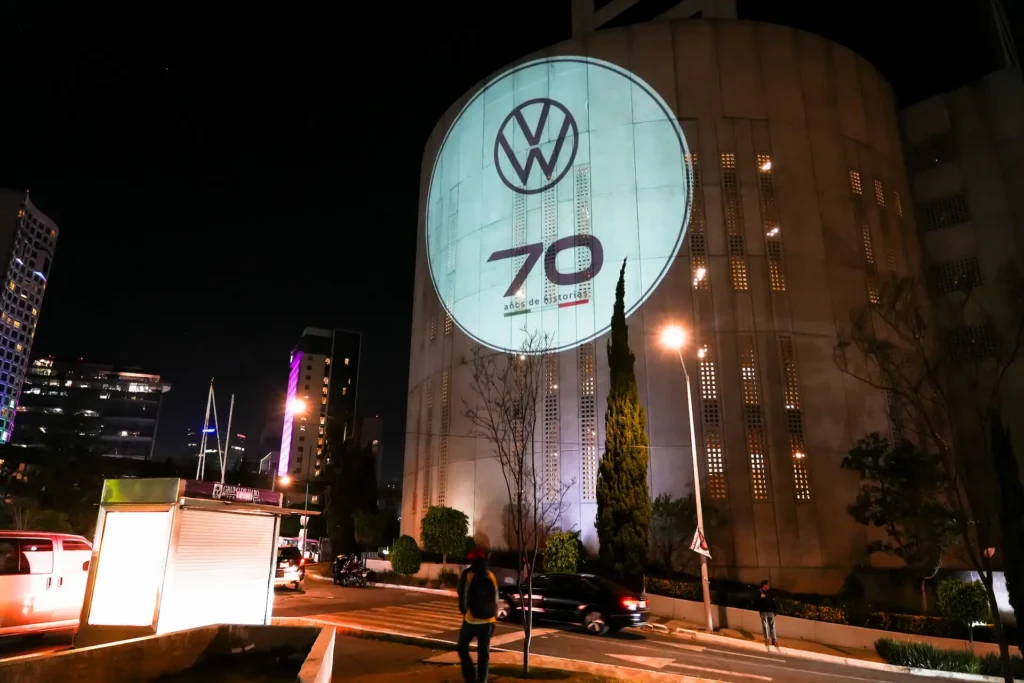
For guerrilla projection campaigns, Reforma is not one location — it is several. The corridor shifts character significantly from west to east: pastoral and institutional near Chapultepec, corporate and financial in the tower district from Río Tiber to Cuauhtémoc, entertainment-adjacent near Glorieta de Insurgentes and Zona Rosa, and then transitional as it flows toward Centro. Our team at American Guerrilla Marketing treats these segments as distinct campaign environments, each with its own audience, its own optimal surfaces, and its own temporal rhythm.
This post covers how guerrilla projections work along the Reforma corridor — the physical environment, the monument locations, the tower facades, the Sunday cyclist phenomenon, and the specific campaign types that land hardest in each segment of the boulevard.
Before getting into specific locations, it is worth establishing what Reforma’s scale actually means for a projection operator. The main avenue runs four to six lanes in each direction, with a central median that historically housed a tree-lined pedestrian path and currently carries the Metrobus Line 7. On either side of the main lanes, lateral service roads provide access to buildings and create additional audience positions at a lower speed and density than the main flow.
This double-avenue structure — main lanes flanked by lateral roads — is one of Reforma’s most operationally valuable features for projection work. An audience member driving the main lanes at speed has limited time to register a projected image. An audience member on the lateral road, stopped at a light, waiting for a valet, or walking from a parked car to a building entrance, has substantially more. Our team consistently finds that the lateral road audience produces better projection engagement than the main lane passing traffic, and we position accordingly — using surfaces that face the lateral roads rather than trying to reach the high-speed central flow.
Reforma’s defining visual rhythm comes from its monument roundabouts, spaced along the boulevard at irregular intervals. These glorietas function as orientation points for the entire avenue, and they concentrate foot traffic in ways that the straight boulevard sections do not. Three of them are particularly significant for projection campaigns.
The Ángel de la Independencia — the golden winged figure atop a 36-meter column at the intersection of Reforma and Río Tiber — is one of Mexico City’s most photographed and most symbolically loaded landmarks. The roundabout is a natural gathering point for social events, sports celebrations, and informal assemblies. When a major Mexican football club wins a championship, fans gather at the Angel. When political events reach a peak, the Angel is where the city expresses itself publicly. This cultural centrality makes the roundabout one of the highest-visibility locations in all of Mexico City at certain moments — but also a highly attentive pedestrian location even on ordinary evenings, when tourists and residents pause at the base of the column to photograph it and orient themselves on the boulevard.
The surrounding buildings at the Angel roundabout are predominantly large-format commercial and office structures. The building at the corner of Reforma and Río Tiber — the former Hotel Nikko site, now the Camino Real Polanco area — provides a large facade facing the roundabout. The building stock on all four quadrants of the intersection offers usable projection surfaces, and the concentration of pedestrian traffic on the roundabout island itself (which visitors access via a pedestrian underpass) creates a captive audience position.
The Cuauhtémoc monument, a few blocks west of the Angel toward Chapultepec, depicts the last Aztec emperor on a tall pedestal at the center of its own roundabout. The monument is important historically and visually, but it functions differently from the Angel as a social gathering point — it is more of a passing landmark than a destination. The projection value here comes less from the monument itself and more from the surrounding building facades, which at this section of Reforma include some of the corridor’s older mid-century commercial structures with solid walls that project well.
The Diana Cazadora — the bronze archer goddess at the intersection near Calle Lieja — sits in a smaller roundabout but one surrounded by some of the highest-traffic hotel and commercial addresses on the entire boulevard. The St. Regis Mexico City, the Hotel Marquis Reforma, and several other luxury properties cluster within a few hundred meters of this monument. The pedestrian traffic at this particular roundabout is disproportionately affluent — hotel guests, business travelers, and the restaurant and rooftop bar crowd from the adjacent properties. This is the highest-income audience concentration on Reforma, and projections positioned at this intersection reach that demographic with unusual directness.
Between Chapultepec and the Zona Rosa intersection, Reforma passes through one of the most architecturally dramatic stretches of any Latin American city. The tower corridor that has developed here over the past three decades concentrates some of the region’s most significant high-rise buildings along a relatively compact stretch of boulevard.
Torre Mayor, at 225 meters, held the title of Latin America’s tallest building for years after its completion in 2003. The tower’s distinctive curved glass facade is a Mexico City landmark, but glass curtain wall construction is challenging for projection precisely because glass absorbs and reflects rather than holds a projected image. Where Tower Mayor provides the most value for projection campaigns is at its podium level — the first several stories of the building where solid concrete and stone materials give way to the glass tower above. Podium-level surfaces on large commercial towers generally offer the most practical projection canvases in the financial district, and Torre Mayor’s podium faces directly onto the main Reforma lanes.
Torre BBVA Bancomer, completed in 2016 at the corner of Reforma and Arquímedes, is one of the more projection-friendly tower bases in the corridor because its design incorporates a broader podium setback from the street, creating a visual relationship between the building base and the boulevard that gives more physical distance for projection sightlines. The tower also anchors a major pedestrian corner that concentrates foot traffic from the Polanco and Reforma junction.
Torre Reforma, standing 246 meters at the corner of Reforma and Juárez, is the current tallest building on the boulevard and one of the tallest in Latin America. Its triangular glass-and-concrete design is architecturally distinctive, and its location near the eastern end of the financial district puts it in a transitional zone between the corporate tower cluster and the entertainment and hotel uses further east. The building’s concrete sides — two of its three facades are primarily solid construction — are some of the more usable projection surfaces in the immediate area.
Working in the Reforma tower corridor is operationally different from working in Coyoacan or Roma Norte, and a significant part of that difference comes from what our team calls the canyon effect. When buildings of 20, 30, or 40 stories line a boulevard, they create a channel that affects how projection beams behave, how ambient light distributes itself, and how audiences orient visually within the space.
The practical implication is that projection visibility in the canyon is more complex than in an open-plaza or low-rise street environment. Light pollution from the towers themselves — their illuminated upper floors, lit lobbies, and facade lighting — raises the ambient light level significantly compared to residential areas. This requires projectors with higher lumen output to achieve comparable image brightness and clarity. Our team uses high-powered projectors in the Reforma tower corridor as a baseline, whereas in Coyoacan or Narvarte, mid-range equipment is often sufficient.
The canyon also channels audience sightlines. People on a boulevard flanked by tall towers tend to look ahead or down, not up. This makes low-to-mid level projections on building bases and podium facades more effective than attempts to project high on a tower facade where the image is above comfortable sightline. Our placement strategy in the tower corridor consistently targets surfaces between ground level and approximately 10 to 15 meters — the range where a pedestrian or stopped vehicle occupant naturally looks without straining upward.
The Reforma tower corridor requires different equipment and placement logic than any other Mexico City projection environment. High ambient light from the buildings themselves, canyon sightline effects, and the mix of automotive and pedestrian audiences at varying distances all shape how we plan and execute campaigns here — and why experience in this specific environment matters.
Reforma’s luxury hotel concentration is one of its defining features as a campaign environment. The St. Regis Mexico City, JW Marriott Mexico City, Hotel Presidente InterContinental, Four Seasons Hotel Mexico City, and Camino Real Polanco all sit along or immediately adjacent to the boulevard in the stretch between Chapultepec and the Zona Rosa. This cluster of five-star properties generates a daily flow of international business travelers, high-net-worth tourists, and the local affluent population that uses their restaurants, spas, and event spaces.
The hotel strip audience is qualitatively different from most guerrilla projection audiences. These are not people stumbling upon a projection in their own neighborhood — they are visitors to a specific part of the city who are already oriented toward the kind of premium experience that the boulevard presents. This makes the strip particularly effective for luxury brand campaigns: watches, spirits, premium automotive, fashion, and financial services all find a receptive audience here simply because the demographic sorting has already happened through the choice of hotel.
Projection positions facing hotel entrance driveways, the approach walks to hotel lobbies, and the restaurant patios that several of these properties operate at street level are among the most precisely targeted spots on the entire corridor. An audience waiting for a car at a valet stand or walking from a taxi into a hotel lobby is stationary for 30 to 90 seconds — more than enough time to register and engage with a projection message.
American Guerrilla Marketing plans and executes guerrilla projection campaigns in Mexico City and across Latin America through our operator network.
Every Sunday morning from approximately 8am to 2pm, Mexico City’s Secretaría de Movilidad closes Reforma’s main lanes to automobile traffic under the Muevete en Bici program. The central lanes are given over entirely to cyclists, in-line skaters, runners, and pedestrians. The transformation is dramatic. In a matter of minutes, one of the continent’s busiest automotive corridors becomes something more like a park: families pedaling slowly, competitive cyclists training, fitness groups running in formation, vendors setting up at intervals along the route, children learning to ride without training wheels.
Participation in the Sunday Muevete en Bici program is consistently large. City-reported figures put regular Sunday attendance at 60,000 to 80,000 people across the full Reforma route, making it one of the highest-attendance weekly public events in the entire metropolitan area. This is not a niche cycling event — it is a mainstream weekly recreation opportunity that draws from across the city’s income spectrum, with participants arriving by Metro, bus, and private car to access the route.
For projection campaigns, Sunday morning Reforma is a categorically different environment from any other projection window on the boulevard. The audience moves slowly. They are physically present in the main lanes rather than the lateral roads. They are in a leisure state rather than a transit state. And they are using mobile devices heavily — people on the Sunday ride photograph everything, creating high organic social amplification potential for a projection that appears along the route.
Running projection campaigns during Muevete en Bici requires daytime-capable equipment: projectors with lumen output sufficient to produce a visible image in full daylight are significantly more expensive and require different positioning than nighttime equipment. Our team uses specialized high-lumen units for Sunday daytime campaigns, and we have tested enough positions along the Reforma corridor to know exactly where daytime projections hold visibility and where they do not.
The western terminus of Reforma’s most active section is the entrance to Bosque de Chapultepec and the visible mass of Chapultepec Castle rising on its hill above the park. The castle — originally built as a military academy and later used as the official residence of Emperor Maximilian — is visible from long distances down Reforma and functions as a visual anchor for the western end of the boulevard. The Museo Nacional de Antropología, one of Mexico’s most visited museums, sits inside the first section of Chapultepec Park just off Reforma, drawing over two million visitors annually.
The park entrance zone at the intersection of Reforma and the Chapultepec roundabout is one of the most diverse audience concentration points on the boulevard. Museum visitors, park-goers, couples walking toward the wooded interior of the park, joggers, and vendors all converge here. The nearby Auditorio Nacional — Mexico’s premier concert and performance venue — generates its own audience surges on event nights, when the streets around the auditorium fill with concertgoers arriving and departing. Our team frequently pairs Reforma corridor projections with Auditorio Nacional event timing, targeting the concentrated audience of music fans and entertainment seekers on show nights.
| Corridor Segment | Primary Audience | Best Surfaces | Optimal Window |
|---|---|---|---|
| Chapultepec Entrance to Diana Cazadora | Museum visitors, park-goers, hotel guests | Building podiums, cultural institution walls | Weekends 4pm-midnight; Auditorio event nights |
| Diana Cazadora to Angel (Hotel Strip) | Luxury hotel guests, business travelers, affluent diners | Hotel base facades, lateral road-facing walls | Weekday evenings 7pm-midnight; weekends all evening |
| Angel to Cuauhtemoc (Financial Core) | Corporate workers, financial sector professionals | Tower podiums, mid-century commercial facades | Weekday evenings 6pm-10pm |
| Cuauhtemoc to Glorieta Insurgentes (Zona Rosa Transition) | Mixed: office workers, Zona Rosa nightlife audience | Mixed construction facades, commercial buildings | Weekday 6pm-9pm; weekend nights 9pm-1am |
| Full Route, Sundays 8am-2pm | Cyclists, families, runners, all demographics | Any boulevard-facing surfaces with clear sightlines | Sunday 9am-noon (peak volume) |
At the eastern end of the primary Reforma financial and hotel district, the boulevard intersects with Avenida Insurgentes at the Glorieta de Insurgentes, which marks the boundary between the Reforma corporate corridor and the Zona Rosa entertainment district. This transition point is critical for evening campaigns: the corporate office audience of the afternoon gives way to the restaurant and nightlife crowd of the night, and the foot traffic pattern on the lateral roads shifts from purposeful pedestrians heading to parking garages to a slower, more exploratory crowd navigating to bars, restaurants, and clubs.
Our team frequently runs Reforma campaigns that begin targeting the end-of-workday corporate audience and then pivot to the nightlife audience as the evening progresses. Projection timing that starts at 6pm and runs to midnight can cover both windows with a single equipment setup by targeting a surface that is visible from the lateral road at the Reforma-Zona Rosa junction, where both audience types pass in significant numbers.
The financial district segment of Reforma undergoes one of the most dramatic daily audience shifts of any Mexico City location. Between 9am and 6pm, the towers and their surrounding streets carry tens of thousands of financial sector workers: bankers, lawyers, consultants, executives, and the service workers who support them. The lateral roads are busy with valets, delivery vehicles, and lunchtime pedestrian flows. This is a dense, affluent, professionally oriented audience that is primarily in transit — moving between towers, restaurants, and parking structures — rather than lingering.
After 6pm, the evacuation of office workers is rapid. The tower lobbies empty within an hour or two of business closing, the lunch restaurants transition to dinner mode, and the pedestrian traffic on the lateral roads drops sharply before picking back up from the hotel dinner-and-entertainment crowd around 8pm. The window between 6pm and 8pm is a transition gap that our team generally treats as a setup window rather than a peak projection window in the financial district specifically — though the hotel strip farther west remains productive throughout.
Financial services, premium automotive, and technology sector campaigns are natural fits for the financial district segment, where the office tower audience skews heavily toward the exact demographics these categories target. A projection campaign for a new banking app or an investment platform that runs on the lateral road-facing facades of the tower corridor at 7pm on weekday evenings can reach tens of thousands of financial sector professionals over a week-long campaign — at a fraction of the cost of a sustained digital campaign with equivalent reach.
Luxury consumer goods — spirits, watches, fashion, high-end hospitality — are best served by the hotel strip segment centered around the Diana Cazadora roundabout, where the audience demographic already aligns with premium positioning. A projection campaign for a premium tequila brand on the facades near the St. Regis and Four Seasons entrances speaks to an audience that is already self-sorted toward luxury consumption.
Entertainment and event campaigns — concert tours, film premieres, sporting events, nightlife — perform strongest in the Sunday Muevete en Bici window and in the evening transition zone near Glorieta de Insurgentes, where the recreational and nightlife audience is densest. A film premiere announcement projected on a Sunday morning along Reforma reaches the most diverse and photographically active version of the city’s population.
Reforma is the only location in Mexico City where a single projection campaign can reach corporate executives, luxury hotel guests, international tourists, and 60,000 Sunday cyclists on the same boulevard. The canyon effect created by the high-rise tower corridor channels projection beams with unusual efficiency, and the sheer scale of the avenue — 14 kilometers, multiple lanes, central monument roundabouts — gives campaign planners more surface and audience options than any other single Mexico City thoroughfare.
Every Sunday morning from approximately 8am to 2pm, Reforma closes its main lanes to cars and opens them exclusively to cyclists, runners, and pedestrians under the city’s Muevete en Bici program. Participation regularly exceeds 60,000 people on a single Sunday. This creates a projection opportunity that differs significantly from weekday conditions: audiences move at slower speeds (cycling pace vs. automotive), are spread across the entire boulevard width, and are in a recreational mindset rather than a commuting one. Our team has developed specific equipment setups and projection positions for Sunday Reforma campaigns that differ from our nighttime corporate-audience approaches.
The most effective projection surfaces on Reforma are the lower sections of towers where glass curtain walls transition to solid base structures, the concrete podium levels of buildings like Torre Mayor and Torre BBVA, and any buildings in the corridor that feature stone or concrete cladding rather than pure glass. Torre Mayor’s distinctive rounded glass facade is visually iconic but technically challenging for projection — we more commonly use the lower podium and adjacent structures. The older buildings in the corridor, including some mid-20th century commercial structures, offer better projection surfaces precisely because of their more traditional construction.
Nighttime campaigns targeting the corporate and luxury hotel audience run best from 8pm to midnight on weekdays, when the after-work and dinner crowd populates the Zona Rosa and hotel bars adjacent to the boulevard. Sunday morning Muevete en Bici campaigns operate in a completely different window — 8am to noon — and require daytime-capable high-lumen projectors rather than the standard nighttime equipment. Weekend nights from 9pm to 1am also catch the Zona Rosa nightlife flow and tourists from the luxury hotel strip.
The roundabouts at the Angel de la Independencia and the Cuauhtemoc and Diana Cazadora monuments are among the highest-visibility locations on the entire Reforma corridor. The circular traffic island design creates a natural gathering point where pedestrians pause and orient themselves. Our team has experience positioning projections that use the surrounding building facades at these roundabout locations to reach the concentrated audience that clusters at these iconic spots — particularly the Angel roundabout, which is a major meeting point for sporting celebrations, protests, and social gatherings.
Millie Phillips
Campaign Architect — American Guerrilla Marketing
Email: [email protected]
Office: (646) 776-2770
Ready to Run Your Campaign?
Call us or email us. We’ll tell you exactly what we can do in your market and what it costs.
American Guerrilla Marketing — Los Angeles
Street-level campaigns in Los Angeles and nationwide. Wheatpasting, LED trucks, street teams, and more.
(646) 776-2770
July 15, 2026
July 15, 2026
July 15, 2026
July 15, 2026
July 15, 2026