Avenida Presidente Masaryk on a Saturday afternoon is one of the most instructive streets in Latin America for understanding what premium brand communication looks like at scale. The avenue is wide, tree-lined, and impeccably maintained. The storefronts running between Oscar Wilde and Molière represent the most complete concentration of luxury retail in Mexico: Hermès, Louis Vuitton, Prada, Cartier, Porsche, and dozens of others competing for the attention of a consumer population that has the genuine financial capacity to shop any of them. This is Mexico City’s Rodeo Drive, its Via Montenapoleone, its equivalent of the most commercially prestigious retail addresses in the world. When a guerrilla projection campaign runs on the buildings flanking Masaryk, it is not just reaching people who might buy something. It is reaching the highest-income consumer population in Mexico in their natural commercial habitat.
Polanco sits in the Miguel Hidalgo municipality of Mexico City’s Federal District, bound by Avenida Ejército Nacional to the north, Paseo de la Reforma to the south, Lago Zurich to the west, and the arroyo of Av. Mariano Escobedo to the east. The colonia’s street grid departs from Mexico City’s standard orientation and runs on a northwest-southeast diagonal, with major arteries including Masaryk, Avenida Horacio, Avenida Homero, and Avenida Alejandro Dumas running parallel to each other in the diagonal pattern. Cross streets carry literary names, Oscar Wilde, Julio Verne, Hegel, Arquímedes, that reflect the colonia’s ambitions at its founding in the 1930s as a sophisticated upper-class residential district.
This guide covers Polanco as a projection market in the detail that luxury campaign planners require: the specific streets and buildings, the projector geometry that Polanco’s wider streets and taller buildings demand, the audience profile that makes this the right neighborhood for certain brand categories, and how the adjacent Nuevo Polanco zone, with the Museo Soumaya and Museo Jumex, adds a design-forward audience dimension to the campaign geography.
The Physical Geography of Polanco
Understanding Polanco’s physical structure is the first step in understanding how projection campaigns work here. The colonia is meaningfully different from Roma Norte and Condesa in scale, street width, and building height, and those differences drive every equipment and strategic decision in the planning process.
Street Width and the Masaryk Model
Masaryk, at approximately 35 meters from building face to building face including the center median, is a significantly wider street than any of the primary commercial streets in Roma Norte or Condesa. This width has a direct impact on projection geometry. A projector placed on one side of Masaryk, aimed at the facade on the opposite side, is working at a throw distance of 30-35 meters before any additional setback from the projector position. At that distance, maintaining image brightness requires a higher-lumen output than the 20,000-lumen rigs that handle the narrower streets of Roma Norte comfortably.
The width also means that the ambient light competition is different. Masaryk is a well-lit street with high-quality street lamps, retail window illumination, and vehicle headlights creating a baseline light level that is higher than in the more residential side streets of Condesa. This higher ambient light level increases the minimum projector output needed to produce a projection with competitive image brightness. Our standard Polanco setup uses projectors in the 30,000-40,000 lumen range for Masaryk deployments, compared to the 20,000-25,000 lumen units that handle most Roma Norte and Condesa work.
Building Height and Facade Scale
Polanco’s buildings are taller than those in the colonias to the south. While Condesa tops out at 8-14 stories for residential construction and Roma Norte’s industrial and apartment buildings rarely exceed 12 stories, Polanco has significant concentrations of residential and commercial towers in the 15-30 story range. The luxury residential towers on Avenida Oscar Wilde, the hotel towers on Campos Elíseos, and the commercial high-rises on the Reforma frontage all offer facade surfaces at a vertical scale that is simply not available in the Art Deco colonias.
The taller buildings also change the visual grammar of the streetscape. In Condesa, buildings are low enough that the entire facade is visible from street level in a normal downward visual field. In Polanco, the upper floors of tall buildings often disappear above the practical visual attention range of a street-level pedestrian. For projection campaigns, this means that image placement on tall Polanco buildings needs to concentrate the content in the lower and middle registers of the facade, below the point where pedestrian eyes naturally stop tracking upward.
Polanco is consistently ranked among Mexico’s top three most expensive residential real estate markets, with luxury apartment prices per square meter that rival Lomas de Chapultepec for the title of Mexico City’s highest-value residential address. The colonia is home to a significant percentage of Mexico’s Forbes 400-level wealth.
Key Locations for Projection Campaigns in Polanco
Polanco has several distinct zones within the colonia that serve different campaign purposes. Understanding the differences between these zones is essential for matching your campaign geography to your objectives.
Avenida Presidente Masaryk: The Luxury Retail Corridor
The Masaryk corridor between Oscar Wilde and Molière is the most commercially prestigious stretch of street in Mexico. The luxury retail flagships that line both sides of this block represent the highest density of premium brand physical presence in the country. Hermes at Masaryk 426, Louis Vuitton, Gucci, Chanel, Cartier, Patek Philippe, Ferrari — the roster reads like the exhibitor list at an international luxury goods fair. On weekend afternoons, the street fills with the kind of shopper who has come specifically to be in that environment: high-income consumers, their families, and a significant international visitor component of luxury tourists staying in the Polanco hotel cluster.
For projection campaigns on Masaryk, the key strategic insight is that the audience is already in a luxury purchase mindset. They are on this street because they chose to be on this street. This is not an audience that stumbled into a commercial environment while going somewhere else. They are present with intent and attention focused on premium brand communication. A projection campaign on Masaryk that executes with the production quality and visual refinement that matches the surrounding brand environment will land with an audience that is already receptive to the category message.
The most effective projection surfaces on Masaryk are the upper floors of the mixed-use buildings above the retail flagships — the hotel facades, residential towers, and office buildings that occupy the upper stories above the retail level. The ground-level boutique facades are typically entirely occupied by the retail tenant’s own signage and window display, which makes them unavailable as neutral projection surfaces. But the floors above the retail level, particularly on buildings with smooth stone or concrete cladding, offer strong large-scale projection surfaces that are visible from the Masaryk sidewalk and from the center median.
Avenida Horacio and Avenida Homero
One block north of Masaryk, Avenida Horacio carries a mix of upscale restaurants, private member clubs, medical and professional offices, and luxury residential buildings. The street is somewhat narrower than Masaryk, which reduces the throw distance requirement and makes 25,000-30,000 lumen projectors sufficient for most deployments. The audience on Horacio in the evening is primarily the restaurant and bar crowd from the Polanco dining scene, slightly more local and residential in character than the Masaryk shopping audience.
Avenida Homero, the next major east-west artery north of Horacio, runs through a more purely residential section of Polanco. The buildings here are larger luxury residential towers and corporate headquarters, with broad concrete or stone facades that offer some of the cleanest projection surfaces in the colonia. Evening foot traffic on Homero is lower than on Masaryk or Horacio, but weekend foot traffic from residents using the street to access Parque Lincoln and the surrounding area provides deployment windows where the audience is more concentrated and engaged than the dispersed flow on the major commercial streets.
Parque Lincoln and Its Perimeter
Parque Lincoln is Polanco’s central park, located on Avenida Emilio Castelar between Avenida Anatole France and Avenida Julio Verne. It is significantly smaller than Parque Mexico in Condesa but performs a similar social function — a gathering point for the colonia’s resident population, a weekend destination for families from across the city’s affluent north, and a green space around which some of the most desirable residential addresses in Polanco are organized.
The park features a bird aviary, a small lake with ducks, a children’s area, and shaded walking paths that draw consistent weekend crowds from morning through evening. The facades of the residential and hotel buildings surrounding the park, particularly on the Emilio Castelar and Anatole France sides, are strong projection surfaces. A Saturday evening projection on a park-facing building at Parque Lincoln reaches an audience that is in an unusually relaxed and receptive state — families walking after dinner, couples on evening strolls, and the upscale residential population using the park as their neighborhood green space.
The Presidente Intercontinental Hotel Facade
The Presidente Intercontinental Mexico City on Campos Elíseos is one of Polanco’s landmark buildings. The hotel’s tower rises 42 stories and its facade, a combination of glass curtain wall and concrete panel sections, faces a major intersection that draws heavy traffic from the Reforma and Campos Elíseos corridors. Hotel facade projections, particularly on the opaque concrete and panel sections of the Intercontinental tower, offer maximum-scale projection opportunities in Polanco. The building’s height means that projection content can be placed at a vertical scale that is visible from several blocks away, creating a landmark effect that a four-story building simply cannot achieve.
The Campos Elíseos frontage of the Intercontinental is particularly valuable because it faces the Bosque de Chapultepec on the south side of the street, which means projection visibility is not blocked by opposing buildings on the south side of the roadway. This open sight line allows projection content on the Intercontinental’s lower and middle floors to be seen from the park path on the south side of Reforma, effectively adding the park user audience to the Campos Elíseos pedestrian audience.
The Presidente Intercontinental Mexico City on Campos Elíseos stands 42 stories tall and has been one of Mexico City’s flagship international hotel properties since 1969. The hotel hosts the Who’s Who of corporate Mexico and the international business community, giving its immediate neighborhood context some of the highest-value foot traffic in the country.
Nuevo Polanco: The Museo Soumaya and Museo Jumex Zone
Technically, Nuevo Polanco sits across Avenida Ejército Nacional from Polanco proper, in the Granada neighborhood. But in practice, it functions as the northern extension of Polanco’s premium brand environment and draws heavily from the Polanco audience. The key anchors are the Museo Soumaya and the Museo Jumex, two of Mexico City’s most architecturally significant contemporary museums, along with the Antara Fashion Hall shopping complex and Plaza Carso.
Museo Soumaya: The Titanium Surface
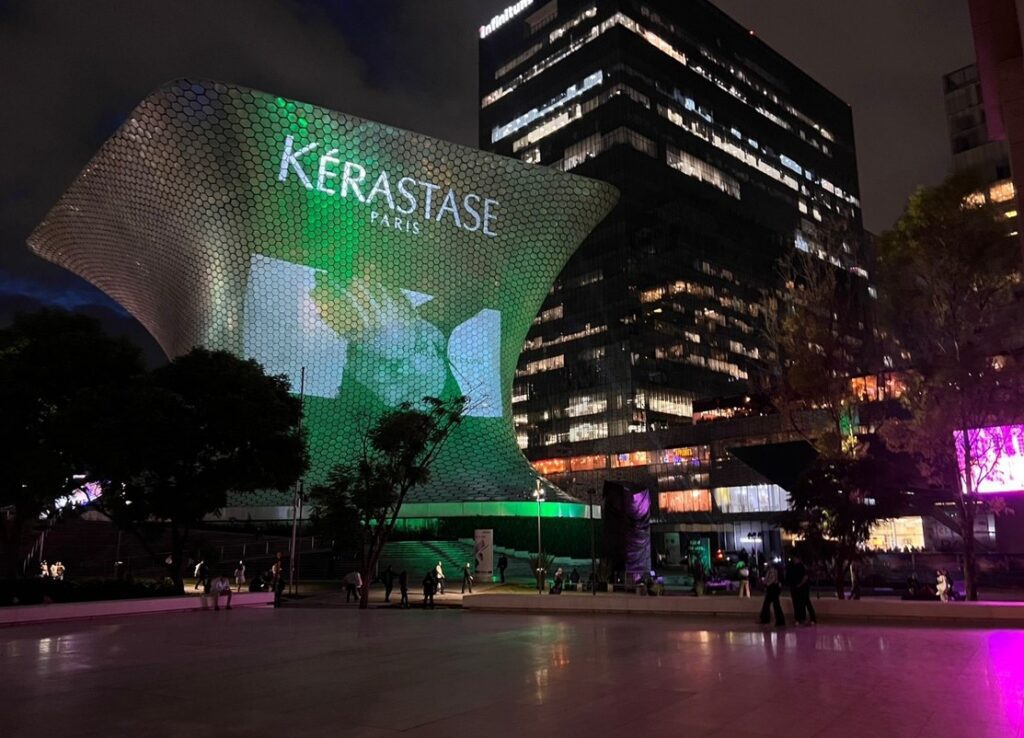
The Museo Soumaya, designed by architect Fernando Romero and funded by Carlos Slim, is one of the most distinctive buildings in Mexico City. Its facade is covered with approximately 16,000 hexagonal aluminum tiles arranged in a mathematically complex pattern that produces a fluid, curving building form designed by computer algorithm. The result is a building that looks different from every angle and that catches and fragments light in a way that no rectangular building can.
As a projection surface, the Soumaya is genuinely unique. The hexagonal aluminum tiles are reflective, and when a projector illuminates the facade, the tiled surface fragments the projected image into thousands of small hexagonal reflections. The effect is visually spectacular from a distance, with the projected content appearing to be constructed of tiny individual elements that flow and change as the content animates. Brands whose content design is prepared for this fragmentation effect, either by treating it as a visual feature or by using abstract image content that reads well in fragmented form, can create projection experiences on the Soumaya facade that are unlike anything achievable on a conventional surface.
The plaza in front of the Soumaya, which is open and flat with multiple benches and pedestrian circulation, provides a natural audience space for projection on the museum’s facade. Weekend visitors to both the Soumaya and the adjacent Jumex museum create a design-forward audience cluster that is distinct in character from the Masaryk shopping crowd — more visual arts literate, more engaged with architecture and design as cultural categories, and more likely to engage in depth with complex or experimental projection content.
Museo Jumex
The Museo Jumex, designed by David Chipperfield Architects and opened in 2013, sits across the plaza from the Soumaya. Its facade is a clean, horizontally banded composition of pale limestone and glass that represents a more restrained architectural statement than the Soumaya’s titanium exuberance. As a projection surface, the Jumex facade’s pale limestone offers excellent reflectivity and a neutral background for content that requires precise color accuracy. The horizontal banding creates a natural compositional framework that content designers can work with or against depending on the creative treatment.
The combined Soumaya-Jumex plaza area has become one of Mexico City’s most photographed contemporary spaces, which means any projection campaign that runs here benefits from the automatic photographic documentation impulse of the large number of visitors who are already photographing the buildings on every visit. A projection that is active during peak museum visiting hours on a weekend afternoon will be captured in thousands of individual photographs and videos that the museum visitors are already taking of the buildings.
In Polanco, production quality is not just a creative consideration — it is a credibility signal. The audience here is spending their daily lives surrounded by the world’s best luxury branding. A projection campaign that looks cheap or poorly executed in this environment actively damages the brand rather than just failing to impress. When we brief creative teams on Polanco deployments, we say: build for the context, not just for the medium.
Projection Geometry in Polanco: Equipment and Technical Strategy
Polanco’s physical characteristics, wider streets, taller buildings, higher ambient light levels, demand a more technically rigorous approach to projection equipment and placement than the smaller-scale colonias to the south require.
Projector Output Requirements
The general rule for Polanco is that effective campaigns require 30,000-40,000 lumens for work on the major commercial streets. For maximum-scale work on towers and hotel facades, 50,000+ lumen units are the standard. These are not the portable, quick-deploy units that handle Roma Norte side street work. They require flatbed transport, crane or scissor lift assistance for raised placement when necessary, and a larger crew for setup and breakdown.
Laser projectors are mandatory for Polanco work for two reasons. First, the longer deployment windows required to reach evening audiences on Masaryk, which runs traffic into the early morning hours on weekends, exceed the effective lamp hours of traditional xenon projector systems without a lamp change. Second, the higher output requirements at Polanco scale favor laser technology’s efficiency advantage over xenon for maintaining consistent lumen output over multi-hour deployments.
Throw Distance and Lens Selection
Masaryk’s 35-meter roadway width means projection lens selection is critical. Standard projectors come with lenses optimized for throw distances of 10-25 meters, which covers Roma Norte and Condesa work comfortably. For Masaryk, we routinely use long-throw lens adapters that allow the projector to be positioned on the near sidewalk or median and still achieve the throw distance to the facing building facade while maintaining the correct focal length for a crisp, undistorted image.
The wider streets also mean that elevation becomes more important. A projector at street level on Masaryk, aimed at a building 35 meters away, will illuminate the lower floors primarily and need significant keystone correction to fill a tall facade. Raising the projector on a van roof rack or scissor lift by 3-5 meters produces better geometry on the target surface and reduces keystone distortion. For tower projections on buildings taller than 15 stories, we use crane-mounted projectors to achieve the throw angle that fills the building’s surface in the most effective vertical range.
Audience Profile: Who Is in Polanco
Polanco’s audience is Mexico City’s most economically elite. The colonia’s resident population includes some of Mexico’s most prominent business figures, political figures, and cultural leaders. The commercial foot traffic on Masaryk and the surrounding streets reflects this demographic — the shopper who is browsing Hermes and Patek Philippe on a Saturday afternoon has a very different economic profile from the artist browsing a record store on Álvaro Obregón.
The Resident Population
Polanco’s permanent residents are established, older, and extremely high-income. The colonia’s residential towers and townhouses attract the senior executives of Mexico’s major corporations, the families of prominent political figures, and a significant international community of corporate expatriates stationed in Mexico City by major global companies with operations in the country. This resident population is sophisticated in their brand exposure — they travel internationally, they are familiar with the reference points that luxury brands use in their global campaigns, and they will notice when a projection campaign’s production quality does not match its brand’s international positioning.
The Business and Corporate Visitor
Polanco is home to the Mexico City offices of many of the world’s largest multinational corporations, concentrated in the towers on the Reforma frontage and in the business parks along Ejército Nacional. The business visitor population, people in town for meetings, conferences, and corporate events, adds significantly to the daily foot traffic in the colonia, particularly on weekday mornings and middays when the residential and leisure crowds are thinner. For B2B brands, financial services, professional technology, and premium corporate services, this weekday business visitor audience is a distinct and valuable target.
The International Hotel Guest
Polanco has one of the highest concentrations of international luxury hotel properties in Mexico City: the Presidente Intercontinental, the St. Regis Mexico City on Paseo de la Reforma, the W Mexico City, the Four Seasons on the Reforma, the Hyatt Andaz Polanco, and several others all operate in or immediately adjacent to the colonia. These properties bring a constant flow of high-income international business travelers and leisure tourists who are in Polanco specifically because they want to be in Mexico City’s most prestigious neighborhood. International hotel guests are a particularly valuable audience for luxury brands with global aspirations, because these visitors carry their brand perceptions back to their home markets.
Polanco contains the Mexico City flagships of more than 30 of the world’s top 50 luxury brands by revenue, making it the most concentrated luxury retail environment in Mexico and one of the most concentrated in all of Latin America.
Brand Strategy in Polanco: The Premium Context
The most important strategic principle for projection campaigns in Polanco is that the environment sets a premium quality expectation that the campaign must match or exceed. The audience in this colonia spends their daily lives surrounded by the world’s best brand communication — the window displays of Hermès, the architectural quality of international luxury hotel lobbies, the product presentation of Ferrari and Porsche showrooms. They have an unconscious but highly calibrated sense of what high-quality brand execution looks like.
Luxury Fashion and Accessories
The most natural brand category for Polanco projection campaigns is luxury fashion. International houses with Mexico City flagships on Masaryk, or aspirational brands seeking to associate themselves with Masaryk’s luxury address, benefit from the geographical specificity of a projection campaign in this colonia in a way that is impossible to achieve through national media. A projection on a building half a block from the Louis Vuitton flagship is a presence in exactly the competitive and consumer context that the brand needs to reinforce. It is not just advertising — it is territory.
Automotive
Premium and luxury automotive brands are among the strongest performers for Polanco projection campaigns. The colonia is home to showrooms for Ferrari, Lamborghini, Maserati, Porsche, and the full roster of German premium brands. Weekend afternoon foot traffic on Masaryk and the surrounding streets includes a high percentage of automotive enthusiasts who are already in a category-engaged mindset. Projection content that places a vehicle in the scale-appropriate context of Polanco’s wide streets and architecturally significant building facades creates the kind of premium visual environment that product shots in a studio cannot replicate.
Private Banking and Financial Services
Polanco is the location of major private banking centers and wealth management operations for most of Mexico’s largest financial institutions and many international private banks. The audience for private banking and premium financial services is concentrated nowhere in Mexico City more densely than in Polanco. Projection campaigns for financial institutions in this environment reach the right demographic at the right income level in a context that communicates precision and value, qualities that align directly with the positioning of premium financial brands.
Ultra-Premium Spirits and Hospitality
High-end restaurant openings, private club launches, ultra-premium tequila and mezcal brands, and international hotel brand campaigns all perform strongly in Polanco. The colonia’s residents and visitors are sophisticated consumers of premium dining and drinking experiences, and they engage with brand communication in those categories with genuine attention and purchasing intent.
Campaign Timing and Deployment Strategy in Polanco
Polanco operates on a different schedule than the southern colonias. The colonia’s professional and business character means weekday evenings run later and harder than in residential-heavy Condesa, while weekends are dominated by the shopping and dining visitor crowds rather than the nightlife-oriented crowds of Roma Norte.
Weekday Windows
Thursday evening is Polanco’s strongest weeknight, with the restaurant corridors running at high capacity from around 8 PM. Wednesday evenings draw the Noche de Museos crowd to the Soumaya and Jumex in Nuevo Polanco, creating a design-forward audience in the northern part of the campaign geography. Friday evenings are equivalent to weekends in terms of foot traffic density on Masaryk and Horacio.
Weekend Windows
Saturday afternoon from roughly 2 PM through 9 PM is the peak deployment window for Masaryk campaigns, aligning with the shopping hours of the luxury retail flagships and the lunch and early dinner activity of the restaurant scene. Sunday afternoons have a slower, more residential character with strong Parque Lincoln foot traffic from families using the park. Projection deployments on Sunday evenings, as restaurant crowds arrive for late dinner, can reach the combination of local resident and visiting dining audience that is a strong target for food and beverage brands.
| Location |
Surface Type |
Output Needed |
Best Audience Window |
| Masaryk building upper floors |
Stone, concrete, mixed |
35,000–45,000 lm |
Sat–Sun 3PM–9PM |
| Parque Lincoln perimeter facades |
Residential tower facades |
25,000–35,000 lm |
Sat–Sun afternoon–evening |
| Presidente Intercontinental, Campos Elíseos |
Concrete and glass panels |
40,000–50,000 lm |
Thurs–Sat 9PM–midnight |
| Museo Soumaya facade, Nuevo Polanco |
Hexagonal aluminum tiles |
30,000–40,000 lm |
Sat–Sun afternoon (museum hours) |
| Museo Jumex facade |
Limestone, horizontal banding |
25,000–30,000 lm |
Sat–Sun afternoon |
Frequently Asked Questions
Why is Polanco the right zone for luxury brand projection campaigns in Mexico City?
Polanco is Mexico City’s highest-income residential district and the primary shopping and dining destination for the city’s wealthiest consumers. Avenida Presidente Masaryk concentrates luxury retail flagships in a compact, walkable strip that draws consistent foot traffic from exactly the demographic that luxury brands need to reach. The wide streets and tall buildings also provide projection surfaces at a scale and visual quality that matches the production standards luxury campaigns require. You cannot reach this specific consumer in any other Mexico City neighborhood at the same concentration.
What is the Museo Soumaya and how does it relate to projection campaigns in Polanco?
The Museo Soumaya in Nuevo Polanco is one of Mexico City’s most architecturally distinctive buildings, its facade covered with approximately 16,000 hexagonal aluminum tiles that fragment projected light into visually complex patterns. This reflective tiled surface creates unusual projection effects that brands with the right creative content can use as a deliberate visual feature rather than fighting against. The museum’s plaza is a natural gathering point for a design-forward audience that is distinct from the Masaryk shopping crowd, and the museum draws strong weekend foot traffic that creates a reliable projection audience during daytime and early evening hours.
How does Polanco’s building height affect projection equipment choices?
Polanco’s taller buildings and wider streets mean that effective projection campaigns require higher-lumen equipment than in Condesa or Roma Norte. Throw distances of 30-50 meters are common on Masaryk and the major avenues, requiring 30,000-45,000 lumen projectors to maintain competitive image brightness against the higher ambient light level of this well-lit commercial district. Tower projections on buildings of 20+ stories may require crane-mounted projectors to achieve the correct throw angle. Laser projectors are standard for all Polanco work due to deployment duration requirements and output efficiency at these lumen levels.
What brand categories perform best with guerrilla projections in Polanco?
Luxury fashion houses, premium automotive brands, private banking and financial services, ultra-premium spirits, international hotel and hospitality brands, high-end jewelry and watch brands, and premium real estate developments all perform strongly in Polanco. The colonia’s ultra-high-net-worth resident and visitor population represents the most financially significant consumer demographic in Mexico. Any category where the purchase decision involves significant discretionary spending benefits from the precise demographic targeting that Polanco’s geographical concentration makes possible.
What are the best Polanco locations for guerrilla projection campaigns?
Avenida Presidente Masaryk between Oscar Wilde and Molière is the primary zone for luxury brand campaigns, with projection on the upper building floors above the retail level on the most well-lit section of the street. The Parque Lincoln perimeter on Emilio Castelar delivers a combined residential and visitor audience in an outdoor park setting that works well for lifestyle and automotive campaigns. The Museo Soumaya and Jumex facade area in Nuevo Polanco attracts a design-forward audience distinct from Masaryk shoppers. The Presidente Intercontinental facade on Campos Elíseos is one of the most architecturally prominent projection surfaces in the district, visible from Chapultepec across the Reforma corridor.