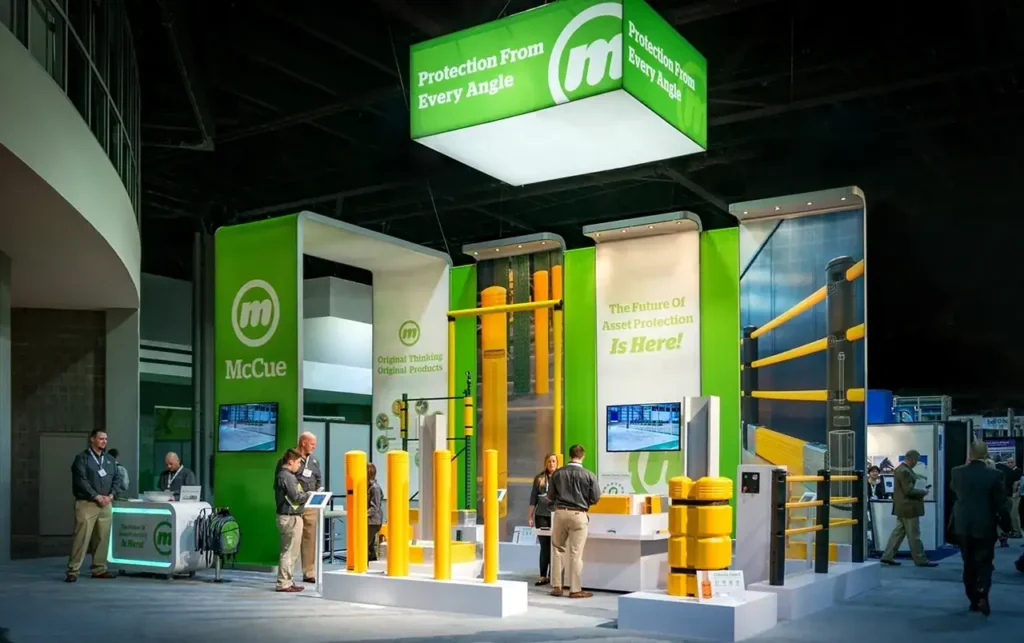
Trade shows remain one of the most efficient lead generation channels available to B2B brands, and the reason is simple: your ideal buyers are all in the same room, at the same time, actively looking for solutions. No digital campaign can replicate that concentration of purchase intent. A well-executed trade show advertising strategy, built around the right pre-show, on-site, and post-show activities, can generate pipeline that exceeds what most brands produce through an entire quarter of digital marketing spend.
But trade shows also represent significant investment. Booth space, build costs, travel, staffing, and collateral add up fast. The brands that consistently win at trade shows are the ones that treat the event as a campaign, not just a presence, and that campaign starts weeks before the doors open.
This guide covers everything from booth strategy to outside-the-floor advertising to lead follow-up systems, with specific attention to how guerrilla marketing near trade show venues creates a competitive advantage that most exhibitors completely ignore.
What Makes Trade Show Advertising Different from Other Channels
The defining characteristic of trade show advertising is context. Attendees arrive with a specific mission. They have carved time out of their schedules, often including travel, to evaluate vendors, see new products, and make connections that will influence their purchasing decisions for the next 12 to 24 months. That context makes every impression at a trade show categorically different from a digital ad seen during a passive browsing session.
Research consistently shows that the average cost per qualified lead from a trade show falls between $150 and $400 when total event costs are divided by the number of qualified contacts captured. That compares favorably with outbound sales development programs that often cost $500 to $1,200 per qualified meeting and digital demand generation campaigns that can run even higher in competitive categories.
The Three Phases of Trade Show Advertising
The brands that generate the best ROI from trade shows treat the event as a three-phase campaign rather than a single-point engagement. The phases are pre-show, on-site, and post-show, and each requires a distinct advertising and communication strategy.
- Pre-show: Build awareness among attendees before they arrive, secure meetings in advance, and generate enough visibility that your brand is already on people’s radar when they walk through the door.
- On-site: Create compelling booth experiences, capture leads with context, run outside-the-booth advertising to reach attendees beyond the show floor, and activate your team for maximum coverage.
- Post-show: Follow up with leads while context is fresh, route contacts to the appropriate nurture or sales track, and measure performance against your pre-defined success criteria.
Pre-Show Advertising: Winning Before the Doors Open
Most exhibitors do nothing to reach attendees before the show. That is a significant missed opportunity. Attendees plan their show schedule in advance, deciding which booths to visit, which sessions to attend, and which meetings to book. Brands that are already on their radar before they arrive have a distinct advantage.
Email Outreach to Attendee Lists
Many shows provide exhibitors with access to attendee lists or offer pre-show email programs that reach registered attendees. Use this channel aggressively. A personalized pre-show email with a specific invitation to visit your booth, see a demo, or attend a hosted event at the show will outperform any generic show-blasting template.
If you have a strong CRM and existing relationships with contacts who will be attending, direct personal outreach from your sales team is even more effective. Even a brief “I’ll be there, want to connect?” message to an existing prospect can result in a meeting that converts.
Paid Social Targeting Show Registrants
LinkedIn campaign targeting allows you to reach people by job title and company, and you can layer in geography and engagement signals to narrow toward likely attendees. Running awareness and appointment-booking campaigns targeted at the specific job titles and industries represented at the show, focused on the metro area of the event, delivers solid pre-show reach.
Meta campaigns geo-targeted to the show city and surrounding area, running in the two weeks before the event, capture local professionals and out-of-town attendees already in the market for reconnaissance.
Guerrilla Marketing Near the Venue
This is where most brands leave real opportunity behind. The area around a major trade show venue, including adjacent streets, host hotels, transit hubs, and restaurants heavily trafficked by attendees, is prime advertising territory that very few exhibitors activate.
Our team at American Guerrilla Marketing has executed campaigns around convention centers that create thousands of impressions with exactly the right audience at exactly the right moment. Poster placements, sidewalk stenciling, and mobile billboard trucks deployed in these areas create brand presence outside the bubble of the show floor, reaching attendees during the unstructured hours when they are open to discovery.
Booth Strategy: Converting Impressions Into Pipeline
Your booth is the centerpiece of your on-site strategy, and it needs to do two things simultaneously: attract attention from the aisle and convert that attention into qualified conversations. Most booths fail at one or both.
Visibility From the Aisle
Trade show floors are visually chaotic. Exhibitors are competing for eye contact from people moving quickly through a crowded space. Your booth needs a clear headline visible from 30 feet, a visual identity that stands out from the neighbors, and a hook that communicates your core value proposition in three seconds or fewer.
Avoid cluttering your booth with too much information. Detailed messaging belongs in conversations and collateral. The booth’s job is to stop foot traffic, not to replace your sales pitch.
Lead Qualification at the Booth
Capturing a badge scan is not capturing a lead. A lead has context: what problem they are trying to solve, what timeline they are working on, what their decision process looks like, and how qualified they are against your ICP. Build a simple qualification script that your booth staff uses consistently for every conversation, and make sure they are recording the context alongside the contact information.
The most effective booth teams have a brief conversation guide, a lead scoring system with 2 to 3 tiers based on qualification criteria, and a plan for routing hot leads directly to a senior sales contact before the person leaves the show floor.
Creating Reasons to Return and Share
Booths that create experiences, demonstrations, interactive elements, or moments worth photographing generate two things traditional booths do not: repeat visits and social sharing. Attendees who photograph your booth and post it are generating organic impressions among their networks, many of whom are in the same industry and therefore your target audience.
Outside-the-Booth Advertising: Creating an Unfair Advantage
The show floor is not the only place to reach trade show attendees. Savvy exhibitors activate advertising in the spaces attendees inhabit outside the exhibit hall, including hotels, restaurants, transit corridors, and surrounding neighborhoods.
Environmental Advertising Around the Venue
Poster placements and other OOH formats near the convention center reach attendees during their commute from hotel to venue, during coffee runs, during evening social events, and during the exploration that happens during off-hours. These impressions accumulate over the duration of the show and create a sense of omnipresence that makes your brand feel dominant in the market.
Hotel and Transit Advertising
For national shows that draw significant out-of-town attendance, advertising in the hotels most commonly booked by show attendees creates prime impressions at moments when people have downtime and are in a receptive mindset. Transit advertising along routes connecting hotels to the convention center captures audiences in a captive environment with dwell time long enough for your message to land.
Event Sponsorship and Networking Function Presence
Most major trade shows have a calendar of evening events, networking functions, and sponsored sessions alongside the official programming. Sponsoring a cocktail reception, a breakfast briefing, or a workshop puts your brand in front of exactly the right people in an environment with far less competition for attention than the show floor.
Post-Show Follow-Up: Where ROI Is Won or Lost
The most common reason trade show investment delivers disappointing returns is not poor lead capture. It is weak follow-up. Leads that were warm during the show grow cold within days. A systematic, personalized follow-up process is essential.
Hot Lead Response Protocol
Hot leads, those who expressed clear purchase intent and meeting requests, should receive personal outreach within 48 hours. Not a generic thank-you email. A message that references the specific conversation you had, the problem you discussed, and the next step you agreed on during the show. This level of personalization requires your team to record notes during the conversation, not after.
Nurture Tracks for Warm Leads
Warm leads that showed interest but are not yet in active evaluation mode belong in a nurture sequence that keeps your brand visible and educational until they are ready. A four to six-email sequence over 30 days, with content that addresses the specific interests and objections relevant to their profile, typically generates the best conversion rates.
Measuring the Full-Cycle Impact
Trade show ROI measurement requires a 12-month window. Many deals that originate at a trade show close 3 to 6 months later. Track every show-sourced opportunity from first contact through close, calculate the total revenue attributed to show relationships, and compare against your total investment, including booth, travel, advertising, and staffing, to get an accurate read on efficiency.
Frequently Asked Questions: Trade Show Advertising
Why is trade show advertising effective for generating quality leads?
Trade shows concentrate your ideal buyers in one place at a moment when they are actively evaluating solutions. Attendees arrive with purchase intent, decision-making authority, and a schedule dedicated to vetting vendors. That combination produces lead quality that is difficult to replicate through any digital channel.
How far in advance should trade show advertising campaigns begin?
Pre-show campaigns should begin 6 to 8 weeks before the event. This includes email outreach to attendee lists, paid social targeting show registrants, and any outdoor or environmental advertising near the venue. Early presence builds anticipation and helps secure meetings before competitors begin their outreach.
What is the best way to capture leads at a trade show booth?
Badge scanning technology is the most efficient method. Supplement it with a qualification form or conversation guide that your team uses consistently to note lead intent and priority. Avoid collecting business cards without a system for recording context, as those piles become unactionable after the show.
How quickly should trade show leads be followed up with?
Within 48 to 72 hours for hot leads. A personalized email referencing the specific conversation you had outperforms a generic follow-up template by a significant margin. Warm leads should be in a nurture sequence within 5 business days.
What does a trade show advertising campaign outside the booth look like?
Outside-the-booth advertising includes environmental branding near the venue, hotel and transit advertising, guerrilla activations in surrounding neighborhoods, sponsored event signage, and digital out-of-home placements. These create impressions with attendees before and after they enter the show floor.
How do I measure the ROI of trade show advertising?
Track total cost per qualified lead, pipeline generated from show contacts, close rate on show-sourced opportunities, and revenue attributed to show relationships within 12 months. Compare against your standard CAC across other channels to determine relative efficiency.
Is guerrilla marketing effective around trade show venues?
Yes. Guerrilla marketing near convention centers, host hotels, and transit routes heavily used by attendees creates impressions in moments when your target audience is primed to engage. Poster campaigns, stenciling, and experiential activations in these zones consistently generate attention and social sharing.
Frequently Asked Questions
What is trade show advertising a key strategy for quality?
American Guerrilla Marketing provides trade show advertising a key strategy for quality services across 50+ U.S. markets. Every campaign is planned, scouted, executed, and GPS-documented by our field teams. We work with regional brands and Fortune 500 companies on campaigns that require real street-level execution and documented proof of performance.
How does AGM approach for quality?
Our process starts with a market consultation to understand your goals, target audience, and budget. We then scout locations, handle any required permissions or permits, coordinate production and installation with our local crews, and provide a full GPS-tagged photo report after the campaign runs.
What markets does American Guerrilla Marketing cover for for quality?
We operate in 50+ U.S. markets including New York, Los Angeles, Chicago, Miami, Houston, Atlanta, Seattle, Denver, Boston, and dozens of secondary markets. Contact us to confirm availability and pricing for your specific market.
How much does a for quality campaign cost?
Campaign pricing depends on market, format, quantity, and duration. We work with budgets ranging from targeted single-market runs to national rollouts across multiple cities. Use our RFP Builder or contact us directly for a custom quote based on your specific campaign requirements.
How do I get started with for quality through AGM?
The fastest way to get started is to submit your campaign details through our RFP Builder at americanguerrillamarketing.com, or contact us directly at [email protected] or (646) 776-2770. Our team typically responds within one business day with availability and initial pricing.