Drone advertising is past the experimental phase. It is a production-ready format generating measurable brand impact for brands willing to operate in a physical dimension that no screen can match. Over 80% of consumers recall a brand that used drone advertising, according to published market research. The drone advertising market is projected to generate nearly $10.9 billion by 2026. Expanding FAA regulatory clarity, dramatically lower drone hardware costs, and brands discovering that a well-executed drone light show stops traffic in a way no digital campaign replicates are all driving mainstream adoption. This guide covers every drone advertising format, what they actually cost, the FAA legal framework every operator must follow, where specific U.S. markets and events deliver the best results, and how drone advertising integrates with street-level guerrilla campaigns for the multi-dimensional brand presence that neither format achieves alone.
The Three Primary Drone Advertising Formats
1. Drone Light Shows: The High-Impact Format
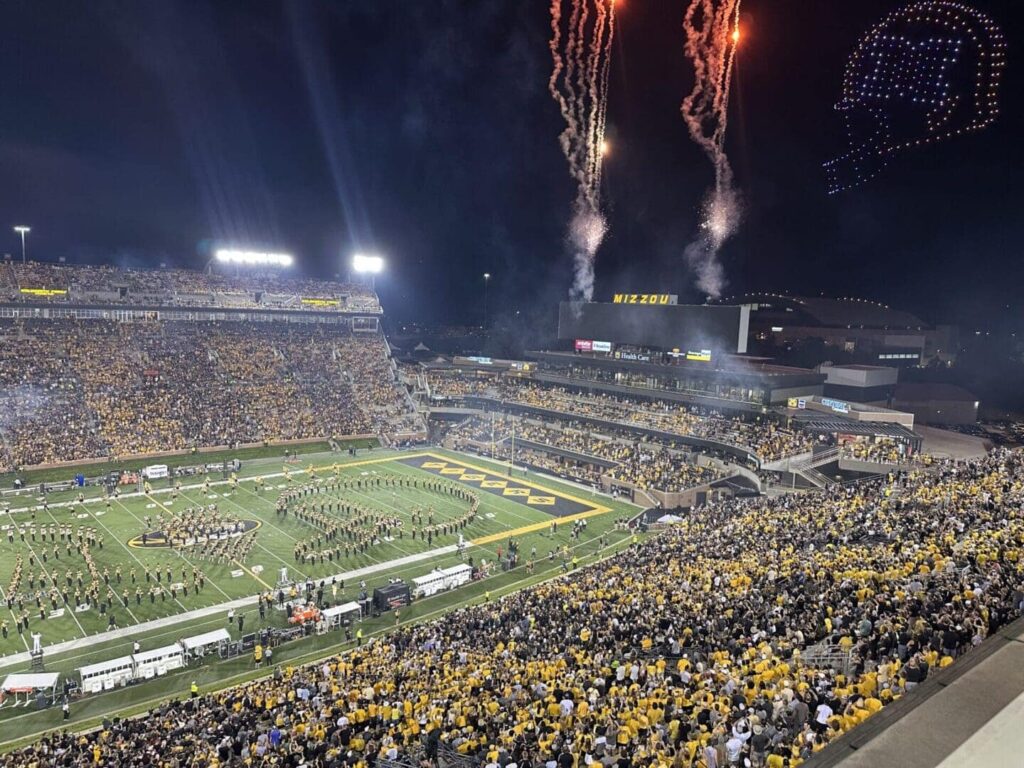
Coordinated drone light shows, fleets of 50 to 500 or more drones flying synchronized formations to display brand logos, animated characters, product shapes, and text messages against the night sky, are the highest-impact and most media-worthy drone advertising format. The spectacle is inherently shareable: a drone light show over a stadium, beach, or event venue stops every person in view and generates thousands of organic social media posts from witnesses who didn’t plan to document a brand moment but couldn’t resist.
The earned media value of a well-executed drone light show typically exceeds the production cost by a significant multiple. When a brand executes a drone show at a Super Bowl week event in New Orleans, a music festival in Austin, or a beachfront New Year’s Eve in Miami, the resulting social media documentation from attendees and the press coverage from local and national media create impression delivery that paid media at equivalent CPMs would cost millions to match. The spectacle is the media plan.
Production requirements for a 100-drone branded light show: FAA Part 107 Remote Pilot Certificates for all operators, site-specific airspace authorization (FAA LAANC system or formal waiver), 60 to 90 days minimum lead time for FAA approvals in controlled airspace environments, ground safety perimeter of at least 200 feet from spectators, choreography programming of 4 to 8 weeks for custom branded animation, and a full ground crew for launch, monitoring, and recovery. Show runtimes typically run 5 to 15 minutes depending on creative scope.
Cost for a 100-drone custom branded show: starting at $50,000 for a basic branded formation show. 200-drone shows with complex animated sequences: $80,000 to $120,000. 500-drone productions for major brand launches or large-scale events: $200,000 to $400,000+. The production cost is significant, but when measured against the earned media value of the resulting coverage and social documentation, the CPM is frequently competitive with or superior to conventional media buys of equivalent impact.
2. Drone Banner Advertising: Accessible Aerial Reach
A single drone or small formation pulling a trailing fabric banner is the most accessible entry point for drone advertising. Single-drone banner campaigns run $300 to $1,500 per flight hour depending on operator, region, and banner specification. This format is most effective at beaches, open-air sports events, outdoor concert venues, and coastal markets where airspace is clear, crowds are large and stationary, and the natural upward orientation of beach and event audiences creates favorable viewing conditions.
Specific high-value drone banner markets: Miami Beach on Memorial Day, Fourth of July, and Labor Day weekends, where South Beach and Mid-Beach deliver beach crowds of 50,000 to 100,000+ people within a compact coastline footprint. The Jersey Shore beach towns (Asbury Park, Seaside Heights, Long Beach Island) during summer peak season. Virginia Beach on holiday weekends. Santa Monica Beach in Los Angeles on summer weekends. Myrtle Beach during spring break and summer season. The Outer Banks of North Carolina during peak July and August weekends.
Banner content is limited by the format: simple text and a basic logo are the practical maximum for readable aerial banner creative. The banner must be legible from below at the viewing angle, which means large, high-contrast text on a solid or minimal background. Complex graphics and detailed typography do not work. A clear URL, a phone number, or a single brand name with a brief tagline is the right scope for drone banner creative.
Flight duration in a single battery deployment is typically 20 to 40 minutes depending on drone model and banner weight. For sustained 3 to 4-hour coverage over a beach event, operators use a relay system, multiple drones, swapping for battery recharge while continuous coverage is maintained. Budget for multi-drone relay programs: $1,500 to $4,000 for a 4-hour continuous coverage window.
3. Drone Camera Production: Advertising Content Creation
The most widely used marketing application of drones is aerial photography and videography for advertising content production. Drone camera production for advertising campaigns, aerial establishment shots, product demonstration footage from improved perspectives, campaign documentation from the air, is now standard in commercial production workflows at a fraction of the cost of helicopter or crane alternatives.
A licensed Part 107 drone operator with a professional gimbal-stabilized 6K cinema camera runs $800 to $2,500 per production day, versus helicopter production costs of $5,000 to $15,000+ per day for equivalent aerial footage. For real estate, lifestyle brand, outdoor product, and event marketing campaigns, drone camera production provides the improved visual perspective that differentiates advertising creative without the budget barrier of traditional aerial production approaches.
For real estate projects, preparation is just as important as the aerial shoot itself. American Guerrilla Marketing recently contributed expert insight to Redfin’s guide on preparing a home exterior for drone photography, including practical steps sellers can take to make a property look its best from above.
For AGM clients running street-level campaigns, drone photography provides campaign documentation assets that static ground photography cannot: aerial photographs of street poster advertising coverage across a neighborhood showing the density of placements relative to street geography, aerial views of event activation footprint, and social content from perspectives that turn a good campaign into a visually arresting documentation piece. Several client campaigns have turned drone documentation footage into organic viral social content when the visual scale of the campaign was visible from above and shared to the brand’s social channels.
FAA Regulations: The Legal Framework Every Drone Advertiser Must Follow
Drone advertising in the United States is regulated by the Federal Aviation Administration. Operating commercial drone campaigns without proper certification and authorization is illegal, carries civil penalties of up to $27,500 per violation, and creates significant legal liability for both operators and hiring brands. Every AGM drone activation partner holds all required certifications.
Part 107 Remote Pilot Certificate
All commercial drone operations require a valid FAA Part 107 Remote Pilot Certificate. Obtaining this certification requires passing the FAA Aeronautical Knowledge Test, a 60-question multiple-choice exam covering airspace classification, weather, operations, and emergency procedures. The test is administered at FAA-approved testing centers nationwide. Any agency or vendor offering commercial drone advertising services whose operators cannot provide their Part 107 certificate numbers on request should not be hired. Non-certified commercial operations are illegal and expose the hiring brand to liability.
Airspace Authorization
Most drone advertising operations require specific FAA airspace authorization beyond the Part 107 certificate. Flights in controlled airspace (Class B, C, D, and surface E airspace within 5 nautical miles of most airports) require real-time authorization through the FAA’s LAANC (Low Altitude Authorization and Notification Capability) system or, for complex operations, a formal FAA waiver. Drone light shows involving flights over crowds of people require Part 107 waivers for the specific operations (waiver applications take 60 to 120 days), plus Notice to Air Missions (NOTAMs) to notify aviation of the activity.
Local Municipal Permits
Beyond FAA requirements, many cities and event venues require separate local permits for commercial drone operations. New York City’s rules for drone flights over populated areas are among the most restrictive in the country. Los Angeles, Chicago, Miami, and most major U.S. cities have specific municipal regulations governing commercial drone activities. An operator who claims to operate in a major city without knowledge of city-specific permitting requirements has not done the work required to operate professionally in that market. Always ask for permit documentation before assuming any drone activation in a major urban market is legally compliant.
Where Drone Advertising Works Best: Markets and Contexts
Drone advertising works best in environments that combine large stationary outdoor audiences with open airspace and natural upward audience orientation. In order of consistent performance:
Beachfront markets in summer: Miami Beach, Santa Monica, Virginia Beach, Myrtle Beach, the Jersey Shore, Clearwater Beach. These markets combine large beach crowds (50,000 to 200,000+ on major holiday weekends), clear coastal airspace relatively free of urban density restrictions, and audiences who are already oriented upward, watching the sky, the water, the horizon. Drone banner advertising in these markets produces among the highest impression-per-flight-hour ratios available.
Music festivals: Coachella, Lollapalooza, Bonnaroo, Austin City Limits, Electric Daisy Carnival, Outside Lands. These events concentrate 50,000 to 100,000+ young adult attendees in open-air environments where drone activations are visible to the full crowd. The social documentation behavior of festival audiences means drone activations generate outstanding organic social media content from attendees.
Stadium and arena exteriors on game and event nights: Drone light shows positioned outside stadium venues, visible to crowds arriving and departing, reach the event audience in the pre- and post-game windows when emotional engagement is highest. Super Bowl city-wide activations, playoff-week events, and championship game environments concentrate massive audiences in defined geographies where drone shows can reach the maximum audience per flight.
Urban brand launch events: Rooftop events, waterfront launch parties, and outdoor brand experiences where a drone show serves as the event’s visual centerpiece. New York’s Hudson River waterfront, San Francisco’s Embarcadero, Chicago’s lakefront, and Miami’s Biscayne Bay waterfront all offer launch event contexts where a nighttime drone show becomes the photograph that defines the event’s press coverage.
Integrating Drone Advertising With Ground-Level Campaigns
Drone advertising produces maximum value as an event anchor within a larger campaign, not as a standalone format. The integration pattern that consistently produces the best results across campaigns we’ve coordinated: the drone event creates the spectacle and generates earned media. Street-level street poster advertising and guerrilla activation campaigns in the surrounding areas in the days before the event prime the audience. Social monitoring captures and amplifies the organic documentation from the event. Post-event paid social promotes event content to audiences who weren’t physically present.
In campaigns we’ve coordinated for music and entertainment clients, the drone moment generates the content, the photograph that every outlet and attendee shares. The ground campaign generates the context, the neighborhood presence that makes the drone moment feel like a brand that belongs in that space rather than an outsider spectacle. The digital amplification extends the reach of the combined physical and aerial moment to networks far beyond the event’s physical attendance.
AGM coordinates the ground-level components (street poster advertising, street teams, experiential activations) alongside certified drone advertising partners for clients who want the full multi-dimensional campaign approach. Contact americanguerrillamarketing.com/contact to discuss drone integration with street-level campaign strategy.
Frequently Asked Questions About Drone Advertising
How much does a drone advertising campaign cost?
Drone banner flights: $300 to $1,500 per flight hour for single-drone operations. Multi-drone relay programs for 4-hour sustained coverage: $1,500 to $4,000. Custom branded drone light shows: starting at $50,000 for 100-drone productions, scaling to $200,000 to $400,000+ for large-scale 500-drone events. Drone camera production for advertising content: $800 to $2,500 per production day.
Is drone advertising legal in the United States?
Yes, when conducted by FAA Part 107 certified operators with appropriate airspace authorizations. Commercial drone operations without Part 107 certification are illegal. Urban events and operations over crowds require FAA waivers with lead times of 60 to 120 days. Always hire operators who can demonstrate active Part 107 certification and confirm their specific airspace authorization for your planned campaign location.
How much lead time does a drone light show require?
Custom drone light show choreography programming requires 4 to 8 weeks. FAA airspace authorization for complex operations (shows over crowds in controlled airspace) requires 60 to 120 days. Full production timeline from brief to show day: minimum 90 days for outdoor urban environments, 60 days minimum for open rural or coastal airspace. Begin planning drone light show activations at least 4 months before the desired event date.
What’s the difference between a drone banner and a drone light show?
A drone banner uses a single drone (or small formation) to pull a fabric sign with text or a logo through the air at viewing altitude. It’s the entry-level drone advertising format, best suited for outdoor daytime events and beach markets. A drone light show uses coordinated fleets of LED-equipped drones to create synchronized aerial animations visible at night, producing significantly higher visual impact and earned media value, but requiring substantially higher production investment and regulatory lead time.
Where should I run a drone advertising campaign?
The highest-value drone advertising environments are: major beach markets in summer (Miami, Santa Monica, Virginia Beach), music festival grounds during events, stadium exterior zones on major game nights, and outdoor urban event venues with large stationary audiences and open airspace. Avoid dense urban environments without specific FAA authorization, the permitting process for urban drone operations is complex and requires significant lead time.
Can I advertise with drones at any outdoor event?
No. Drone advertising at outdoor events requires FAA airspace authorization (and often municipal permits) regardless of the event’s size or location. Flying a commercial drone over a crowd without proper Part 107 waiver authorization is illegal under FAA regulations. Event-specific permitting requirements add to the baseline FAA requirements. Any operator who tells you they can fly at any event without permits is misrepresenting the regulatory requirements, don’t hire them.
How do I measure the results of a drone advertising campaign?
For drone light shows: social media mention volume and organic impression tracking during and immediately after the event, press coverage impressions (earned media value calculation based on publication reach), and event attendance impressions (number of people physically present during the show). For drone banner campaigns: estimated impressions based on audience count at the venue during flight windows, organic social media documentation rate, and any digital attribution from QR codes or URLs included in banner creative. Measure event attendance, earned media, social reach, video views, branded search lift, press coverage, and any direct response tied to the campaign.
Do drone advertising companies carry the right insurance?
Legitimate commercial drone operators carry aviation liability insurance covering their operations. Minimum coverage for commercial drone advertising operations over public audiences should be $1,000,000+ per occurrence. Request certificates of insurance and verify coverage limits before hiring any drone operator for a brand campaign. Uninsured or underinsured drone operations create liability exposure for the hiring brand in the event of equipment failure, injury, or property damage.
What weather conditions cancel a drone event?
High winds, lightning risk, and heavy rain are the most common cancellation triggers. Exact thresholds depend on drone platform and operator policy, but any serious vendor will have explicit wind and precipitation cutoffs in the operating plan.
Can drone shows include logos and text?
Yes, but simple shapes, icons, and short words perform best. Complex logos with fine details do not read well at altitude. Most effective brand moments use a recognizable symbol, a bold product silhouette, or one short line of text.
What kind of brands benefit most from drone advertising?
Entertainment, automotive, sports, tourism, real estate, festivals, and launch driven brands often benefit because drones can create attention grabbing visuals and memorable footage.
Are drone advertising campaigns only for large budgets?
Not always. Aerial filming can be relatively accessible, while full drone show productions require more budget, planning, and approvals.
What approvals do drone advertising campaigns need?
Many campaigns need FAA compliance, local site permissions, insurance, safety planning, and coordination with event or property operators.
Can drones help create social content?
Yes. Aerial footage and event visuals often perform well across social platforms because they give viewers a perspective they do not see every day.
What is the biggest mistake with drone advertising?
Using drones without a clear concept is a common mistake. The technology gets attention, but the campaign still needs a message, audience fit, and distribution plan.
Do drones work better for live events or recorded content?
They can work well for both. Live events create spectacle in the moment, while recorded content stretches the value by giving the brand assets to reuse later.
What is included in a drone advertising production plan?
A successful drone activation has a longer prep list than most buyers expect. You need FAA authorization, municipal clearance where required, weather contingency planning, spectator safety barriers, launch and recovery zones, batteries and charging rotation, pre-programmed choreography, and a documentation team on-site. The show itself may last 8 minutes. The planning behind it can take 8 weeks or more. Brands that underestimate the operational layer end up with preventable delays or compromised execution.