
November 18, 2026
Projection Advertising: How It Actually Works
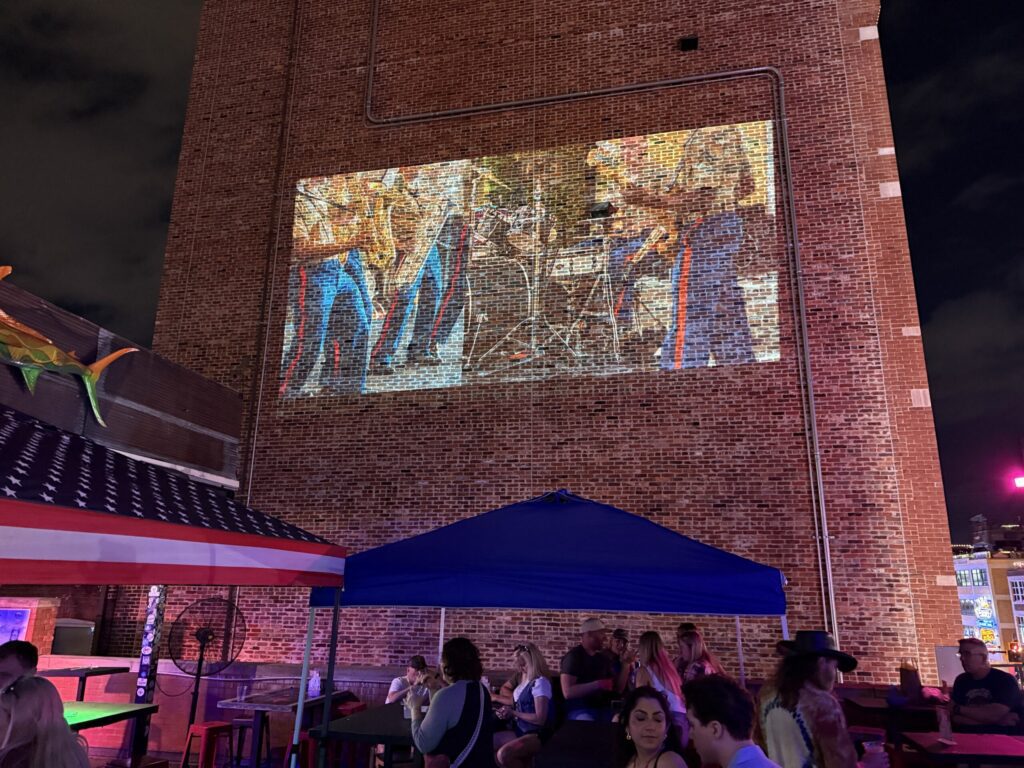
Projection Advertising is the format buyers are most confident about and least informed on. Everyone has seen a logo thrown onto a building and assumed it is simple. Point a projector, plug it in, done.
Then they book one, and the first question from our side is what the ambient light level is on the target wall, and the conversation changes.
I have run projection nights in downtown cores, on riverfronts, against parking structures and off the back of a moving vehicle. The honest position is this: projection is the highest-impact outdoor format we offer on the right night against the right surface, and the most fragile one. It has more failure modes than posters, decals and truck media combined, because it depends on three things you do not control. Light, weather and the wall.
This page is about how it genuinely works. Equipment, lumens, throw, surfaces, crew, permissions and the specific reasons a projection night underdelivers. No theory. The things we check before we agree to run.
The one number that decides everything: ambient light
Projection is a contrast medium. The image you see is not the brightness of the projector, it is the difference between the projector's light on the wall and whatever light is already falling on that wall.
A modest projector against a dark wall on a dark street looks spectacular. An enormous projector against a wall washed in sodium streetlight, retail spill and sign illumination looks like a faint smudge.
This is the single most common misunderstanding in the category. Clients ask for a bigger projector when the actual problem is that the target wall sits under a streetlight.
So the first thing our survey measures is not distance. It is how dark the surface actually goes after midnight. We photograph the wall at the intended hour, with manual exposure, so we have a repeatable reference rather than an impression. Phone cameras in auto mode brighten everything and make a hopeless wall look workable.
What we are looking for:
Direct fixtures aimed at or near the wall. Streetlights, building floodlights, parking lot poles, illuminated signage. Any of these can kill a projection outright.
Spill from glazing. Ground floor retail, lobby lighting and office floors left on overnight throw a surprising amount of light onto adjacent facades.
Headlight sweep. On a busy street, passing traffic repeatedly washes the lower portion of a wall.
Sky glow. In a dense downtown the general ambient level never drops as far as people assume.
Sometimes the fix is simple: move the projection higher up the building, above the streetlight line, where the wall genuinely is dark. We do that often. Height also improves sightlines.
Lumens, throw distance and why bigger is not the answer
Lumen figures are the specification buyers fixate on, and they are meaningful, but only in context.
The brightness that actually matters on the wall is the projector's light spread across the area of the image. Double the width of your projection and you have roughly quadrupled the area, so the same projector delivers a quarter of the light per unit of surface. A big dim image is a common result of a client asking for scale without accepting the consequence.
Throw distance affects placement, not brightness, in the sense that most of the practical limit is about where you can physically stand the machine. Lenses are selected to achieve the image size you want from the position you can actually occupy. A long throw lens lets you sit further back, which is often necessary because the obvious close position is in a traffic lane, on private property or in a spot where a pedestrian will walk through the beam every ten seconds.
The real constraints in the field are rarely the lumen rating:
Where can we legally and safely place a heavy machine for several hours?
Is there an unobstructed line from that position to the wall, with no tree canopy, no bus shelter, no signage, no scaffolding and no parked delivery truck that will arrive at two in the morning?
Can we run power there, or do we run a generator, and is generator noise acceptable at that hour in that block?
Is the position secure, meaning a crew member stays with the equipment the entire time?
A moderate projector in the right position beats a much brighter one in the wrong one. We would rather spend the night solving placement than specifying up.
The wall is a screen, and most walls are bad screens
Surface behaviour decides image quality as much as the machine does.
What works well:
Large, flat, light-coloured, matte facades. Smooth precast concrete, painted render, light stone and plain stucco are ideal. Light surfaces reflect more and read brighter.
Unbroken area. You want a clear field with no windows, no balconies, no pipework and no signage cutting through the artwork.
What works badly:
Dark brick and dark stone. They absorb light. A dark red brick facade can swallow a projection that would look perfect on pale concrete next door.
Glass. It reflects and transmits rather than scattering light back at the viewer. Heavily glazed towers are the worst projection targets in any city, which disappoints clients who pick the most prominent building downtown.
Heavy texture. Deep rustication, corrugated metal and rough aggregate break up fine detail and type.
Windows across the image. Every window is a hole in your artwork, and depending on the building, a person inside it.
Angle. Projecting from a sharp angle distorts the image, and while keystone correction compensates geometrically, it costs you brightness and sharpness at the far edge. We would rather move the projector than correct heavily in software.
Artwork design follows from this. Projection rewards bold shapes, strong contrast and large type. White and bright colours carry. Dark colours simply do not exist in projection, because the absence of light is the wall itself. Black in your artwork means no projection, so a design with a black background and white logo is exactly right, while a design with a dark logo on a white field will throw a huge glowing rectangle at a building and read poorly.
We rework artwork on nearly every brief for this reason.
Weather, and the nights we stand down
Projection is weather-sensitive in ways clients do not anticipate.
Rain is mixed. Light rain can actually help, because moisture in the air catches the beam and the throw becomes visible, which looks dramatic. Heavy rain is a stand-down, because the equipment is not something we will expose and visibility drops.
Fog and mist are the best looking conditions in the category. The beam itself becomes part of the piece.
Wind matters more than people expect, because wind moves anything we have rigged, moves the vehicle if we are projecting from one, and introduces vibration that shows up as a shimmering image.
Cold is an equipment issue, condensation on optics being the main one when gear comes out of a warm van into freezing air.
Summer is the hardest season for scheduling, not because of heat but because of daylight. In northern cities in June, usable darkness may not arrive until well after nine in the evening and ends early. Winter gives you long dark hours. We tell clients plainly that a projection campaign in late June in a northern market has a much shorter nightly window than the same campaign in November.
Snow on the ground is an underrated problem. Fresh snow raises ambient light substantially by reflecting everything back up.
Because of all this, we build weather calls into the schedule rather than pretending they will not happen. On multi-night bookings we agree a stand-down rule in advance and a reserve night, so that nobody is arguing about conditions at eight in the evening with a crew already loaded. A projection campaign with no reserve night is a campaign that will eventually deliver nothing.
Crew, call times and how a night runs
A standard single-surface projection runs with a crew of two or three. One operator on the machine and content, one on site, sightlines and public interaction, and on vehicle-based or multi-position nights a third on driving and logistics.
We arrive before full dark to set position, then wait. The waiting is real and it is billable time in the sense that the crew is on site, but the usable window does not begin until the ambient level drops.
The sequence:
Establish and secure the position. Vehicle placement, cones, cable management so nothing crosses a pedestrian path unprotected.
Power up. Mains where available by arrangement, generator otherwise.
Rough alignment while there is still some light, so we are not hunting for the wall in the dark.
Fine alignment, focus, geometry and masking once it is genuinely dark. Masking matters: we blank out windows, neighbouring buildings and anything the artwork should not spill onto.
Run content. Static holds, slow sequences or short looping animation.
Monitor continuously. Projection is not a format you set and leave. Someone stays with the machine the whole time, for security, for refocus and because conditions change.
Document. Stills and video, from multiple distances, including the street context shot that shows people seeing it.
Strike and clear.
A typical night delivers several usable hours in winter and considerably fewer in midsummer. Multi-location nights are possible, moving the rig between two or three surfaces, but each move costs setup and alignment time, so there is a hard limit on how many positions one crew covers before the sky starts to lighten.
Vehicle-based and mobile projection
Projecting from a vehicle solves the placement problem on streets where you cannot occupy ground position for hours.
A rig in a van or box truck lets us arrive, align, run and leave without ever setting equipment on a sidewalk. It also lets a single crew hit several surfaces in a night.
The tradeoffs are honest ones. Power comes from the vehicle or an onboard generator. Stability is worse than a tripod on pavement, because suspension moves and people lean on vehicles. Alignment has to be redone at every stop. And you still need a legal, safe place to park with a clear line to the wall, which in a dense downtown is the hard part.
Projection from a moving vehicle onto passing surfaces is something clients ask for after seeing edited video. In practice it produces a smeared, unreadable image, and we talk people out of it.
Permission, ordinance and the grey area
This is where I have to be careful and precise.
Projection advertising sits in a grey area in the United States. There is no single national rule, the position varies by municipality, and nothing here is legal advice.
What I can describe is how the grey behaves in practice.
Nothing is physically applied to the building, which is why many people assume projection is unregulated. That assumption is unreliable. Several cities address projected images directly in their sign codes, treating a projected commercial message as signage, which can bring in size, illumination, duration and permitting rules. Others approach it through nuisance, light trespass or public display provisions. Some have no applicable language at all, and the result there is unpredictable rather than permissive. Occupying street or sidewalk with equipment and a generator is frequently a separate permitting question from the image itself.
Enforcement is inconsistent. The same technique can go unremarked in one corridor and draw an immediate response a few blocks away, and complaint history matters more than written rules in determining what actually happens.
Building ownership is the other half. Projecting onto a facade without the owner's agreement is a relationship problem regardless of how any ordinance reads.
So AGM's standard posture on projection is the same as on every other format. We seek written permission from the building owner or manager for the specific surface, dates and hours. We identify whether the projection position itself needs any local permission for equipment and obstruction. We document the surface and the setup. And we design the masking so that light falls only where it is agreed to fall, which is both courteous and the single best way to avoid a complaint.
We will decline surfaces where occupants are behind the glass we would be lighting, residential facades, and buildings where we cannot identify a responsible owner.
Removal, in projection, is the easiest in outdoor advertising. We switch it off. Nothing remains. That reversibility is genuinely the format's strongest argument when we approach a property owner.
What goes wrong on a projection night
The failures repeat, and almost none of them involve the projector breaking.
The wall is brighter than the survey suggested. A building that was dark during the survey has its floodlights on, or the ground floor tenant left the lobby lit, or seasonal decorative lighting went up. We re-survey close to the date for exactly this reason.
The sightline is blocked. A delivery vehicle, a skip, scaffolding or a parked trailer appears in the position we planned to shoot through. Having a second viable position identified in advance is the only real defence.
The image is geometrically fine but soft at one edge, because we are correcting too much angle in software instead of moving the machine.
Spill lands where it should not. Light clipping a neighbouring facade or a residential window is the fastest route to a complaint, which is why masking is set before content runs rather than after.
The artwork was approved on a monitor. Dark tones that looked rich on a screen disappear entirely on a wall, and fine type that was legible at desk distance is unreadable from across a street.
Nobody planned the photography. The piece ran for four hours and the only record is a handful of phone shots at the wrong exposure. We treat capture as a deliverable with its own slot in the running order.
What AGM talks clients out of
We talk clients out of glass towers. The most prominent building downtown is usually the worst available screen. We will suggest the plain parking structure flank across the street instead, and it will look better.
We talk clients out of maximum scale. Oversized projections go dim. A smaller, brighter, sharper image is a better asset.
We talk clients out of dark artwork and small type. If the design relies on dark colours or fine detail, it will not survive the medium.
We talk clients out of early evening starts in midsummer in northern markets. We would rather shift the campaign than run against a bright sky.
We talk clients out of treating projection as a reach buy. It is a short nightly window, one or a few surfaces, seen by whoever is on that street at that hour. The audience in person is modest.
And we talk clients out of booking projection alone, because the value sits somewhere other than raw street impressions.
Where projection actually pays off
Projection earns its place as an event and content format.
It produces exceptional photography and video. A well-chosen surface, a clean mask and a sharp image give a brand a visual that performs far beyond the people who stood on the street that night. For launches, premieres, sponsorship activations and anything with a press element, that is the real product.
It is also the most reversible format available, which makes it viable on buildings where nothing physical would ever be permitted.
What it does not do is frequency. For that, the pairing we recommend is projection alongside LED Trucks & Mobile Billboards. The truck carries the daytime presence, moves through the corridors and events where your audience actually is, and delivers consistent repeated exposure on a schedule that does not depend on darkness, weather or a cooperative wall. The projection night sits on top of that as the hero moment.
Run together, the truck covers the hours projection cannot, and the projection gives the campaign the image everyone shares.
Frequently asked questions
What makes a good building for projection advertising?
A large, flat, light-coloured matte facade with minimal windows, little surface texture and genuinely low ambient light at the hour you intend to run. Smooth precast, painted render and pale stone work well. Glass towers, dark brick, heavily textured facades and anything washed by streetlights or illuminated signage perform badly, regardless of how bright the projector is.
How many lumens does projection advertising need?
There is no single figure, because brightness only matters relative to ambient light and image size. Doubling the width of a projection roughly quadruples its area and cuts the light per unit of surface. We specify the machine and lens after surveying how dark the wall goes, how large the image must be, and where we can physically place equipment, rather than before.
Does projection advertising need a permit?
It is a grey area and varies by municipality, and nothing here is legal advice. Some cities treat a projected commercial message as signage under their sign code, others address it through nuisance or light trespass provisions, and many have no clear language. Occupying sidewalk with equipment is often a separate question. We work from written building owner permission for the specific surface, dates and hours.
How long can you project in one night?
The usable window begins only when ambient light drops and ends at first light, so winter nights give several hours and midsummer nights in northern markets give far fewer. A crew can move between two or three surfaces in a night, though each relocation costs setup and alignment time. Someone stays with the equipment continuously for security and refocusing.
Can you project in the rain?
Light rain and fog often improve the look, because airborne moisture catches the beam and makes the throw visible. Heavy rain is a stand-down, since we will not expose the equipment and visibility drops. Wind causes vibration that shows as a shimmering image, and fresh snow on the ground raises ambient light by reflecting it back up onto the facade.
What artwork works best for projection?
Bold shapes, strong contrast, large type and bright colours on dark or black backgrounds. Black in artwork means no projected light, so the wall shows through, which is why a white logo on black reads cleanly while a dark logo on white throws a large glowing rectangle. We rework supplied artwork for projection on almost every campaign before the first night.
Request a campaign quote
Tell us the city, the building you have in mind and the dates. Before anything else we will tell you honestly whether that surface can carry a projection, because the wall and the ambient light decide the outcome more than the equipment does. Quite often we recommend a different building on the same block, and the result is better for it.
From there we scope the survey, the artwork rework, the equipment and lens selection, the position and power plan, the permission package, the crew and the documentation, and we build the nightly window around the season rather than pretending it is fixed.
Request a campaign quote and tell us the surface you want lit.

Ready to Run Your Campaign?
Call us or email us. We’ll tell you exactly what we can do in your market and what it costs.
Related Service
Explore similar advertising solutions offered by American Guerrilla Marketing.
American Guerrilla Marketing — Los Angeles
Street-level campaigns in Los Angeles and nationwide. Wheatpasting, LED trucks, street teams, and more.
(646) 776-2770
Related Articles
-
Event Adjacent Guerrilla Marketing: A Field Guide
November 18, 2026
-
Experiential Merchandising: How It Actually Works
November 18, 2026
-
Experiential Marketing Agency Chicago for a National Rollout
November 18, 2026
-
Jacksonville Projection Advertising: Permits, Corridors and
November 18, 2026
-
Planning a Hanging Sign Design Campaign Start to Finish
November 16, 2026