Poster Standard Size: Every Format and Use Case Explained | AGM
Standard poster dimensions in the United States are not arbitrary. They evolved from print industry constraints, transit advertising systems, cinema lobbies, and the practical realities of street-level campaign execution. Knowing which standard poster size fits your application is the first decision in any print campaign – it affects print cost, visual impact, vendor availability, and how much material you can deploy per dollar.
At American Guerrilla Marketing, we execute wheatpasting campaigns, street poster runs, and guerrilla marketing activations across 50+ US markets. Our team works with standard poster formats daily. This guide covers every relevant standard size – from the 11 x 17 tabloid to the 48 x 72 large format – with honest guidance on what each size is actually used for, what it costs relative to alternatives, and when to use something other than the most common format.
The goal here is not a list. The goal is a working reference you can use to make a decision about what size to order for a real campaign.
The US poster market has settled on several de facto standard sizes. These are widely available at commercial print vendors, have predictable pricing, and fit standard display hardware, frames, and transit ad holders. The four sizes that account for the vast majority of poster production in the US:
11 x 17 inches – High-volume flyer and small poster format
18 x 24 inches – Indoor campaign poster and window display standard
24 x 36 inches – The primary US street poster standard
27 x 40 inches – Cinema one-sheet standard
Each of these sizes has a specific role in the campaign ecosystem. The right choice depends on your campaign objectives, placement environment, budget per unit, and how many locations you are covering.
11 x 17: The Tabloid Poster
The 11 x 17 inch poster is the lowest-cost printed format that can be called a poster rather than a flyer. At 11 x 17, you can typically print 50-100 pieces per dollar at volume print pricing. The format is readable at distances up to about 5-6 feet in good light.
When to use 11 x 17
Use 11 x 17 when volume is more important than individual poster impact. High-volume wheat paste runs covering dozens of locations, guerrilla distribution campaigns, and situations where per-unit cost needs to be minimized. The format also works well for indoor applications where viewers are close to the surface – coffee shop bulletin boards, door poster slots, and corridor displays.
When not to use 11 x 17
Do not use 11 x 17 for outdoor placements where posters will be viewed from more than 6-8 feet. At street-level viewing distance (10-20 feet), the 11 x 17 format does not deliver enough visual surface area to stop attention. Use 18 x 24 or 24 x 36 for outdoor campaign applications.
18 x 24: The Mid-Size Campaign Standard
The 18 x 24 inch format is a versatile mid-size poster that works for both indoor and outdoor applications. It prints economically, applies quickly in wheatpasting campaigns, and is large enough to be read comfortably from 10-12 feet. At 18 x 24, you get significantly more visual presence than 11 x 17 at a modest cost increase per unit.
When to use 18 x 24
The 18 x 24 standard is the right choice for indoor retail displays, window poster campaigns, bar and venue promotion, and outdoor street campaigns where you need to cover many locations at controlled cost. It is also the most common size for interior transit posters (bus and subway interior cards, lobby displays) and for retail point-of-sale materials that need poster-scale impact.
Indoor vs. outdoor use
Indoors, the 18 x 24 inch standard poster performs well at viewing distances from 3 to 15 feet. In a retail environment, it is readable across a room. Outdoors, it works at locations where pedestrians pass within 5-8 feet of the surface. For high-speed traffic or wider viewing distances, 24 x 36 is the better choice.
24 x 36: The Primary US Poster Standard
The 24 x 36 inch format is the default street poster standard in the United States. When someone says “standard poster size” without further specification, they almost always mean 24 x 36. It is the size that most campaign vendors quote by default, the size that fits most standard outdoor poster frames, and the format that delivers the right balance of visibility, cost, and portability for street-level campaigns.
Why 24 x 36 became the standard
The 24 x 36 format emerged from practical pressures across multiple print and campaign markets. At 24 x 36, a poster is large enough to be read from across a two-lane street (approximately 20-25 feet) when printed with appropriately sized typography. It rolls efficiently for transport and application. It fits in standard large-format print press configurations without waste. And it has become the default that print vendors have optimized their pricing and production around, making it the most cost-efficient format per square inch of visual surface area.
Campaign applications for 24 x 36
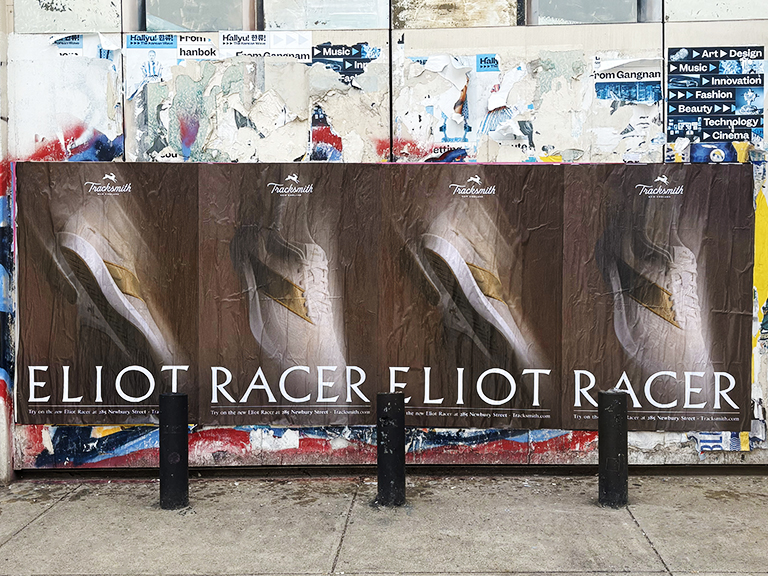
AGM uses 24 x 36 as the primary format for outdoor wheatpasting campaigns, event marketing, brand launch street activations, and any application where the poster needs to perform in a competitive visual environment. At this size, a well-designed poster competes effectively with other environmental advertising. Larger formats (36 x 48 and above) exist, but the per-unit cost increase and logistics complexity often make 24 x 36 the practical choice for campaigns covering 20+ locations.
Print specifications for 24 x 36
Standard 24 x 36 poster specifications: 300 DPI minimum resolution at full size. CMYK color mode for offset print; RGB acceptable for wide-format inkjet with vendor confirmation. 0.125 inch bleed on all sides. Keep critical content at least 0.25 inch from the trim edge. Paper stock: 80 lb text or 100 lb text for standard campaign use; 80 lb matte for wheatpaste applications (absorbs paste better than coated stocks).
27 x 40: The Cinema One-Sheet Standard
The 27 x 40 inch one-sheet is the standard movie poster format used in US cinema lobbies. The format was established by the film industry as a standard for backlit display cases in theater lobbies. At 27 x 40, the proportions are noticeably more vertical than the 24 x 36, giving the one-sheet a distinctive tall format that the film industry uses to create strong vertical compositions with actor portraits and title treatments at the top.
One-sheet outside of cinema
For non-cinema applications, the 27 x 40 format sees limited use because it does not fit standard outdoor frames designed for 24 x 36. For collectors, the one-sheet is a desirable size for framed art prints and promotional pieces. For campaign applications, the one-sheet is less common due to the non-standard frame compatibility and the slight premium over 24 x 36 production cost.
Mini-sheet: 22 x 28
The 22 x 28 inch mini-sheet is a cinema-adjacent format used in theater lobbies, retail displays, and transit advertising. It fits standard display cases in movie theaters and retail environments that do not accommodate the full one-sheet. The 22 x 28 format is also commonly used for transit advertising displays and point-of-purchase retail stands.
Large Format Standard Poster Sizes
Above 24 x 36, standard poster sizes enter large-format territory. These sizes require specialized print equipment and are typically more expensive per unit, but deliver significantly more visual impact at outdoor placements and high-traffic locations.
36 x 48 inches
The 36 x 48 format is four times the area of an 18 x 24 poster and is used for high-impact outdoor applications, construction wall campaigns, and large retail displays. At this size, a poster is readable from 30-40 feet. AGM uses 36 x 48 for premium outdoor placements, construction barriers, and campaigns where the location quality justifies the higher per-unit cost. Our mural advertising campaigns sometimes use tiled 36 x 48 prints as a cost-effective alternative to painted murals.
48 x 72 inches
The 48 x 72 format is a banner-scale poster size used for premium outdoor placements, building wraps, and high-visibility urban advertising locations. At 48 x 72, the poster approaches the scale of a transit shelter advertisement. Print cost is significantly higher than standard sizes, and installation typically requires more than one person. Use this format when the location justifies the investment and the visual impact needs to be dominant.
Standard Poster Sizes for Specific Applications
Beyond the general-purpose formats, specific industries have developed their own standard sizes for particular applications. Knowing these prevents specification errors when ordering for a specific context.
Retail and Point-of-Sale Standards
Retail poster frames and display hardware are often built around specific sizes. Common retail display standards: 22 x 28 inches (standard retail poster frame), 24 x 36 inches (standard floor-standing display), 18 x 24 inches (standard counter-top display frame), 11 x 17 inches (standard bulletin board insert). When ordering for retail display systems, always confirm the frame or hardware dimensions before specifying the poster size.
Transit Advertising Standards
US transit systems use standardized ad formats. Interior transit cards: 11 x 28 inches (standard bus interior) and 22 x 21 inches (subway interior). Exterior transit posters: 30 x 40 inches (transit shelter) and 68 x 48 inches (large transit shelter). Subway platform posters: typically 48 x 70 or 48 x 84 depending on the system. Each transit authority has their own specifications, so confirm dimensions with the specific media buyer before ordering.
Event Marketing Standards
Event poster campaigns typically use the 18 x 24 or 24 x 36 format depending on placement. Indoor venue posters (bars, clubs, record stores) typically use 18 x 24 or smaller. Outdoor event campaign posters are usually 24 x 36. Large venue lobby posters may use 24 x 36 or 27 x 40. For festival and concert campaigns, AGM’s street team deployments carry a mix of sizes – typically 24 x 36 for wheat paste locations and 11 x 17 for high-volume hand distribution.
Standard Poster Size Chart: Complete Reference
The following table covers all standard US poster formats with dimensions and primary applications. Use this as a quick reference when briefing designers or print vendors.
Size (Inches)
Width
Height
Use Case
Notes
8.5 x 11
8.5″
11″
Flyers, counter inserts
Not a poster – flyer scale
11 x 17
11″
17″
High-volume street, bulletin boards
Tabloid format
12 x 18
12″
18″
Small posters, indoor retail
Less common – 18×24 preferred
18 x 24
18″
24″
Indoor campaigns, window displays
Second most common US size
22 x 28
22″
28″
Retail frames, transit displays
Mini-sheet cinema format
24 x 36
24″
36″
Outdoor campaigns, street marketing
Primary US standard
27 x 40
27″
40″
Cinema lobbies, collectors
One-sheet movie poster standard
36 x 48
36″
48″
Large outdoor, construction walls
Large format territory
48 x 72
48″
72″
Premium outdoor, building displays
Banner scale – specialized
Choosing the Right Standard Size for Your Campaign
Selecting the right poster standard is a decision that affects every downstream variable in your campaign: cost per unit, locations eligible for placement, visual impact at distance, and logistics of transport and installation. Here is how our team thinks through size selection.
Budget-driven campaigns
If you are working with a fixed budget and want maximum location coverage, start with 11 x 17 or 18 x 24 depending on your viewing distance requirements. At 18 x 24, you typically print 3-4 posters for every one 24 x 36 you could afford. For a campaign covering 50 locations, that difference in quantity can determine whether each location gets 2-3 posters or 8-10.
Impact-driven campaigns
If your priority is visual impact at key locations, use 24 x 36 as your baseline and consider 36 x 48 for premium spots. One well-placed 24 x 36 in a high-traffic location outperforms five poorly placed 11 x 17 posters. AGM scouts locations before campaigns – knowing the specific walls and surfaces in your target areas lets you match size to location rather than applying a blanket format decision.
Mixed-size campaigns
For larger campaigns, we often recommend a mixed approach: 24 x 36 for high-traffic primary locations, 18 x 24 for secondary locations, and 11 x 17 for bulletin boards and high-volume coverage areas. This maximizes impact where it matters while keeping total campaign cost under control. Our billboard advertising and outdoor media team can advise on the right mix for your specific market and objectives.
Standard Size Considerations for Design
Each standard poster size has specific design implications. The aspect ratio of 24 x 36 (2:3) is different from 18 x 24 (3:4), and different again from 27 x 40 (roughly 2:3 but more elongated). Designing to the wrong aspect ratio and then scaling or cropping to fit is a common error that compromises the original design intent.
Always brief your designer with the exact final poster size before design begins. Designing in one size and adapting to another after the fact works only if the designer has built in sufficient safe zones and the aspect ratios are close. Adapting a 24 x 36 (2:3 ratio) design to 18 x 24 (3:4 ratio) requires significant cropping or redesign – the formats are not directly compatible without intentional adaptation.
For multi-size campaigns, provide the designer with all required sizes at the start. Designing the largest format first and adapting to smaller formats is generally more efficient than designing small and scaling up, because scaling up reveals resolution limitations in raster elements.
Standard Poster Size in Practice: Common Campaign Scenarios
How the standard poster size plays out in real campaign scenarios depends on the specific goals, budget, and market. Here are the typical approaches our team uses for different campaign types.
Single-size campaign
A single-size campaign orders one format and deploys it across all locations. The most common single-size outdoor campaign uses 24 x 36. This is appropriate when all placements are outdoor street-level locations, the viewing distance is consistent (10-25 feet), and simplifying the production process is a priority. Single-size campaigns are easier to brief, produce, and install than multi-size campaigns. The trade-off is that indoor locations that would benefit from 18 x 24 are either skipped or given a too-large poster.
Two-size campaign
A two-size campaign uses 24 x 36 for outdoor placements and 18 x 24 for indoor placements. This is the most common structure for event promotion and general brand campaigns where both outdoor and indoor coverage are part of the strategy. The production brief specifies both sizes with consistent creative (same design adapted to each size’s aspect ratio). Installation crews are briefed on which size goes to which location type.
Three-size campaign
Three-size campaigns add 11 x 17 for high-volume secondary coverage areas – bulletin boards, door poster slots, and close-range indoor surfaces. This approach maximizes coverage across all location types but requires more complex production coordination. For large-budget campaigns in major markets, the three-size approach produces the most comprehensive coverage footprint.
Standard Poster Size: Production Lead Times
Planning a poster campaign requires understanding lead times for standard size production. Most commercial print vendors quote standard lead times that apply to the 24 x 36 and 18 x 24 formats because these are their primary poster production sizes.
Standard offset printing (for runs of 1,000+): typically 5-7 business days for 24 x 36 and 18 x 24 formats from approved print-ready files. Rush turnaround (24-48 hours) is available at most offset shops at a premium of 25-50 percent above standard pricing.
Digital large-format inkjet (typical for runs under 1,000): 2-4 business days for standard sizes. Rush same-day or next-day available at larger print shops for an additional fee. Digital inkjet is appropriate for runs of 1-999 units; offset becomes more cost-effective at 1,000+ units.
Plan to have print-ready files to the vendor at least 5-7 business days before the campaign installation date for standard lead times. For rush campaigns, confirm availability with the vendor before committing to the schedule – rush capacity is limited and books quickly during peak campaign seasons (spring/summer event season and fall back-to-school).
What is the standard poster size in the US?
The most widely used standard poster size in the US is 24 x 36 inches. It is the default format for street campaigns, event marketing, retail displays, and general-purpose advertising. The 18 x 24 is the second most common size for indoor and lower-budget outdoor applications.
What is the standard 18×24 poster used for?
The 18 x 24 inch poster is used for indoor retail signage, window displays, event promotion, and street campaigns where cost per unit is a priority. It is large enough to be read at 5-10 feet and small enough to apply quickly in high-volume wheatpasting campaigns.
What is the standard 24×36 poster used for?
The 24 x 36 inch poster is the standard for outdoor street campaigns, event marketing, bar and venue promotion, and any application where the poster needs to be read from 10-20 feet. It is the most common size for wheatpasting and is considered the default campaign poster format in the US.
What is a one-sheet poster size?
A one-sheet is 27 x 40 inches, the standard movie poster format used in US cinema lobbies. The dimensions were established by the film industry and have remained the cinema standard for decades. For street and campaign use, the one-sheet is less common than 24 x 36 due to its non-standard proportions and higher print cost.
What is the standard movie poster size?
The US movie poster standard is 27 x 40 inches (the one-sheet). A second cinema format, the mini-sheet, is 22 x 28 inches. For theatrical lobby display, posters are framed in backlit display cases sized for the 27 x 40 one-sheet. International cinema markets use A1 (23.4 x 33.1 inches) as the equivalent standard.
What size poster works best for outdoor street campaigns?
For outdoor street campaigns and wheatpasting, 24 x 36 inches is the standard. It provides enough visual surface area to be readable from the sidewalk across the street, while being practical to apply in large quantities. For premium high-traffic locations, 36 x 48 or larger formats increase impact.
What is the standard size for bus stop and transit posters?
US transit advertising uses several standardized formats. Bus shelter posters are typically 68 x 48 inches. Interior bus and subway car cards range from 11 x 28 to 22 x 21 inches. Platform posters vary by transit system. The standardized formats are defined by each transit authority and require confirmation before ordering.
Campaign Architect — American Guerrilla Marketing
Frequently Asked Questions
What is the standard poster size in the US?
The most widely used standard poster size in the US is 24 x 36 inches. It is the default format for street campaigns, event marketing, retail displays, and general-purpose advertising. The 18 x 24 is the second most common size for indoor and lower-budget outdoor applications.
What is the standard 18×24 poster used for?
The 18 x 24 inch poster is used for indoor retail signage, window displays, event promotion, and street campaigns where cost per unit is a priority. It is large enough to be read at 5-10 feet and small enough to apply quickly in high-volume wheatpasting campaigns.
What is the standard 24×36 poster used for?
The 24 x 36 inch poster is the standard for outdoor street campaigns, event marketing, bar and venue promotion, and any application where the poster needs to be read from 10-20 feet. It is the most common size for wheatpasting and is considered the default campaign poster format in the US.
What is a one-sheet poster size?
A one-sheet is 27 x 40 inches, the standard movie poster format used in US cinema lobbies. The dimensions were established by the film industry and have remained the cinema standard for decades. For street and campaign use, the one-sheet is less common than 24 x 36 due to its non-standard proportions and higher print cost.
What is the standard movie poster size?
The US movie poster standard is 27 x 40 inches (the one-sheet). A second cinema format, the mini-sheet, is 22 x 28 inches. For theatrical lobby display, posters are often framed in backlit display cases sized for the 27 x 40 one-sheet. International cinema markets use A1 (23.4 x 33.1 inches) as the equivalent standard.
What size poster works best for outdoor street campaigns?
For outdoor street campaigns and wheatpasting, 24 x 36 inches is the standard. It provides enough visual surface area to be readable from the sidewalk across the street, while being practical to apply in large quantities. For premium high-traffic locations, 36 x 48 or larger formats increase impact.
What is the standard size for bus stop and transit posters?
US transit advertising uses several standardized formats. Bus shelter (transit shelter) posters are typically 68 x 48 inches. Interior bus and subway car cards range from 11 x 28 to 22 x 21 inches. Platform posters vary by transit system. The standardized formats are defined by each transit authority and require confirmation before ordering.