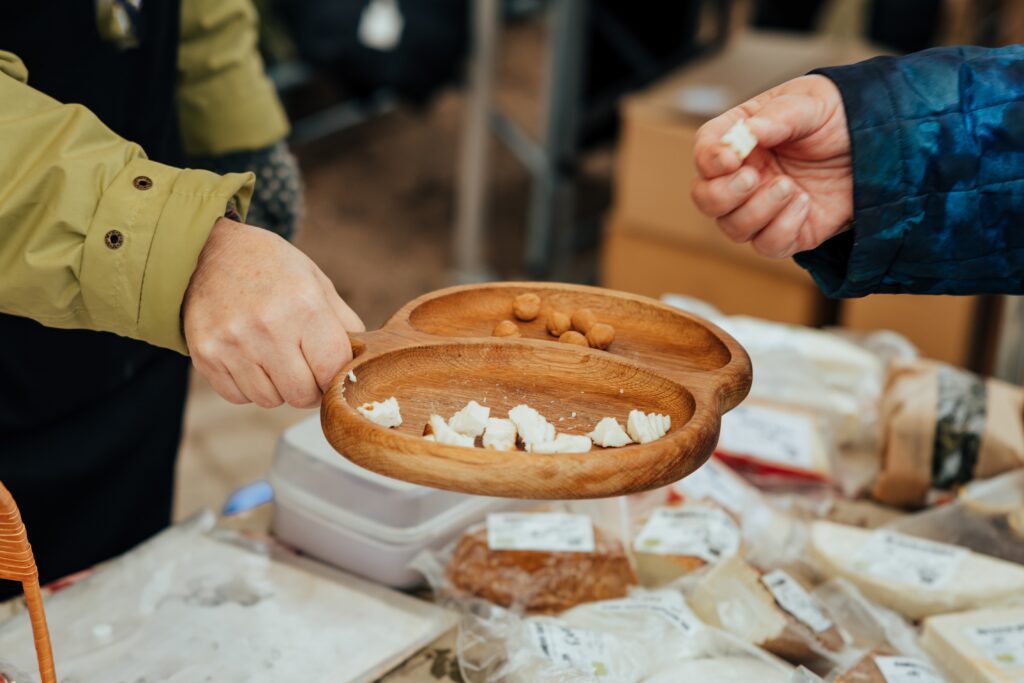
In-store sampling companies execute product demonstrations and sampling programs inside retail locations, at the highest-conversion environment available in the consumer goods marketing network. A consumer who tries a product while they are actively shopping in a store that stocks that product is already at the point of purchase decision. A positive sample experience in this environment can translate to an immediate sale on the same trip, which is the most direct and measurable conversion in any marketing channel.
We are American Guerrilla Marketing. We execute in-store sampling programs for food, beverage, and consumer goods brands in grocery stores, specialty food retailers, natural food chains, and mass-market retailers across the United States. We handle retailer coordination, team recruitment and training, sample preparation and handling, field management, and post-program reporting. This guide explains how in-store sampling programs work, what to look for in in-store sampling companies, and how we build programs that convert.
Why In-Store Sampling Is the Highest-Conversion Marketing Format
In-store sampling holds a unique position in the marketing funnel because it collapses the distance between awareness, trial, and purchase decision to essentially zero. In most marketing channels, those three stages are separated by time, by channel, and by geography. Digital advertising creates awareness. The consumer considers the product over days or weeks. They encounter it in a store at some future date and decide whether to buy it. The gap between awareness and purchase is long, and many potential conversions are lost in that gap.
In-store sampling compresses that gap to minutes. The consumer is in the store. They try the product. They like it. The product is on the shelf within arm’s reach. The distance from positive trial experience to purchase is ten feet and thirty seconds. That compression is the format’s unique value and why it consistently delivers higher direct conversion rates than any out-of-store sampling or advertising program.
What In-Store Sampling Companies Do
In-store sampling companies manage the full execution of sampling programs inside retail locations. The specific scope varies by company and by program, but a complete in-store sampling execution includes:
- Retailer coordination and approval management
- Demo specialist recruitment, training, and scheduling
- Sample preparation and quality management
- Sampling station setup and breakdown
- In-store compliance with retailer-specific requirements
- Consumer interaction and sales support during the demo
- Field management and supervisor oversight
- Post-program reporting with sales data and field observations
Companies that handle only some of these elements, typically the staffing and basic execution components, are staffing operations rather than full-service sampling companies. The difference matters because the elements they leave out, retailer coordination, quality standards, active field management, meaningful reporting, are the elements that most directly determine program quality and results.
AGM Field Note: The in-store sampling programs that generate the highest sales velocity lift for our clients are the ones where the demo specialist is genuinely enthusiastic about the product and creates a real interaction with each consumer, not a transaction. The consumer who is handed a sample by someone who clearly cares about the product and can tell them why it is good in a sentence or two is more likely to buy than the consumer who takes a sample from a disengaged representative who says nothing beyond “would you like to try this?” Training the interaction, not just the mechanics, is what determines conversion quality.
The In-Store Sampling Process
Here is how a properly executed in-store sampling program runs from initial planning through post-program reporting.
Retailer Coordination
Every retail chain has its own process for approving and managing in-store sampling programs. Major grocery chains, specialty retailers, natural food chains, and mass-market retailers all have different requirements, lead times, and approval processes. We manage this coordination for every retailer in scope, ensuring all requirements are met before any demo specialist enters the store.
Store and Location Selection
Within a retailer’s network, specific store locations are selected based on the target consumer demographic, the store’s performance in the relevant product category, and the operational feasibility of the sampling setup at each location. Not every store in a chain is the right store for every sampling program. We apply selection criteria based on the specific program objectives.
Demo Specialist Recruitment and Training
Specialists are recruited for genuine product affinity and communication capability, not just availability. They are trained on the product, the key messages, the sampling protocol, the retailer’s specific in-store rules, and how to handle consumer interactions from the opening line through the conversion prompt. Standard product demo rates run from $389.99 per six-hour shift to $589.99 for premium hosts.
Sample Quality Management
Sample preparation standards, temperature management, freshness protocols, and serving format specifications are established and enforced throughout the program. We do not allow quality shortcuts in sample preparation because the sample is the first product experience for a consumer who may become a lifetime customer if that experience is excellent.
Field Management and Reporting
Field supervisors manage program compliance and quality throughout the deployment. Post-program reports cover store locations served, demo specialist performance, consumer interaction observations, sample volume distributed, and any available sales data from the retail partner. We deliver these reports promptly and with enough detail to be genuinely useful for planning the next program phase.
What to Look For in In-Store Sampling Companies
Evaluating in-store sampling companies requires asking specific questions about the elements that most directly determine program quality.
Do They Have Established Retailer Relationships?
In-store sampling companies with established relationships with major retail chains have smoother, faster access to programs and fewer surprises in the coordination process. Ask specifically which retailers the company has active relationships with and what their track record is for program approval and compliance at those chains.
How Do They Train Their Demo Specialists?
Training quality is the most important predictor of demo performance. Ask specifically what the training covers: product knowledge, key messages, interaction protocol, retailer compliance requirements, and how to handle common field situations. A vague answer about “comprehensive training” is not the same as a specific description of a structured pre-deployment training process.
How Do They Manage Food Safety?
In-store food sampling programs must comply with food safety standards for the product category and the retail environment. Ask specifically about the company’s food safety protocols: temperature management, freshness standards, handling procedures, and how they manage compliance across the range of retail environments they operate in.
What Does Their Reporting Look Like?
Ask for a sample report from a comparable in-store program. A strong report includes store-level performance data, demo specialist observations, consumer interaction quality notes, sample volume, and any available sales data. A weak report shows photos and counts without analytical insight into performance quality.
AGM Field Note: We have run the same product in the same store chain with two different demo specialists and tracked the difference in conversion. The difference between a well-trained, genuinely enthusiastic specialist and a disengaged, poorly briefed one is large, sometimes more than double the conversion rate on the same product in the same store location. Team quality is not a secondary variable in in-store sampling. It is the primary variable. Everything else, location, sample preparation, timing, matters. But team quality matters more than any of them individually.
In-Store Sampling for Product Launches
New product launches benefit enormously from in-store sampling programs at the retail locations where the product is newly stocked. A consumer who encounters a new product on the shelf and tries it in the same shopping trip, with an enthusiastic demo specialist providing context, is in the highest-conversion state available to any marketing program for a new product.
Launch sampling programs are typically concentrated in the first four to eight weeks of distribution availability, when building trial volume early creates the purchase frequency and shelf reorder signals that lead retailers to maintain and expand the product’s shelf presence. A strong early sampling program can be the difference between a product that gets pulled from shelves after an initial trial period and one that earns permanent placement.
Multi-Chain and Multi-Market In-Store Sampling Programs
For brands with distribution across multiple retail chains or multiple regional markets, coordinated multi-chain or multi-market sampling programs create comprehensive trial coverage across the full distribution footprint. We manage retailer coordination across multiple chains simultaneously and maintain consistent program quality standards across all markets and all retail partners in a national program.
Multi-chain programs require more coordination overhead than single-chain programs because each retailer has different access protocols, different compliance requirements, and different store-level coordination needs. We manage this complexity centrally so the client receives consistent program quality regardless of the complexity of the retail footprint.
Launch Your In-Store Sampling Program
In-store sampling is the closest thing to a guaranteed conversion mechanism available in consumer goods marketing when the product is good, the specialist is excellent, and the location and timing are right. We manage all of these variables. Call us and let’s design the in-store sampling program that gives your product the best possible launch at retail.
The AGM Approach: Strategy First, Execution Always
Every program we plan starts with a strategic brief, not a tactical checklist. We want to understand the brand, the product, the target consumer, the market, and the objective before we recommend any tactical approach. A brief that starts with the objective gives us the latitude to recommend the right program. A brief that starts with the tactical specification constrains us to executing something that may or may not be the right approach for the stated goal.
We bring genuine opinions to every brief we receive. If the approach being requested is not the best way to achieve the stated objective, we say so and recommend an alternative. If the budget is insufficient for the program scope being discussed, we say so and recommend an adjustment. If the timeline is too compressed for quality execution, we say so and recommend a realistic alternative. We are a partner, not a vendor. Partners tell you what you need to know, not just what you want to hear.
Our execution standards are professional in the specific, non-generic sense: we have specific standards for rider training, for creative review, for field management, for sample quality, for reporting content, and for client communication throughout the program. These standards exist because we have learned through field experience what determines the difference between programs that deliver and programs that disappoint. We apply them consistently because consistency is how good programs become reliably good programs rather than variable ones.
We are reachable throughout every program we run. Field issues are communicated to clients in real time. Weekly program updates go out during multi-week programs. Post-program reports arrive within five business days of the final deployment day. We do not disappear after a program is sold and reappear with a report at the end. We are present throughout the program at a level of engagement that keeps clients informed and gives us the information we need to manage the program actively rather than reactively.
If any of this describes what you are looking for in a field marketing partner, call us at (646) 776-2770 or email [email protected]. We will schedule a direct conversation about your program and give you an honest assessment of whether we are the right choice for it.
Building a Program That Delivers in the Real World
The gap between a field marketing program that delivers genuine results and one that generates an expensive activity report with nothing to show for it comes down to three variables: strategic clarity in the brief, professional quality in the execution, and honest accountability in the reporting. When all three are present, field marketing programs create meaningful, measurable brand outcomes. When any of the three is missing, the budget gets spent without proportional returns.
We start every program engagement with a strategic conversation, not a price negotiation. We need to understand the brand deeply enough to make genuinely useful strategic recommendations. That means understanding the product, the target consumer, the competitive environment the brand operates in, the specific market we are activating in, and the specific outcome the client needs the program to produce. Without that understanding, we can execute tactics competently but we cannot build a program that is strategically sound.
Professional execution is what we are known for and what we protect as the foundation of every client relationship we have. Our field teams are trained, briefed, supervised, and held to clear performance standards. We do not deploy teams without field management. We do not finalize programs without creative review. We do not accept sample quality that does not represent the brand accurately. We do not allow route drift without field supervisor intervention. These standards exist because field marketing quality is the only thing that determines whether a program generates genuine consumer impact or generates the appearance of activity.
Honest reporting is the accountability mechanism that makes the whole system function. We deliver reports that tell clients what actually happened: where the program was strong, where it was weak, what we did to address problems when they arose, and what we recommend for the next program cycle based on what we learned. We do not optimize our reports for optics. We optimize them for usefulness. A client who gets an honest, useful report from a program that underperformed in specific areas can make better decisions with that information than a client who gets a glowing report that conceals what went wrong.
Field Marketing Program Economics: Getting Value from Your Investment
Field marketing programs are an investment, and like any investment, they require a clear-eyed view of what they return relative to what they cost. Here is how we think about the economics of field marketing across the main program types we execute.
Street team programs generate a specific type of value: direct, human-scale brand encounters with the target consumer in the physical environments where they spend their time. The cost of a six-hour shift with a trained, briefed, supervised street team member running from $389.99 at the standard tier to $589.99 at the premium tier reflects the cost of a professional who represents your brand competently in every interaction they conduct during that shift. The return on that investment is the number and quality of direct brand encounters generated during the shift and the downstream brand recognition and purchase consideration that those encounters produce over time.
Sampling programs generate a different type of value: direct product trial among the target consumer in contextually appropriate environments. The cost of a sampling program includes specialist staffing, sample production and logistics, equipment, field management, and reporting. The return is measured in trial volume, purchase intent lift, retailer velocity data, and long-term brand adoption among the consumers who had a positive first product experience. For brands with genuinely strong products, the ROI on well-executed sampling programs is among the highest in the marketing mix.
Mobile advertising programs, including billboard bikes, LED display bikes, and vehicle-based advertising, generate the value of brand presence in premium access environments. The cost reflects the unique access value of the format: being in Central Park, on the Lakefront Trail, at a major outdoor market is not the same as being on a commercial street. The premium access environment is what the format delivers and what justifies the investment relative to static or vehicle-restricted formats.
Across all program types, the most reliable way to maximize return on investment is to be specific about the objective, design the program specifically to achieve that objective, execute at a professional standard, and measure against the specific outcome the program was designed to produce. Generic programs generate generic results. Specifically designed, professionally executed programs generate the specific outcomes they were built for.
Common Questions We Get from Brands Starting Field Marketing Programs
We have introductory conversations with brands evaluating field marketing programs every week. Here are the questions we hear most often and the honest answers we give.
“How much does a field marketing program cost?” It depends entirely on the scope. A two-person street team for one week in one market is a modest investment. A twenty-city sampling program with twenty specialists per market and full field management is a significant one. We size programs based on objectives and build budgets based on the specific scope required to achieve them. We do not have a standard package price because no two programs are the same.
“How do I know if field marketing will work for my brand?” We evaluate fit based on the brand, the product, the target consumer, and the specific objective. For consumer brands with genuinely strong products targeting specific urban demographics in environments where field marketing operates effectively, it almost always works when it is executed at quality. For brands where the fit is less clear, we say so and recommend whether a test program or a different approach makes more sense.
“How do you ensure the team represents our brand appropriately?” Through recruitment based on genuine product-audience fit, thorough pre-deployment training, active field management throughout every shift, and honest performance reporting that holds teams and supervisors accountable for quality. We have multiple layers of accountability built into every program precisely because brand representation quality is the non-negotiable foundation of field marketing value.
“What if we are not happy with the results?” We have a direct conversation about it. We review the program data together, assess what worked and what did not, and make a recommendation about how to adjust the next program cycle to address the shortcomings of the current one. We do not tell clients that disappointing results are an inherent limitation of the format. We assess whether the issue was strategic, creative, or executional and address it specifically in the next program design.
Why Brands Choose American Guerrilla Marketing
We are a guerrilla marketing agency that has been executing field campaigns in New York and across the United States for years. We are not a large agency with a field marketing division and a hundred other service lines. Field marketing and guerrilla activation is what we do. It is the focus of our team, our systems, our relationships, and our expertise. That focus produces consistently better results than the same service delivered by a generalist agency with many competing priorities.
Our team includes field marketing strategists who have planned and executed programs in every major market in the country, riders and brand ambassadors who represent our clients with professionalism and genuine brand knowledge, field supervisors who manage every deployment with active oversight rather than passive check-ins, and account managers who maintain client communication throughout every program with the transparency and responsiveness of a genuine partner.
We do not have a minimum program size that prevents smaller brands from working with us. We have worked with single-location restaurants, emerging food brands with three grocery store placements, and campaign-stage startups launching their first product. We have also worked with national CPG companies, major entertainment brands, and Fortune 500 companies running simultaneous programs in twenty markets. The program structure scales. The quality standard does not vary by client size.
Our rates are straightforward and transparent. Street team and brand ambassador programs run from $389.99 per six-hour shift for standard members to $589.99 per shift for premium members. Product demonstration programs run the same range. Add-ons including overtime at $65 per hour, travel days at $275 per day, and hotel per diem at $65 per day are billed separately when applicable. There are no hidden fees. The program cost you agree to at the start is the program cost on the invoice at the end.
We operate in all major U.S. markets with primary strength in New York, Chicago, Los Angeles, Miami, Boston, Washington DC, Philadelphia, Atlanta, and San Francisco. In secondary markets, we work with established local execution partners whose quality standards we have verified and whose work we manage directly. Every program we run regardless of market gets the same strategic input, the same training standards, and the same reporting quality that defines our programs in our primary markets.
Our reporting is honest, specific, and delivered on time. We do not celebrate mediocre results or hide field problems behind polished photography. When a program encounters issues, we document them, explain what we did about them, and recommend how to avoid them in the next program cycle. Clients who work with us on an ongoing basis get better programs over time because our reporting gives both parties the information needed to continuously improve the strategy and execution.
If you are looking for a field marketing partner who takes your brand as seriously as you do, who delivers professional execution in the field, and who reports honestly on what the program accomplished, we are ready to have that conversation. Call us at (646) 776-2770 or email [email protected]. We will respond quickly and give you the direct, useful answers you need to make a good decision about your next field marketing program.
How do you ensure demo specialists maintain energy and professionalism throughout a full six-hour shift?
Through scheduling, training, and field supervision. We build shift schedules that include appropriate breaks without creating gaps in sampling coverage. We train specialists specifically on energy and engagement maintenance, including the physical and interpersonal techniques for staying genuinely present and enthusiastic over an extended deployment period. Field supervisors check in throughout each shift and intervene when a specialist’s energy or engagement quality drops below our standard. A sampling specialist who is visibly disengaged or fatigued is rotated or relieved rather than left on the floor representing the brand below the standard we maintain.
Frequently Asked Questions
How do we get approval for in-store sampling at major grocery chains?
Each major grocery chain has its own vendor or sampling partner program with specific approval requirements and processes. Some chains require brands to use approved sampling partners. Others allow brands to use their own sampling companies. We know the approval requirements for the major chains we work with and manage the process from initial application through program execution. We discuss the specific retailer requirements for your program during planning.
How far in advance do we need to plan an in-store sampling program?
For major grocery chains, four to six weeks of lead time is typically required to accommodate the retailer’s approval process, specialist scheduling, and sample logistics. Natural and specialty retailers may allow shorter lead times. We build the timeline based on the specific retailers in scope and their approval process requirements.
Can in-store sampling be coordinated with other marketing activities?
Yes, and this is how we recommend approaching it. In-store sampling programs that run simultaneously with digital advertising, out-of-home placements, or other marketing activities in the same market compound the conversion rate of the sampling program because consumers arrive at the store with existing brand awareness. The sampling encounter feels like confirmation of something they already know about rather than a cold introduction to something they have never heard of.
How do you measure the sales lift from an in-store sampling program?
The cleanest measurement is scan data from the retail partner comparing sales velocity at sampled stores during the sampling period versus comparable unsampled stores. Many retailers make this data available to brands through their vendor portals. We help clients access and interpret this data as part of our post-program reporting. Where scan data is not available, we use coupon redemption rates, demo specialist conversion observations, and any other available proxy metrics.
What is the minimum number of stores needed for a meaningful in-store sampling program?
There is no absolute minimum, but a program covering very few stores in a major market generates insufficient trial volume to move category metrics. For launch programs, we recommend covering at least the top-performing stores in the target market’s distribution footprint to ensure the trial volume creates the early purchase signals that support continued distribution. For specific programs like regional tests, even a small store count can generate meaningful data when the stores are selected correctly.
Can in-store sampling work for non-food products like personal care or household items?
Yes. Personal care, household, and other non-food CPG categories can all benefit from in-store sampling or demonstration programs. The mechanics differ from food sampling: you may be offering a product trial or demonstration rather than a consumable sample. The conversion dynamic is similar: a positive in-store trial experience at the point of purchase drives purchase decisions in ways that no advertising can replicate. We have executed in-store programs for non-food CPG categories and can tailor the approach to the specific product and retailer environment.
Do you handle all food safety compliance for in-store sampling programs?
Yes. We research and comply with applicable food safety standards for every product type and every retail environment we operate in. This includes temperature management requirements, freshness standards, handling protocols, and any retailer-specific food safety compliance requirements. We do not ask clients to manage food safety compliance independently. It is part of our standard program management.