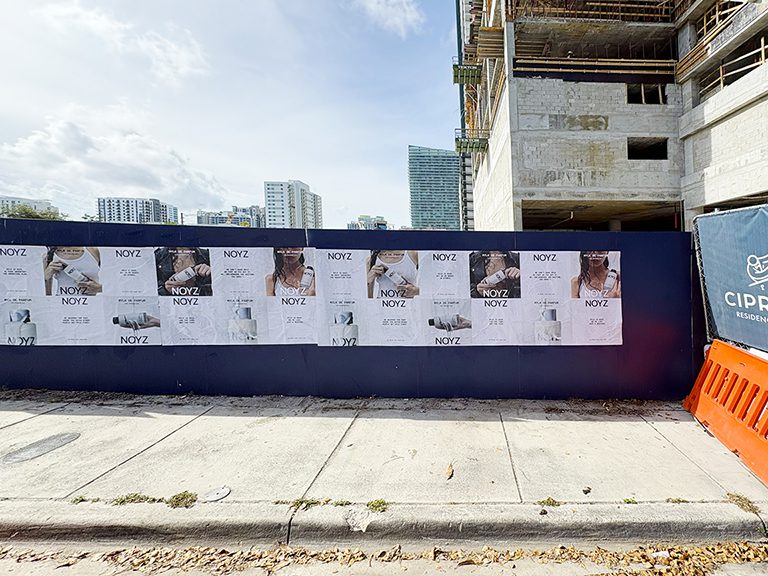
Fly Posting: The Complete Street Poster Campaign Guide | AGM
Fly posting has been on the walls of every major city for centuries. Here is how it works, who uses it, and what it takes to execute a campaign that actually performs.
Fly posting is one of the oldest and most durable advertising formats in existence. Long before digital platforms, streaming, or social media, brands, artists, and promoters used paste, paper, and urban walls to communicate directly with the people who moved through their cities. The format has evolved since then. Paste formulations are better. Paper is more durable. Location strategy is more sophisticated. But the core logic is unchanged: put your message at eye level, on the streets where your audience actually is, and make it impossible to ignore.
We have been running fly posting campaigns for over a decade. Our teams have covered the walls of Williamsburg and the Lower East Side in New York. We have posted along Fairfax and Melrose in Los Angeles, on Milwaukee Avenue in Chicago’s Wicker Park, in Wynwood in Miami, in East Nashville, and in Austin’s Red River corridor. Every campaign across every market teaches you something about how this format works, what it rewards, and where it fails.
This guide covers the full picture: what fly posting is, where it came from, who uses it, what the materials look like, how to plan a campaign, and what separates campaigns that generate attention from campaigns that disappear into the visual noise of the street.
Fly posting is the practice of adhering paper posters to walls, barriers, fences, construction hoardings, and other outdoor urban surfaces using paste. The traditional adhesive is wheatpaste, a mixture of flour and water cooked to a thick, gel-like consistency that bonds paper to surface and dries into a semi-permanent installation. The term “fly posting” is most widely used in the United Kingdom and parts of Europe, but the practice is global. In the United States, the same format goes by several names: postering, bill posting, snipe campaigns, and wheatpasting all describe variations of the same core activity.
What distinguishes fly posting from other outdoor advertising is its physical integration into the urban environment. Unlike a billboard elevated above traffic or a transit advertisement behind glass, a fly posted poster occupies the same physical space as the people looking at it. It is at eye level. It is part of the street’s visual texture. It does not ask you to look up or down. It is simply there, in the flow of the environment you are already moving through.
That environmental embeddedness is part of what makes fly posting work. When the creative is right and the location is right, the poster belongs on the wall. It reads as a natural part of the street’s visual culture, not as a paid interruption. People stop and look. They photograph it. They share it. The physical placement becomes a digital discovery moment when the right image lands in front of the right audience. Street presence and digital documentation amplify each other in a way that either medium alone cannot produce.
The History of Fly Posting
Paper posted to walls is one of the oldest forms of mass communication in recorded history. Printed handbills and broadsides covered the walls of European cities from the earliest days of the printing press. Theaters, taverns, political factions, and merchants all used the format to communicate publicly before any other mass media existed. The streets of London, Paris, and Amsterdam were dense with posted paper by the seventeenth century, and the practice spread to North American cities as urban populations grew.
By the nineteenth century, bill posting had become a formal commercial industry on both sides of the Atlantic. Dedicated bill posting companies hired crews to apply advertisements to every available surface in cities and towns. The profession developed its own standards, territories, and trade organizations. Advertisers paid for surfaces by the week, and posting crews competed fiercely for the best walls and barriers in high-traffic corridors. The visual density of posted paper in Victorian-era cities was extraordinary by modern standards.
In early twentieth century America, fly posting and street-level postering were core components of promotional campaigns for theaters, circuses, boxing matches, and traveling shows. Advance crews would arrive in a city days before an event and cover every available surface with promotional paper. The visual saturation was the campaign. Before radio and before television, the walls were the media.
The punk rock movement of the 1970s gave fly posting a new cultural identity that persists today. In New York, London, Los Angeles, and dozens of other cities, bands, venues, and promoters put up their own posters on the walls of neighborhoods where their audiences lived and moved. The aesthetic was raw, urgent, and direct. A Xeroxed poster with hand-drawn type on the telephone pole outside a venue in the East Village or Camden Town became a cultural artifact. The format absorbed the energy of underground music culture and has carried those associations ever since.
Through the 1980s and 1990s, major record labels adopted fly posting as a standard tool for album and tour promotion. Professional crews with better materials and more sophisticated location strategies replaced the informal DIY posting of the punk era. The format reached its modern operational maturity in this period, with city-specific location networks, professional paste formulations, and coordinated multi-market installations becoming standard practice for large campaigns.
Digital advertising did not displace fly posting. It changed its role. As digital environments became more crowded and consumers’ attention became more fragmented, physical street presence became more valuable, not less. Brands that had relied on digital to carry all the weight began using street campaigns to create the physical, real-world presence that screens cannot replicate. The cultural authenticity that fly posting carries from its history became an asset in a media environment where that authenticity is genuinely scarce.
AGM Field Note: Fly posting has outlasted every wave of media that was supposed to make it obsolete. Radio. Television. Digital. Social media. Streaming. Through all of it, the pasted poster on the urban wall has held its value. The reason is straightforward: nothing else puts your brand in the physical environment of your audience, at eye level, with the cultural credibility of the street. That combination has no digital equivalent.
Who Uses Fly Posting
The client profile for fly posting has broadened significantly over the past fifteen years. The format is no longer primarily an independent music tool. It spans a wide range of industries and organizational types, each using it for different strategic reasons.
Music Artists and Labels
Music remains the foundational use case for fly posting. Major labels, independent labels, and self-releasing artists all use the format for album releases, single launches, and tour announcements. No other advertising channel carries the cultural credibility in music that fly posting does. A poster campaign on the walls of the right neighborhoods signals that an artist is embedded in the culture, not simply marketed at it. The format has been part of how music reaches audiences for over a century, and that history still matters to audiences who care about authenticity signals.
Fashion Brands
Fashion brands across the price spectrum use fly posting to build neighborhood presence and associate their identity with the visual culture of specific urban corridors. For a brand launching a new collection, placing posters in Soho, Williamsburg, Fairfax, or Shoreditch is itself a positioning statement. The location selection communicates cultural alignment before anyone reads a single word of the poster. Fashion campaigns often use the format in concert with pop-up events, retail activations, and editorial shoots in the same neighborhoods to create a coherent physical presence across multiple touchpoints.
Film and Television
Studios and streaming platforms use fly posting for film and series launches, particularly for projects targeting urban audiences or positioned as culturally distinctive. The teaser campaign format, placing posters weeks before a release with minimal information to build mystery and anticipation, is one of the most effective uses of fly posting for entertainment marketing. A strong image with a date and nothing else creates conversation and discovery before the full campaign breaks. The format rewards restraint in a way that most entertainment marketing does not practice.
Consumer Brands
Consumer brands in food, beverage, tech, wellness, beauty, and retail have significantly expanded their use of fly posting over the last decade. The format reaches urban demographics efficiently and with a cultural authenticity that traditional outdoor advertising formats lack. Brands that have genuine urban relevance and creative strong enough to earn its place on a wall get significant value from the format. Brands that treat fly posting as simply another outdoor media buy without regard for creative quality or location strategy get limited results.
Nonprofits and Advocacy Organizations
Cause-based organizations and advocacy groups use fly posting to build awareness and generate community engagement at street level. The format’s grassroots associations make it particularly well-suited to advocacy work. A well-designed poster in the right neighborhood communicates a cause with an immediacy and authenticity that broadcast advertising cannot match. For organizations building community-level momentum, street presence is both a practical tool and a signal of genuine engagement with the physical spaces where their audience lives.
Fly Posting Materials: What a Professional Campaign Uses
The materials in a fly posting campaign directly determine how long it holds, how it looks at street scale, and how it performs across different surface types and weather conditions. Professional campaigns use materials specifically selected for each campaign’s environment and duration requirements.
Paper
Paper weight and coating are the two most important variables in poster production for fly posting. The standard range for most campaigns is 60 to 80 lb text weight. This range bonds well with paste, applies smoothly without excessive wrinkling, and holds color saturation adequately. Lighter paper below 50 lb is more fragile during application and less durable in outdoor conditions. Heavier paper at 90 to 100 lb provides greater durability and better detail retention at large format sizes, but requires more careful paste application to avoid air pockets between the paper and the wall surface.
Coating selection affects both print quality and weather resistance. Matte and semi-matte coatings are preferred for most fly posting applications. They read clearly across variable outdoor lighting conditions, absorb paste more evenly for better adhesion, and do not create the light reflections that glossy finishes produce in direct sunlight. For campaigns expected to run longer than three weeks, or in markets with significant weather exposure, a UV-resistant matte coating extends the visual lifespan of the placement significantly.
Paste
Wheatpaste, the traditional adhesive for fly posting, is made from flour and water cooked together into a thick gel. It is water-soluble before drying, which makes application easy, and it creates strong adhesion on porous surfaces like concrete, brick, and untreated wood. After curing, wheatpaste forms a semi-permanent bond that resists light rain and wind. The bond weakens significantly when re-wetted, which is why posting immediately before heavy rain is never recommended.
Commercial methyl cellulose paste is the professional alternative. It mixes to a consistent viscosity, has a longer working time before setting, and performs predictably across surface types including non-porous surfaces like metal and painted concrete where wheatpaste adhesion is inconsistent. For campaigns on varied surface types, methyl cellulose is the more reliable choice.
Hybrid formulations combining wheat starch with methyl cellulose are common in professional fly posting operations. The wheat starch provides strong initial tack for quick installation, which matters when a crew is moving through a long corridor on a compressed overnight schedule. The methyl cellulose component adds durability for campaigns expected to hold through multiple weeks of weather exposure. Paste formulation is adjusted by crew based on surface type, temperature, humidity, and the weather forecast for the 24 to 48 hours following installation.
Format Reference Table
Format
Size
Best Surface
Primary Use Case
Visibility Distance
Snipe / Handbill
11″ x 17″
Pole, fence, door
Dense saturation, event promotion
5–10 feet
Standard Street Poster
24″ x 36″
Wall, barrier, fence
Music, events, product launches
10–25 feet
Large Format
48″ x 72″
Wide wall, construction barrier
Brand presence, major campaigns
25–50 feet
Supersized
60″ x 90″ and larger
Building side, long barrier
Launch campaigns, media moments
40–100 feet
Multi-Panel Mural
Custom
Full building side, long hoarding
Immersive brand moments
Entire street width
Fly Posting Locations: How We Select Where Campaigns Go
Location selection is where fly posting strategy either works or falls apart. Placing posters in the wrong neighborhoods at the wrong density is the single most common reason campaigns underperform. Placing them precisely in the corridors where your audience concentrates is what makes a campaign efficient.
The Corridors We Know
In New York, Bedford Avenue in Williamsburg is the most consistently productive posting corridor for youth, music, and culture-adjacent brands. The side streets off Metropolitan Avenue in Williamsburg, Orchard Street and Ludlow on the Lower East Side, and Bushwick’s Wyckoff and Irving corridors each carry distinct demographic profiles. Crown Heights’ Nostrand and Franklin avenues have grown as productive corridors in recent years. Knowing which street is right for which campaign requires knowing those distinctions in detail.
In Los Angeles, Fairfax Avenue between Melrose and Beverly Hills is the most visible fly posting corridor for streetwear and youth culture campaigns. The Arts District along Traction and Mateo is the primary corridor for creative industries, music, and experiential events. Melrose between La Brea and Fairfax, Abbott Kinney in Venice for design and wellness brands, and parts of Silverlake and Echo Park each serve different demographic profiles. A fashion brand targeting streetwear audiences and a wellness brand targeting creative professionals belong on different streets.
In Chicago, Milwaukee Avenue through Wicker Park and Bucktown is the primary indie music and arts corridor. Division Street serves nightlife. Pilsen’s 18th Street corridor reaches arts and Latino culture audiences. Each corridor has its own character, its own foot traffic, and its own best use case for fly posting campaigns.
Surface Assessment
Not every wall in a productive neighborhood is a productive fly posting surface. Surface texture, condition, orientation, and sight line all affect performance. Smooth, clean surfaces like concrete and plywood provide strong adhesion and clean print reproduction. Textured brick requires heavier paste application and more careful paper alignment. Peeling or damp surfaces are poor candidates regardless of location quality.
Sight line matters as much as surface quality. A wall facing into approaching foot traffic outperforms one facing away. A placement at 5 to 8 feet height at eye level outperforms one at 12 feet that requires looking up. Corner walls with cross-street exposure deliver more foot-traffic contact than mid-block walls with single-direction visibility. We factor all of these variables into every location plan.
AGM Field Note: Our location database covers hundreds of confirmed surfaces across a dozen major US markets. But we scout before every campaign, not just before new market entries. Neighborhoods change. Construction starts. A wall that was clean six months ago may have been painted, fenced off, or taken over by a competing campaign. Fresh eyes before every campaign is a non-negotiable part of our process.
Planning a Fly Posting Campaign: Stage by Stage
A professional fly posting campaign moves through a consistent sequence from brief to street. Understanding each stage helps brands set realistic timelines, allocate budget correctly, and build accurate expectations for what the campaign will deliver.
The Brief
Every campaign starts with a brief. The brief answers three core questions: Who is the target audience? What is the campaign trying to accomplish? Where does that audience concentrate physically in the city? The answers drive every decision that follows. A campaign for a new sneaker release targeting streetwear-aligned 18 to 28-year-olds in New York is a different campaign from one for a documentary film targeting 30 to 50-year-old arts and culture audiences in the same city. Same format. Completely different geography, creative approach, and scale.
Location Scouting
After the brief, we build a location plan. For markets we work regularly, the plan draws on our existing location database combined with current conditions scouting. For markets we are entering for the first time, we scout in person and deliver a placement plan with photographs of proposed surfaces before any production begins. This step exists because the best location plan on paper is worth nothing if the walls it specifies have changed since the database entry was written.
Creative Review
We review creative before it goes to print. Fly posting creative has requirements that differ from other advertising formats. Text must be readable at walking pace from 10 to 20 feet away. Color contrast must hold across variable outdoor lighting conditions. Images must communicate at actual print scale, not just at screen preview size. We check these factors during review and flag anything that needs adjustment before production begins. This is a quality control step. Problems found during creative review cost an afternoon. The same problems found after a print run cost a full reprinting cycle.
Print Production
Standard production for a fly posting campaign takes 7 to 14 days depending on quantity, format, and vendor capacity. We work with print partners who understand outdoor-specific production requirements. Physical proofs are reviewed before large runs go to press. Color management between digital file and physical print output is where most production problems originate. The proof step catches them before they become expensive mistakes.
Installation is where campaign planning becomes physical reality. The quality of installation work determines how good the campaign looks in documentation photos, how long placements hold, and how the brand appears in the street environment across the campaign window.
Overnight Execution
All installation happens between midnight and 5 AM. The practical reason is straightforward: streets are quieter, which allows for deliberate, high-quality installation work. Crew can focus on precise alignment, proper paste coverage, and thorough edge bonding without the interference of daytime foot traffic. The quality difference between rushed daytime installation and careful overnight installation shows up in every documentation photo and in how long placements hold before edges start lifting.
The secondary benefit of overnight installation is that placements are fresh and at their best condition for the morning’s peak foot traffic. A freshly installed poster in perfect condition that the morning commute encounters for the first time is the highest-impact moment of any campaign. That moment cannot be manufactured for a daytime installation where the poster has already been in place through hours of heat, wind, and passing contact before peak foot traffic arrives.
Crew Composition and Tools
A professional fly posting crew typically operates in pairs or small teams. One person applies paste to the surface, a second applies the poster, and a third applies a top coat of paste to seal the paper and prevent edge lifting. For large format installations, this sequence requires coordination. For multi-panel installations, crew alignment accuracy is critical to making the assembled image read correctly on the wall.
Application tools are simple: wide brushes or rollers for paste application, buckets for paste transport, extension poles for placements above standing reach. Every placement is photographed immediately after completion while paste is still wet, with the surrounding environment clearly visible. GPS coordinates are captured at each placement for the post-campaign documentation report.
Weather Management
Paste behavior changes significantly with temperature and humidity. Cold temperatures slow cure time and can reduce adhesion on cold surfaces. Rain during or immediately after installation compromises adhesion before paste can cure. Hot, dry conditions accelerate drying and require faster application to avoid bubbling. We monitor weather forecasts for every installation window and plan accordingly. A rain forecast changes paste formulation. A cold snap changes the installation sequence and timing. We never install in active rain and never plan installations without a 12-hour dry window confirmed following completion.
What Makes Fly Posting Work: The Creative Variables
Creative quality is the multiplier on every other campaign variable. A great creative in a great location with a great installation is as good as outdoor advertising gets. Poor creative in the same location with the same installation produces a different result entirely. Here is what distinguishes creative that works at street level.
Contrast and Readability
High contrast between text and background is non-negotiable at street scale. The lighting environment of an outdoor wall is variable across the day, across weather conditions, and across seasons. Creative that depends on subtle tonal differentiation loses legibility in the field. Black on white, white on black, yellow on black, black on yellow. These combinations hold across all outdoor lighting conditions. Everything more nuanced than this needs rigorous real-world testing before a campaign goes to press.
Scale and Hierarchy
Type that reads at screen scale does not always read at street scale. The hierarchy of a fly posting design must work at the walking pace of someone 15 feet away who is not stopping to read. The primary message must land in two seconds. Secondary information can reward closer inspection, but the primary read must happen at distance and pace. Title type on a 24×36 poster should be set at 120 points or larger. Anything requiring close reading should be treated as an optional layer, not a primary communication element.
The Value of Restraint
The campaigns that perform best at street level consistently use fewer elements, not more. A single powerful image with a name and a date outperforms a design with five headline lines, a tagline, a social handle, a QR code, and a website URL. The discipline to put one thing on a poster and make that one thing as strong as it can be is the creative skill the format rewards most directly. Street audiences do not stop to read. They notice. Then they look up or look away. The creative has to earn the notice and then deliver the message in the moment of noticing.
AGM Field Note: One of the most effective campaigns we have run used three words and a date on a black poster. No image. No supporting copy. No logo. Just three words and a date in white type. By the morning after installation, people were photographing it and asking publicly what it meant. That is what restraint earns you in the street environment. Curiosity is one of the most valuable states you can produce in an audience.
Fly Posting in Major US Markets
Every city has its own posting culture, its own productive corridors, and its own audience environment. What works in Williamsburg does not automatically work in Pilsen or Silver Lake. Here is how we approach each major market.
New York City
New York is the densest and most competitive fly posting market in the United States. The productive corridors are well-established and crowded, which means turnover is faster than in other markets. We typically recommend either tight geographic focus in a specific neighborhood with multiple placements per block, or a wider dispersal with larger format placements that hold their visual presence even as competition increases around them. New York rewards specificity. The audience differences between Williamsburg and the Lower East Side, or between Bushwick and Crown Heights, are real and significant for campaign targeting.
Los Angeles
Los Angeles is a car-centric city with specific walking corridors where fly posting concentrates. Fairfax, Melrose, Abbott Kinney, the Arts District, and parts of Silverlake and Echo Park are the primary zones. The creative environment in LA is competitive but different from New York: the city skews toward highly visual, photography-friendly creative that earns organic documentation and sharing. LA campaigns benefit from placement on walls that have strong visual backgrounds and that photograph well in daylight.
Chicago
Chicago’s fly posting activity concentrates in Wicker Park, Bucktown, Pilsen, and Andersonville. Milwaukee Avenue in Wicker Park is the most consistently active posting corridor. The market has a lower overall posting density than New York or LA, which means placements hold longer and face less competition. Campaign timing around music and cultural events at venues like Thalia Hall, Empty Bottle, and Metro creates natural audience concentration points for location strategy.
Miami
Wynwood is Miami’s primary fly posting corridor, though the market has evolved significantly as the neighborhood has become more commercial and higher-traffic. The result is a market where strong creative stands out more clearly than it does in more saturated environments. Design District adjacencies and parts of Little Havana offer alternative corridors for campaigns targeting specific demographic segments.
Frequently Asked Questions
What is fly posting?
Fly posting is the practice of adhering printed paper posters to walls, barriers, fences, and other outdoor urban surfaces using paste. It is one of the oldest and most widely used forms of street advertising, employed by music artists, fashion brands, film studios, and consumer brands to reach urban audiences at street level.
What paste is used in fly posting?
The traditional adhesive is wheatpaste, made from flour and water cooked to a thick, gel-like consistency. Professional campaigns also use methyl cellulose paste or hybrid formulations that combine wheat starch with synthetic adhesive for improved durability on non-porous surfaces.
How long do fly posted posters last?
A professionally installed fly posting campaign typically holds for two to four weeks in most urban environments under normal weather conditions. Placement longevity depends on surface type, paste quality, weather exposure, and the posting activity level of the specific corridor.
What sizes are used in fly posting?
The most common format is 24×36 inches, which is the standard street poster size for music, events, and brand campaigns. Large format runs from 48×72 inches up to multi-panel supersized installations. Snipe posters at 11×17 are used for dense saturation in high-competition areas.
Who uses fly posting?
Fly posting is used by music artists, record labels, fashion brands, film studios, streaming platforms, consumer brands, nonprofits, and advocacy organizations. The format spans from independent artists running small local campaigns to major labels and global brands executing citywide campaigns across multiple markets simultaneously.
What neighborhoods are best for fly posting in New York?
The most active and productive fly posting corridors in New York include Bedford Avenue in Williamsburg, the streets around Orchard and Ludlow on the Lower East Side, parts of Bushwick and Ridgewood in Brooklyn, and select corridors in Crown Heights and Bed-Stuy. The best neighborhood for any specific campaign depends on the target demographic.
How much does a fly posting campaign cost?
Campaign cost depends on poster format, quantity, market, and scope. Contact us directly at (646) 776-2770 for a custom quote. Multi-city campaigns require four to six weeks lead time for planning and coordination.