Financial services brands operate in the most regulated category in marketing. Every claim is scrutinized. Every rate reference triggers compliance review. The legal and regulatory environment that governs financial advertising makes many brand managers reluctant to venture beyond the formats where compliance teams are most comfortable. But the result is financial services brands that rely entirely on digital and traditional advertising in a category where nearly every competitor is running the same channels with the same claims at the same people.
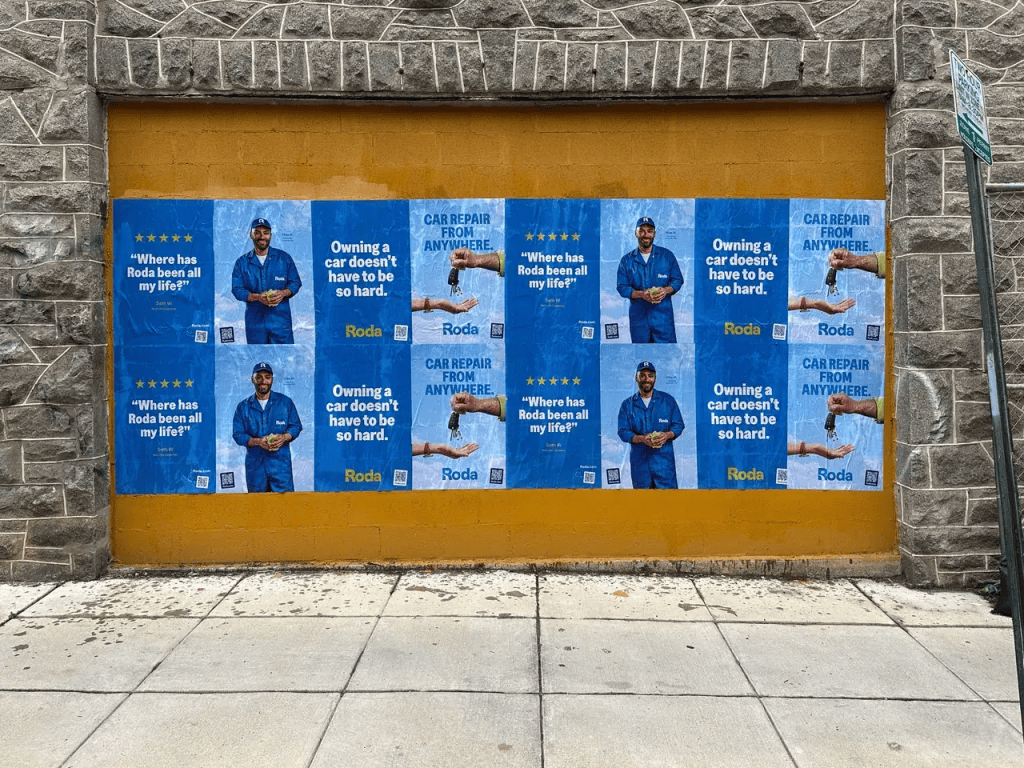
Street-level guerrilla marketing offers financial services brands a way out of that trap. Ambient brand awareness formats that do not make product-specific claims or rate references are generally outside the scope of the regulatory frameworks that govern financial advertising. A well-designed wheat paste poster campaign that communicates brand identity and positioning without quoting rates or making performance guarantees builds familiarity and trust in a way that a digital retargeting ad cannot, and does it without triggering the compliance review process that slows most financial advertising campaigns.
Our team at American Guerrilla Marketing has executed campaigns for banks, credit unions, fintech platforms, insurance brands, and investment services companies. This guide covers the formats that work within financial services compliance constraints, how to target the right neighborhoods and transit corridors, and how to build a street-level presence that makes your digital acquisition more efficient.
Why Street-Level Marketing Works for Financial Services
Financial services purchase decisions are built on trust and familiarity. A consumer is significantly more likely to open a bank account with, apply for a card from, or download an app for a brand they have seen multiple times in their daily environment than one they encountered only in a retargeting ad. The repeated brand exposure that street-level campaigns create, at zero marginal cost per impression after the initial placement, builds the ambient familiarity that reduces friction in the digital acquisition funnel.
The Familiarity Effect in Financial Services
Research in behavioral finance consistently shows that consumers prefer familiar brands when making financial decisions, all else being equal. Brand familiarity reduces the perceived risk of a financial relationship. A fintech brand that has built awareness through a market-specific poster campaign before launching a digital acquisition push in that market will see meaningfully lower CPAs on the digital side than a brand that goes direct-to-digital without the ambient familiarity foundation.
Geographic Density as a Targeting Advantage
Unlike digital advertising, which targets by audience signal, street-level campaigns target by geography. For financial services brands with a specific market expansion strategy (a credit union expanding into a new metropolitan area, a fintech company targeting a specific urban demographic concentration, a bank opening new branch locations), geographic precision is exactly what is needed. Our guerrilla marketing services team selects deployment zones based on the concentration of the target customer in each market area, not just broad neighborhood names.
Compliant Campaign Formats for Financial Services Brands
The key to compliant financial services street marketing is selecting formats that build brand identity without making the product-specific claims that trigger regulatory review. The formats below consistently work within financial services compliance frameworks.
Wheat Paste Poster Campaigns: Brand Presence Without Product Claims
Wheat paste poster campaigns that communicate brand identity, positioning, and a brand message without rates, guarantees, or performance claims are generally outside the scope of financial services advertising regulations. A campaign that says “Banking for people who actually work for a living” or “Your money should work as hard as you do” with a brand name and website URL is an ambient brand building message, not a financial advertisement in the regulatory sense. All materials should go through the brand’s compliance review before production, but the review process for this category of messaging is typically straightforward.
LED Billboard Trucks on Commuter Routes
Our LED billboard trucks running brand identity creative along commuter corridors deliver repeated impressions to the professional demographic that is the primary target for most financial services brands. A financial services brand running an LED truck on the FDR Drive during morning commute hours, or along the I-90 corridor in Chicago, or on the 101 in San Francisco, reaches exactly the income and employment profile that defines the target customer base for most premium financial products.
Sidewalk Stencils Near Branch and ATM Locations
Sidewalk stencil campaigns placed near branch locations, ATM footprints, and target residential neighborhoods create environmental reminders of brand presence that are highly effective for bank and credit union expansion campaigns. A stencil placed on the approach to a transit hub that connects the target residential neighborhood to the downtown business district creates repeated exposure for the commuter audience in both directions of the daily journey.
Brand Ambassador Programs Near Financial Districts
Our brand ambassador team programs for financial services brands operate in financial district lunch zones, corporate campus approaches, and residential neighborhood commercial corridors. Ambassadors distribute brand awareness materials (no product claims, no rate references) and can direct interested prospects to a digital landing page for more information. The human-to-human interaction creates a level of brand warmth that ambient formats alone cannot achieve.
Target Markets for Financial Services Street Campaigns
Financial services street marketing works most efficiently in markets with high concentrations of the target demographic, defined primarily as working professionals with savings capacity and investment or banking products to allocate.
Primary Markets
New York is the primary market for most financial services brands. The concentration of financial industry professionals in Manhattan and the adjacent Brooklyn neighborhoods (Dumbo, Park Slope, Williamsburg, Brooklyn Heights) creates a uniquely high-density target audience for premium financial products. Our team operates across the full New York market from our Industry City, Brooklyn NY base.
San Francisco and the Bay Area target tech-sector employees with above-average investable assets and high affinity for fintech products. Chicago’s Loop and North Side neighborhoods concentrate the financial professional demographic that is the primary target for premium banking and investment products. Boston, Washington DC, and Seattle round out the primary markets for most financial services campaigns targeting the affluent professional demographic.
Fintech and Underbanked Market Opportunities
Fintech brands targeting the underbanked or financially underserved demographic have a different geographic targeting profile. Markets with high concentrations of unbanked households, including parts of Miami, Houston, Los Angeles, Chicago’s South and West Sides, and New York’s outer boroughs, offer strong opportunities for brands offering accessible financial products. Ambassador programs in these markets that clearly communicate product accessibility and fee transparency are particularly effective.
Transit Hub Targeting for Financial Services
Transit hubs are among the most effective environments for financial services street marketing because they reliably concentrate the professional commuter demographic that defines the primary target audience for most financial products. A commuter sitting at a subway station or walking through a transit hub is doing nothing but moving through space. Brand exposure in that moment is high-quality because there is no competing media, no scrolling, no multi-tasking.
Key Transit Targeting Opportunities
Grand Central and Penn Station approaches in New York reach 700,000+ daily commuters with high professional income concentration. Chicago’s Loop CTA stations concentrate financial district workers during the 7 to 9 AM and 5 to 7 PM commute windows. BART’s Montgomery and Embarcadero stations in San Francisco reach the financial district and tech sector commuter demographic. Coordinating subway advertisement programs with street-level poster campaigns in the surrounding neighborhoods creates layered reach in the same target demographic across multiple touchpoints in the daily commute journey.
How Street Campaigns Improve Digital Acquisition Efficiency
The ROI case for financial services guerrilla marketing is strongest when it is connected to digital acquisition performance. The mechanism is straightforward: consumers who have encountered a brand in their physical environment are more likely to convert when they encounter it in a digital acquisition context. The brand familiarity built through street-level campaigns reduces the cognitive effort required to trust a digital ad or sign-up prompt from an unfamiliar brand.
Our team coordinates street campaign deployment zones with the client’s digital team’s geo-targeting parameters. When the poster campaign coverage area in Brooklyn and Williamsburg matches the geo-target radius for the brand’s paid social campaign in New York, the consumer receives reinforcing brand encounters across both channels. This coordination consistently produces lower digital acquisition CPAs in markets where street campaigns have run compared to markets with digital-only programs, based on client data our team reviews at program close.
Creative Considerations for Financial Services Street Creative
Financial services street campaign creative needs to balance brand warmth with the institutional credibility that consumers associate with financial trust. Over-casual creative that prioritizes streetwear-level cool over financial competence signals misses the mark for most financial services audiences. Over-formal creative that reads like a regulatory disclosure creates no brand warmth and generates no attention at street level.
The creative that works for financial services street campaigns communicates a clear brand perspective, addresses a specific consumer pain point or aspiration (without making a guarantee), and uses visual design that reads as premium without being exclusionary. For fintech brands targeting younger demographics, bolder, more typographically driven design outperforms photography-based treatments in street environments. For traditional financial institution brands, design that communicates heritage and stability while modernizing the visual presentation performs best.
Campaign Documentation for Financial Services
Financial services brands require the same standard of campaign accountability from their street marketing investments as from their digital media buys. Our documentation for financial services campaigns includes GPS-tagged photography of every placement and ambassador deployment, activity logs with hourly data, a post-campaign summary with estimated reach by format and market, and any lead capture or digital conversion data tied to the campaign. This documentation supports internal reporting and marketing budget justification at the same standard our clients apply to their paid search and social investments.
Frequently Asked Questions
Can financial services brands use guerrilla marketing?
Yes. Banks, fintech companies, insurance providers, credit unions, and investment platforms all use street-level guerrilla marketing effectively. The key is using ambient formats that build brand familiarity without product-specific claims that trigger regulatory review. All materials should be reviewed by the brand’s compliance team before production.
What guerrilla marketing formats work best for financial services brands?
Wheat paste poster campaigns in target residential and commercial corridors, LED billboard trucks on commuter routes, brand ambassador programs near branch locations and target retail areas, and sidewalk stencil campaigns near transit hubs are the most effective formats for financial services brand building at street level.
How do financial services brands handle compliance in street campaigns?
Ambient brand awareness formats that do not make product-specific claims or rate references are generally outside the scope of financial advertising regulations. All materials should go through the brand’s compliance review before production, but the review process for this category of messaging is typically straightforward and fast compared to direct response advertising.
What markets are most effective for financial services guerrilla marketing?
New York, Chicago, San Francisco, Los Angeles, Boston, and Washington DC are strongest for campaigns targeting professional demographics with high investable assets. Fintech brands targeting underbanked communities prioritize urban markets with underserved banking infrastructure in Miami, Houston, and Chicago’s South and West Sides.
How does street-level marketing complement digital acquisition for financial services?
Brand familiarity built through street campaigns reduces digital acquisition CPAs. Consumers who have seen the brand in their physical environment are more likely to click, sign up, or convert when encountered digitally. Coordinating street deployment zones with geo-targeted paid social in the same neighborhoods amplifies both channels and produces measurably lower digital acquisition costs.
How much does a financial services guerrilla marketing campaign cost?
Entry-level poster campaigns in 2 to 3 neighborhoods run $5,000 to $12,000. Mid-scale programs with ambassador components in 2 to 3 markets run $20,000 to $50,000. Multi-city launch programs for fintech or bank branch expansions with multiple formats across 5 to 10 markets run $75,000 to $200,000+.